

Bitcoin: What the Capitulation of the Coin’s Top Holders Is Telling Us

The Strongest Hands Have Finally Given Up
The world of Bitcoin has its own hierarchy of resilience. Newcomers buy at the top and sell at the bottom. Experienced traders try to time the market but often get it wrong. And then there is a special class of investors: long-term holders. These are the people who buy coins and leave them untouched in their wallets for months or years. They do not react to the news. They do not stare at charts every hour. They simply believe.
They believe that Bitcoin is the future of money, that the current price is irrelevant, and that sooner or later everything will pay off.
These people form the backbone of the Bitcoin community. They are often called “diamond hands.” As long as they hold, the market has a floor. As long as they are not selling, a decline does not turn into a collapse.
But in recent weeks, something has broken. Long-term holders—those who have held their coins for at least 155 days—have become sellers. And they are selling a lot. A very large amount.
According to analysts at Compass Point, they sold roughly $2.4 billion worth of Bitcoin over the past two days. Two and a half billion dollars in just 48 hours. This is not profit-taking. This is an exodus. This is capitulation.
Ed Engel, a Compass Point analyst who tracks long-term holder behavior, notes that these investors were largely inactive from February through April. They sat on their coins, watched Bitcoin fall from its October highs above $126,000, and did not budge. They endured. They hoped for a reversal.
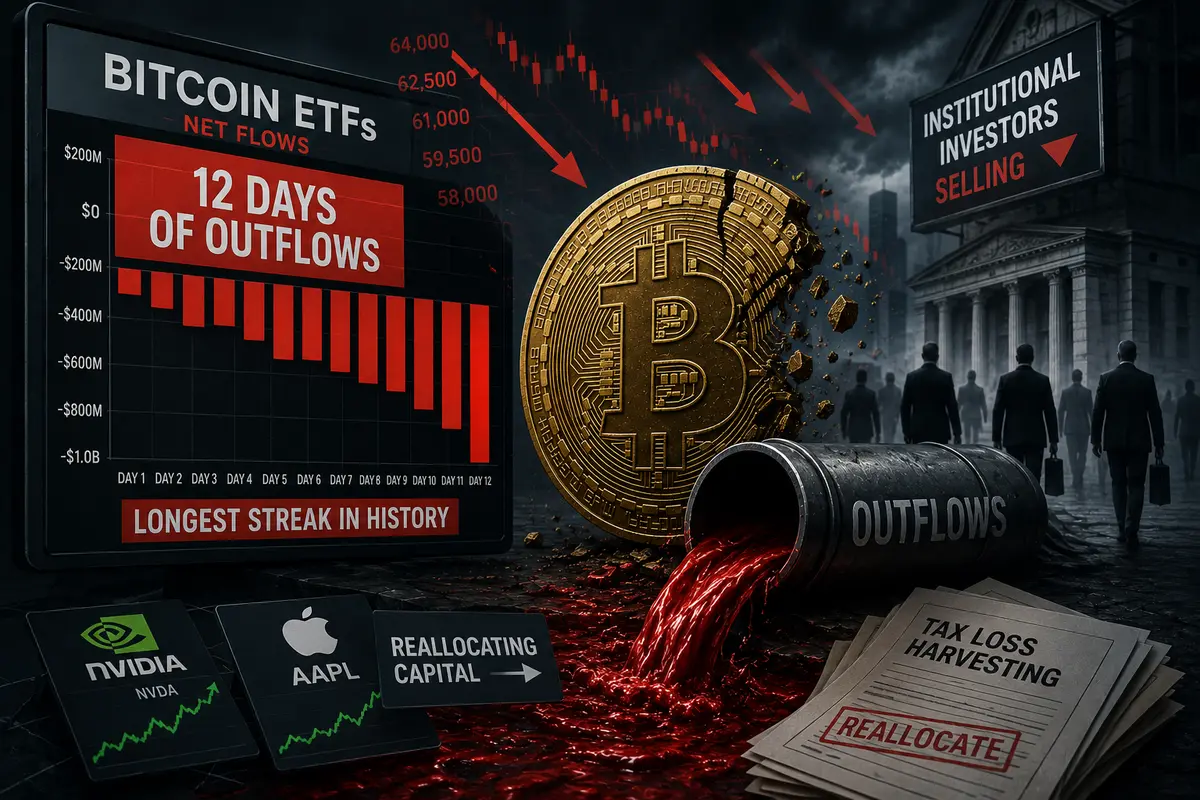
But hope has faded. The price has fallen below $64,000. The conflict in the Middle East is not ending—it is escalating. Institutional investors have withdrawn money from Bitcoin ETFs for twelve consecutive days. Meanwhile, the stock market continues to set new records, attracting capital away from crypto.
And the diamond hands have finally wavered.
Capitulation Among Top Buyers: What It Means
Engel points to an even more troubling statistic. Twenty-six percent of all Bitcoin sold over the last 30 days came from investors who bought above $90,000.
In other words, these were not newcomers who bought the peak in late 2024. These were investors who saw Bitcoin fall from $126,000 to $90,000 and thought it represented an attractive entry point.
“A 30% discount—great opportunity,” they likely told themselves.
They were wrong.
Bitcoin now trades below $64,000. For those who bought above $90,000, that translates into losses of roughly 30–40%. And they are now realizing those losses. They are selling. They are exiting.
“This cohort of top buyers remained resilient throughout the bear market, but they are finally capitulating as Bitcoin approaches new cyclical lows,” Engel wrote in a recent note.
The key word here is capitulation.
This is not simply selling. It is the acknowledgment of defeat. When the most patient, committed, and conviction-driven investors finally give up, it often signals that the bottom may be near. After all, there may be few sellers left.
According to Engel, the capitulation of top buyers is a common feature of late-stage bear markets. It does not guarantee a reversal, but it is an important signal.
The only question is how deep the bottom will be—and how long Bitcoin will remain there before beginning a new climb.
The Divergence: Bitcoin vs. the Stock Market
One of the most interesting aspects of the current crypto downturn is its divergence from the stock market.
While Bitcoin falls, U.S. equities continue to rise. The S&P 500 is setting fresh records. So is the Nasdaq. The technology sector remains strong despite geopolitical tensions and elevated interest rates.
This divergence is undermining the two dominant narratives that have supported Bitcoin’s investment thesis.
Narrative #1: Bitcoin as “Digital Gold”
During periods of geopolitical uncertainty, investors are supposed to flock to Bitcoin as a safe haven. If gold rises, Bitcoin should rise as well.
Yet war is unfolding in the Middle East, and Bitcoin is falling.
Moreover, while gold has also weakened recently, Bitcoin’s decline has been significantly steeper. The “digital gold” narrative suddenly looks less convincing.
Narrative #2: Bitcoin as a High-Beta Tech Asset
Another common belief is that Bitcoin behaves like a high-beta technology stock—rising when tech stocks rise and falling when they fall.
Yet technology stocks are climbing while Bitcoin is declining.
That correlation has broken down.
Investors are increasingly confused. If Bitcoin is neither digital gold nor a tech stock, then what exactly is it?
A speculative asset sustained primarily by belief? A cross-border payment tool few people use because of its volatility? A digital currency regulators will eventually suppress?
Different investors offer different answers.
But one fact remains: Bitcoin has lost the clarity of its identity. It no longer fits neatly into any traditional asset category. And that uncertainty is unsettling.
Bitcoin ETFs: Twelve Days of Bleeding
Bitcoin ETFs tell a separate but equally important story.
Launched with enormous fanfare in early 2024, these exchange-traded funds were supposed to bridge traditional finance and cryptocurrency markets. Institutional investors unwilling or unable to buy Bitcoin directly could gain exposure through ETFs.
At first, everything went according to plan.
Inflows surged. Bitcoin prices rose. A new era appeared to have begun.
Now the trend has reversed.
For twelve consecutive trading days, Bitcoin ETFs have experienced net outflows—the longest streak in their history.
Institutional investors are pulling money out. And they are doing so aggressively.
Why?
Because they no longer believe in near-term upside. Or perhaps they still believe in Bitcoin long term but see little reason to hold a declining ETF while paying management fees.
Many prefer to take tax losses and reallocate capital into assets that are performing better—such as Nvidia or Apple.
Twelve straight days of outflows represent a record. More importantly, they indicate a fundamental shift in institutional sentiment.
Bitcoin is no longer viewed as a must-own asset.
It is increasingly viewed as a problem position that investors would rather eliminate.
This creates a bearish feedback loop. ETFs sell Bitcoin to meet redemptions. Those sales pressure the price. Falling prices encourage additional selling. And the cycle continues.
The question is when that cycle will finally break.
The Psychology of Capitulation
To understand what is happening in Bitcoin today, it helps to put yourself in the shoes of an investor who bought above $90,000.
Imagine you spent years reading about Bitcoin.
You watched it rise from $10,000 to $60,000, fall to $30,000, and then surge toward $100,000. You regretted not buying earlier. You promised yourself that the next correction would be your opportunity.
Then Bitcoin dropped from $126,000 to $90,000.
You bought.
You felt smart. You were entering at a 30% discount.
Then Bitcoin fell to $80,000.
“No problem,” you thought. “Just another correction.”
Then it fell to $70,000.
“I’m getting nervous, but I’ll hold. Diamond hands.”
Then it fell to $64,000.
“I’m down 30%. Maybe it’s time to get out.”
At that moment, the headlines arrive:
-
Long-term holders are selling.
-
Bitcoin ETFs are seeing record outflows.
-
Geopolitical tensions continue to escalate.
And you make a decision.
You sell.
Not because you stopped believing in Bitcoin.
Because you can no longer tolerate the losses.
Because every new headline hurts.
Because you fear Bitcoin might fall to $50,000—or even $40,000.
Congratulations.
You have capitulated.
You have become part of the very statistic Ed Engel is describing.
Historical Parallels
Long-term holder capitulation has happened before.
It occurred in 2018, when Bitcoin fell from $20,000 to $3,000.
It happened again in 2022, when Bitcoin dropped from $69,000 to $15,000.
Each time, it ultimately signaled that the bottom was approaching.
In 2018, Bitcoin spent months near its lows before beginning a gradual ascent that eventually led to new all-time highs in 2021.
In 2022, Bitcoin fell a bit further after capitulation, then reversed and eventually climbed to $126,000.
A pattern emerges.
When the strongest holders finally surrender, relatively few sellers remain. The market flushes out weak hands.
Those who remain are either deeply profitable long-term believers or investors sitting on losses too large to justify selling.
In that environment, even a modest positive catalyst can trigger a powerful rally.
Supply becomes scarce. Sellers disappear. Any meaningful buying pressure pushes prices higher.
That is why Engel believes the capitulation of top buyers strengthens the case that Bitcoin’s bear market is in its later stages.
He is not claiming the bottom is already in.
He is saying we may be getting close.
What Comes Next? Three Scenarios for Bitcoin
Scenario 1: A Traditional Bottom
Bitcoin falls a bit further, perhaps to the $55,000–58,000 range.
Capitulation ends. Sellers are exhausted.
The market enters a prolonged consolidation phase lasting weeks or months.
Gradually, buyers return—first retail investors, then institutions.
By year-end, Bitcoin climbs back toward $80,000–90,000.
Scenario 2: A Prolonged Bottom
Geopolitical conditions deteriorate.
A broader conflict erupts. Oil surges to $150 per barrel. Inflation accelerates. The Federal Reserve raises rates.
Bitcoin falls toward $40,000–45,000.
Additional long-term holders panic and sell.
Capitulation deepens.
The bottom proves far lower than expected, and recovery takes years.
Scenario 3: A V-Shaped Recovery
Bitcoin finds support around current levels of $60,000–64,000.
Then an unexpected positive catalyst emerges.
Perhaps China lifts restrictions on cryptocurrency. Perhaps a major institution announces a multibillion-dollar Bitcoin purchase.
The market reverses sharply.
Within weeks, Bitcoin returns to the $80,000–90,000 range.
Those who sold at the lows regret their decision.
Most analysts currently lean toward the first scenario.
The Middle East conflict will likely remain regional rather than expanding into a global war. The Federal Reserve may begin cutting rates later in the year, providing support for risk assets.
As one of the highest-risk assets available, Bitcoin could benefit significantly.
But there are no guarantees.
Crypto markets remain notoriously unpredictable.
What Should Investors Do?
For those who already own Bitcoin, the primary advice is simple: do not panic.
Panic is a terrible investment strategy.
If you bought above $90,000 and are currently facing significant losses, selling near the bottom permanently locks in those losses.
If you still believe in Bitcoin’s long-term potential, patience may be the better option.
For those who do not yet own Bitcoin but are considering it, current prices are interesting.
Below $64,000 is neither a historical low nor a market peak.
If Compass Point’s analysis is correct and the bear market is entering its final stages, buying now could prove attractive over the long run.
However, risks remain.
Bitcoin could still fall another 20–30%.
That is why a gradual accumulation strategy often makes sense. Rather than investing everything at once, investors can buy incrementally over time—a method commonly known as dollar-cost averaging.
And remember:
Bitcoin remains a high-risk asset.
Do not invest money you cannot afford to lose.
Do not borrow money to buy Bitcoin.
Do not gamble with your family’s financial future.
It is simply an investment—and like any investment, it can generate both gains and losses.
Conclusion: Light at the End of the Tunnel
The capitulation of major holders is painful.
It signals a broken market.
It suggests that even the strongest believers have begun to surrender.
But it may also indicate that the bottom is near.
Because once everyone who wants to sell has sold, there are few sellers left.
Ed Engel of Compass Point believes current market conditions reinforce the idea that Bitcoin’s bear market is entering its final stages.
He is not predicting specific price targets.
He is not promising an imminent rally.
He is simply observing a recurring pattern: capitulation is a normal feature of the end of bear markets, and it often signals that the cycle is approaching completion.
Bitcoin has survived worse.
It has endured 80–90% drawdowns, years of stagnation, regulatory attacks, and endless bearish predictions from respected experts.
And every time, it eventually recovered.
Whether history will repeat itself is for each investor to decide.
But those who maintained conviction during previous cycles were ultimately rewarded.
Those who panicked and sold at the bottom were not.
The choice is yours.
Bitcoin, meanwhile, will continue on its path—with $64,000 on the screen and hope for better days ahead.

Comments
No comments yet. Be the first to share your thoughts!
Authentication Required
You must be logged in to post a comment.