
Bar Pipa
We pay for a post of 10$

Energy Shock Pushes Small-Cap Companies Into the Spotlight

Energy Shock Pushes Small-Cap Companies Into the Spotlight

The first quarter of this year delivered several surprises for investors focused on small-cap companies, and the biggest one came from the oil rally. Analysts reviewed the performance of more than three dozen exchange-traded funds targeting small-cap stocks and discovered an interesting pattern. Topping the list with a return of 8.6% was a fund focused on small-cap value stocks. The secret behind its success lies in the portfolio structure: eight of its ten largest holdings belong to the energy sector.

The flagship holding of the leading fund was oil and gas producer Kosmos Energy, which owns assets in Africa and the Gulf of Mexico. Its shares surged alongside oil prices after tensions escalated in the Middle East. The same factor also pushed another fund to the top among international small-cap ETFs: nearly half of its portfolio is concentrated in the financial and consumer sectors, while energy accounts for one-fifth of its holdings. This combination of industries allowed the fund to ride the wave of the oil shock especially effectively.

The market logic is both simple and brutal. When conflict erupts in the Middle East and tankers are forced to take longer routes, every extra day at sea effectively reduces the available shipping fleet. Freight rates climb, oil prices rise, and companies involved in extracting or transporting crude become the biggest beneficiaries.

Peloton Teams Up With Spotify: Rescue or Temporary Relief?

Fitness equipment maker Peloton, whose market capitalization has long slipped into small-cap territory, announced a partnership with streaming giant Spotify. Fitness and wellness content will now be available to Spotify Premium subscribers in most of the platform’s operating markets. Investors welcomed the news enthusiastically: the company’s stock gained 2.5% in a single day, reaching its highest level since early February.

However, behind this short-term optimism lies a far more complicated...

Continue reading...
0
0

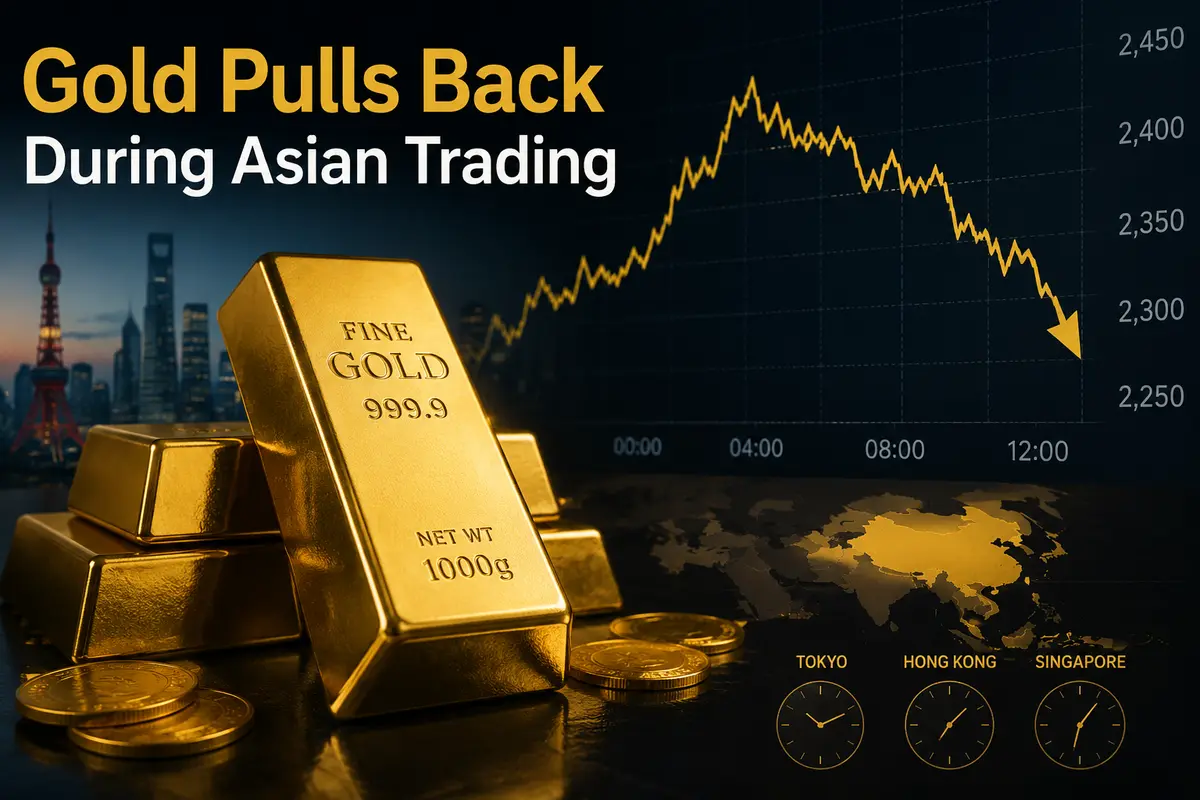
Gold Pulls Back During Asian Trading

Gold Pulls Back During Asian Trading

Gold futures headed lower during the Asian session on Wednesday, snapping a recent stretch of choppy trading near the elevated levels reached earlier. The COMEX division of the New York Mercantile Exchange recorded a decline in June gold contracts, which settled at roughly $4,707.57 per troy ounce, down about 0.45% at the time of writing.

The session kicked off with the metal searching for a foothold. The intraday low plunged well below the opening levels, and gold was forced to test support around the 4,646.01. A narrow corridor emerged, and the metal spent the entire morning trading within this confined range.

Why is this happening now? Gold is highly sensitive to the mood surrounding the U.S. dollar, and the greenback was sending mixed signals on Wednesday. The U.S. Dollar Index, which measures the dollar's strength against a basket of six major currencies, was barely changed — trading at 98.20, down just 0.02%. On the surface, any slight dollar weakness should nudge gold higher. Instead, investors seemed to hit the pause button, clearly unwilling to pile into aggressive positions ahead of the next batch of macroeconomic news.

Silver and Copper: A Sharp Divergence

While gold was slipping moderately, the silver market was undergoing a far steeper correction. July silver futures tumbled 1.59%, hitting $86.95 per troy ounce. For silver, which often moves in gold's wake but with larger swings, this kind of drop wasn't a shock. When the market gets jittery, industrial demand forecasts for the white metal often get revised downward, and speculators rush to lock in profits.

The copper market told a completely different story. July contracts on this key industrial metal instead rose by 0.26%, climbing to $6.65 per pound. Copper has been living a life of its own lately, paying...

Continue reading...
0
0
Lin Brings

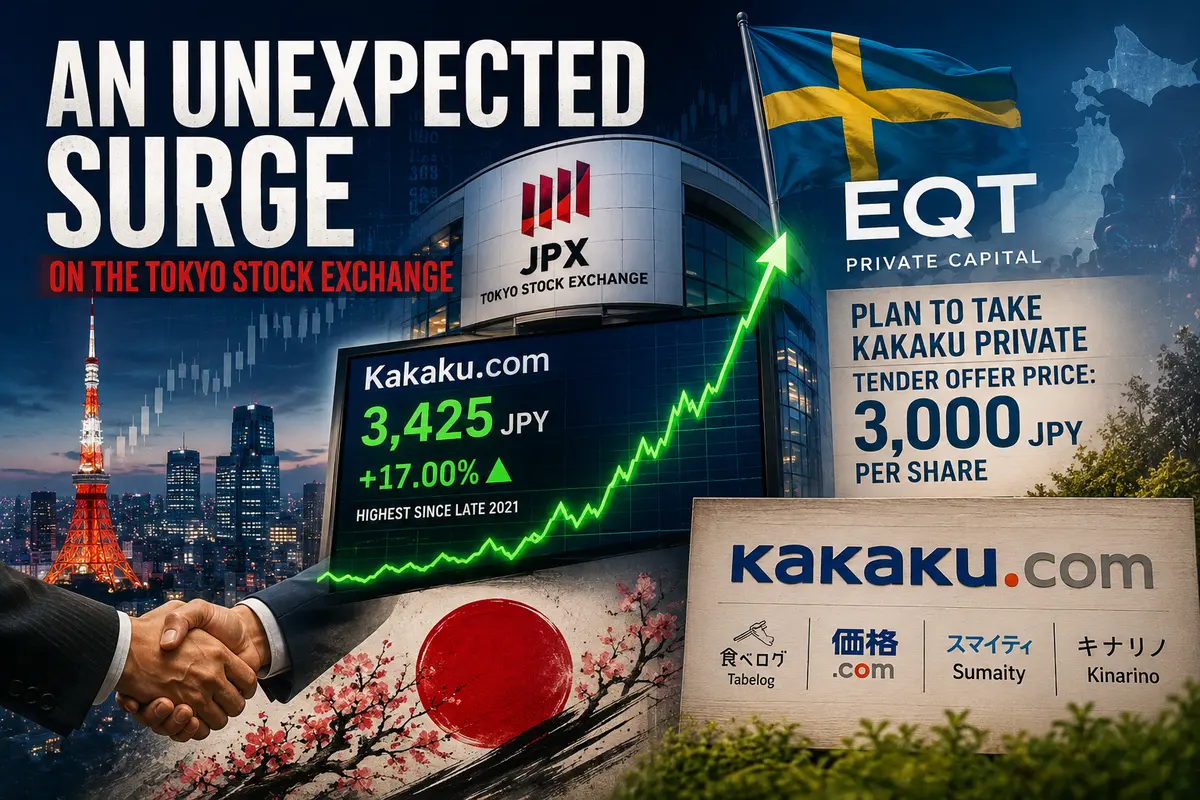
An Unexpected Surge on the Tokyo Stock Exchange

An Unexpected Surge on the Tokyo Stock Exchange

On Wednesday, shares of the Japanese company KakakuCom Inc made a real leap that caught many market watchers off guard. The stock soared by seventeen percent to hit 3,425 yen per share. Prices haven't climbed this high since late 2021 — nearly three and a half years ago. For the market, it was a glaring signal: something serious is happening, and investors are rushing to buy shares before the price runs even higher.

The reason behind such a fierce rally came all the way from Sweden. That's where the investment firm EQT is based — the company that became the headline act of the day by announcing its designs on a Japanese business. When a major player like that publicly states it's ready to buy out an entire company, the market reacts instantly. A seventeen percent single-day jump speaks for itself.

The Swedish Giant's Plan: Taking the Company Private

EQT laid out its intentions with crystal clarity: the investment group plans to launch a tender offer to fully acquire Kakaku from the public market and take it private. Simply put, the Swedes want the entire Japanese service for themselves, delisting it from the exchange.

The price tag is impressive — the whole business is valued at roughly 593.5 billion yen, which in dollar terms comes to about 3.76 billion. For each individual share, EQT is ready to pay exactly 3,000 yen. That's the very number that fueled the frenzy: at the time of the announcement, the stock was trading noticeably cheaper, so traders rushed to buy it hoping to pocket the difference as the price climbs toward the offer.

Taking a publicly listed company private is a classic investment fund maneuver. The point is to gain full control, stop worrying about quarterly filings with the exchange, and calmly — away...

Continue reading...
0
0
Tom Maffin

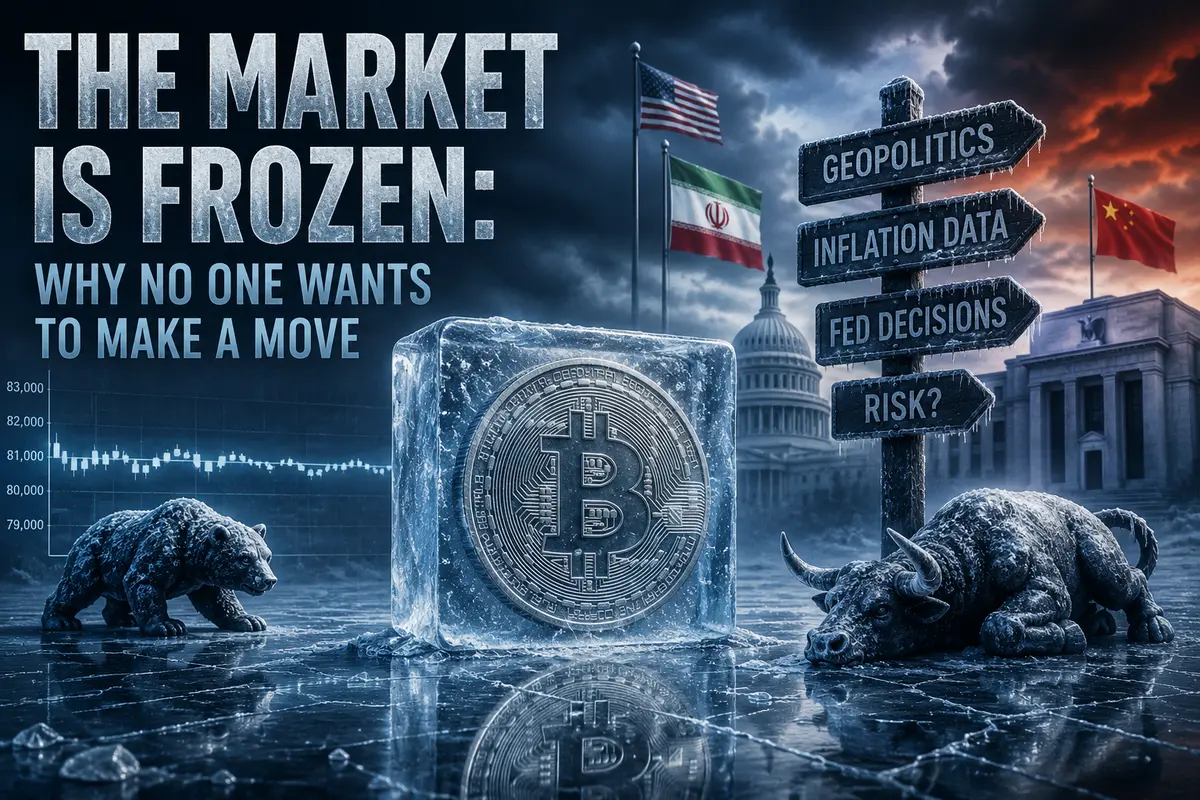
The Market Is Frozen: Why No One Wants to Make a Move

The Market Is Frozen: Why No One Wants to Make a Move

On Tuesday, Bitcoin just treaded water, practically glued to the price tag just above $81,000. No dives, no spikes — just a flat, dull line. You see this kind of lull when the market has two huge questions hanging over it at the same time, and nobody wants to be the first to place a bet.

On one hand, talks about a possible peace between the U.S. and Iran are fading, and that’s getting on people’s nerves. On the other, fresh U.S. inflation figures are about to drop, and that’s always like opening a mystery box — you never know what’s inside. Traders literally froze, turning away from their screens. Even that modest climb to $82,000 we saw over the weekend completely evaporated within a day: as soon as troubling new headlines flickered onto the feed, any desire to buy vanished instantly.

Adding fuel to the fire is the summit between the U.S. and Chinese leaders, happening against a backdrop of openly souring relations. The world’s two largest economies are hashing things out — and the crypto market, being the most jittery of all assets, is highly sensitive to every signal.

Geopolitics Strikes a Nerve: The Region Is on Edge Again

At some point, it started to feel like the Middle East was once again yanking the markets around. Reports that Trump is privately discussing additional military options against Iran hit like a cold shower. And even though nobody expects a decision this very moment — the sheer fact that such scenarios are even on the table instantly killed any appetite among investors to dabble in risky plays.

Trump, in essence, brushed off Iran’s counterproposal to the peace plan and left the door open for warships returning to the Strait of Hormuz. And when the president says the ceasefire regime...

Continue reading...
0
0
Tom Maffin

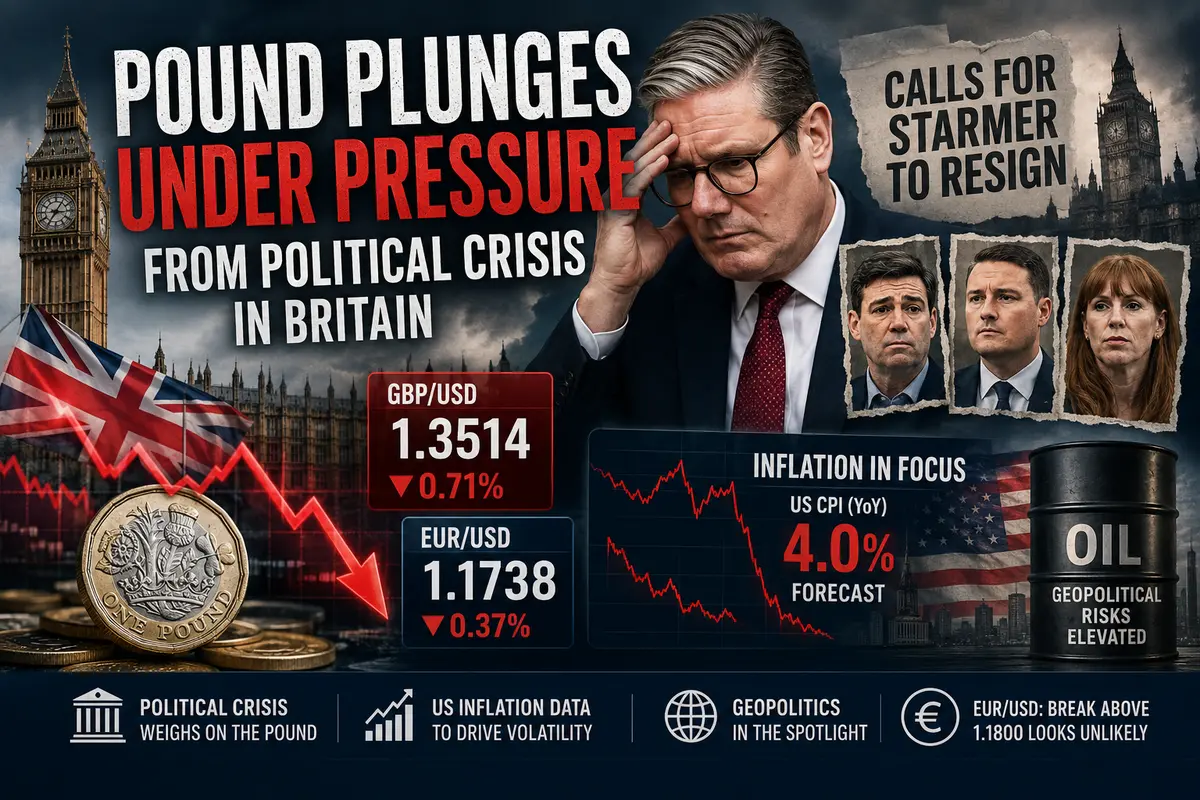
Pound Plunges Under Pressure from Political Crisis in Britain

Pound Plunges Under Pressure from Political Crisis in Britain

On Tuesday, the British pound continued its decline. The reason was growing political pressure on Prime Minister Keir Starmer, which only intensified the negative risk premium for the national currency. In parallel, global markets paused in anticipation of the release of US inflation data, which promises to be a key driver of volatility.

By mid-session, the GBP/USD pair was trading 0.71% lower, hovering around the 1.3514 mark. The EUR/USD pair, meanwhile, declined more modestly — by 0.37%, to 1.1738.

Pressure on the Prime Minister Reaches a Critical Point

The political situation in the UK deteriorated sharply after Home Secretary Shabana Mahmood joined more than 70 parliamentarians who publicly called on the sitting prime minister to resign. According to betting market odds, there is now a high probability that Starmer will leave his post as early as this year.

Analysts at one major bank note that investors are likely to interpret any imminent public address by the prime minister as a potential resignation statement. They emphasize that a political risk premium is clearly visible in the EUR/GBP pair for the first time in a long while.

According to their estimates, this premium is currently modest (about 0.3% of short-term mispricing), suggesting significant potential for the negative trend to deepen if political uncertainty escalates.

Who Could Replace Starmer

Andy Burnham, Wes Streeting, and Angela Rayner are named as the main potential successors to Starmer. Markets are particularly sensitive to Burnham's fiscal and economic views.

US Inflation Will Be the Main Trigger for the Dollar

Meanwhile, the main event capable of impacting the dynamics of the dollar and the entire currency market during the current session will be the release of April data on US consumer inflation. Analysts' forecasts suggest a second consecutive monthly rise of 0.9% in the headline figure. In that...

Continue reading...
0
0
NorthRay

How Charts Affect Sleep and Nerves: Is Trading About Health?

How Charts Affect Sleep and Nerves: Is Trading About Health?

Hey, this is NorthRay.

You know what no one told me before I opened my first order?

That trading isn't just about charts, strategies, and green candles.

It's also about sleepless nights. And the anxious "uh oh, why did the price go the wrong way?" And the urge to close the laptop and never open it again.

I thought the hardest part was learning to read the market.

Turns out, the hardest part is learning not to lose your mind while doing it.


My first "hello" from insomnia

Remember that 0.50 lot trade I wrote about last time?

Well, I didn't close it all day. Or all evening. Or all night.

I lay in bed, stared at the ceiling, and thought, "I wonder what's happening with EUR/USD right now?"

I grabbed my phone. Opened the terminal.

The price dropped 20 pips.

I closed my phone. Lay down. Five minutes later, I opened it again. The price went up 10 pips.

This went on for about two hours.

I didn't sleep. I couldn't sleep. Because it wasn't an alarm clock ticking in my head — it was the chart.

The next morning, I looked like a zombie. Drank three cups of coffee. And asked myself: "Are you going to trade or destroy your health?"


Is trading about money? Or about nerves?

I started with the thought: "Once I learn, I'll start making money."

But now I'm starting to understand something else.

Trading isn't about money.

Trading is about self-control.

Because the market doesn't care about you. About your sleep. About your nerves. About the fact that you have work tomorrow or that you have a headache.

The market goes where it goes. And you either handle it emotionally, or you crash.

And you can crash not just financially —...

Continue reading...
0
0

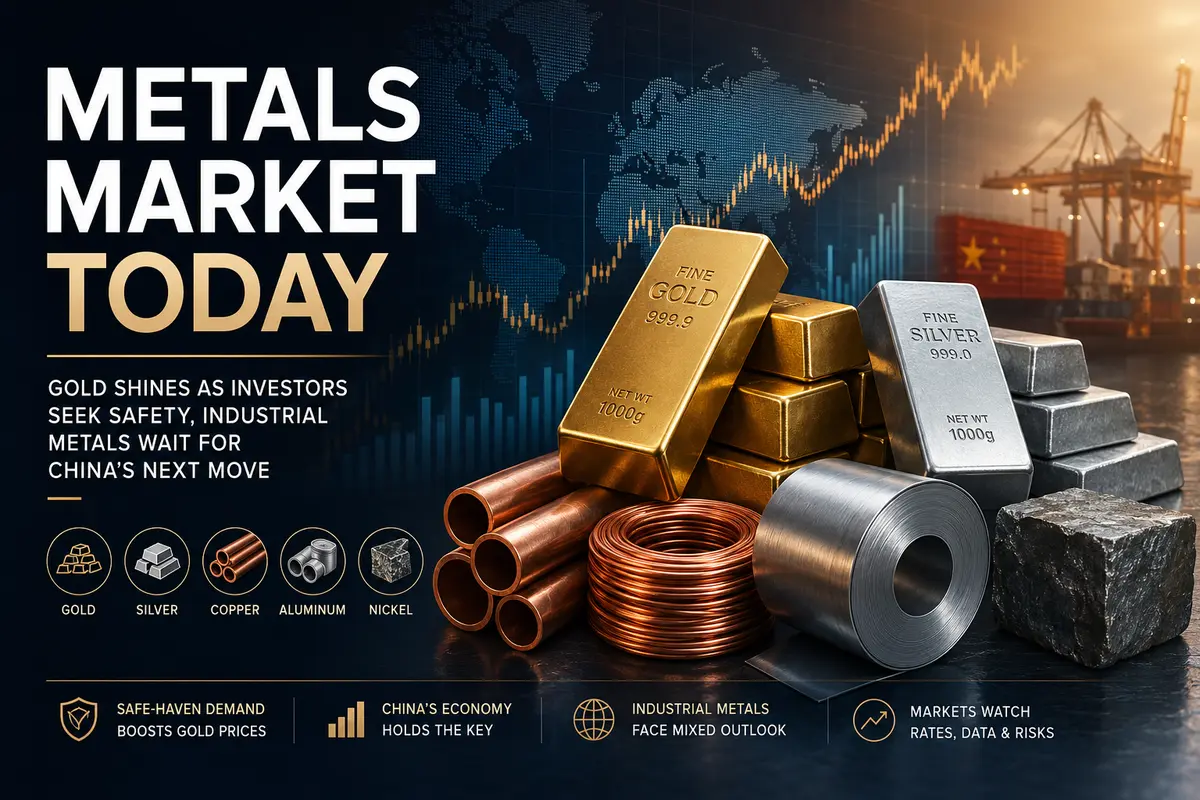
Metals Market Today: Investors Move Into Gold While Industrial Metals Wait for Signals From China

Metals Market Today: Investors Move Into Gold While Industrial Metals Wait for Signals From China

The global metals market is entering the middle of May with investors still unsure about where the economy goes next. After months of sharp swings across commodities and financial markets, traders are becoming more selective. Money is flowing back into safer assets like gold, while industrial metals are struggling to regain momentum.

Right now, everything comes down to a few major questions: Will the Federal Reserve finally start cutting interest rates? Can China revive demand in construction and manufacturing? And is the global economy slowing down more than expected?

Those questions are driving nearly every move across the metals market — from gold and silver to copper, aluminum, and nickel.

Gold Keeps Winning the Attention

Gold continues to trade near historic highs and remains the strongest part of the metals market. Investors are still looking for protection against economic uncertainty, stubborn inflation, and geopolitical risks.

There’s also growing belief that the US Federal Reserve may eventually ease interest rates later this year. That matters because lower rates usually weaken bond yields and make gold more attractive.

What’s interesting this time is that gold has stayed strong even while the dollar remains relatively expensive. In previous years, a stronger dollar would normally push gold lower. But the market mood has changed. Investors are less focused on short-term currency moves and more focused on preserving capital.

Central banks are also helping support prices. Several countries continue adding gold to reserves as governments try to reduce dependence on the US dollar and protect themselves from financial instability.

At the same time, geopolitical tensions continue to keep traders nervous. Every new headline involving conflicts, trade disputes, or political uncertainty quickly sends buyers back into safe-haven assets.

Silver Is Moving With Gold — But More Carefully

Silver is benefiting from the same safe-haven demand supporting...

Continue reading...
0
0
Lin Brings

The Private Market Is Now The Real Fintech Index

The Private Market Is Now The Real Fintech Index

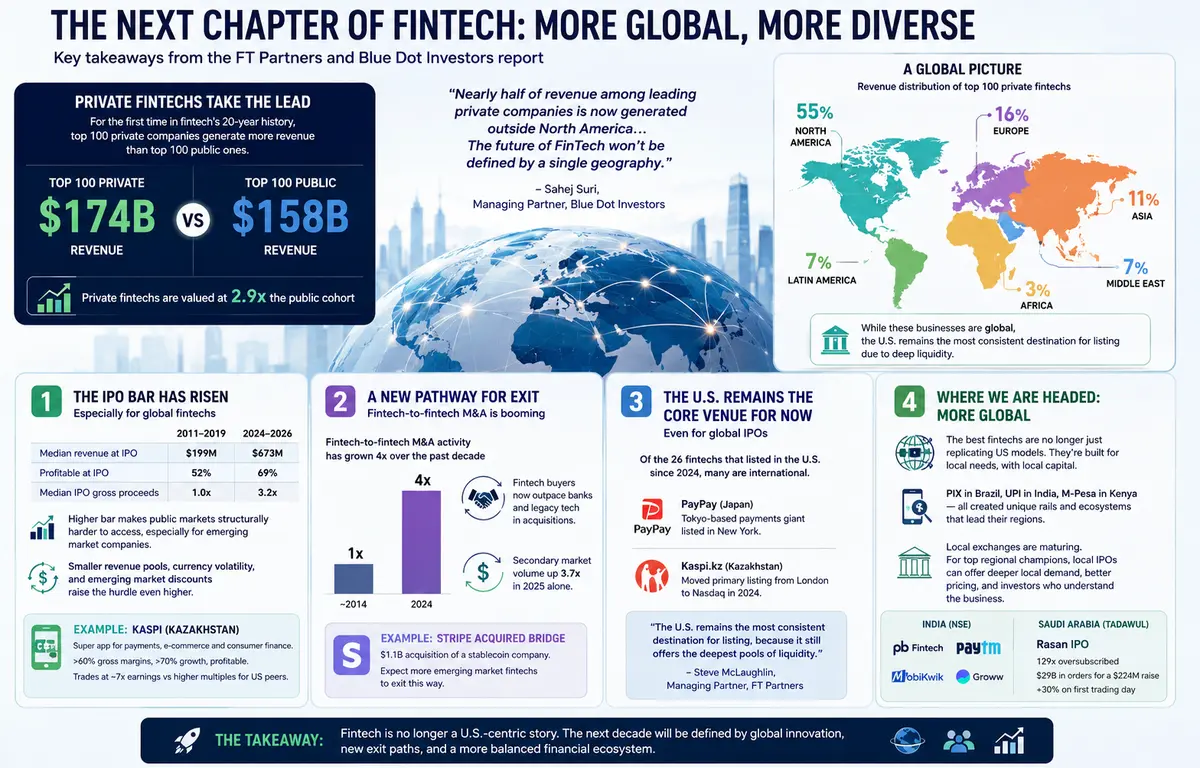
For the first time in fintech’s twenty-year history, the sector’s largest private companies are generating more revenue than the biggest public ones. Today, the top 100 private fintechs bring in around $174 billion in revenue versus $158 billion for the top 100 public companies founded after 2006. At the same time, private fintechs are valued at nearly three times more. These figures come from a new report by FT Partners and Blue Dot Investors.

But the report’s most important takeaway goes beyond the numbers. If you want to understand where financial services are heading, private companies are where you should look. Public markets increasingly reflect a relatively narrow group of firms that managed to catch the IPO window — especially during 2020 and 2021. The private market is broader, more diverse, and, importantly, far more global.

As Blue Dot Investors Managing Partner Sahej Suri noted, nearly half of the revenue generated by leading private fintech companies already comes from outside North America. And the future of fintech is unlikely to be defined by a single geography.

IPOs Have Become Much Harder — Especially for International Fintechs

A decade ago, companies could go public with around $200 million in revenue. Today, the median figure is closer to $670 million. On top of that, most recent fintech IPOs are already profitable at the time of listing.

For investors, this may look like a healthy shift toward rewarding stronger businesses. But there’s another side to it: public markets have become far less accessible for globally important fintechs, especially those from emerging markets.

There are several reasons for this. In many countries, the addressable market is simply smaller than in the US. Currency volatility also reduces dollar-denominated revenue even for fast-growing businesses. And public market investors still apply an “emerging markets discount,” even when...

Continue reading...
0
0

The Future of Digital Education in Europe: EU Executive Vice-Presidents Discuss EdTech Development with Industry Leaders

The Future of Digital Education in Europe: EU Executive Vice-Presidents Discuss EdTech Development with Industry Leaders

On April 15 in Brussels, Executive Vice-Presidents of the European Commission Roxana Mînzatu, responsible for social rights, skills, and employment, and Henna Virkkunen, in charge of technological sovereignty, security, and democracy, held a high-level meeting dedicated to educational technologies.

The event brought together 15 founders and executives of European EdTech companies. The main focus of the discussion was the use of digital innovation to modernize education and vocational training systems across EU member states.

The dialogue took place as part of the European Commission’s preparation of a new Roadmap for Digital Education and Skills Development through 2030. This document will become part of the European Union’s broader education strategy.

The Importance of the Initiative

Digital solutions are increasingly being integrated into education and training. EdTech refers to technological tools and platforms that help organize learning, develop skills, and improve the quality of education — from online courses and virtual classrooms to AI-powered services.

These technologies make education more flexible, accessible, and personalized. At the same time, the EU aims to develop digital education products in line with European principles, including data protection, inclusiveness, and high standards of educational quality.

In addition, the educational technology sector is viewed as an important driver of Europe’s digital economy. The development of competitive and ethically oriented EdTech solutions can strengthen the EU’s technological independence, stimulate innovation, and reinforce democratic resilience.

Key Discussion Topics

Participants discussed ways to improve the global competitiveness of European educational technologies, as well as the creation of reliable and high-quality digital solutions.

Industry representatives emphasized their readiness to jointly invest in the development and scaling of European platforms. According to participants, European EdTech products can gain a significant competitive advantage thanks to their focus on data security, user trust, and strong educational methodology.

Special attention was also given to the...

Continue reading...
0
0
NorthRay

I Closed the Trade. Profit — 24 Cents. And That’s a Victory.

I Closed the Trade. Profit — 24 Cents. And That’s a Victory.

Hey, this is NorthRay.😎

Remember that very first trade of 0.01 lots? The one I opened with shaking hands and a feeling that the world was about to explode?

I closed it.

Not in a minute, not in an hour. I held it for several days. Watched the green numbers turn red. Bit my lip. Wanted to hit "close" a hundred times.

But I held.

Because I wanted to understand: what would happen if I just let the trade live?

Spoiler: the world didn't collapse. And I got my first conscious profit.


The numbers that make my friends laugh

When I told a friend, "I made 24 cents on a trade," he looked at me like I was crazy.

— Seriously? You waited several days for 24 cents?
— Yes, — I said. — Seriously.

He didn't get it. And that's okay.

Because it's not about the money. On a demo account, those cents are virtual. You can't spend them on coffee. They won't buy me a sandwich.

But for me, those 24 cents mean more than $1,000 of someone else's "easy money."

Why? I'll explain now.🔝


What this trade really means

First: I held on.

The market went back and forth. I wanted to close at zero, just to stop suffering. I wanted to close at a small loss because "what if it drops even more?"

I didn't give in. I gave the price time.

Second: I closed by the rules.

I had a plan. Not complicated. Simple: "I hold until I realize I'm wrong, or until I see a +."

I waited for the green zone. Small. Funny. But mine.

Third: I took the next step.

24 cents of profit on demo — it's not about money. It's about confirmation: "You can do this. You're capable...

Continue reading...
0
0
Navigation menu
instaforex banner