

The Future of Digital Education in Europe: EU Executive Vice-Presidents Discuss EdTech Development with Industry Leaders

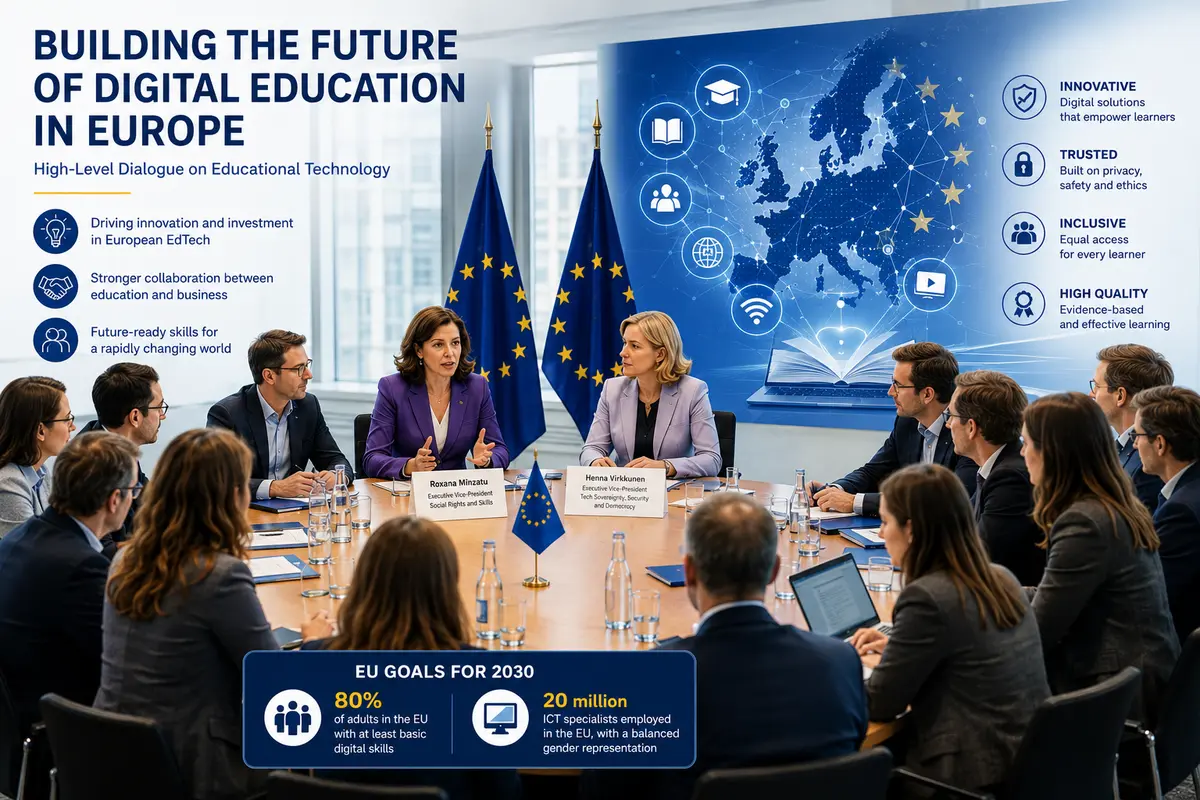
On April 15 in Brussels, Executive Vice-Presidents of the European Commission Roxana Mînzatu, responsible for social rights, skills, and employment, and Henna Virkkunen, in charge of technological sovereignty, security, and democracy, held a high-level meeting dedicated to educational technologies.
The event brought together 15 founders and executives of European EdTech companies. The main focus of the discussion was the use of digital innovation to modernize education and vocational training systems across EU member states.
The dialogue took place as part of the European Commission’s preparation of a new Roadmap for Digital Education and Skills Development through 2030. This document will become part of the European Union’s broader education strategy.
The Importance of the Initiative
Digital solutions are increasingly being integrated into education and training. EdTech refers to technological tools and platforms that help organize learning, develop skills, and improve the quality of education — from online courses and virtual classrooms to AI-powered services.
These technologies make education more flexible, accessible, and personalized. At the same time, the EU aims to develop digital education products in line with European principles, including data protection, inclusiveness, and high standards of educational quality.
In addition, the educational technology sector is viewed as an important driver of Europe’s digital economy. The development of competitive and ethically oriented EdTech solutions can strengthen the EU’s technological independence, stimulate innovation, and reinforce democratic resilience.
Key Discussion Topics
Participants discussed ways to improve the global competitiveness of European educational technologies, as well as the creation of reliable and high-quality digital solutions.
Industry representatives emphasized their readiness to jointly invest in the development and scaling of European platforms. According to participants, European EdTech products can gain a significant competitive advantage thanks to their focus on data security, user trust, and strong educational methodology.
Special attention was also given to the need for closer coordination between education and technology policy. This is important both for modernizing learning processes and workplaces, and for creating favorable conditions for EdTech entrepreneurs — including funding opportunities, ecosystem development, and clear regulation.
Key discussion areas included:
-
supporting innovation and investment in the European EdTech sector;
-
strengthening cooperation between educational institutions and businesses;
-
preparing the workforce for a rapidly changing labor market.
What’s Next
The conclusions of the meeting will be used in shaping the European Commission’s new education package, including the strategic Roadmap for Digital Education and Skills through 2030.
By that time, the European Union aims to achieve several major goals: at least 80% of EU adults should possess basic digital skills, while the number of ICT specialists is expected to exceed 20 million, with gender balance maintained across the sector.

Comments
No comments yet. Be the first to share your thoughts!
Authentication Required
You must be logged in to post a comment.