

Metals Market Today: Investors Move Into Gold While Industrial Metals Wait for Signals From China
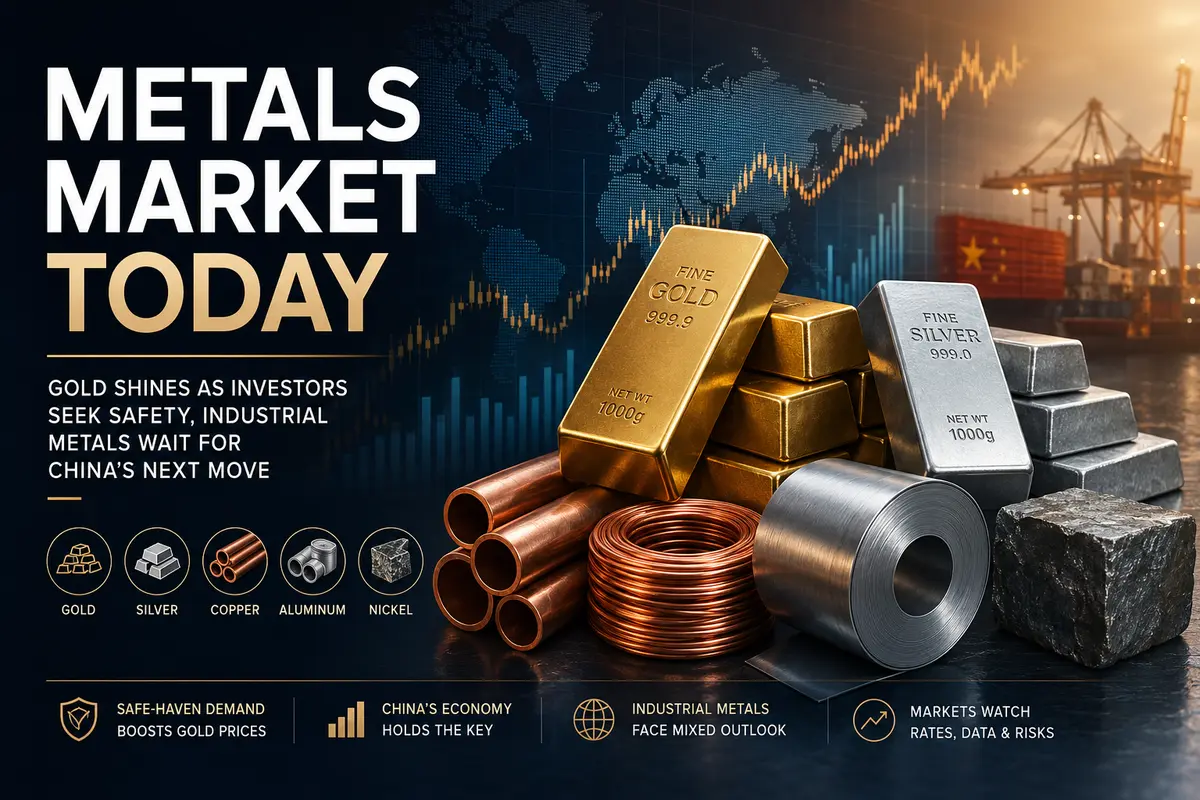
The global metals market is entering the middle of May with investors still unsure about where the economy goes next. After months of sharp swings across commodities and financial markets, traders are becoming more selective. Money is flowing back into safer assets like gold, while industrial metals are struggling to regain momentum.
Right now, everything comes down to a few major questions: Will the Federal Reserve finally start cutting interest rates? Can China revive demand in construction and manufacturing? And is the global economy slowing down more than expected?
Those questions are driving nearly every move across the metals market — from gold and silver to copper, aluminum, and nickel.
Gold Keeps Winning the Attention
Gold continues to trade near historic highs and remains the strongest part of the metals market. Investors are still looking for protection against economic uncertainty, stubborn inflation, and geopolitical risks.
There’s also growing belief that the US Federal Reserve may eventually ease interest rates later this year. That matters because lower rates usually weaken bond yields and make gold more attractive.
What’s interesting this time is that gold has stayed strong even while the dollar remains relatively expensive. In previous years, a stronger dollar would normally push gold lower. But the market mood has changed. Investors are less focused on short-term currency moves and more focused on preserving capital.
Central banks are also helping support prices. Several countries continue adding gold to reserves as governments try to reduce dependence on the US dollar and protect themselves from financial instability.
At the same time, geopolitical tensions continue to keep traders nervous. Every new headline involving conflicts, trade disputes, or political uncertainty quickly sends buyers back into safe-haven assets.
Silver Is Moving With Gold — But More Carefully
Silver is benefiting from the same safe-haven demand supporting gold, but the metal still looks more fragile overall.
Unlike gold, silver depends heavily on industrial demand. That creates a difficult balance. Investors buy silver during uncertain periods, but slowing manufacturing activity can quickly pressure prices.
Right now, the market is stuck between those two forces.
Demand from green energy industries remains one of silver’s biggest strengths. Solar panel production continues consuming large amounts of the metal, while electronics manufacturers also remain active buyers.
Because of that, some traders believe silver still has strong upside potential if the global economy avoids a serious slowdown. Historically, silver tends to move more aggressively than gold once momentum builds.
Still, for now, investors are trading it more cautiously.
Copper Rally Starts Losing Steam
Copper had been one of the hottest trades in the commodity market earlier this year. Prices surged as investors bet on a recovery in China and stronger long-term demand tied to electric vehicles, energy infrastructure, and renewable technologies.
But over the past few weeks, momentum has faded.
The biggest problem remains China’s property sector. Construction activity there continues to disappoint, and that matters because China consumes enormous amounts of global copper supply.
Weak manufacturing data from Europe has added more pressure. Many factories are still struggling with high energy costs and soft demand, leading companies to cut production and slow expansion plans.
As a result, traders who bought copper aggressively during the rally have started locking in profits. That profit-taking accelerated the recent pullback in prices.
Even so, most long-term investors are not turning bearish on copper.
The metal remains critical for the global energy transition. Electric cars, charging stations, power grids, wind farms, and solar projects all require huge amounts of copper. Many analysts still believe the world could eventually face supply shortages if demand keeps growing faster than mining production.
That’s why many investors see the current correction as temporary rather than the beginning of a larger collapse.
Aluminum Finds Support From Production Costs
Aluminum has been more stable compared to some other industrial metals.
One of the main reasons is the cost of production. Aluminum manufacturing requires massive amounts of electricity, and energy prices in many parts of the world remain elevated. That limits how quickly producers can increase supply.
Supply chain disruptions and trade restrictions are also continuing to affect the market. Global logistics have improved compared to previous years, but the system still hasn’t fully stabilized.
Demand for aluminum remains fairly healthy, especially from the automotive sector. Car manufacturers continue using more aluminum to reduce vehicle weight and improve efficiency, particularly in electric vehicles.
Packaging demand is also helping support the market.
While aluminum prices are not exploding higher, the market currently looks more balanced than many other industrial metals.
Nickel Continues To Struggle
Nickel remains one of the weakest areas of the market right now.
The main issue is oversupply. Indonesia has dramatically expanded nickel production over the last several years, flooding the market with additional material and putting heavy pressure on prices.
Not long ago, nickel was considered one of the biggest “future metals” because of its role in EV battery production. But supply growth has moved faster than expected, changing the market completely.
Many producers are now operating with very thin margins. Some mining companies have already started delaying projects and reviewing expansion plans as lower prices reduce profitability.
At the same time, traders know the situation could shift again in the future. If electric vehicle demand accelerates faster than expected, nickel consumption could rise sharply once more.
For now, though, the market still feels heavy.
Russian Metal Producers Watch The Ruble Closely
For Russian металлургические companies, currency moves remain one of the most important factors.
A weaker ruble generally helps exporters because foreign sales generate more revenue once converted back into local currency. That gives many companies temporary breathing room even during periods of softer global prices.
Still, volatility in the currency market creates uncertainty for businesses trying to plan ahead.
Russian producers also continue adjusting trade routes and export strategies as global supply chains keep changing. Asian markets have become increasingly important, especially for steel and non-ferrous metals.
Domestic demand inside Russia remains relatively stable thanks to infrastructure spending and construction activity, helping offset some external pressure.
What Traders Are Watching Next
The next few weeks could become extremely important for the metals market.
Investors are waiting for fresh inflation data from the United States and any signals from the Federal Reserve about future rate cuts. If the US economy slows more noticeably, gold could push even higher as traders move deeper into defensive assets.
For industrial metals, however, China remains the key story.
Without stronger demand from Chinese construction and manufacturing, it will be difficult for copper, nickel, and several other industrial metals to build a sustainable rally.
Still, many analysts believe the second half of the year could look better for commodities overall. Infrastructure spending, green energy investment, and long-term electrification trends continue supporting the broader outlook for metals.
Until then, markets are likely to remain nervous and highly reactive to economic headlines. Traders are moving carefully, avoiding oversized bets and staying ready for sudden swings in either direction.

Comments
No comments yet. Be the first to share your thoughts!
Authentication Required
You must be logged in to post a comment.