

The Private Market Is Now The Real Fintech Index
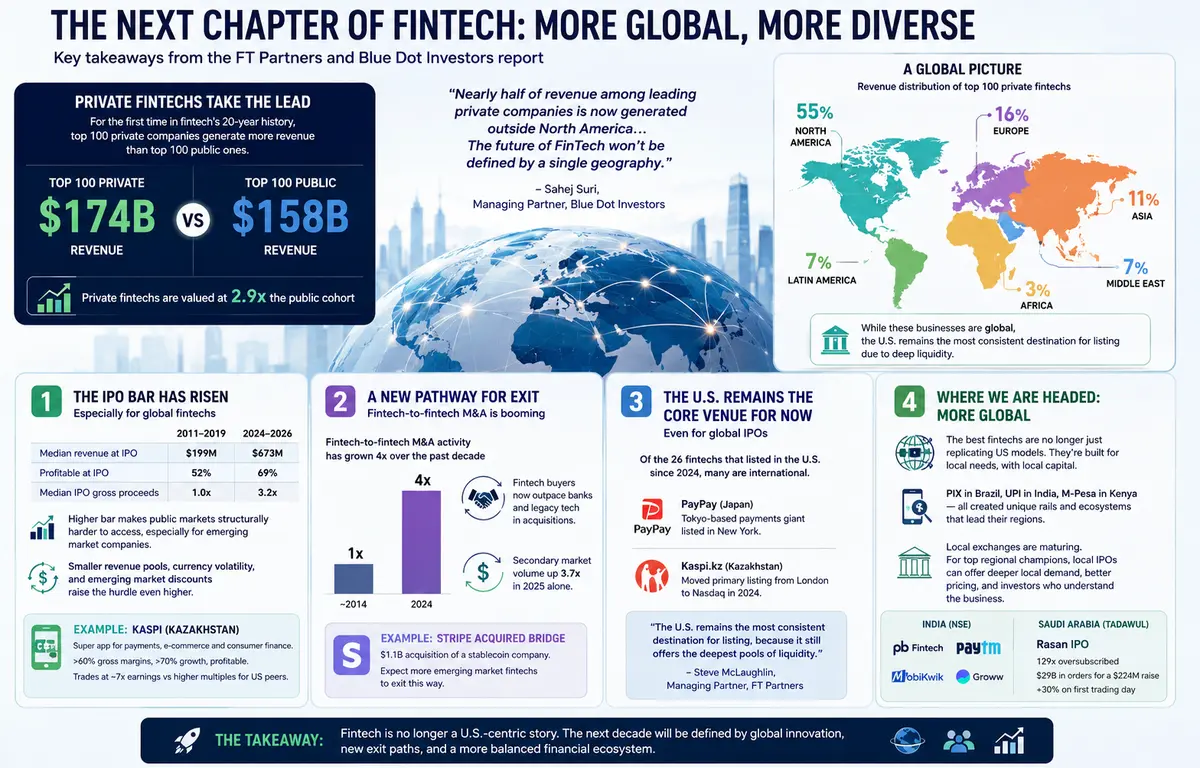
For the first time in fintech’s twenty-year history, the sector’s largest private companies are generating more revenue than the biggest public ones. Today, the top 100 private fintechs bring in around $174 billion in revenue versus $158 billion for the top 100 public companies founded after 2006. At the same time, private fintechs are valued at nearly three times more. These figures come from a new report by FT Partners and Blue Dot Investors.
But the report’s most important takeaway goes beyond the numbers. If you want to understand where financial services are heading, private companies are where you should look. Public markets increasingly reflect a relatively narrow group of firms that managed to catch the IPO window — especially during 2020 and 2021. The private market is broader, more diverse, and, importantly, far more global.
As Blue Dot Investors Managing Partner Sahej Suri noted, nearly half of the revenue generated by leading private fintech companies already comes from outside North America. And the future of fintech is unlikely to be defined by a single geography.
IPOs Have Become Much Harder — Especially for International Fintechs
A decade ago, companies could go public with around $200 million in revenue. Today, the median figure is closer to $670 million. On top of that, most recent fintech IPOs are already profitable at the time of listing.
For investors, this may look like a healthy shift toward rewarding stronger businesses. But there’s another side to it: public markets have become far less accessible for globally important fintechs, especially those from emerging markets.
There are several reasons for this. In many countries, the addressable market is simply smaller than in the US. Currency volatility also reduces dollar-denominated revenue even for fast-growing businesses. And public market investors still apply an “emerging markets discount,” even when companies deliver strong operational results.
Kaspi from Kazakhstan is a good example. The company combines payments, e-commerce, and consumer finance in one ecosystem, delivers high margins and rapid growth, and remains profitable — yet it trades at significantly lower multiples than comparable US companies.
That’s why many fintechs in emerging markets are built differently. Instead of chasing growth at any cost, they focus on profitability, capital efficiency, and resilience. They can afford to wait for a better IPO window.
Fintech Companies Are Increasingly Buying Each Other
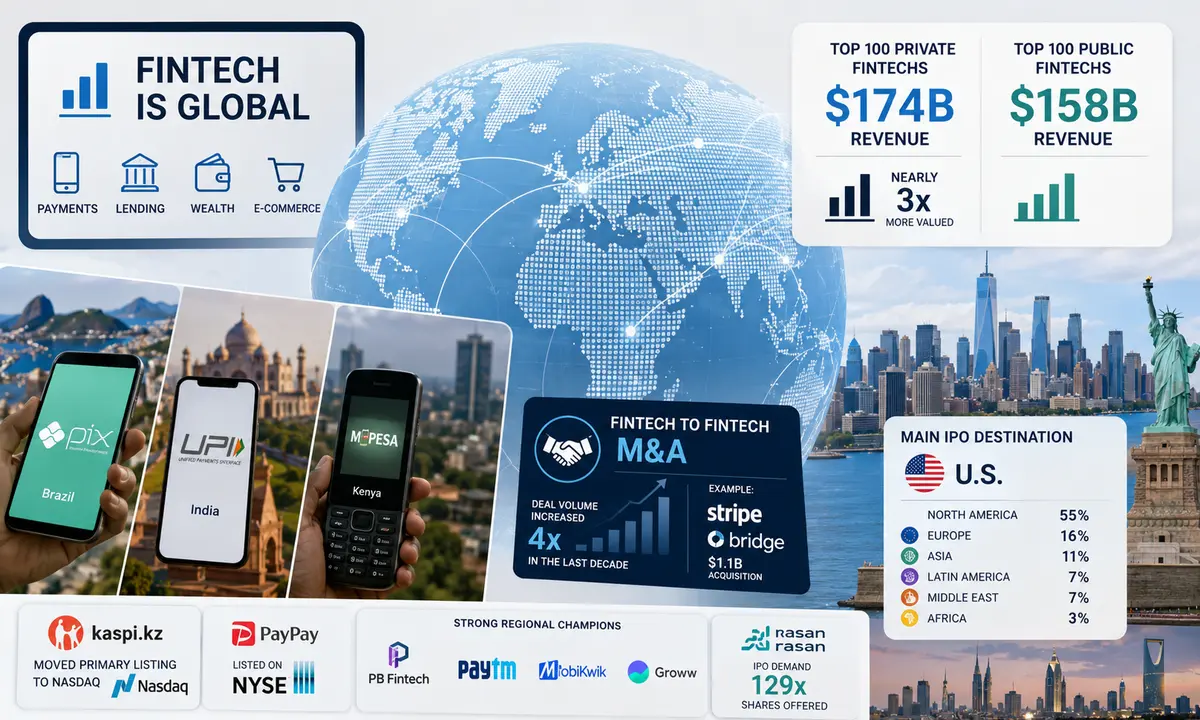
Another major trend is the rapid growth of fintech-to-fintech M&A. Over the past decade, the volume of these deals has increased fourfold.
Strategic buyers are no longer primarily banks or legacy tech companies — increasingly, fintechs themselves are acquiring other fintechs. Secondary market activity has also surged.
A notable example is Stripe’s $1.1 billion acquisition of stablecoin company Bridge. And for fintech startups in emerging markets, this type of exit is likely to become much more common.
The US Still Dominates as the Main IPO Market
Even though only 55% of the top private fintechs’ revenue comes from North America, the US remains the dominant destination for listings.
Europe now accounts for 16% of global top-100 fintech revenue, Asia for 11%, Latin America and the Middle East for 7% each, and Africa for 3%.
Still, companies around the world continue to choose US exchanges because of their liquidity and access to capital. Japanese payments giant PayPay listed in New York, while Kazakhstan’s Kazpi moved its primary listing from London to Nasdaq.
Fintech Is Becoming Truly Global
The first wave of international fintech companies largely replicated US business models in local markets. Many were founded by entrepreneurs with US backgrounds and funded by American venture capital.
That is changing.
Some of the most interesting fintech products today are emerging entirely outside the US ecosystem, supported by local capital and built around local infrastructure.
Brazil’s PIX payment system has created an entire generation of financial services with no direct US equivalent. India’s UPI has become so successful that it is now being exported internationally as financial infrastructure. Kenya’s M-Pesa launched long before Apple Pay and still dominates payments across East Africa.
Local stock exchanges are also becoming more competitive. In India, companies such as PB Fintech, Paytm, MobiKwik, and Groww have all gone public domestically. In Saudi Arabia, Rasan’s IPO attracted demand 129 times larger than the shares offered.
For strong regional champions, local exchanges can sometimes be even more attractive than Nasdaq: investors understand the business models better, and local demand may be stronger.

Comments
No comments yet. Be the first to share your thoughts!
Authentication Required
You must be logged in to post a comment.