

The Private Market Is Now The Real Fintech Index
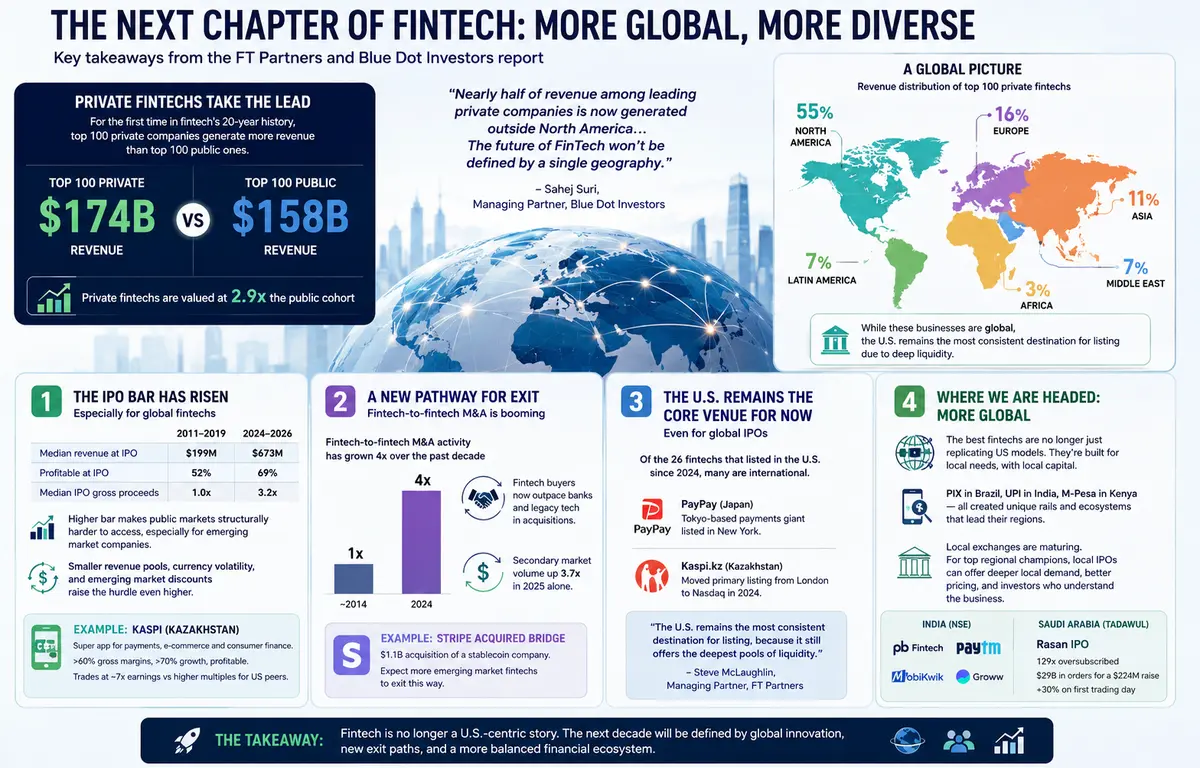
For the first time in fintech’s twenty-year history, the sector’s largest private companies are generating more revenue than the biggest public ones. Today, the top 100 private fintechs bring in around $174 billion in revenue versus $158 billion for the top 100 public companies founded after 2006. At the same time, private fintechs are valued at nearly three times more. These figures come from a new report by FT Partners and Blue Dot Investors.
But the report’s most important takeaway goes beyond the numbers. If you want to understand where financial services are heading, private companies are where you should look. Public markets increasingly reflect a relatively narrow group of firms that managed to catch the IPO window — especially during 2020 and 2021. The private market is broader, more diverse, and, importantly, far more global.
As Blue Dot Investors Managing Partner Sahej Suri noted, nearly half of the revenue generated by leading private fintech companies already comes from outside North America. And the future of fintech is unlikely to be defined by a single geography.
IPOs Have Become Much Harder — Especially for International Fintechs
A decade ago, companies could go public with around $200 million in revenue. Today, the median figure is closer to $670 million. On top of that, most recent fintech IPOs are already profitable at the time of listing.
For investors, this may look like a healthy shift toward rewarding stronger businesses. But there’s another side to it: public markets have become far less accessible for globally important fintechs, especially those from emerging markets.
There are several reasons for this. In many countries, the addressable market is simply smaller than in the US. Currency volatility also reduces dollar-denominated revenue even for fast-growing businesses. And public market investors still apply an “emerging markets discount,” even when...
