Bar Pipa
We pay for a post of 10$

The Big Twenty-Four: Who Made the List and Why It Matters

The Big Twenty-Four: Who Made the List and Why It Matters

On May 8, asset management company Bitwise — long considered one of the key bridges between cryptocurrencies and traditional finance — published a short but remarkably revealing post on X. Accompanying it was a chart listing the world’s 24 largest financial institutions, each already involved with cryptocurrencies in one way or another. The post read: “Banks and crypto: better together.” Behind that simple phrase may lie the most important institutional story of 2026.

The list spans nearly every imaginable area of crypto activity. Trading, custody, private funds, exchange-traded products, payments, and tokenization — six columns populated by heavyweight names. Bank of America, Goldman Sachs, JPMorgan Chase, BlackRock, Fidelity Investments, HSBC, Deutsche Bank, Citigroup, Visa, and Mastercard — the list reads like the table of contents of a handbook on the global financial elite. Most importantly, these firms are no longer merely observing the crypto market or experimenting with pilot programs. They are integrating crypto infrastructure directly into their core business operations, treating it as an essential component alongside equities trading or bond custody.

Exchange-Traded Products as the Main Gateway

The broadest entry point for institutional investors has become crypto exchange-traded products — the very ETPs that regulators viewed as dangerous and exotic only a few years ago. Today, they are the main highway through which pension funds, insurance companies, wealth managers, and private banks enter the crypto market.

Bank of America now provides clients of Merrill Lynch, its wealth management division, access to spot Bitcoin ETPs. This marks a dramatic shift considering the bank’s previously skeptical stance toward cryptocurrencies. Vanguard, which once famously blocked Bitcoin ETFs and faced a wave of criticism from its own clients, now allows brokerage customers to trade crypto ETPs. It is a silent 180-degree turn driven not by ideology, but by straightforward client demand.

Alongside...

Continue reading...
0
0

Third Consecutive Beat or a Moment of Truth

Third Consecutive Beat or a Moment of Truth

On Tuesday, before the market opens, trading platform eToro will release its first-quarter results. To an outside observer, this is just another earnings report — one of thousands passing through financial terminals every week. But for those closely following the company, this is a moment of truth.

The question is straightforward: can the platform deliver results above analysts’ expectations for a third consecutive quarter? eToro has already surprised the market twice in a row, and investors now want to understand whether this marks the beginning of a sustainable trend or merely a fortunate combination of circumstances driven by explosive commodity markets.

Analysts surveyed ahead of the release expect earnings of 67 cents per share. That is lower than the 71 cents reported in the fourth quarter, when the company beat consensus estimates by nearly three percent. The expected decline in profitability is itself an interesting signal. It suggests the market is trying to determine what a “normal” level looks like after an extraordinary period in which precious metals and energy markets pushed revenues sharply higher.

eToro’s diversified business model performed brilliantly last quarter, but the real question now is whether it can maintain momentum when external tailwinds are no longer blowing quite as strongly.

What the Analysts Are Saying

Fifteen analysts covering the stock remain unanimously optimistic: every single one rates it a buy. The consensus price target stands at $52.33. Compared with the current price of $38.38, that implies upside potential of 36 percent.

That is a substantial figure, and it says a great deal about how the professional investment community views the platform’s prospects.

One particularly interesting detail: earnings-per-share forecasts have increased by 1.76 percent over the past 60 days. In other words, analysts have gradually raised their expectations as new data came in. However, estimates have edged...

Continue reading...
0
0

Bulls Refuse to Surrender: Morgan Stanley Raises the Bar Again

Bulls Refuse to Surrender: Morgan Stanley Raises the Bar Again

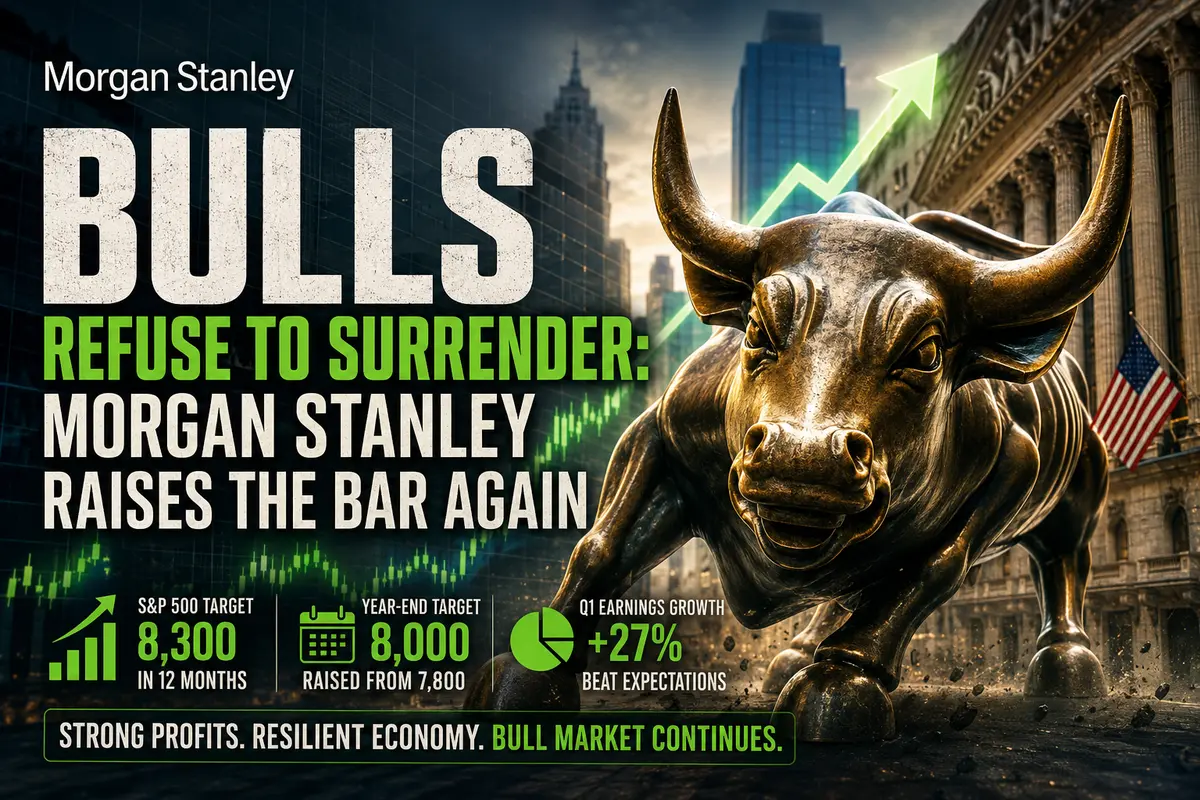
While a large part of the market remains nervous about geopolitics, oil prices, and endless recession talk, Morgan Stanley continues to stick to its narrative. The bank views the U.S. stock market with a level of optimism that many may consider excessive, yet the logic behind it is remarkably coherent. The core thesis is that two powerful engines — strong corporate earnings and a resilient economy — are capable of driving the bull market forward without losing momentum.

Bloomberg, citing the bank’s latest projections, reported some striking numbers. Over the next year, Morgan Stanley analysts believe the S&P 500 could climb to 8,300 points. From current levels, that implies roughly a twelve percent gain. Not bad for a market that already appears historically elevated. Even more interesting, however, is that Mike Wilson’s team simultaneously raised its year-end target from 7,800 to 8,000 points. In other words, the bank expects a meaningful acceleration in the coming months, not sometime in the distant future.

Earnings Season That Caught Everyone Off Guard

Why such confidence? The answer lies in what just happened during the latest U.S. earnings season. The first quarter turned out to be so strong that even hardened skeptics were forced to revise their expectations. Earnings for companies in the S&P 500 surged by twenty-seven percent. That is not merely a good result — it is more than double the modest twelve percent growth analysts had originally built into their models at the start of the reporting season.

A twenty-seven percent jump in profits is difficult to dismiss. It suggests that American businesses, despite all the noise surrounding trade wars, geopolitical crises, and expensive oil, continue to generate money with astonishing efficiency. Companies are not merely staying afloat — they are accelerating. And when that happens, the market gains a fundamental...

Continue reading...
0
0

The Step the World Had Been Waiting Three Decades For

The Step the World Had Been Waiting Three Decades For

On Wednesday, Turkey did something that observers of the Caucasus region had long been waiting for, but that few had dared to believe would actually happen until the very last moment. Ankara lifted a series of customs restrictions on Armenia, thereby cracking open the door to direct trade between the two neighbors. To the average person, this sounds like a dull, technical piece of news from the world of foreign trade documentation. In reality, this event drags behind it a long trail of historical grievances, geopolitical calculations, and frozen conflicts that have resisted resolution for more than thirty years.

Reuters, which reported the decision, did not casually describe it as a new sign of normalization in relations. The phrasing is cautious but weighty. Behind it lies an understanding that the process set in motion several years ago — against the backdrop of Turkey rethinking its regional role — continues to gather pace. And while a full opening of the border and the establishment of diplomatic relations are still a long way off, these customs relaxations represent that very first practical step that shifts the rhetoric of reconciliation into the realm of concrete action.

How the Border Was Buried: A Brief History of the Rupture

To grasp the scale of what is happening, you have to rewind the tape more than three decades. In 1991, as the Soviet Union crumbled into pieces and its former republics were declaring their independence, Turkey was among the first countries to recognize Armenia as a sovereign state. It was a gesture that, under different circumstances, could have become the beginning of good-neighborly relations. But circumstances took a different turn.

Just two years later, in 1993, Ankara unilaterally sealed its border with Armenia and halted all direct trade. The reason was simple and brutal: the first...

Continue reading...
0
0
Lin Brings

Two Titans Slam the Door Shut at the Same Time

Two Titans Slam the Door Shut at the Same Time

Anthropic and OpenAI have done what many had long expected but what participants in the shadow market refused to believe until the very last moment. Both companies updated their internal policies almost in sync, putting a firm stop to secondary trading of their shares. The wording published on their respective pages sounds nearly identical, as if the lawyers of two fierce rivals had been copying off each other. But that's not really the point. The point is that the two hottest AI startups on the planet have just cut off the oxygen supply to an entire industry that grew up around investors desperate to grab a piece of their businesses before either goes public.

At Anthropic, the language is brutally clear: any sale or transfer of securities without board approval is declared void. A buyer who risks entering such a transaction will not be recognized as a shareholder and will receive absolutely no rights whatsoever. OpenAI mirrors the exact same structure: without the company's written consent, any transfer of shares has neither legal nor economic value. In plain terms: if you bought without asking, you might as well have thrown your money to the wind.

An Entire List of Grey Schemes Now Banned

What's most interesting is that neither company limited itself to a generic prohibition. They named specific avenues that are now considered illegitimate. The list includes direct sales, special purpose vehicles, tokenized equity interests, and forward contracts. This is not a random collection of words. These are precisely the tools that the market has spent the last several years using to carve out detours toward shares in private AI giants.

The notorious SPVs — special purpose vehicles — deserve particular attention. The scheme is simple and elegant in its audacity. A shell company is created with the sole...

Continue reading...
0
0
Tom Maffin

What Really Happened to Bitcoin and What the Headlines Aren’t Telling You

What Really Happened to Bitcoin and What the Headlines Aren’t Telling You

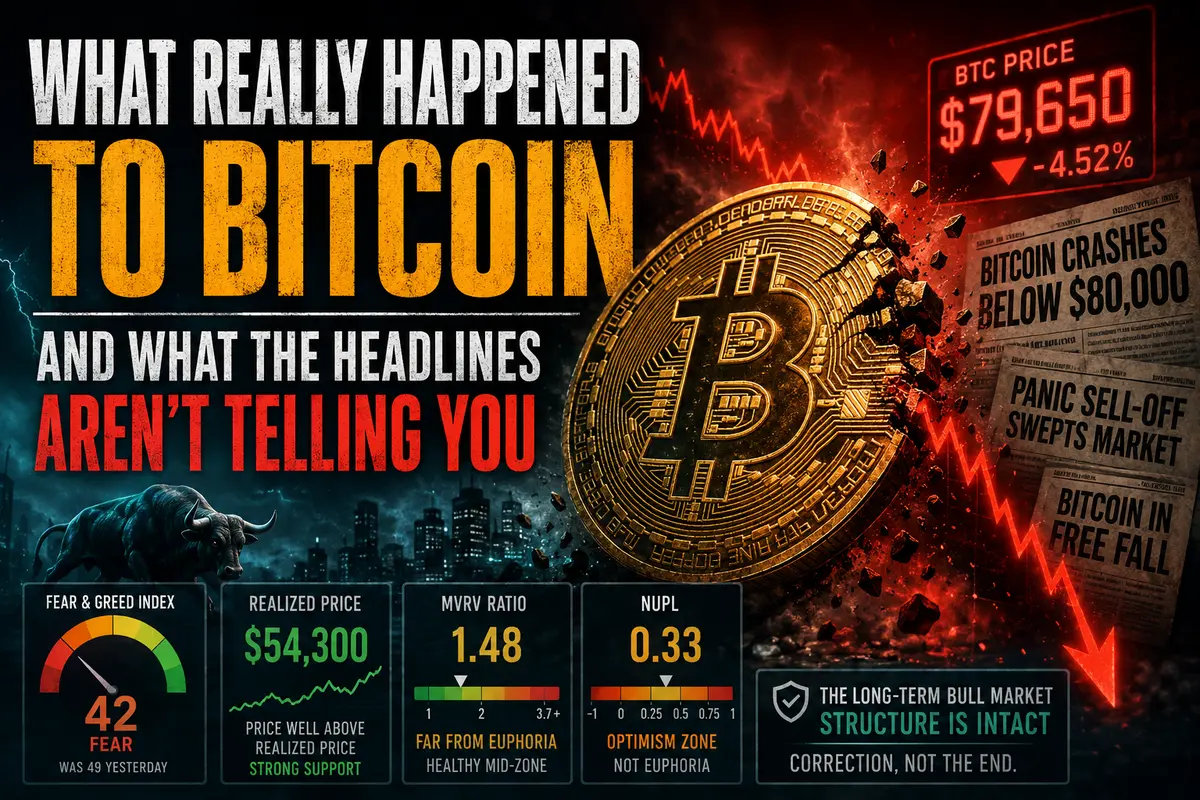
Bitcoin has once again dipped below the level that many had already started to treat as a new floor. Eighty thousand dollars — a psychological threshold beyond which either panic or calm accumulation begins, depending on who's looking at the chart. And that threshold just gave way. Over the past 24 hours, the leading cryptocurrency slid to $79,650, and a wave of forced liquidations swept across the market — the kind that always accompanies sharp moves.

But the headlines screaming about a crash are telling only half the story. They capture the fear while missing the curious picture that emerges when you look under the hood of the blockchain. And there, beneath the layer of momentary emotions and liquidation cascades, the numbers paint a far more nuanced picture. Yes, the market is getting shaken. Yes, sellers are applying pressure. But the long-term bull market structure hasn't gone anywhere — it has simply taken a breather, and the data backs that up.

A Bloodbath in the Derivatives Market

What happens when the price takes a sudden dive? A familiar mechanic kicks in — one the crypto market knows all too well. Traders who opened leveraged long positions get caught off guard. The exchange forcibly closes their positions to avoid taking a loss, and those liquidations themselves become fuel for further declines. A snowball rolling downhill, growing as it goes.

Over the past 24 hours, positions totaling nearly 142.6 million came from longs, while barely $15.9 million came from those betting on a decline. Nearly 90% of all liquidations were buyers who believed the uptrend would continue and didn't manage to jump out in time. This is a classic picture of a sudden panic sell-off: the market catches the crowd leaning in one direction, then sharply reverses, shaking out everyone standing on...

Continue reading...
0
0
NorthRay

I Set Take Profit and Stop Loss. And My Trade Closed in Profit for $10.97. Now I’m Thinking About 1.0 Lot.

I Set Take Profit and Stop Loss. And My Trade Closed in Profit for $10.97. Now I’m Thinking About 1.0 Lot.

Hey, this is NorthRay.

Remember last time I said I was learning not to freak out and to trust my strategy?

Well, today I took the next step.

I opened a new order on EUR/USD. Again with 0.50 lots. But this time — with two new words in my vocabulary:

Take Profit and Stop Loss.

Before, I used to look at those fields in the terminal and leave them empty. I thought: "Why? I'll close it myself when I need to."

How wrong I was.


What Take Profit and Stop Loss are (for those who were also afraid of them)

I'll explain it the way I understood it myself. Simply.

Stop Loss — is your safety net.

It's the price at which a trade will close AUTOMATICALLY if the market goes against you.

You tell the broker in advance: "Listen, if the price drops to this level — close the trade. Don't ask me. I don't want to lose more than I'm ready to lose."

Why you need it:

You don't sit at the screen 24/7.

You don't rely on "maybe it will turn around."

You limit your losses.

Without a stop loss, you're like a skier without brakes. Fun until you have to hit a tree.

Take Profit — is your success alarm clock.

It's the price at which a trade will close AUTOMATICALLY with a profit.

You tell the broker: "When the price reaches this level — take my profit. I won't be greedy and hope for more."

Why you need it:

You lock in profit before the market turns around.

You don't torture yourself with the question "close or not close."

You protect yourself from greed.


What I did this time

I opened an order on EUR/USD, 0.50 lots.

And for the first time in...

Continue reading...
0
0
Lin Brings

Earnings Season Is Winding Down — The Money Has Already Moved On

Earnings Season Is Winding Down — The Money Has Already Moved On

The first quarter has been reported, the numbers have landed on the table, and now the most interesting part of the market is beginning. Big investors aren't sitting idle, digesting what's already happened — they're reallocating capital. And not just into companies that delivered a solid report, but into those where explosive quarterly profit growth is layered on top of something far heavier and longer-lasting.

Strong three-month results still act as the main trigger for the most eye-catching price moves. But if you look closely at which stocks are truly taking off, a pattern emerges. More and more often, the most powerful rallies belong to companies sitting at the intersection of several massive waves: accelerating trends, strategic expansion, and large-scale investment in the future. Wall Street is only just beginning to fully price these stories into its models, and it's in that gap — between what insiders are starting to grasp and what the broader public has reacted to — that the real opportunity lies.

Hunting at the Intersection of Catalysts

Catching this kind of rotation before everyone starts talking about it is no simple task. Reading financial headlines isn't enough. By the time something hits the news, the market has usually already digested it and priced it in. The real hunt happens at the level of data, patterns, and complex signals that the naked eye can't easily spot.

This season, several recommendations landed squarely in that sweet spot — the coincidence of immediate strength and a long-term tailwind. We're not talking about isolated names plucked from the noise, but about companies united by a common thread: their quarterly success is just the tip of the iceberg, beneath which lies a business transformation capable of fueling growth for years.

The Texas Cloud Player: From Data to AI Platform

One such...

Continue reading...
0
0
Tom Maffin

The Energy Shock That Rewrote the Rulebook

The Energy Shock That Rewrote the Rulebook

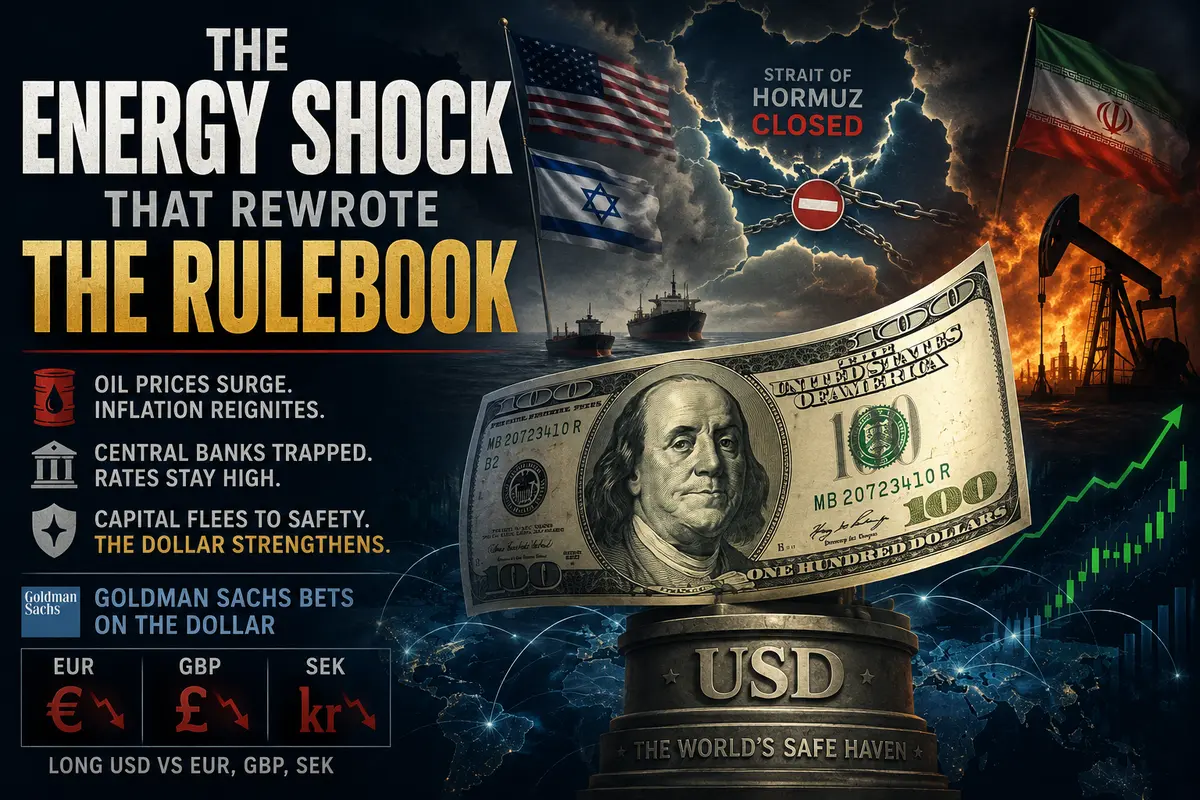
What happened in late February is still reverberating through global markets. The joint American and Israeli strikes on Iran didn't just become another line in the news feed — they physically reshaped the global energy market. The Strait of Hormuz, through which a fifth of the world's oil passes, was effectively closed to normal shipping. This isn't the kind of shock the market can digest in a couple of weeks and forget. It's a tectonic shift whose consequences will be felt for months.

The first reaction was a sharp spike in oil prices. But as always happens in these stories, a whole chain of consequences followed the oil surge. Inflation, which had seemed to be losing steam, suddenly got fresh fuel to accelerate. Central banks around the world, already starting to entertain the idea of easing policy, found themselves trapped: cutting rates now means risking a new inflationary spiral. Not cutting them means squeezing already fragile economic growth. It's at this crossroads that the renewed strength of the U.S. dollar is born.

Goldman Sachs Bets on the Dollar

Currency strategists at one of the most influential banks on Wall Street have released a fresh research note, and its core message sounds unambiguous: the dollar will keep strengthening. In the near term, an almost perfect storm is brewing for the greenback — not the kind that sinks ships, but the kind that fills sails.

Karen Reichgott Fishman, a strategist at Goldman Sachs, laid out the picture without embellishment. Macroeconomic reality, in her words, is playing squarely in the dollar's favor. Here's why. On one hand, inflation is gaining momentum again, stoked by expensive oil. On the other, the U.S. economy is showing enviable resilience to external shocks. Unlike Europe, which sits far closer to the epicenter of the conflict and is...

Continue reading...
0
0

Two Projects, One Team, and a Shared Ending

Two Projects, One Team, and a Shared Ending

On June 1, 2026, another sad mark will appear on the calendar of the Bitcoin ecosystem. On that day, two services born from the same team will officially shut down — Ord.io and Zap. The news came as a shock to many users, although if you look closely at what's been happening around these projects in recent months, the warning signs had been flashing for a while.

Behind both products stands a small but ambitious group of developers. One of the co-founders, known in the crypto community under the pseudonym Leonidas, put it bluntly: the developers see no road ahead and cannot ensure the further development of their creations. It was said without the usual attempts to sugarcoat the pill with grand promises or talk of a future relaunch. No — just a statement of fact: the money ran out, and there are no prospects.

What Ord.io Was and Why It Mattered

Ord.io was born in 2023, just as a frenzy was starting to build around Bitcoin — specifically around so-called inscriptions and non-fungible tokens on the world's oldest cryptocurrency. The idea itself was fresh and audacious: to use Bitcoin's blockchain space to host digital artifacts, images, and other content. Ord.io became a kind of explorer and showcase for this new world — a place where you could browse, study, and evaluate tokens created using the Ordinals and Runes standards.

But the project was never limited to the role of a passive gallery. Mechanisms were baked in that allowed the community to somehow measure and weigh the value of these tokens. It was an attempt to create not just a viewing platform, but a living ecosystem with valuation elements and, perhaps, future trading. Ord.io became a visible piece of the infrastructure that grew up around Bitcoin artifacts, and its disappearance...

Continue reading...
0
0
Navigation menu
instaforex banner