Bar Pipa
We pay for a post of 10$

OpenAI

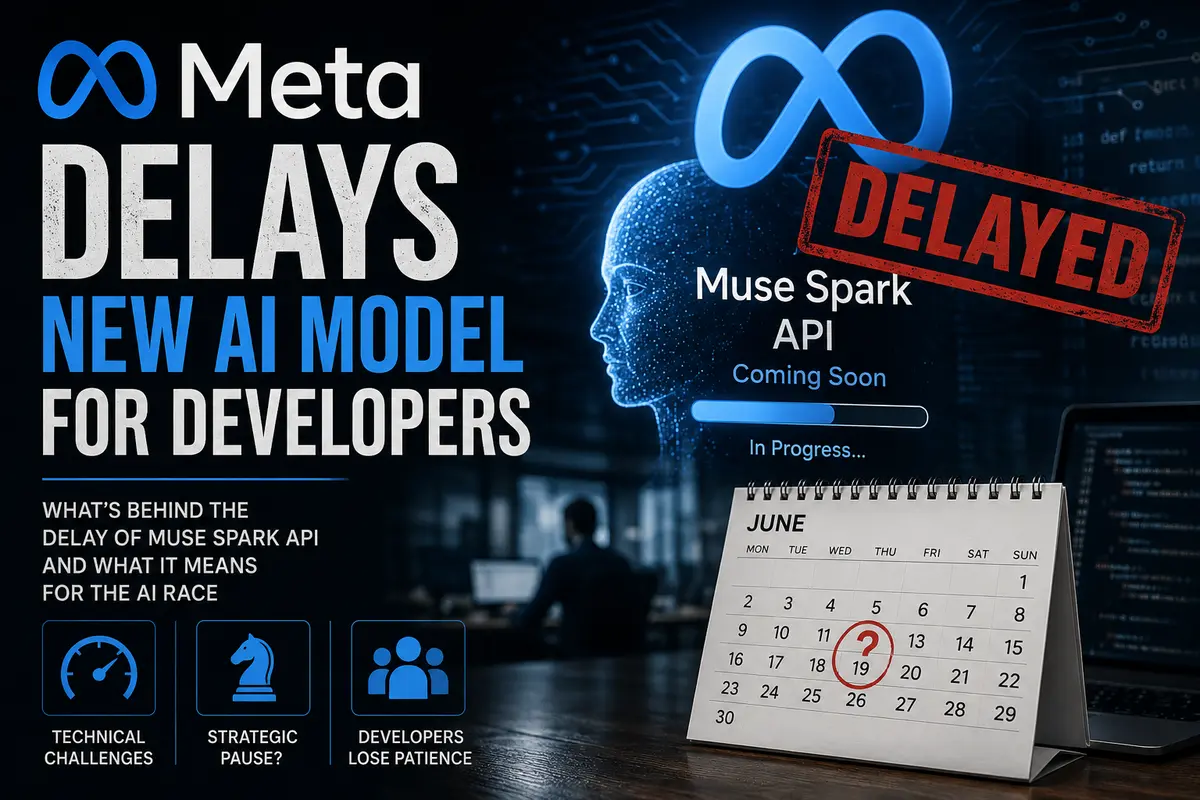
Meta Delays Release of New AI Model for Developers

Meta Delays Release of New AI Model for Developers
Promises That Haven’t Materialized

The world of artificial intelligence has grown accustomed to a relentless pace. Every week brings a new breakthrough. Every month sets a new benchmark. Companies compete to launch smarter models, more convenient APIs, and cheaper tokens. In this race, Meta Platforms has occupied the position of a confident middle-ground player—not the fastest, but not the slowest either.

Until now.

According to information published by The Wall Street Journal on Wednesday, Meta has repeatedly postponed the release of its latest AI model for developers. The delay has stretched to nearly two months, and more importantly, the company still has not committed to a new release date.

What is behind this delay? Why has a company that recently promoted its openness and rapid development suddenly gone quiet and started pushing back deadlines?

As is often the case in technology, the answer is more complicated than it appears. This is not simply a matter of unfinished code. It is a strategic pause—perhaps even a reassessment of the company’s entire approach.

The story began in April, when Meta unveiled its newest AI model, Muse Spark, with considerable fanfare. The company promised a model capable of competing with OpenAI’s GPT-4 and Google’s Gemini while remaining partially open, consistent with Meta’s broader philosophy. Developers around the world eagerly anticipated the launch of an API that would allow them to integrate Muse Spark’s capabilities into their own applications. The expected timeline was ambitious: the API would be released alongside the model itself.

April came and went. Then May.

The API never arrived.

A Promise Left Unfulfilled

According to sources cited by The Wall Street Journal, the head of Meta’s AI division assured developers that the release was coming “soon.” That statement was made nearly two months ago.

“Soon” has stretched considerably.

Developers who...

Continue reading...
0
0
Lin Brings

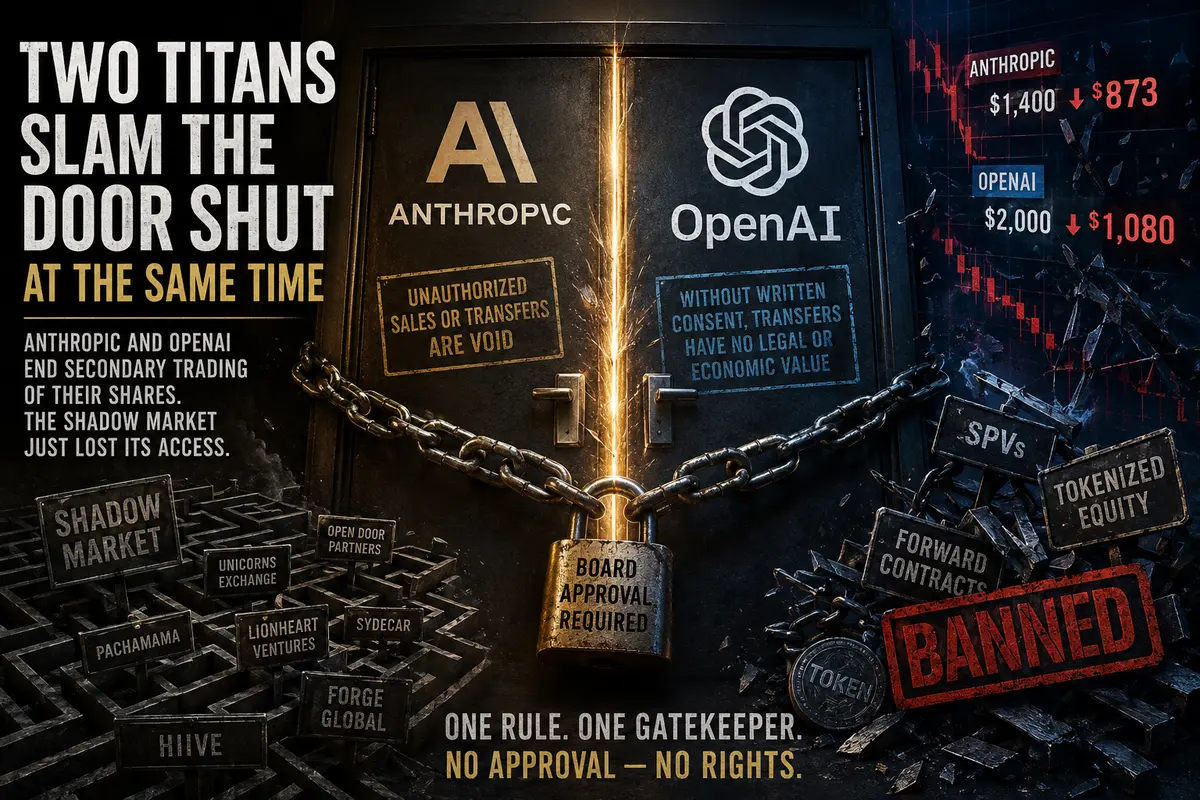
Two Titans Slam the Door Shut at the Same Time

Two Titans Slam the Door Shut at the Same Time

Anthropic and OpenAI have done what many had long expected but what participants in the shadow market refused to believe until the very last moment. Both companies updated their internal policies almost in sync, putting a firm stop to secondary trading of their shares. The wording published on their respective pages sounds nearly identical, as if the lawyers of two fierce rivals had been copying off each other. But that's not really the point. The point is that the two hottest AI startups on the planet have just cut off the oxygen supply to an entire industry that grew up around investors desperate to grab a piece of their businesses before either goes public.

At Anthropic, the language is brutally clear: any sale or transfer of securities without board approval is declared void. A buyer who risks entering such a transaction will not be recognized as a shareholder and will receive absolutely no rights whatsoever. OpenAI mirrors the exact same structure: without the company's written consent, any transfer of shares has neither legal nor economic value. In plain terms: if you bought without asking, you might as well have thrown your money to the wind.

An Entire List of Grey Schemes Now Banned

What's most interesting is that neither company limited itself to a generic prohibition. They named specific avenues that are now considered illegitimate. The list includes direct sales, special purpose vehicles, tokenized equity interests, and forward contracts. This is not a random collection of words. These are precisely the tools that the market has spent the last several years using to carve out detours toward shares in private AI giants.

The notorious SPVs — special purpose vehicles — deserve particular attention. The scheme is simple and elegant in its audacity. A shell company is created with the sole...

Continue reading...
0
0
Navigation menu