

Two Projects, One Team, and a Shared Ending
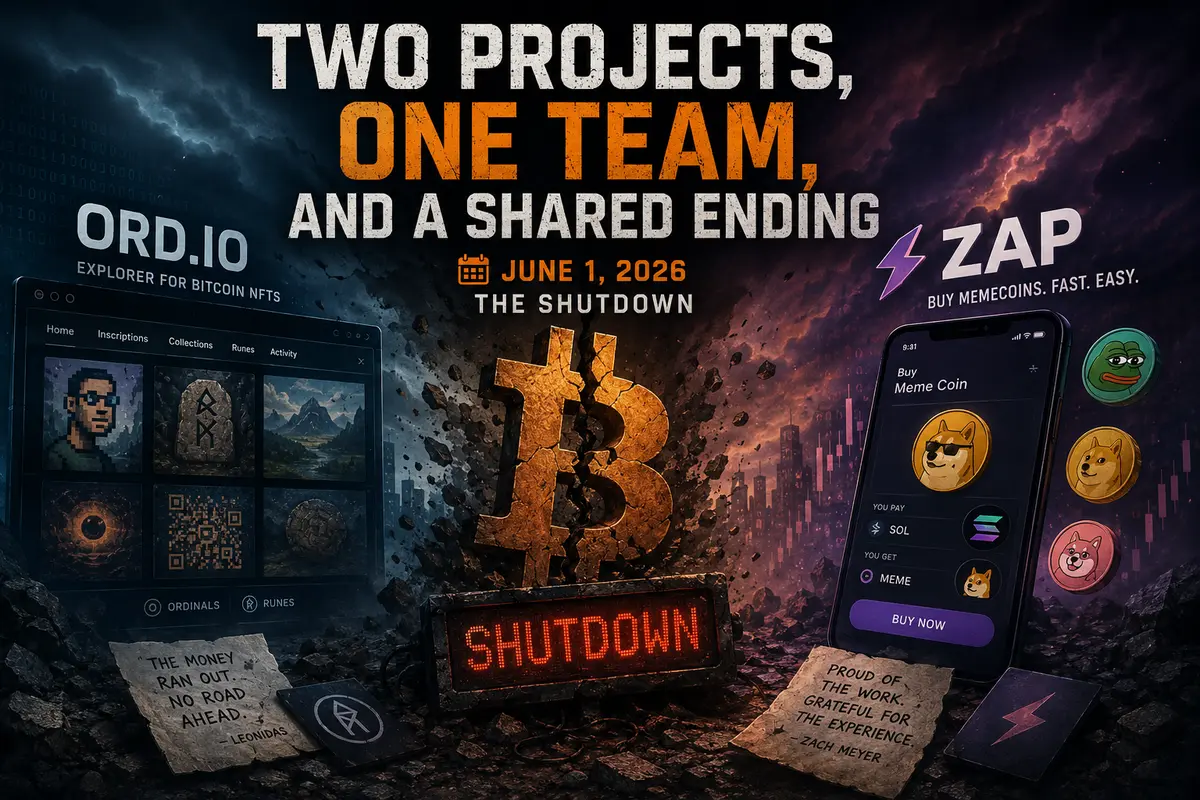
On June 1, 2026, another sad mark will appear on the calendar of the Bitcoin ecosystem. On that day, two services born from the same team will officially shut down — Ord.io and Zap. The news came as a shock to many users, although if you look closely at what’s been happening around these projects in recent months, the warning signs had been flashing for a while.
Behind both products stands a small but ambitious group of developers. One of the co-founders, known in the crypto community under the pseudonym Leonidas, put it bluntly: the developers see no road ahead and cannot ensure the further development of their creations. It was said without the usual attempts to sugarcoat the pill with grand promises or talk of a future relaunch. No — just a statement of fact: the money ran out, and there are no prospects.
What Ord.io Was and Why It Mattered
Ord.io was born in 2023, just as a frenzy was starting to build around Bitcoin — specifically around so-called inscriptions and non-fungible tokens on the world’s oldest cryptocurrency. The idea itself was fresh and audacious: to use Bitcoin’s blockchain space to host digital artifacts, images, and other content. Ord.io became a kind of explorer and showcase for this new world — a place where you could browse, study, and evaluate tokens created using the Ordinals and Runes standards.
But the project was never limited to the role of a passive gallery. Mechanisms were baked in that allowed the community to somehow measure and weigh the value of these tokens. It was an attempt to create not just a viewing platform, but a living ecosystem with valuation elements and, perhaps, future trading. Ord.io became a visible piece of the infrastructure that grew up around Bitcoin artifacts, and its disappearance will leave a very tangible hole in that landscape.
Zap: The Late Child with Mobile Trading Ambitions
If Ord.io was a project for observers and collectors, Zap was aimed at a completely different audience. It was a non-custodial mobile app geared toward one simple yet incredibly sought-after task: buying memecoins. No complex interfaces, no headache with private keys that scare off newcomers — just open your phone and buy whatever is hyped right now.
Zap appeared much later than Ord.io, as if the team was trying to find a new foothold when the first direction began to stall. The bet was on the growing popularity of memecoins and on the fact that people want to trade them easily, quickly, and without diving into technical weeds. The app was positioned specifically as a solution for those tired of clunky exchange interfaces who wanted to grab fortune by the tail in a single click.
The Money Ran Out: What Lies Behind Leonidas’ Words
The story of these two services shutting down is, unfortunately, not a story about a bad product or a lack of users. It’s a story about money — or more precisely, the lack of it. Leonidas didn’t hide behind vague wording and spoke with disarming frankness.
He said he feels terrible because wonderful people put a huge amount of work into these products. Friends invested in him personally, users believed in the team, and in the end he feels like he let everyone down. He said the money simply ran out and the team sees no viable path forward. But through all that bitterness, a note of pride still breaks through: despite everything, Leonidas still believes they have something to be proud of.
The second co-founder, Zach Meyer, added short but weighty words: he is proud of the work done and grateful for the experience gained. Behind those spare words likely lies a long period of fighting for the project’s survival, searching for investors, and the painful realization that even a great idea doesn’t always find enough funding.

What Happens to Users and Their Assets
When a project shuts down, the first and sharpest worry for its users is the question: how do I get to my money or tokens now? In Zap’s case, the team tried to provide clear instructions and timeframes.
Before June 1, anyone who used the app is strongly advised to export their private keys to a Phantom Wallet. That’s a standard solution for the ecosystem, giving people a familiar and proven tool to retain control over their assets. However, the team also provided a backup path. Even if someone misses the deadline, access to funds won’t disappear forever — they can still be retrieved through the Privy infrastructure. That’s an important clarification that softens the blow for those who don’t follow the news daily and risk finding out about the closure after the fact.
When asked whether the projects might be handed over to someone else, Leonidas replied that the team in principle doesn’t object to new leadership, but there are no concrete steps or agreements in that direction. It sounds more like an open door that no one is rushing to walk through, rather than an actual rescue plan.
Leonidas’ Footprint in the Bitcoin Ecosystem
The person behind the pseudonym Leonidas is no random passerby in the crypto world. He’s known as an active promoter of inscriptions and the idea of non-fungible tokens directly on the Bitcoin network. In the community, his name is associated with attempts to push the boundaries of what can even be done on the first cryptocurrency’s blockchain.
Beyond Ord.io and Zap, he has another project to his name — Runestone. And this is where an intriguing question arises, one that remains unanswered for now: what will happen to Runestone? If the other two services are shutting down due to a lack of funding, is the third in a better position, or is it also teetering on the edge? No statements have been made on the matter so far, leaving the community to only guess.
Not an Isolated Case: A Whole Wave of Shutdowns
The story of Ord.io and Zap stops looking like an isolated incident when you zoom out to the broader picture. Since the start of 2026, fifteen different projects in the crypto space have already announced they are ceasing operations. Fifteen teams that once started out with burning enthusiasm are now forced to wind things down. And in the overwhelming majority of cases, the reason is the same — the money simply ran out.
This is the harsh reality of the crypto industry beyond the headlines about hundred-thousand-dollar Bitcoin and the new bull cycle. Beneath the surface of hyped-up news, a constant and brutal selection process is underway. Projects that just yesterday seemed promising today find themselves facing a choice: find a new source of funding or shut down. And finding that source is far from guaranteed.
The Bitcoin NFT market, which was in many ways the reason Ord.io was created, went through a wild surge of interest followed by an equally wild cooldown. Memecoins, which Zap bet on, are a ride with highly fickle fortunes. Today the crowd is snapping up one coin, tomorrow another, and the day after they’ve forgotten the whole segment even exists. In such a turbulent environment, building a sustainable business without a solid financial cushion is extraordinarily difficult.
What Remains After the Shutdown
Behind the dry lines about ceasing operations, there is always something more. Years of life spent, sleepless nights, lines of code written on pure enthusiasm, and a community that came to believe in the idea. Ord.io and Zap will disappear as working services, but the code will remain, the work product will remain, and the experience of their creators will remain.
Perhaps that experience will be applied in new projects — by the same or different developers. Perhaps forks or similar services will appear, learning from their predecessors’ mistakes. Or perhaps this story will simply remain yet another reminder that in the world of cryptocurrencies, the distance between success and shutdown is often just the thickness of a financial cushion and the ability to find new funding in time. Tens of thousands of users, hundreds of hours of development, and years of life — all of it can simply cease to exist because the money ran out before the project managed to find its feet.

Comments
No comments yet. Be the first to share your thoughts!
Authentication Required
You must be logged in to post a comment.