

The Energy Shock That Rewrote the Rulebook
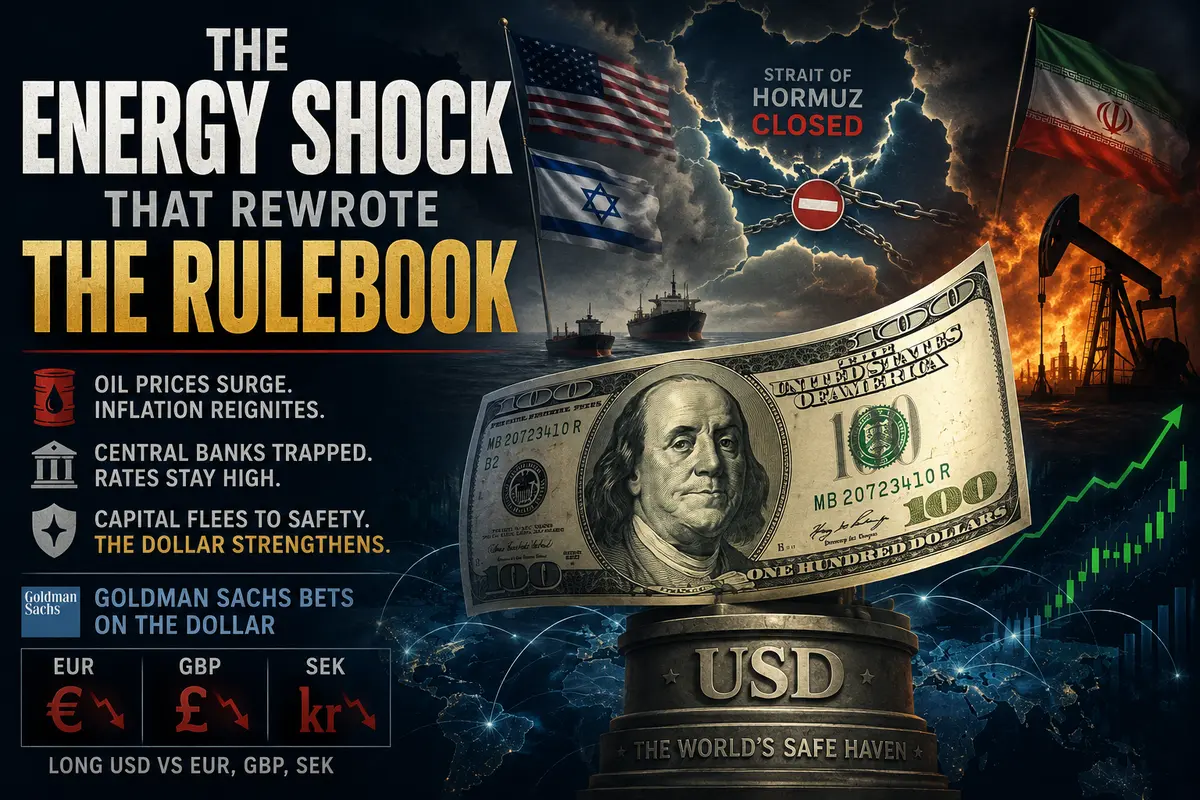
What happened in late February is still reverberating through global markets. The joint American and Israeli strikes on Iran didn’t just become another line in the news feed — they physically reshaped the global energy market. The Strait of Hormuz, through which a fifth of the world’s oil passes, was effectively closed to normal shipping. This isn’t the kind of shock the market can digest in a couple of weeks and forget. It’s a tectonic shift whose consequences will be felt for months.
The first reaction was a sharp spike in oil prices. But as always happens in these stories, a whole chain of consequences followed the oil surge. Inflation, which had seemed to be losing steam, suddenly got fresh fuel to accelerate. Central banks around the world, already starting to entertain the idea of easing policy, found themselves trapped: cutting rates now means risking a new inflationary spiral. Not cutting them means squeezing already fragile economic growth. It’s at this crossroads that the renewed strength of the U.S. dollar is born.
Goldman Sachs Bets on the Dollar
Currency strategists at one of the most influential banks on Wall Street have released a fresh research note, and its core message sounds unambiguous: the dollar will keep strengthening. In the near term, an almost perfect storm is brewing for the greenback — not the kind that sinks ships, but the kind that fills sails.
Karen Reichgott Fishman, a strategist at Goldman Sachs, laid out the picture without embellishment. Macroeconomic reality, in her words, is playing squarely in the dollar’s favor. Here’s why. On one hand, inflation is gaining momentum again, stoked by expensive oil. On the other, the U.S. economy is showing enviable resilience to external shocks. Unlike Europe, which sits far closer to the epicenter of the conflict and is far more dependent on energy imports, the United States feels much more confident. It has its own oil, its own gas, and a much more diversified consumption structure.
This combination — rising prices and relatively solid economic growth — has already resulted in U.S. bond yields staying elevated far longer than anyone expected. Investors who just six months ago were pricing in imminent Fed rate cuts are now being forced to tear up their models.
The Flight of Capital to a Safe Haven
When a major storm breaks out in the world, money behaves predictably. It runs to wherever is safest. And the United States, in the current situation, looks like the principal shelter. Fishman writes directly that any renewed fears of a prolonged energy shock will keep driving capital flows in line with the altered terms of trade. In simple terms: as long as the Middle East is in turmoil, investors will flee risky assets and emerging-market currencies and pile into the U.S. dollar.
This process is already underway and gathering steam. The dollar index rose by three-tenths of a percent on Tuesday — not a huge jump by any means, but it was the strongest daily gain of the entire month. The driver was another lurch in oil prices, triggered by the realization that a peace deal between the U.S. and Iran remains a phantom and the strategically vital strait is still at a standstill. Every oil jolt like this is another argument in the dollar’s favor.

Trade Recommendations: Where to Place Your Bets
The Goldman strategist doesn’t just share broad thoughts — she names specific currencies against which it now makes sense to hold long dollar positions. Three targets are singled out as the preferred hedging vehicles in the current environment: the Swedish krona, the euro, and the British pound sterling.
This choice is no accident. European economies are on the front lines of the energy crisis. They are far more tightly tethered to swings in oil and gas prices, their industry is more energy-intensive, and the room for maneuver at the European Central Bank is far narrower than at the Fed. The euro, the pound, and the krona are the currencies of the region that is bearing the brunt of the Middle Eastern shock, and that is precisely why they look the most vulnerable when paired against the dollar.
The Swedish krona on this list might seem like a surprise — Sweden is hardly the first country that springs to mind in the context of the Iran conflict. But the Swedish economy is heavily tied to exports and extremely sensitive to global trade disruptions. On top of that, the Riksbank is traditionally cautious, and in times of global instability the krona frequently comes under pressure.
The Scenario That Inexorably Pushes the Dollar Higher
Fishman puts forward a thesis that is hard to shrug off: the current scenario will inevitably fuel a broad-based strengthening of the dollar against every currency in the G10 group. Not just one or two, but all ten. That is a very forceful statement, and it is backed by cold calculation.
It’s not just about oil or geopolitics alone. A whole mosaic of factors is falling into place. The Federal Reserve, shackled by inflation, cannot afford to cut rates. High rates in America mean capital finds it more profitable to stay in dollar-denominated assets. Investors collect decent yields on U.S. bonds and take no risk by moving into currencies of countries where rates may be lower and economies weaker. Add to that the dollar’s role as a global safe haven during crises, and you get what looks like an almost inevitable rally.
The energy shock serves as the catalyst here. It accelerates processes that were already in motion and lends them fresh force. As long as oil remains expensive, as long as the Strait of Hormuz remains dysfunctional, and as long as diplomatic efforts remain stalled, the dollar will keep receiving one boost after another.
The American Economy: An Island of Stability
The thesis about the resilience of the American economy deserves special attention. While Europe is frantically counting its gas reserves and bracing for a difficult winter, the United States is watching events unfold with far greater composure. It is not just about energy independence, though that undoubtedly plays a key role. The American domestic market is enormous, consumer demand is holding up surprisingly well, and the labor market continues to produce numbers that are the envy of both sides of the Atlantic.
It is precisely this combination — energy self-sufficiency plus robust domestic demand — that makes the dollar so attractive right now. Investors look at the world map, see a burning Middle East, a jittery Europe, and a slowing China, and then shift their gaze to America. There, at least, you know what to expect.
Where All This Might Lead
A stronger dollar is a double-edged sword. For American exporters, an expensive currency means a loss of competitiveness abroad. For developing countries whose debts are denominated in dollars, every fresh turn higher in the U.S. currency means a heavier debt burden. For global markets more broadly, a strong dollar often means capital outflows from risky assets and downward pressure on commodity prices.
But for now, Goldman Sachs is looking at the situation without excessive emotion. Their research note is not panic mode or alarmism — it is more of a cold-eyed assessment of how the macroeconomic gears have meshed in the dollar’s favor. Inflation is preventing rates from falling. The energy shock is feeding inflation. Geopolitics is scaring money away from risky currencies. The U.S. economy is holding up better than the rest. In this configuration, betting against the dollar is an occupation for the brave of heart — or for those in possession of information the rest of the market lacks.
As long as the conflict with Iran finds no diplomatic resolution, as long as oil prices are in a fever, and as long as central banks are shackled by inflation fears, the dollar will remain the king among currencies. And Goldman Sachs’ recommendations reflect precisely that simple, and slightly unsettling, logic.

Comments
No comments yet. Be the first to share your thoughts!
Comments only for logged-in users.