

Bulls Refuse to Surrender: Morgan Stanley Raises the Bar Again
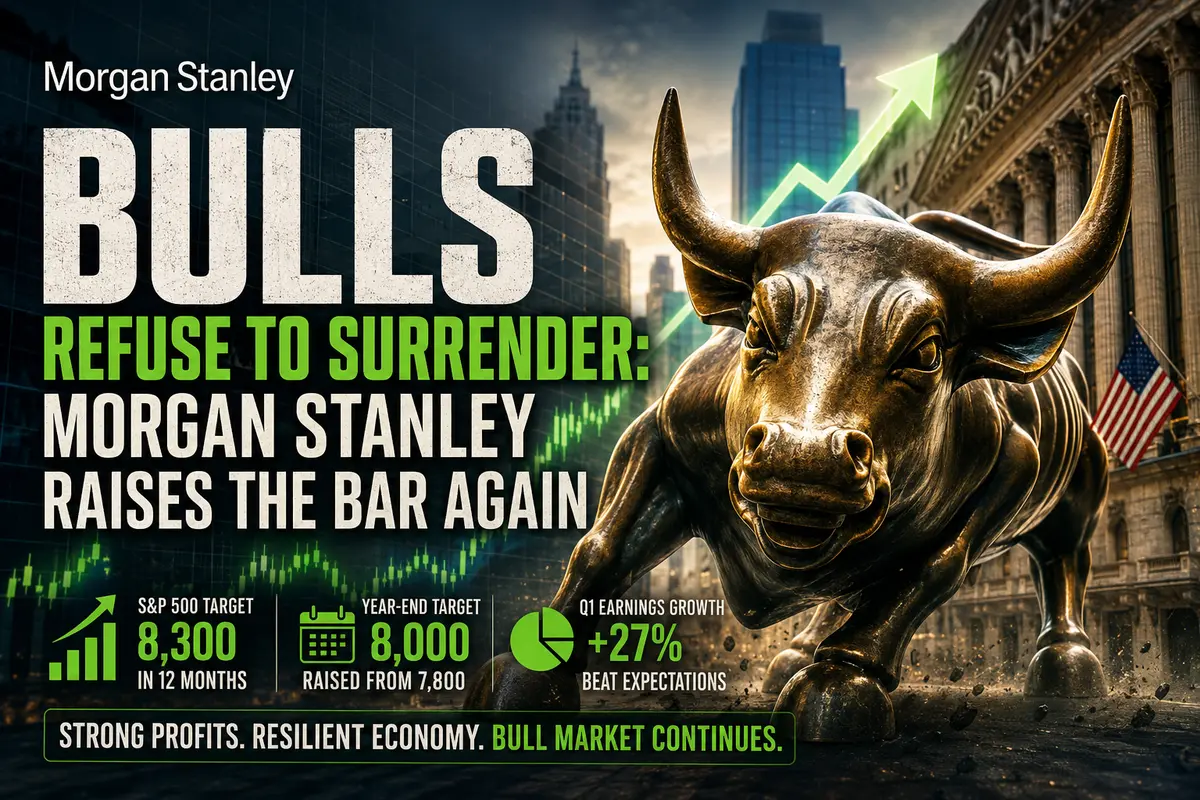
While a large part of the market remains nervous about geopolitics, oil prices, and endless recession talk, Morgan Stanley continues to stick to its narrative. The bank views the U.S. stock market with a level of optimism that many may consider excessive, yet the logic behind it is remarkably coherent. The core thesis is that two powerful engines — strong corporate earnings and a resilient economy — are capable of driving the bull market forward without losing momentum.
Bloomberg, citing the bank’s latest projections, reported some striking numbers. Over the next year, Morgan Stanley analysts believe the S&P 500 could climb to 8,300 points. From current levels, that implies roughly a twelve percent gain. Not bad for a market that already appears historically elevated. Even more interesting, however, is that Mike Wilson’s team simultaneously raised its year-end target from 7,800 to 8,000 points. In other words, the bank expects a meaningful acceleration in the coming months, not sometime in the distant future.
Earnings Season That Caught Everyone Off Guard
Why such confidence? The answer lies in what just happened during the latest U.S. earnings season. The first quarter turned out to be so strong that even hardened skeptics were forced to revise their expectations. Earnings for companies in the S&P 500 surged by twenty-seven percent. That is not merely a good result — it is more than double the modest twelve percent growth analysts had originally built into their models at the start of the reporting season.
A twenty-seven percent jump in profits is difficult to dismiss. It suggests that American businesses, despite all the noise surrounding trade wars, geopolitical crises, and expensive oil, continue to generate money with astonishing efficiency. Companies are not merely staying afloat — they are accelerating. And when that happens, the market gains a fundamental support structure that is not easily shaken even by the darkest headlines.
Commenting on these results, Mike Wilson emphasized that the resilience of corporate profits emerged despite a whole spectrum of risks. Geopolitical tensions have not disappeared. Concerns surrounding the private credit sector continue to flare up periodically. The transformation triggered by artificial intelligence is reshaping entire industries. Yet companies continue to produce profits, reinforcing the view Wilson’s team defended even during the bleakest phases of market selloffs.
The Man Who Refused to Panic
Mike Wilson deserves special attention. The strategist maintained his bullish stance even when markets were rattled by news surrounding the Iranian conflict. While others were issuing gloomy forecasts and advising investors to hide in defensive assets, he insisted that corporate earnings would pull the market out of any hole. And he turned out to be right.
Markets not only recovered losses caused by the geopolitical shock — they returned to record highs and continued climbing. The episode strengthened Wilson’s reputation as an analyst who refuses to follow herd mentality and is capable of seeing through the fog of headlines to the underlying reality of the economy.
Now the strategist is making another prediction that could prove equally important for investors trying to determine where markets go next. In his view, the base of companies posting earnings growth should broaden this year. During the first quarter, the heavy lifting was done primarily by a narrow group of technology giants — the familiar household names dominating headlines. But Wilson believes other sectors will soon pick up the baton. This is the classic pattern of a healthy bull market, where growth ceases to belong exclusively to a handful of elite companies and begins spreading across the broader economy.
What This Means for the Average Investor
A broadening earnings base is far more important than it may initially appear. When a market rests on the shoulders of five or six mega-cap companies, any stumble by one of them can trigger a major correction. But when profits begin growing across multiple industries — from industrials to consumer sectors — the market becomes significantly more resilient. It gains not one support pillar, but many.
That, apparently, is exactly what Morgan Stanley is betting on. The bank sees an American economy that continues to function, consumers who continue spending, and businesses adapting to new realities faster than anyone expected. In such an environment, even major external shocks — whether conflict in the Middle East or spikes in oil prices — are unable to reverse the broader trend. Instead, they merely create temporary pullbacks that are eventually bought up by investors.

Europe Stalls: A View from the Other Side of the Atlantic
While American strategists paint an optimistic picture, their colleagues covering Europe are considerably more cautious. Marina Zavolok, who works within the same Morgan Stanley team, described the European market using a rather grim metaphor. According to her, European equities are trapped inside a swinging pendulum of uncertainty triggered by disruptions in the Strait of Hormuz.
The image is remarkably accurate. Europe sits much closer to the epicenter of the Middle Eastern crisis, its economy depends more heavily on imported energy supplies, and its industrial sector is far more sensitive to disruptions in trade routes. While American companies report record profits, European firms are increasingly focused on how to pass rising costs onto consumers. And that, Zavolok warns, creates risks for demand.
The logic is simple and unsettling. When manufacturers raise prices to offset more expensive energy and raw materials, consumers begin buying less. Demand contracts, profits decline, and stock prices weaken. This vicious cycle is precisely why European strategists are unwilling to embrace the same optimism as their American counterparts.
Two Continents, Two Different Realities
The contrast between forecasts for America and Europe may be the clearest evidence yet of how differently the global energy shock has affected various parts of the world. The United States, with its own oil and gas production, watches developments in the Strait of Hormuz with concern, but not panic. Europe, tied far more tightly to imported energy supplies, feels every disruption like a direct blow.
Morgan Stanley’s forecasts simply reflect this new reality. The U.S. market receives a bullish recommendation, with expectations of double-digit gains over the next year. Europe, meanwhile, receives a cautious warning that the pendulum of uncertainty may continue swinging for quite some time, making hopes for quick stabilization premature.
This divergence creates both opportunities and risks for investors. Opportunities, because U.S. equities — especially outside the narrow circle of technology giants — may deliver strong gains as earnings growth broadens. Risks, because European assets, no matter how cheap they may appear after recent selloffs, could remain under pressure until the situation surrounding the Strait of Hormuz stabilizes.
Final Take: Optimism with Eyes Wide Open
Morgan Stanley’s forecast is not blind faith in the best-case scenario, nor is it an attempt to ignore obvious problems. It is a relatively sober calculation built on the idea that companies continue making money and the economy continues growing. Geopolitics creates noise and temporary drawdowns, but it does not break the fundamental trend. That is exactly what Wilson and his team argued during the Iranian crisis, and it is exactly what they continue arguing now.
An S&P 500 target of 8,300 within twelve months is certainly ambitious. But it stops looking unrealistic when viewed against the pace of earnings growth American companies have just demonstrated. When businesses are generating twenty-seven percent more profit than a year ago, and analysts across Wall Street are steadily raising forecasts, the market gains more than just hope — it gains real fuel for further upside. That is the fuel Morgan Stanley is betting on. And as long as the numbers continue supporting their thesis, the bulls remain very much in the game.

Comments
No comments yet. Be the first to share your thoughts!
Authentication Required
You must be logged in to post a comment.