

Two Titans Slam the Door Shut at the Same Time
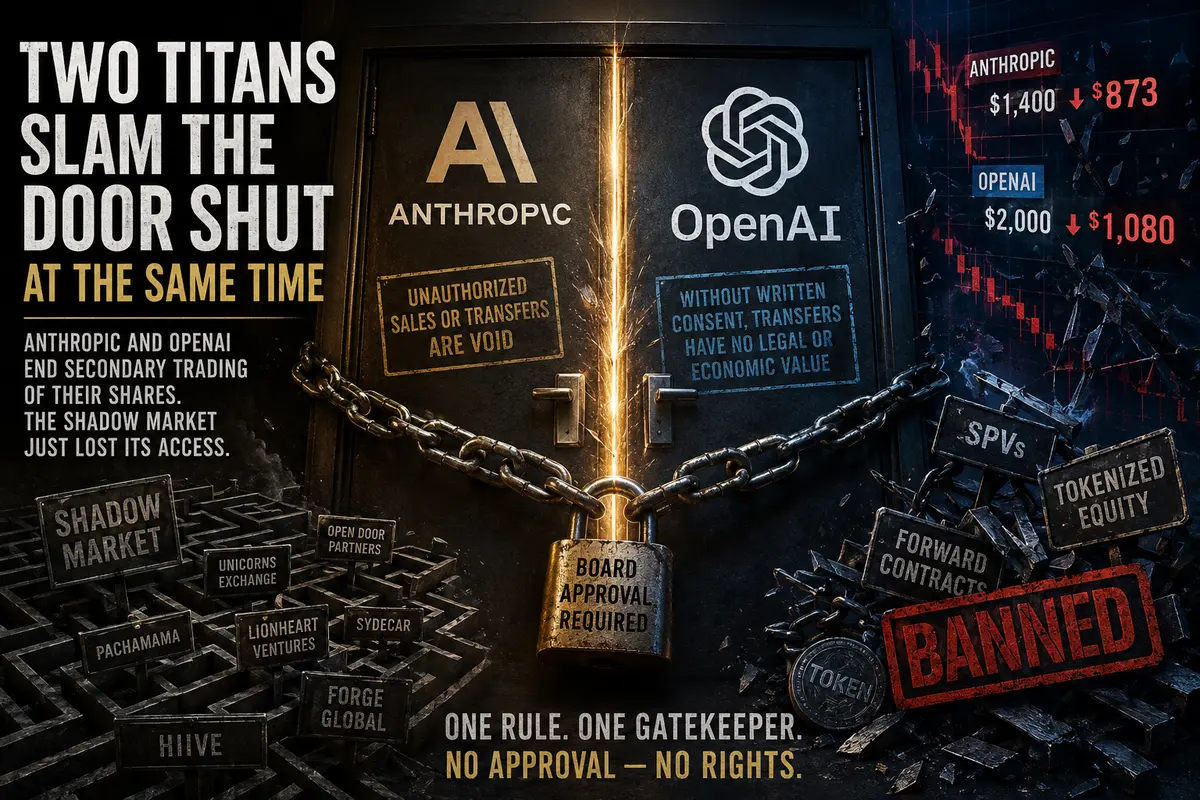
Anthropic and OpenAI have done what many had long expected but what participants in the shadow market refused to believe until the very last moment. Both companies updated their internal policies almost in sync, putting a firm stop to secondary trading of their shares. The wording published on their respective pages sounds nearly identical, as if the lawyers of two fierce rivals had been copying off each other. But that’s not really the point. The point is that the two hottest AI startups on the planet have just cut off the oxygen supply to an entire industry that grew up around investors desperate to grab a piece of their businesses before either goes public.
At Anthropic, the language is brutally clear: any sale or transfer of securities without board approval is declared void. A buyer who risks entering such a transaction will not be recognized as a shareholder and will receive absolutely no rights whatsoever. OpenAI mirrors the exact same structure: without the company’s written consent, any transfer of shares has neither legal nor economic value. In plain terms: if you bought without asking, you might as well have thrown your money to the wind.
An Entire List of Grey Schemes Now Banned
What’s most interesting is that neither company limited itself to a generic prohibition. They named specific avenues that are now considered illegitimate. The list includes direct sales, special purpose vehicles, tokenized equity interests, and forward contracts. This is not a random collection of words. These are precisely the tools that the market has spent the last several years using to carve out detours toward shares in private AI giants.
The notorious SPVs — special purpose vehicles — deserve particular attention. The scheme is simple and elegant in its audacity. A shell company is created with the sole purpose of holding shares in a private firm. That company then raises capital from investors who are formally buying not shares in the startup, but stakes in the SPV itself. And just like that, dozens or even hundreds of people gain indirect access to the coveted securities through a chain of legal entities, technically without violating any prohibitions.
The vulnerability of this structure lies in the ability to spawn multiple layers of such entities. One SPV buys a stake in another SPV, which buys a stake in a third, and so on ad infinitum. Figuring out who ultimately stands behind this entire matryoshka doll and how legitimate the original transaction with the underlying shares actually is becomes nearly impossible. Or at least, it was impossible until now.
The New Rules: The Chain Breaks at Its Very Start
Anthropic and OpenAI have delivered a surgical strike against this multi-layered structure. Under the new rules, if the very first transfer of funds into an SPV was not approved by the board of directors, then the entire chain of transactions — no matter how many links it contains — is automatically deemed void. It’s a solution that is brilliant in its simplicity: instead of chasing down every link in the chain, the companies simply declared that if the root was rotten, the whole tree is deadwood.
And to make sure no one harbored any illusions, Anthropic went even further and published a named list of specific structures that are now blocked. The list includes Open Door Partners, Unicorns Exchange, Pachamama, Lionheart Ventures, Sydecar, Upmarket, as well as two far better-known platforms — Forge Global and Hiive. The latter two are not some no-name operations; they are the largest venues for secondary trading of private company shares, regulated and carrying serious reputations.
Forge Global Got Caught in the Crossfire by Mistake
With Forge Global, a separate story unfolded that slightly complicates the picture of a total purge. The company landed on the list but immediately stated that it was a mistake. Their comment was measured in a diplomatic yet firm tone: we are working with Anthropic to have Forge’s name removed from this warning, because we do not facilitate transactions in shares of any private companies without explicit approval from the firm itself.
This caveat matters, because Forge is a regulated venue for accredited investors, and its inclusion on a blacklist could have meant an escalation of the conflict far beyond the shadow market. The fact that Anthropic is willing to revise the list suggests that the crackdown is not aimed at everyone indiscriminately, but specifically at those trying to trade without permission. At the same time, the implied valuation of Anthropic on Forge had previously reached a staggering one trillion dollars, outpacing the 880 billion figure for OpenAI. That says a great deal about the scale of the frenzy surrounding these companies.
The Market Reacted Instantly and Brutally
The reaction was not long in coming. It was especially dramatic on PreStocks, a platform built on Solana that allows trading of tokenized derivatives tied to private company shares. The Anthropic token crashed from 1,400 to 873, while the OpenAI token plunged from 2,000 to 1,080. This isn’t a percentage drop — it’s a near-total collapse, almost halving in value within hours of the news breaking.
PreStocks and platforms like it represent yet another layer of workarounds that has flourished over the past year. Crypto companies have launched investment products promising access to shares in private firms. Most often they take the form of perpetual futures — derivative instruments that track the valuation of companies on secondary markets but confer absolutely no ownership rights over real shares. In essence, they are bets on valuation, not ownership. And now the companies have made it clear that even such surrogates are unacceptable.
Why All This Was Necessary: The Tender Offer Story
To understand the motivation of both companies, it’s enough to recall October 2025. OpenAI conducted a large-scale tender offer, fully sanctioned by the board of directors. Current and former employees were allowed to sell shares worth up to 30 million each. 6.6 billion in a single transaction.
Of those, around seventy-five individuals chose to cash out the full amount — all thirty million. For comparison, the previous limit per employee was just $10 million. The company tripled the cap precisely because the old rule was generating quiet but palpable dissatisfaction among leading researchers and engineers. The people creating the technology on which the company’s multi-billion-dollar valuation rests wanted the ability to turn at least some of their paper wealth into real money.
And here is the key point: OpenAI organized this entire campaign on its own, ran it through the board of directors, and approved every transaction. This is exactly the right that private companies are so fiercely trying to protect. They are not against secondary sales as such. They are against anyone doing it without their knowledge and control.
Control Over the Cap Table as the Ultimate Asset
For a private company, the shareholder register is not just a list of names. It is a strategic asset. Too many holders and the company risks crossing the threshold beyond which it is obligated to go public, even if it doesn’t want to. Too many unknown or unfriendly shareholders and the board loses control over key decisions. Too hot an uncontrolled market and the company’s valuation begins to lead a life of its own, detaching from reality and creating problems for future funding rounds.
Investors, for their part, are desperately seeking access to the fast-growing revenues of AI startups. Demand for OpenAI and Anthropic paper is colossal, while supply is artificially constrained. And when there is that kind of imbalance, the market will always find a loophole. And indeed, it found them — those very same SPVs, forward contracts, tokenized stakes, and crypto platforms. Now the companies are methodically shutting those loopholes down.
Context: The Robinhood Tokens and Other Episodes
The current crackdown has a backstory. In July 2025, OpenAI already had to deny reports about launching tokenized shares of the company, which Robinhood had allegedly been planning to offer. At the time, many saw this as a trial balloon: maybe the company really was thinking about issuing some kind of blockchain-based instrument for trading its shares? But OpenAI responded instantly and firmly: no, we are not planning anything of the sort, period.
Looking back now, it becomes clear that this was not just an isolated episode, but part of a broader picture. The companies watched as a shadow market grew up around them, as new schemes kept appearing, as crypto platforms launched products exploiting their brand and their valuation, and they decided that enough was enough. Enough of grey-market SPVs, enough of perpetual futures, enough of PreStocks and others like them.
What Comes Next
For investors who were hoping to grab a piece of Anthropic or OpenAI before an IPO, hard times are coming. The official channels for secondary sales — through tender offers sanctioned by the board of directors — remain, but they are open only to employees and select early investors. For everyone else, the door has just slammed shut.
Both companies have made it clear that they will defend their shareholder registers with the same determination with which they defend their models and their technology. Control over who owns their shares is no less important to them than control over their code. And in a world where the valuation of AI startups has already sailed past the trillion-dollar mark, this battle over the cap table is only going to intensify.

Comments
No comments yet. Be the first to share your thoughts!
Authentication Required
You must be logged in to post a comment.