

The Big Twenty-Four: Who Made the List and Why It Matters
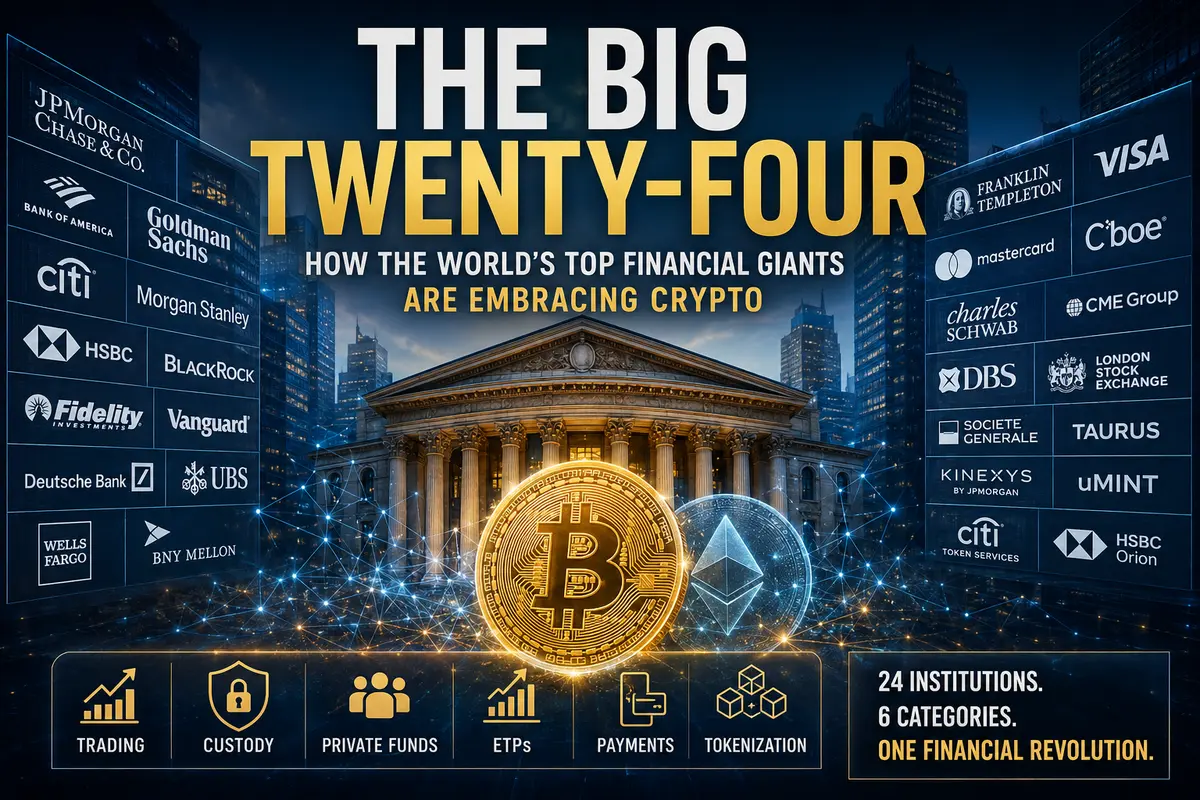
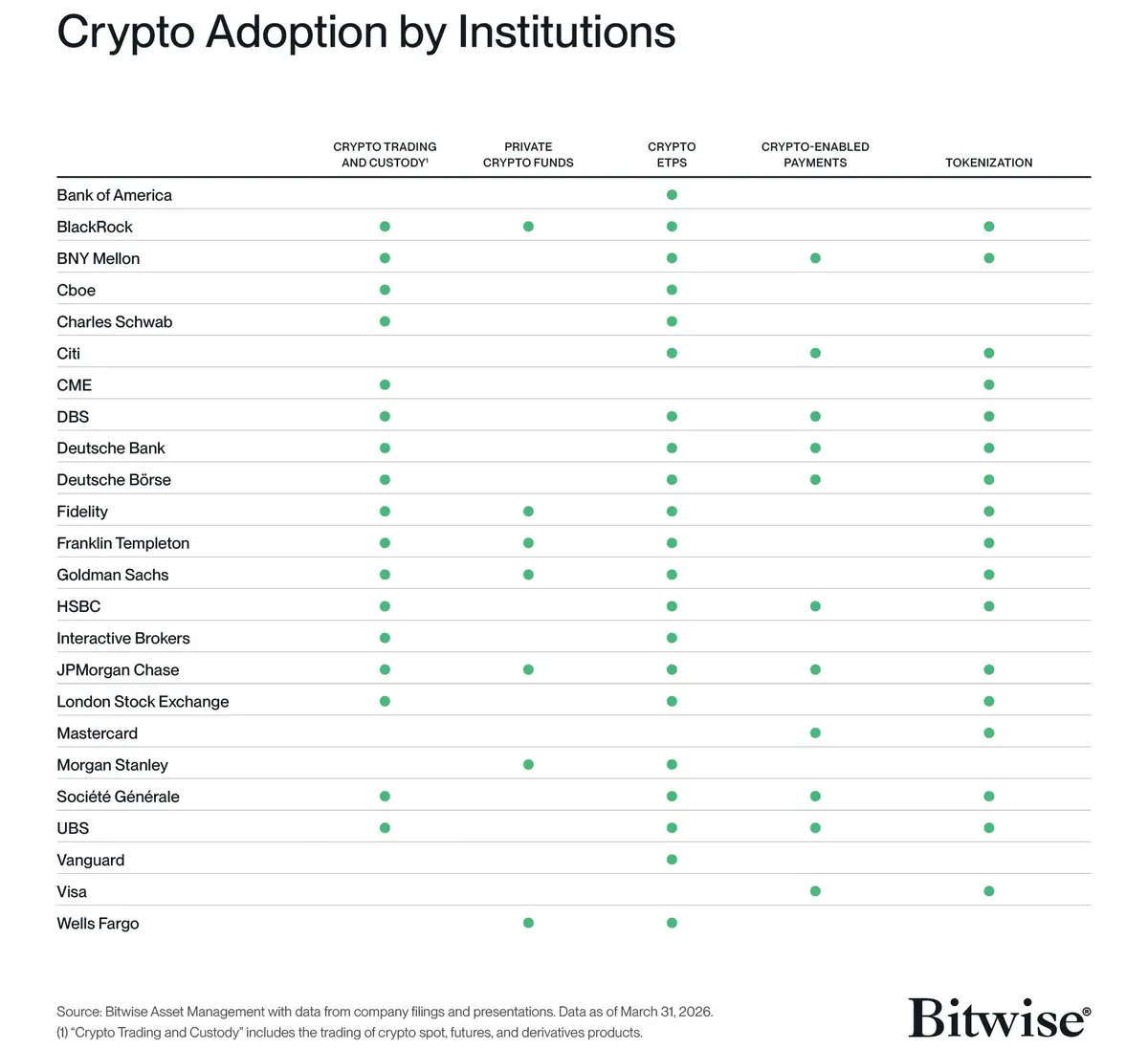
On May 8, asset management company Bitwise — long considered one of the key bridges between cryptocurrencies and traditional finance — published a short but remarkably revealing post on X. Accompanying it was a chart listing the world’s 24 largest financial institutions, each already involved with cryptocurrencies in one way or another. The post read: “Banks and crypto: better together.” Behind that simple phrase may lie the most important institutional story of 2026.
The list spans nearly every imaginable area of crypto activity. Trading, custody, private funds, exchange-traded products, payments, and tokenization — six columns populated by heavyweight names. Bank of America, Goldman Sachs, JPMorgan Chase, BlackRock, Fidelity Investments, HSBC, Deutsche Bank, Citigroup, Visa, and Mastercard — the list reads like the table of contents of a handbook on the global financial elite. Most importantly, these firms are no longer merely observing the crypto market or experimenting with pilot programs. They are integrating crypto infrastructure directly into their core business operations, treating it as an essential component alongside equities trading or bond custody.
Exchange-Traded Products as the Main Gateway
The broadest entry point for institutional investors has become crypto exchange-traded products — the very ETPs that regulators viewed as dangerous and exotic only a few years ago. Today, they are the main highway through which pension funds, insurance companies, wealth managers, and private banks enter the crypto market.
Bank of America now provides clients of Merrill Lynch, its wealth management division, access to spot Bitcoin ETPs. This marks a dramatic shift considering the bank’s previously skeptical stance toward cryptocurrencies. Vanguard, which once famously blocked Bitcoin ETFs and faced a wave of criticism from its own clients, now allows brokerage customers to trade crypto ETPs. It is a silent 180-degree turn driven not by ideology, but by straightforward client demand.
Alongside them in the ETP category are BlackRock, Fidelity Investments, Franklin Templeton, Morgan Stanley, UBS, and Wells Fargo — virtually the entire elite of American and European finance. The reason is not that these firms suddenly fell in love with Bitcoin as an ideology. Clients are demanding access, and refusing to provide it means losing business. When firms like UBS or Morgan Stanley see capital flowing toward competitors already offering crypto products, the decision becomes obvious. This is not ideology; it is pure mathematics of client flows.
Custody Becomes Part of Core Infrastructure
The category dedicated to digital asset custody deserves special attention. For years, crypto custody services were dominated by specialized firms like Coinbase or BitGo. Traditional banks kept their distance, citing regulatory uncertainty and technical complexity. That era is over.
BNY Mellon — America’s oldest bank, founded by Alexander Hamilton — has integrated digital asset custody into its primary infrastructure. This is not an experimental side project run by a handful of developers; it is a fully operational service embedded within the same systems that safeguard trillions of dollars in traditional assets. Deutsche Bank expanded its custody capabilities through a partnership with Swiss firm Taurus. The list continues with Cboe Global Markets, Charles Schwab, CME Group, DBS Bank, Goldman Sachs, HSBC, and the London Stock Exchange — all supporting trading venues, listed products, custody services, or market infrastructure tied to cryptocurrencies.
This is a tectonic shift. When digital asset custody becomes as standard a banking service as safeguarding gold or securities, the final major obstacle to large-scale institutional adoption disappears. A pension fund that once wanted Bitcoin exposure but could not find a regulated, reputable custodian now has a choice of multiple global banks. And this is precisely the infrastructure crypto needed in order to mature into a legitimate asset class.
Tokenization: From Experiments to Real Funds
The sixth column in Bitwise’s chart — tokenization — may be the most exciting for anyone thinking about the future of finance. The names listed there are enough to send chills down the spine of any market observer. BlackRock, through its BUIDL fund, is moving institutional liquidity on-chain. Franklin Templeton is recording fund activity on public blockchains, making reporting transparent and available in real time.
Special attention should also be paid to blockchain initiatives that have already moved beyond the presentation stage. Citigroup Token Services, Kinexys by JPMorgan Chase, HSBC Orion, uMINT by UBS, and FORGE by Société Générale are live systems already handling real settlements and asset issuance. Banks are no longer asking whether blockchain has a future. They are simply building that future — pragmatically, quietly, and without the rhetoric of crypto-anarchism.
Bitwise CTO Matt Hougan put it bluntly: “Eventually, every fund will be tokenized.” It is a bold statement, but no longer sounds far-fetched. When BlackRock and JPMorgan move in the same direction, this is not hype or speculation. It is a cold assessment of where the market is heading. Tokenization promises lower administrative costs, faster settlements, and broader access to assets once locked behind high minimum investments and complex procedures. Banks understand this and are acting ahead of competitors still hesitating.
Payments: Blockchain at the Level of Global Card Networks
The payments column in Bitwise’s chart speaks for itself. It includes Citigroup, BNY Mellon, DBS Bank, Deutsche Bank, HSBC, JPMorgan Chase, Mastercard, Société Générale, UBS, and Visa. Global banks and payment networks alike are working to make crypto payments part of everyday financial infrastructure.
Visa has already explored stablecoin settlement infrastructure, recognizing that blockchain-based digital dollars could move faster and cheaper than traditional payment rails. Mastercard developed the Multi-Token Network — a blockchain-based financial services system that could become for digital assets what Mastercard itself became for card payments. DBS Bank supports regulated digital asset services across trading, custody, and tokenization, demonstrating how Asian banks are in some areas moving faster than their Western peers.
Stablecoins are the key element here. They promise to solve the problem that has haunted cryptocurrencies since their inception: how to use blockchain for payments without exposing either party to currency volatility. Pegged to the dollar or euro and operating on fast, low-cost networks, stablecoins have become the bridge through which traditional finance is entering the crypto world. Banks have noticed.
Private Funds: An Exclusive Club
Private crypto funds remain part of the institutional landscape, though their adoption is occurring on a smaller scale than exchange-traded products. This category includes BlackRock, Fidelity Investments, Franklin Templeton, Goldman Sachs, JPMorgan Chase, Morgan Stanley, and Wells Fargo. Goldman Sachs, staying true to its reputation as a bank for elite clients, focuses on institutional traders and private fund access, offering wealthy customers opportunities unavailable to the general public.
JPMorgan Chase deserves special mention because it appears in all six categories of the Bitwise table. Every column contains a check mark next to its name. This means America’s largest bank is simultaneously trading crypto, providing custody, offering private funds, supporting exchange-traded products, developing payment infrastructure, and building tokenization systems. Such comprehensive involvement reflects a strategic decision made at the highest level: digital assets are no longer a side project, but a core direction of future growth.
What It Means for the Market
The Bitwise chart is not merely an attractive infographic for social media. It is documentary evidence that the cryptocurrency industry has entered a new phase. Regulated access is no longer a dream; it is reality. The world’s largest banks and asset managers no longer view cryptocurrencies as a threat or competitor. They are embedding them into their operating models, turning Bitcoin, Ethereum, and tokenized assets into as normal a part of the financial landscape as stocks, bonds, or currencies.
For the average investor, this means the barrier to entry is falling month by month. There is no longer a need to understand private keys or cold wallets in order to gain exposure to crypto markets. It is enough to open a brokerage app and purchase a product tracking Bitcoin’s price with the same ease as buying shares of Apple. Behind that simple transaction stands an enormously complex infrastructure built by twenty-four financial giants that are quietly and methodically transforming cryptocurrencies from an underground movement into a fully recognized asset class. And judging by the speed at which Bitwise’s table continues to fill up, this process is only accelerating.

Comments
No comments yet. Be the first to share your thoughts!
Authentication Required
You must be logged in to post a comment.