Bar Pipa
We pay for a post of 10$

Shares

Tom Maffin

Silicon Revolt: How 48,000 Samsung Workers Are Bringing a Tech Giant to Its Knees

Silicon Revolt: How 48,000 Samsung Workers Are Bringing a Tech Giant to Its Knees

The news that came out of South Korea on Wednesday hit global technology markets with the force of a finely tuned industrial press. The largest labor union at Samsung Electronics — a company whose name has become synonymous with South Korea’s economic miracle — announced the start of a full-scale strike. Eighteen days, forty-eight thousand workers, and the complete collapse of negotiations mediated by the government. This is not merely a labor dispute; it is an event capable of redrawing the global semiconductor landscape and leaving a deep scar on South Korea’s export-driven economy. And what terrifies investors most is that this is happening not on the periphery, but at the very heart of global memory chip manufacturing, where Samsung has maintained an iron grip for decades.

Breakdown of Negotiations: Why the Government Failed to Save the Situation

When a government steps into a labor dispute, it is always a sign of extreme concern. South Korea’s labor authorities, usually operating behind the scenes, moved center stage this time and sat down at the negotiating table alongside Samsung management and union representatives. It was a desperate move driven by the understanding of what was at stake. Yet even state mediation failed to bridge the gap dividing the two sides.

The union submitted a proposal whose full details remain undisclosed, but the core issues are known: performance bonuses and compensation. It sounds like a standard list of demands, but behind those words lies a deeper shift in the relationship between Korean chaebols and their workers. For decades, Samsung cultivated a culture of loyalty in which employees identified themselves with the corporation, while the corporation provided stability and generous bonuses during prosperous years. But now, as the semiconductor industry undergoes tectonic shifts driven by the AI boom, trade wars, and supply-chain restructuring, that...

Continue reading...
0
0

From Loss to Profit: How Bakkafrost Turned the Tide in a Tough Salmon Market

From Loss to Profit: How Bakkafrost Turned the Tide in a Tough Salmon Market
A Quarter That Changed the Narrative

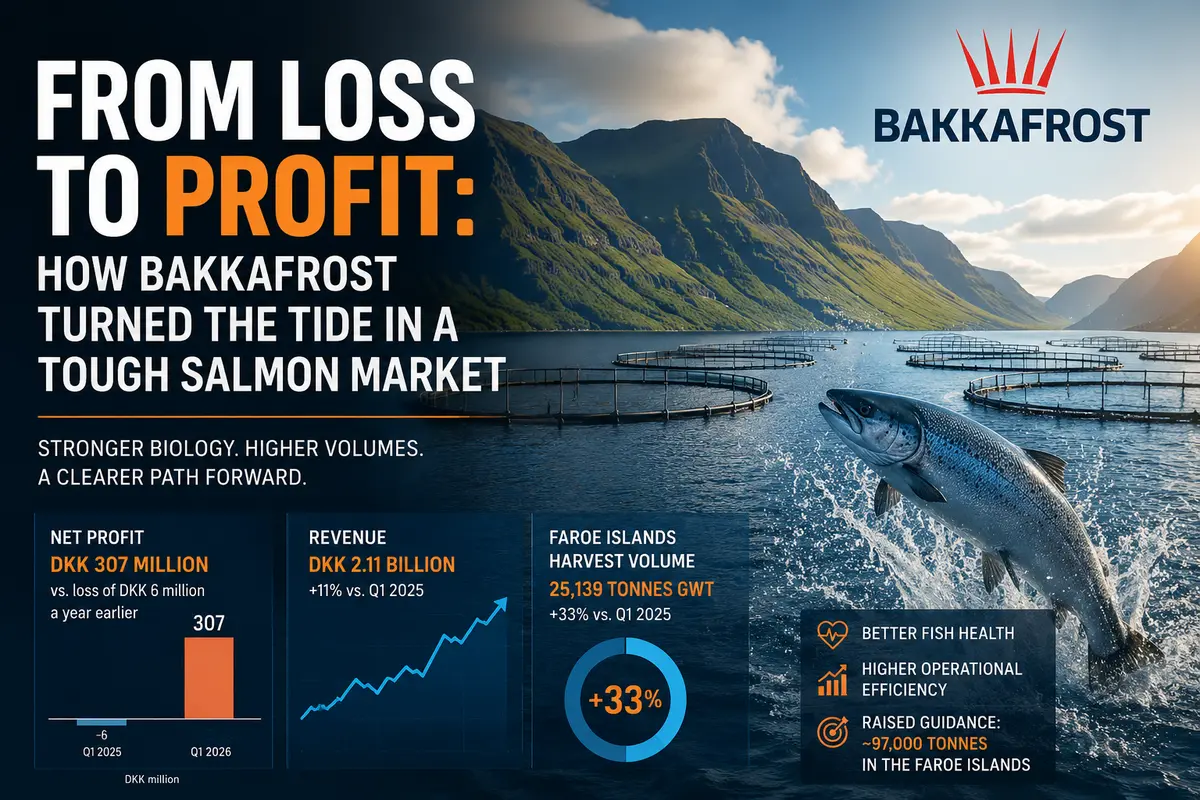
When Bakkafrost published its first-quarter results, the numbers immediately caught the market’s attention. A year ago, the company reported a small net loss. This year, it delivered a net profit of DKK 307 million. On paper, it looks like a sharp turnaround. In reality, the story behind those figures is much deeper than a simple rebound in earnings. What happened over the past twelve months reveals how modern salmon farming has become a battle not only of prices and production volumes, but also of biology, geography, and operational discipline.

At first glance, the broader market environment did not look particularly favorable. Global salmon prices in the quarter were lower than a year earlier. Supply from major producing countries increased significantly, putting pressure on benchmark prices across Europe and Asia. In industries tied to commodities, lower prices usually translate directly into weaker profits. Yet Bakkafrost managed to move in the opposite direction.

That alone says a great deal about the company’s underlying condition.

Why Efficiency Matters More Than Salmon Prices

The key to understanding this quarter lies in one word: efficiency. Not the empty corporate kind of efficiency often repeated in investor presentations, but the real, measurable kind that determines whether a fish farmer makes money or loses it. In salmon farming, efficiency starts with biology. Healthy fish grow faster, require less treatment, consume feed more effectively, and survive in greater numbers until harvest. Sick fish do the opposite. Every biological problem eventually becomes a financial problem.

This is where Bakkafrost’s Faroese operations stood out.

The Faroe Islands are not just another production region on the map. For salmon farming, they are close to ideal. Cold Atlantic waters, strong ocean currents, stable temperatures, and relatively isolated fjords create natural conditions that reduce many of the...

Continue reading...
0
0

Three and a Half Million in Just a Few Weeks

Three and a Half Million in Just a Few Weeks

Tap Global, a company whose shares are traded on London’s AIM market, has released a short but highly revealing statement. Its new product, called Tap Earn, managed to attract $3.5 million in assets under management since launching in early May. For giants like Coinbase or Binance, that amount would barely register as statistical noise. But for Tap Global, whose audience is still measured in hundreds of thousands rather than tens of millions of users, it is a significant signal.

The product was officially announced on May 7, and within just a couple of weeks clients had already deposited $3.5 million into it. If that pace were extrapolated over a quarter or a year, the numbers could materially reshape the company’s financial profile. More importantly, however, customers are voting with their feet — or rather, with their wallets — for a model fundamentally different from what cryptocurrency platforms have traditionally offered.

Tap Earn provides variable yield on crypto assets and stablecoins. In practice, this means users can open the mobile app, deposit their Bitcoin, Ether, or dollar-pegged tokens, and begin earning interest on them. There is no need to trade, monitor charts, or stress over volatility — users simply deposit assets and earn passive income. The idea itself is as old as finance, but in the crypto world it has long been associated with risky decentralized finance protocols and infamous yield platforms that promised high returns before disappearing along with users’ funds. Tap Global is attempting to offer a similar product, but within a regulated framework and through a publicly traded company.

A Strategic Shift: From Transactions to Passive Income

The most interesting aspect of Tap Global’s announcement is not the $3.5 million figure itself, but what it represents. CEO Arsen Torosian described the launch of Tap Earn as the beginning...

Continue reading...
0
0

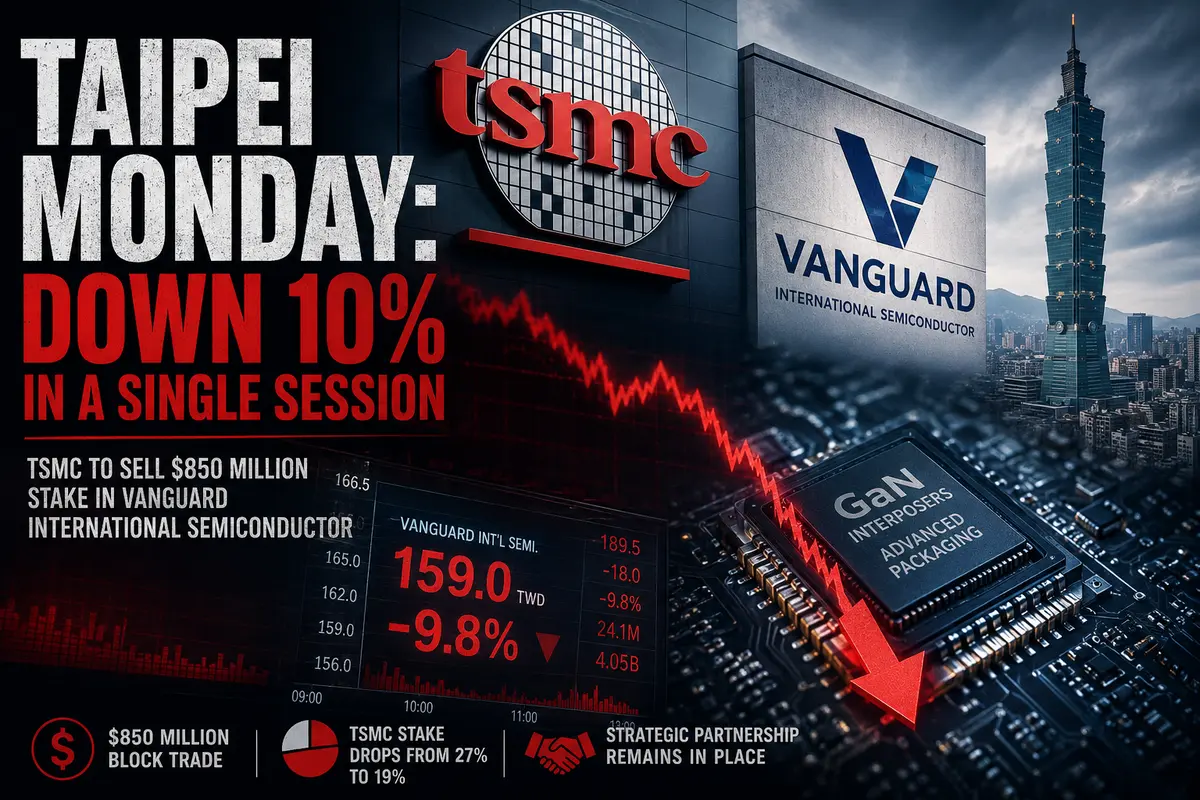
Taipei Monday: Down Ten Percent in a Single Session

Taipei Monday: Down Ten Percent in a Single Session

Monday morning on the Taipei exchange began with a steep dive for Vanguard International Semiconductor. The company’s shares plunged nearly ten percent, falling to 159 New Taiwan dollars apiece. For a stock that had seemed relatively stable as recently as Friday evening, the move came as a real shock. A ten-percent drop in a single trading session is not a routine correction, not a technical pullback, and not a reaction to general market noise. It is a verdict delivered by investors after learning about the decision of the company’s largest shareholder.

And that shareholder is none other than TSMC, the world’s largest contract chipmaker — a company whose very name makes competitors from Silicon Valley to Shenzhen nervous. On Friday, the giant announced plans to sell up to 152 million Vanguard shares to institutional investors through a block trade. Not gradually, not through the open market, and not with careful regard for short-term market conditions — but all at once, in a large, deliberate transaction executed with corporate precision.

The Math of the Deal: From 27% to 19%

The numbers behind the transaction are substantial. Once completed, TSMC’s stake in Vanguard will shrink from just over 27 percent to exactly 19 percent. The stake changing hands is valued at roughly NT$26.8 billion — about US$850 million at current exchange rates. Nearly a billion dollars’ worth of Vanguard shares will move to new institutional owners, while TSMC will either lock in a sizable profit or free up capital for other purposes.

Why did the market react with a selloff rather than indifference? The answer lies in investor psychology. When the company’s largest and best-informed shareholder decides to reduce its stake by nearly a third, investors inevitably interpret it as a signal. A signal that the company which knows Vanguard better than...

Continue reading...
0
0
NorthRay

My First Full Lot Made Me $23.50. And Now I’m Looking at Oil, Gold, and Apple.

My First Full Lot Made Me $23.50. And Now I’m Looking at Oil, Gold, and Apple.

Yes, I’m Expanding My Horizons.

Hi, this is NorthRay.

Remember when I said I wanted to try opening a trade with one full lot?

Well, I did it.

And you know what? I didn’t blow up my account. My trade hit take profit.

Profit: $23.50.

So far, this is my biggest “win” on demo.

But instead of sitting back and celebrating, I’m already looking in a new direction. Because currency pairs are only the beginning.


How the 1-Lot Trade Ended

I opened a EUR/USD trade. Lot size — 1.0. Stop-loss and take-profit were mandatory (thanks to previous lessons).

Honestly? It was scary.

Every time the price moved 10–15 pips, my brain instantly calculated:
“That’s already plus or minus $100–150.”

I literally had to sit on my hands to avoid closing the trade too early. I trusted my plan.

And the market rewarded me.

Price reached my take-profit level. The trade closed automatically. That green $23.50 number appeared on my terminal.

I exhaled.

It’s not life-changing money. But for me, it was a signal:
“You’re growing. You’re learning. You’re moving in the right direction.”


But Something Started to Bother Me

After that trade, I sat down and started thinking.

I only trade EUR/USD. Just one currency pair. I already feel like I can “read” it. I’m beginning to understand its personality.

But trading is much bigger than just the euro and the dollar.

There’s also:
— Oil (Brent, WTI)
— Gold (XAU/USD)
— Silver
— Company stocks: Apple, Tesla, Amazon, Google, Microsoft

And honestly? I know almost nothing about them.

What if there are opportunities there too?
What if my strategy works outside of forex?
What if I’m missing something important?

So I decided: it’s time to expand.


What Commodities Are — And Why They Attract Me

For...

Continue reading...
0
0
Tom Maffin

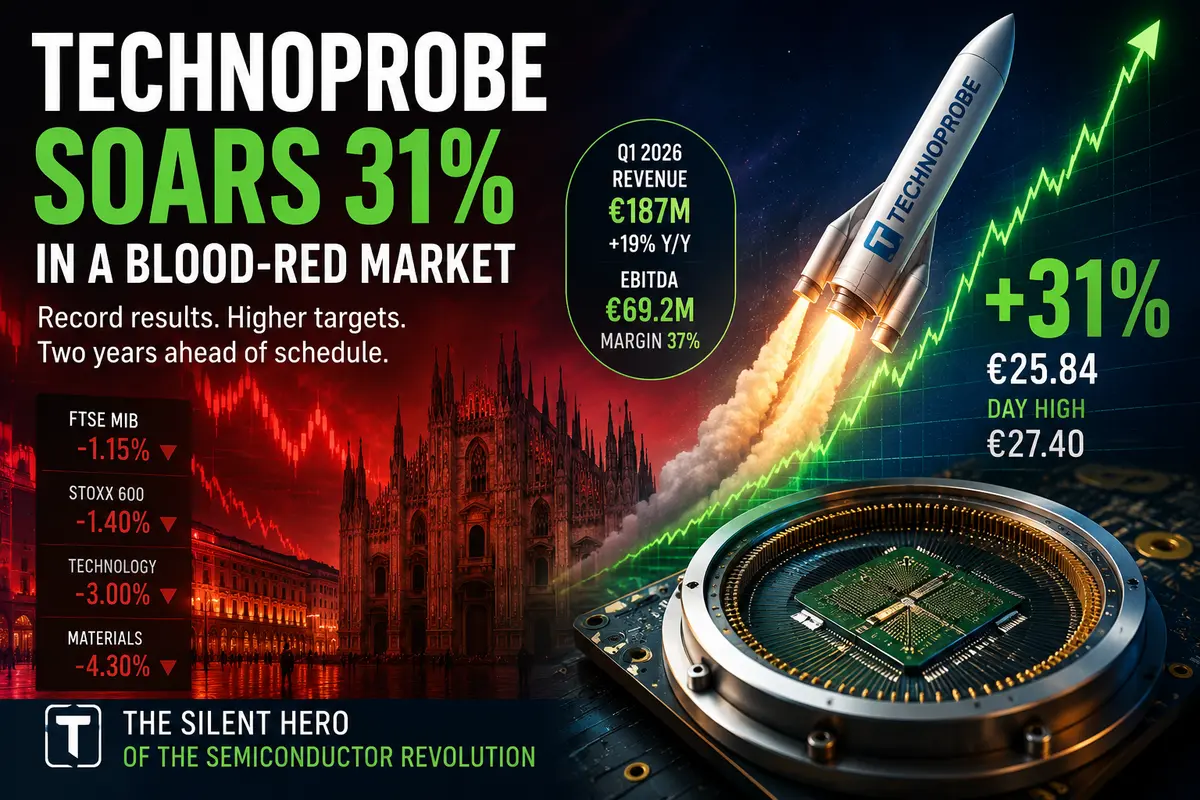
The Milan Outlier in a Blood-Red Market

The Milan Outlier in a Blood-Red Market

While Italy’s FTSE MIB opened down 1.15% and the pan-European STOXX 600 slid 1.4%, one stock on the Milan exchange traded as if the broader market meltdown simply didn’t exist. Shares of Technoprobe surged 31% to €25.84 and, at the session high, touched a new yearly peak of €27.40. This wasn’t just a rally — it was a full-blown rocket launch moving against the gravity of the entire market.

The contrast with the broader backdrop was striking enough to make even veteran traders do a double take. Europe’s technology sector was down 3%, materials stocks had dropped 4.3%, yet Technoprobe kept climbing, ignoring geopolitical tensions, stalled US-Iran talks, and fears of disruptions in the Strait of Hormuz. To understand why, you had to look at the numbers the company released before the market opened.

A Quarterly Report That Blew Past Expectations

Technoprobe’s first-quarter 2026 results weren’t merely solid — they were record-breaking. Consolidated revenue came in at €187 million, up 19% year over year. For a mature industrial company, that kind of growth is serious. Those are the sorts of numbers you expect from young tech startups, not established equipment manufacturers.

But the real surprise was EBITDA. Earnings before interest, taxes, depreciation, and amortization reached €69.2 million. Roughly speaking, that puts EBITDA margin near 37% — the kind of profitability usually associated with software companies, not makers of physical hardware. It showed that Technoprobe wasn’t just selling more; it was doing so with increasing efficiency, keeping costs under control and extracting more profit from every euro of revenue.

Earnings per share also beat expectations. Analysts had been looking for €0.08, while the company delivered €0.09 — a 12.5% beat. In a market where companies are often praised for beating estimates by fractions of a percent, a double-digit surprise sends a...

Continue reading...
0
0
Tom Maffin

The Swiss Giant Keeps Its Word

The Swiss Giant Keeps Its Word

On Thursday, confirmation arrived from Baar, home to Glencore’s headquarters, of what the market had been expecting since the company released its annual report. Glencore announced that on June 3 shareholders will receive a return of capital of 8.5 cents per ordinary share.

On paper, the figure looks modest. But once multiplied by the billions of shares outstanding, it turns into hundreds of millions of dollars flowing into investor accounts — from London-based funds to South African pension managers.

Formally, the payment still requires shareholder approval at the annual general meeting. In Glencore’s case, though, that is largely procedural. The company typically aligns such decisions with its major shareholders in advance and rarely walks back announced distributions.

There is also an important technical detail: only investors on the Jersey shareholder register at the close of trading on May 8 will qualify for the payment. Jersey is not there by accident. The island has long been part of Glencore’s corporate structure, helping the company navigate different tax and legal regimes.

A Multi-Currency Setup

Glencore operates as a global machine, and its payout structure reflects that. Shareholders can receive the distribution not only in US dollars, but also in pounds sterling, euros, or Swiss francs. Investors who did not submit a currency election by May 11 will automatically receive the payment in dollars.

The company fixed the conversion rates using the average closing exchange rates published by London Stock Exchange Group on May 13. That translates into approximately:

6.29 pence per share;

7.26 euro cents;

6.65 Swiss centimes.

Glencore also disclosed the underlying exchange rates:

GBP/USD — 1.3515;

EUR/USD — 1.1709;

USD/CHF — 0.7826.

For retail investors, this may look like routine disclosure. For institutional holders, however, it is useful operational detail — a quick way to assess how favorable the conversion...

Continue reading...
0
0
Lin Brings

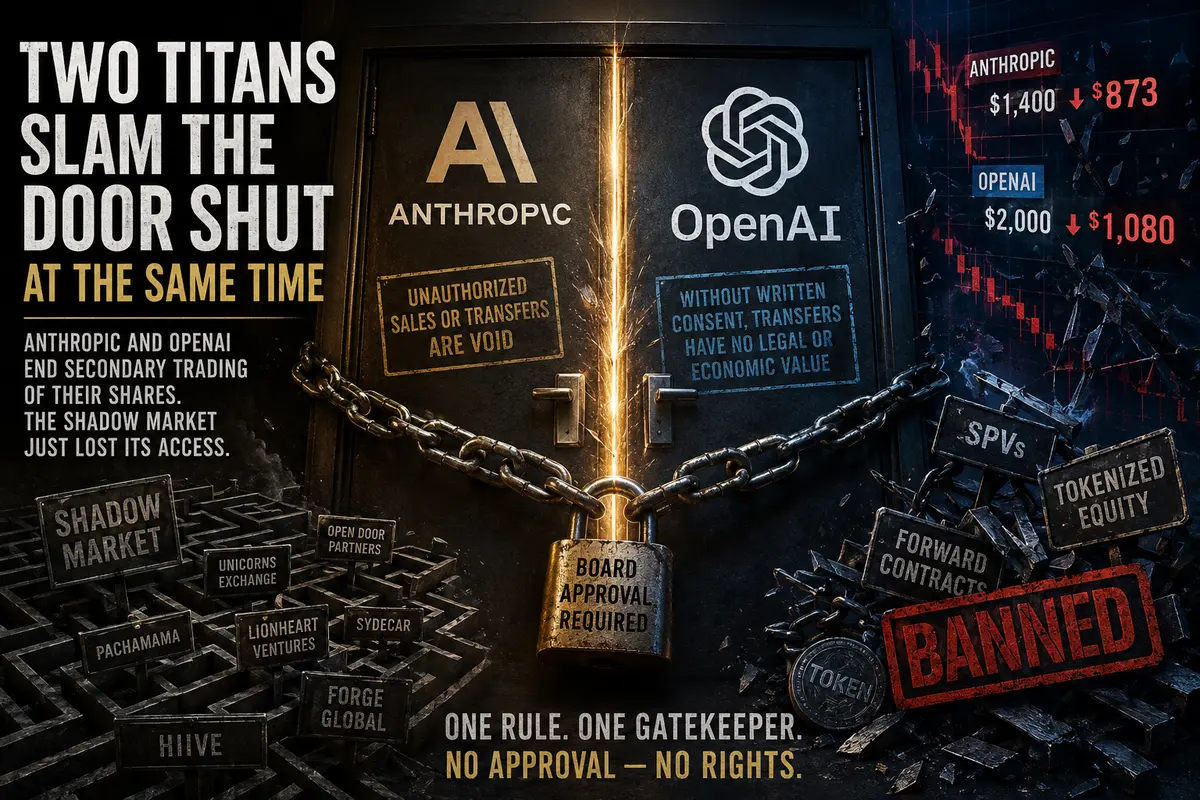
Two Titans Slam the Door Shut at the Same Time

Two Titans Slam the Door Shut at the Same Time

Anthropic and OpenAI have done what many had long expected but what participants in the shadow market refused to believe until the very last moment. Both companies updated their internal policies almost in sync, putting a firm stop to secondary trading of their shares. The wording published on their respective pages sounds nearly identical, as if the lawyers of two fierce rivals had been copying off each other. But that's not really the point. The point is that the two hottest AI startups on the planet have just cut off the oxygen supply to an entire industry that grew up around investors desperate to grab a piece of their businesses before either goes public.

At Anthropic, the language is brutally clear: any sale or transfer of securities without board approval is declared void. A buyer who risks entering such a transaction will not be recognized as a shareholder and will receive absolutely no rights whatsoever. OpenAI mirrors the exact same structure: without the company's written consent, any transfer of shares has neither legal nor economic value. In plain terms: if you bought without asking, you might as well have thrown your money to the wind.

An Entire List of Grey Schemes Now Banned

What's most interesting is that neither company limited itself to a generic prohibition. They named specific avenues that are now considered illegitimate. The list includes direct sales, special purpose vehicles, tokenized equity interests, and forward contracts. This is not a random collection of words. These are precisely the tools that the market has spent the last several years using to carve out detours toward shares in private AI giants.

The notorious SPVs — special purpose vehicles — deserve particular attention. The scheme is simple and elegant in its audacity. A shell company is created with the sole...

Continue reading...
0
0
Lin Brings

Earnings Season Is Winding Down — The Money Has Already Moved On

Earnings Season Is Winding Down — The Money Has Already Moved On

The first quarter has been reported, the numbers have landed on the table, and now the most interesting part of the market is beginning. Big investors aren't sitting idle, digesting what's already happened — they're reallocating capital. And not just into companies that delivered a solid report, but into those where explosive quarterly profit growth is layered on top of something far heavier and longer-lasting.

Strong three-month results still act as the main trigger for the most eye-catching price moves. But if you look closely at which stocks are truly taking off, a pattern emerges. More and more often, the most powerful rallies belong to companies sitting at the intersection of several massive waves: accelerating trends, strategic expansion, and large-scale investment in the future. Wall Street is only just beginning to fully price these stories into its models, and it's in that gap — between what insiders are starting to grasp and what the broader public has reacted to — that the real opportunity lies.

Hunting at the Intersection of Catalysts

Catching this kind of rotation before everyone starts talking about it is no simple task. Reading financial headlines isn't enough. By the time something hits the news, the market has usually already digested it and priced it in. The real hunt happens at the level of data, patterns, and complex signals that the naked eye can't easily spot.

This season, several recommendations landed squarely in that sweet spot — the coincidence of immediate strength and a long-term tailwind. We're not talking about isolated names plucked from the noise, but about companies united by a common thread: their quarterly success is just the tip of the iceberg, beneath which lies a business transformation capable of fueling growth for years.

The Texas Cloud Player: From Data to AI Platform

One such...

Continue reading...
0
0
Lin Brings

An Unexpected Surge on the Tokyo Stock Exchange

An Unexpected Surge on the Tokyo Stock Exchange

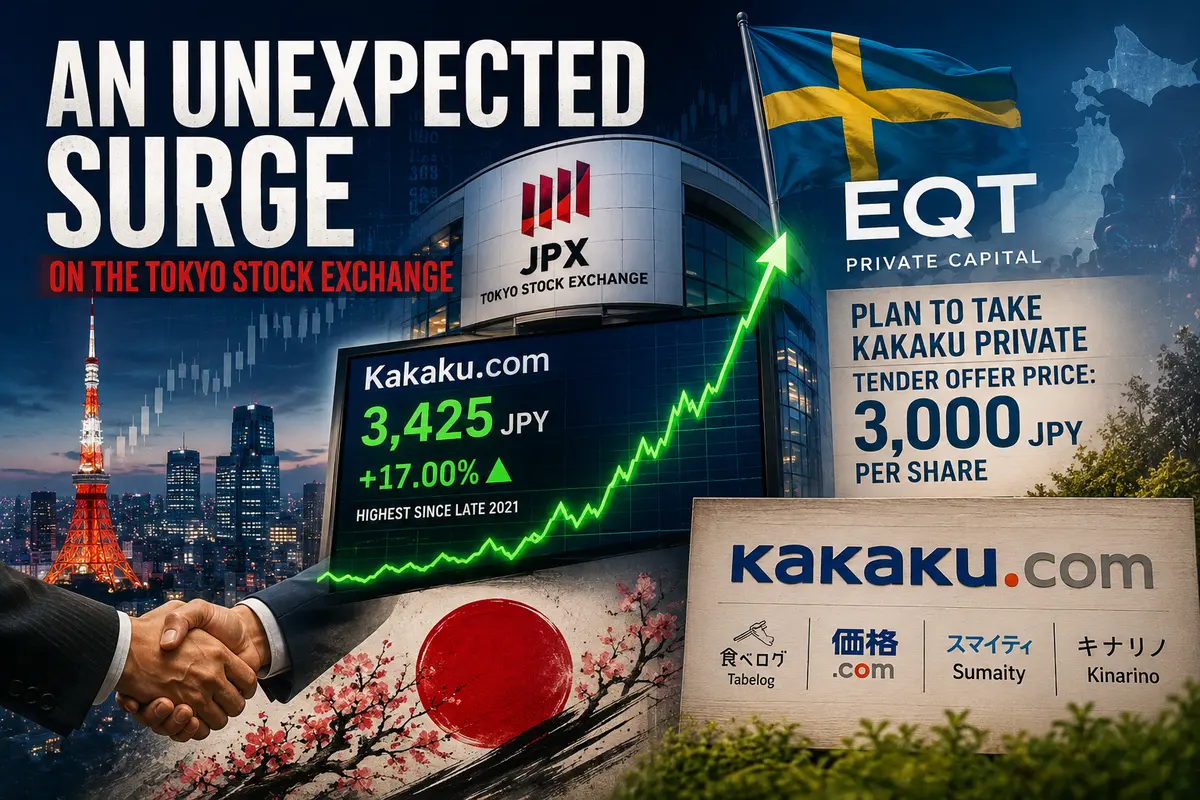
On Wednesday, shares of the Japanese company KakakuCom Inc made a real leap that caught many market watchers off guard. The stock soared by seventeen percent to hit 3,425 yen per share. Prices haven't climbed this high since late 2021 — nearly three and a half years ago. For the market, it was a glaring signal: something serious is happening, and investors are rushing to buy shares before the price runs even higher.

The reason behind such a fierce rally came all the way from Sweden. That's where the investment firm EQT is based — the company that became the headline act of the day by announcing its designs on a Japanese business. When a major player like that publicly states it's ready to buy out an entire company, the market reacts instantly. A seventeen percent single-day jump speaks for itself.

The Swedish Giant's Plan: Taking the Company Private

EQT laid out its intentions with crystal clarity: the investment group plans to launch a tender offer to fully acquire Kakaku from the public market and take it private. Simply put, the Swedes want the entire Japanese service for themselves, delisting it from the exchange.

The price tag is impressive — the whole business is valued at roughly 593.5 billion yen, which in dollar terms comes to about 3.76 billion. For each individual share, EQT is ready to pay exactly 3,000 yen. That's the very number that fueled the frenzy: at the time of the announcement, the stock was trading noticeably cheaper, so traders rushed to buy it hoping to pocket the difference as the price climbs toward the offer.

Taking a publicly listed company private is a classic investment fund maneuver. The point is to gain full control, stop worrying about quarterly filings with the exchange, and calmly — away...

Continue reading...
0
0
Navigation menu
instaforex banner