

Mark Fryer Moves Up: Dialight CFO Joins the Board of SDI Group
A Quiet Announcement That Speaks Volumes
In the world of finance and public companies, some headlines send stock terminals flashing and social media channels into overdrive. Others appear quietly in regulatory filings on a Friday evening or just before a long holiday weekend. Only those paying close attention understand that important developments often hide behind such silence.
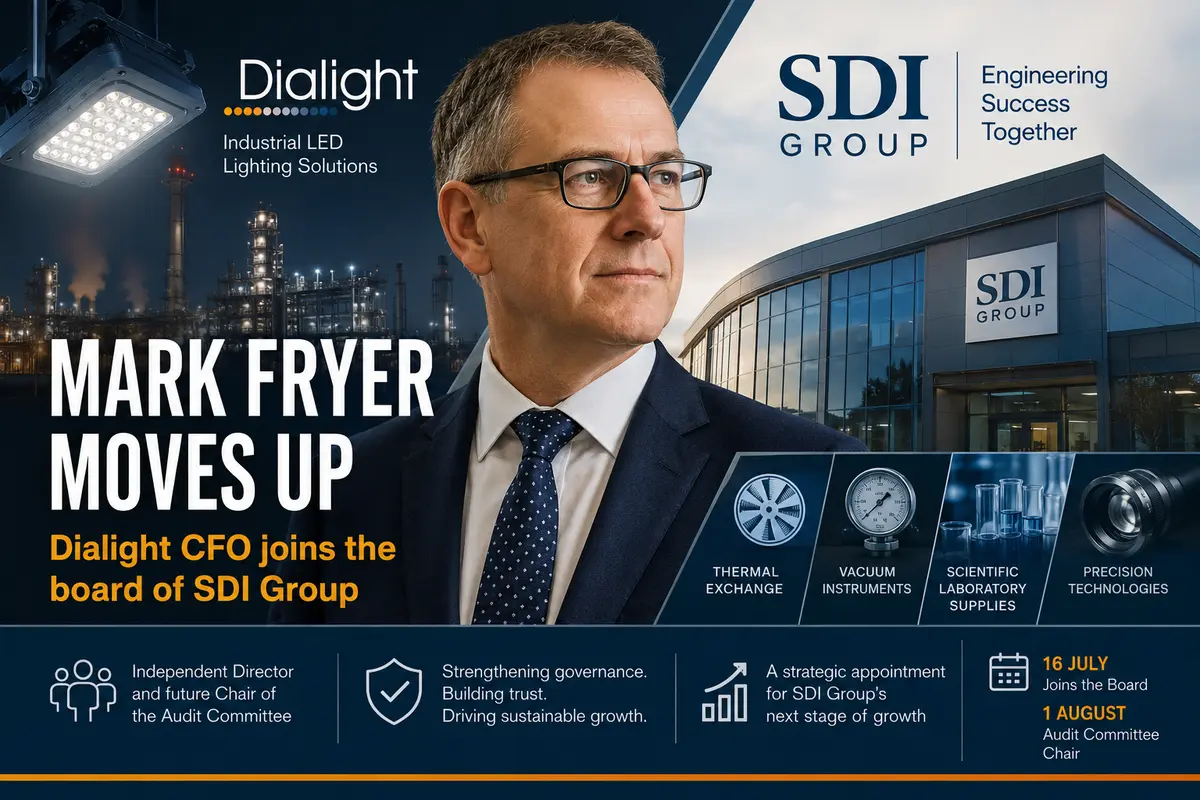
The news that Mark Fryer, Chief Financial Officer of Dialight, will join the board of SDI Group belongs firmly in the second category. On the surface, it looks like a routine corporate appointment: a finance executive from one company joins the board of another. Such moves happen every day. But a closer look reveals a broader story about the state of British industry, the mechanics of corporate governance, and the way experienced executives move between companies, creating invisible networks of expertise and influence.
Dialight manufactures LED lighting systems for factories, oil platforms, airports, and ports. SDI Group is a holding company that owns several technology businesses producing scientific and industrial equipment. At first glance, they appear unrelated. Yet both operate in complex industrial environments, depend on global supply chains, face fluctuating raw-material costs, and require constant attention to operational efficiency. Mark Fryer has spent years navigating precisely these challenges at Dialight.
To understand why this appointment matters, it is worth examining who Fryer is, what the move means for both companies, and why investors should pay attention.
Who Is Mark Fryer, and Why Does SDI Group Want Him?
Mark Fryer is not a public celebrity executive. You are unlikely to find viral LinkedIn posts or newspaper interviews featuring him. He belongs to the type of finance professionals who prefer to speak through numbers rather than headlines. Yet these are often the people who keep companies afloat during difficult periods.
Fryer joined Dialight several years ago when the company was facing significant challenges. Competition in the industrial LED lighting market had intensified dramatically. Chinese manufacturers were driving prices down, European competitors were moving into specialist niches, and American companies were benefiting from protective tariffs. Dialight, a British company with manufacturing operations in Australia, Dubai, Malaysia, Mexico, Singapore, and the United States, found itself caught in the middle.
During Fryer’s tenure, Dialight restructured debt, optimized inventory levels, and renegotiated supplier contracts. The journey was not without setbacks. The company experienced loss-making quarters, share-price declines, and investor dissatisfaction. However, Fryer succeeded in preserving liquidity and giving the business time to adapt.
That experience is exactly what attracted SDI Group.
SDI is a holding company that owns a range of independent businesses, including manufacturers of heat exchangers, vacuum systems, laboratory supplies, and other scientific equipment. Each subsidiary has its own operational realities and financial challenges. SDI needs directors who can evaluate the health of the group as a whole rather than focusing on individual companies in isolation.
As a non-executive director, Fryer will not be responsible for managing SDI’s finances directly—that remains the responsibility of the company’s own CFO. Instead, his role will be one of oversight. He will join the Audit Committee, reviewing financial reporting, monitoring compliance, and ensuring governance standards are maintained. From August, he will serve as Chairman of that committee.
This is a significant responsibility. Audit committees are responsible for ensuring that financial statements accurately reflect reality. They oversee asset valuations, profit reporting, risk management, and internal controls.
In an era shaped by corporate scandals such as the collapse of Wirecard, Carillion, and Patisserie Valerie, a strong audit committee is one of the most important safeguards against disaster. SDI Group appears to have strengthened that safeguard by appointing someone with experience inside a global industrial business.
Dialight: The Company Fryer Helped Steady
To put the appointment in context, it is useful to understand Dialight itself.
Founded in 1938 as Dialight Corporation, the company originally produced indicator lamps for military and civilian electronics. Over nearly nine decades, it reinvented itself several times before focusing on industrial LED lighting.
Today, Dialight is one of the global leaders in industrial LED lighting solutions. Its products are used in oil refineries, chemical plants, ports, airports, mines, and heavy industrial facilities. These are not household light bulbs. They are highly engineered systems designed to withstand vibration, moisture, corrosive environments, and explosive gases. Individual units can cost thousands of dollars and operate for years without maintenance.
Its manufacturing footprint spans multiple continents, allowing the company to serve customers locally while reducing exposure to tariffs and shipping delays. A refinery in North America can source products from facilities in Mexico or the United States rather than waiting for shipments from Britain. Customers in the Middle East can be supplied through operations closer to their markets.
However, globalization also creates vulnerabilities. Dialight remains exposed to currency fluctuations, raw-material costs, and supply-chain disruptions. The past several years have been particularly challenging, with the pandemic disrupting logistics, commodity prices rising sharply, inflation increasing costs, and geopolitical tensions affecting key markets.
Dialight shares trade on the London Stock Exchange under the ticker DIA.L. Over the past two years, the stock has been volatile, falling on concerns about logistics disruptions and rising on announcements of major contract wins. With a market capitalization of roughly £200 million, Dialight occupies the middle ground of British industry—not a giant, but certainly not insignificant.
When Fryer eventually leaves the CFO role, he will leave behind a company in stronger condition than the one he inherited. Debt has been refinanced, inventory management improved, and the customer base diversified. The transformation is not complete, but the business is more resilient than it was several years ago.
SDI Group: A Holding Company Building an Industrial Empire
SDI Group represents a very different business model.
While Dialight is a focused industrial manufacturer, SDI operates as a holding company that acquires and develops specialist technology businesses. The model, popular among British conglomerates in previous decades, has experienced something of a revival in recent years.
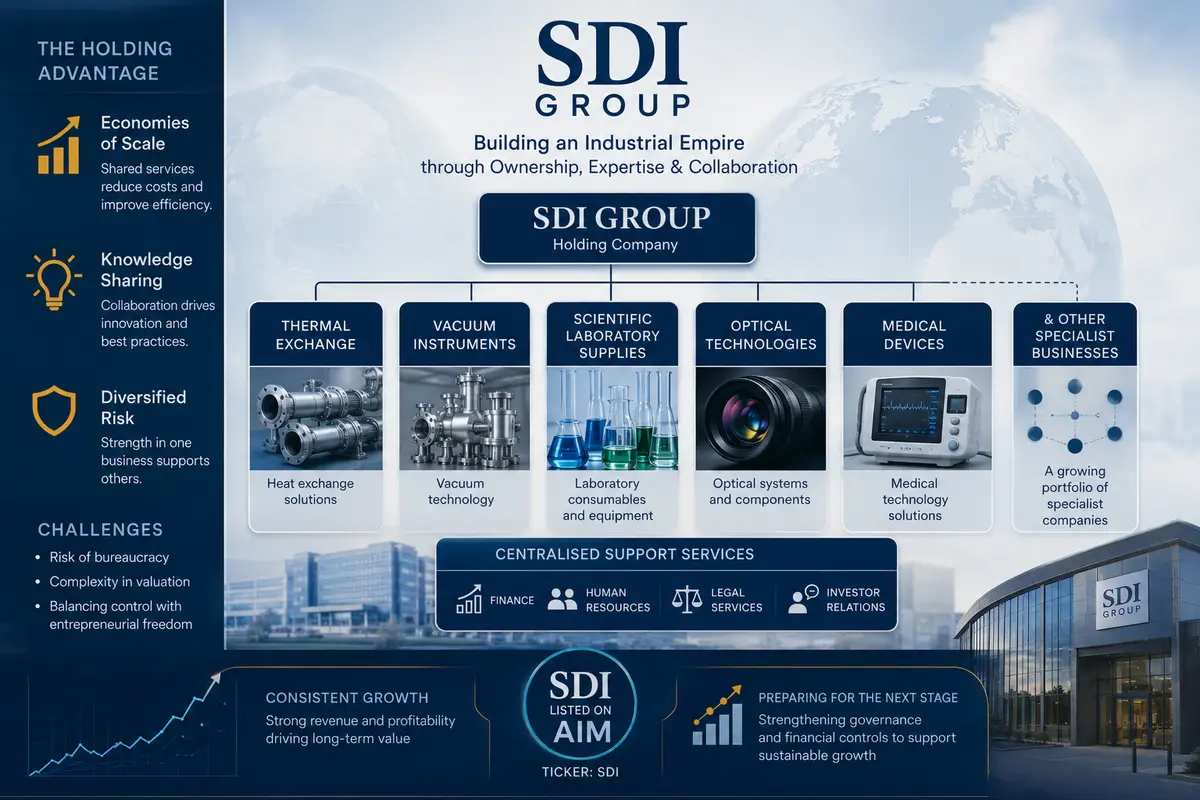
Its portfolio includes companies producing laboratory equipment, quality-control instruments, vacuum systems, optics, and medical devices. Each business maintains its own brand, management team, and product range. However, support functions such as finance, human resources, legal services, and investor relations are centralized where possible.
This structure offers several advantages.
First, it creates economies of scale. Subsidiaries do not need to duplicate every administrative function.
Second, it encourages knowledge sharing and collaboration between businesses.
Third, it diversifies risk. Weak performance in one subsidiary can be offset by stronger results elsewhere.
There are challenges as well. As a holding company grows, it can become more bureaucratic and less agile. Investors may struggle to value a collection of different businesses. Centralized oversight can sometimes limit entrepreneurial flexibility.
So far, SDI Group has managed these challenges successfully. The company has consistently reported growth in revenue and profitability. Its shares trade on AIM, London’s market for smaller growth companies, under the ticker SDI. While smaller than Dialight, SDI has generally grown more rapidly.
Against that backdrop, Fryer’s appointment looks strategic. He is joining not as an executive manager but as an independent director responsible for oversight and governance. This suggests SDI is preparing for a new phase of growth, where robust financial controls become increasingly important.
Why Investors Should Care
For Dialight shareholders, Fryer’s appointment is largely neutral in the short term.
External board positions are common among senior executives and can broaden their experience, strengthen networks, and bring fresh perspectives back to their primary employer.
However, if Fryer eventually decides to leave Dialight entirely—a common outcome when executives transition toward portfolio board careers—the company will lose an experienced finance leader. Finding a replacement of similar quality would not be easy in today’s market.
For SDI shareholders, the development appears positive.
The company is bringing in a director with experience from a publicly listed industrial business operating on a global scale. Dialight is not a start-up or a niche private company. It is a mature manufacturer that has navigated multiple economic and operational crises. Fryer brings lessons learned from those experiences.
His appointment as future Chair of the Audit Committee is particularly significant. It may indicate preparations for stricter governance standards, a larger acquisition strategy, or even a future move to a more demanding stock-market listing. At the very least, it signals a desire to strengthen investor confidence.
Companies often become more sophisticated as they grow. Stronger governance structures are part of that evolution. Fryer’s arrival suggests SDI Group is entering precisely that stage.
The Bigger Picture: Britain’s CFO Talent Market
This story is not only about Dialight and SDI Group. It also reflects broader trends in the market for senior finance executives in the United Kingdom.
Demand for experienced CFOs currently exceeds supply.
The role has evolved dramatically. Modern finance leaders must understand not only accounting and taxation but also ESG reporting, cybersecurity, supply-chain management, investor relations, and data analytics. They are expected to act as strategists rather than merely financial administrators.
Brexit has further complicated recruitment. British companies previously drew heavily from a European talent pool. Today, visas, work permits, and additional bureaucracy make cross-border hiring more difficult. Many experienced professionals choose to remain within the European Union.
At the same time, the pandemic changed attitudes toward work-life balance. Some senior executives opted for earlier retirement, advisory roles, or part-time board positions rather than continuing in demanding full-time corporate jobs.
In such an environment, attracting an active CFO from another listed company to join a board is considered a notable achievement.
What Do the Listing Rules Say?
Dialight’s announcement references UK Listing Rule 6.4.9(2), which requires listed companies to disclose external appointments accepted by directors.
This is more than a regulatory formality. It reflects a fundamental principle of transparency.
Investors have a right to know whether senior executives are taking on commitments elsewhere. External directorships are normal and often beneficial, but they should not interfere with primary responsibilities. If an executive sits on too many boards, concerns naturally arise about their ability to devote sufficient attention to each role.
In Fryer’s case, there appears to be no such concern. Serving as Dialight’s CFO while holding a non-executive role at SDI Group is generally viewed as manageable.
Nor does the appointment create an obvious conflict of interest. Dialight and SDI operate in different sectors. One manufactures industrial lighting systems, while the other owns scientific and industrial technology businesses. They are not direct competitors and do not pursue the same customer contracts.
Conclusion: Where SDI Group Is Headed—and Why Dialight Matters
Someone outside the world of corporate finance might reasonably ask what is so important about one finance executive joining another company’s board. No billions are changing hands. Markets are not crashing. Share prices are not doubling overnight.
Yet long-term trends are often built from exactly these kinds of quiet developments.
SDI Group is strengthening its governance framework. Dialight is demonstrating that its leadership talent is valued across the market. More broadly, the British industrial sector continues to evolve, with expertise flowing from established manufacturers into newer, more dynamic holding companies.
Mark Fryer is not a celebrity, billionaire, or politician. He is a seasoned finance professional. The fact that SDI Group selected him for its board suggests the company is serious about its next stage of development.
On 16 July, Fryer will formally join the SDI Group board. On 1 August, he is expected to take over as Chair of the Audit Committee. By then, additional details may emerge regarding his future at Dialight, SDI’s acquisition plans, or other board appointments.
For now, the market remains quiet. The London Stock Exchange has published the notice. Analysts have made notes in their models. Investors holding SDI Group shares have likely added a reminder to watch future results closely.
And Mark Fryer is probably preparing for his next challenge—helping oversee the finances of a growing industrial group where multiple businesses compete for resources and attention. Managing that balance is an art, and one he appears to have mastered at Dialight before bringing those skills to SDI Group.

Comments
No comments yet. Be the first to share your thoughts!
Comments only for logged-in users.