

Oil Plunges 2%: An Illusion of Peace or a Real Calm?
Thursday: The Silence That Hurts Your Wallet
You wake up on Thursday, open your trading terminal, and can hardly believe your eyes. WTI crude oil, which was trading near $94 just yesterday, is now changing hands at $91.88. A drop of 2.05% in just a few hours. The $88 support level that held earlier this week failed to provide a floor. Oil broke lower and continues to slide.
What happened? Did the war in the Middle East suddenly end? No. Iran and Israel exchanged strikes. The United States launched new attacks on Iranian targets. Iran threatened to block the Strait of Hormuz. All of this happened within the last 24 hours. Oil should have been rising, yet it is falling.
A paradox? Only at first glance.
The oil market today is not a mirror of geopolitics. It is a mirror of expectations. And expectations change faster than missile trajectories.
Let’s take a closer look.
On Thursday morning, WTI found support at $85.95, the low of today’s session. Resistance stands at $95.47. That’s an unusually wide range of nearly $10, signaling extreme volatility.
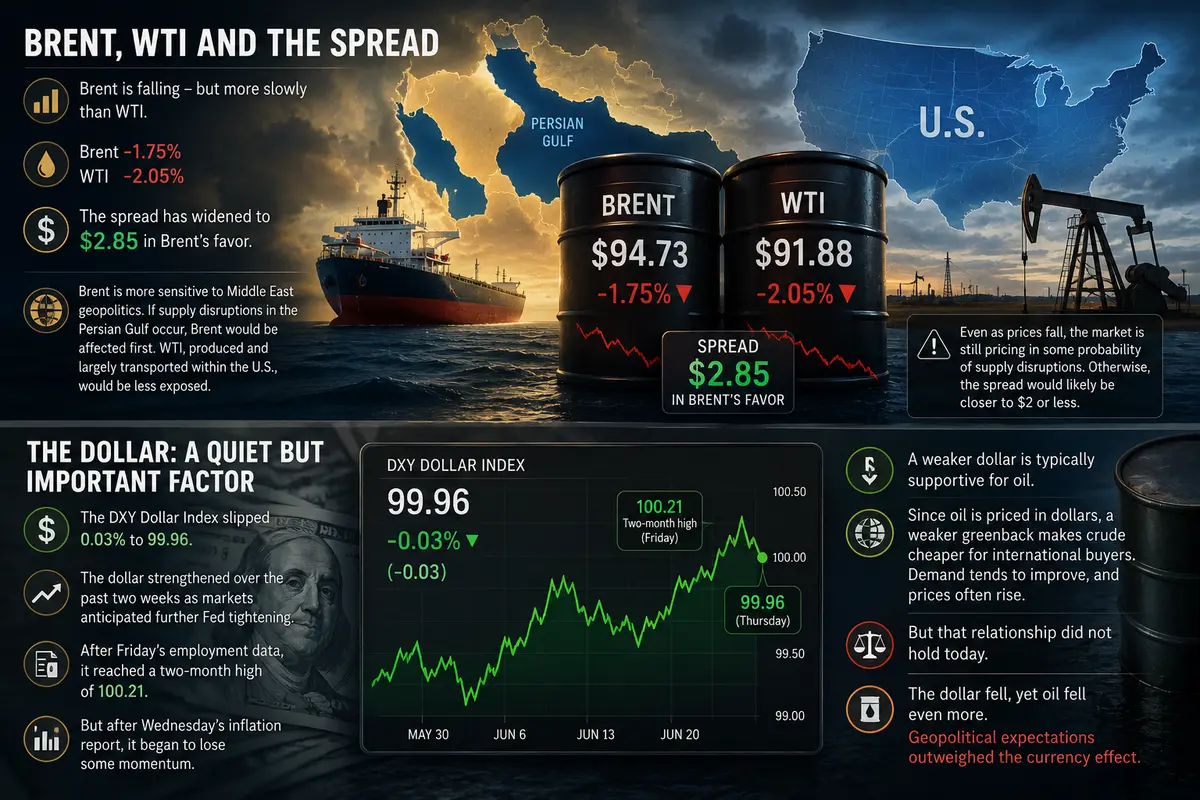
Brent crude is also declining, though slightly less sharply—down 1.75% to $94.73 per barrel. The spread between the two benchmarks is $2.85 in favor of Brent. That’s a fairly normal level for a market that is not expecting immediate disruptions to Persian Gulf supply.
The U.S. dollar, which typically strengthens during periods of panic, weakened slightly today. The DXY Dollar Index slipped 0.03% to 99.96. A symbolic move, perhaps, but an important one: the dollar is no longer acting as an unquestioned safe haven. Or rather, investors are no longer convinced that the conflict will escalate into a catastrophe.
But let’s dig deeper.
Why Is Oil Falling?
There are three main reasons, and all of them point to one thing: the market may have overestimated the risks.
Reason #1: The Ceasefire Is Holding—for Now
On Monday and Tuesday, we discussed the ceasefire between Israel and Iran. Donald Trump declared a “complete victory.” Fragile and temporary as it may be, peace is still peace.
Yes, the United States carried out new strikes on Wednesday. Yes, Iran threatened to close the Strait of Hormuz. But dramatic as these developments are, they do not change the fact that all parties—at least officially—have an interest in de-escalation.
No one wants a full-scale war.
Not Trump, who is preparing for elections.
Not the Iranian leadership, which fears domestic unrest.
Not Israel, which has already achieved many of its objectives.
As a result, the threat of closing the Strait of Hormuz remains just that—a threat, not a reality. Tankers are still moving. Insurance premiums have risen, but not dramatically. Saudi Arabia and the UAE, both of which would suffer from a blockade, are reportedly applying pressure on Iran through back-channel diplomacy.
The market that priced in the worst-case scenario on Monday—war, blockade, and $150 oil—is now adjusting toward a more moderate outlook.
Hence the decline.
Reason #2: U.S. Inflation Data Cooled Hawkish Expectations
On Wednesday, the United States released May consumer inflation data.
Headline inflation accelerated to 4.2%—not good news.
However, core inflation (excluding food and energy) slowed to 0.2% month-over-month, down from 0.4% in April.
That’s an important signal.
Inflationary pressure caused by rising energy prices may be temporary. Once oil prices stabilize—and they are already falling—headline inflation could follow core inflation lower.
Analysts at ING noted after the release:
“Inflation should ease in June due to falling gasoline prices, though it remains vulnerable to continued energy price volatility.”
The key phrase is “should ease.”
If inflation begins to decline in June, the Federal Reserve may not need to raise interest rates in December. In fact, discussions about future rate cuts could return to the agenda.
For oil, that’s generally a positive development.
Why?
Because higher interest rates typically support a stronger dollar. A stronger dollar makes oil more expensive for buyers outside the United States, reducing demand and putting downward pressure on prices.
If markets stop pricing in further rate hikes, the dollar may weaken and provide support for crude prices.
However, that’s a medium-term story measured in weeks or months.
For now, the market’s primary focus remains geopolitics rather than monetary policy.
Reason #3: A Technical Correction After a Sharp Rally
Pure market mechanics should not be overlooked.
Oil has risen more than 10% over the past week—from around $85 to nearly $95 per barrel.
That is a very rapid move.
Any rally of that magnitude invites profit-taking.
Traders who bought oil at $85–87 now see that geopolitical risks have not fully materialized and are closing positions. Those sales push prices lower.
From a technical perspective, WTI encountered resistance at $95.47 and reversed lower.
The next major support level is $85.95.
If oil breaks below that level, the path toward $82–83 opens up.
If support holds, another upward move remains possible.
For now, the market is operating under the classic principle:
“Buy the rumor, sell the fact.”
Rumors of war pushed prices higher.
The fact that a full-scale war has not materialized is pushing them lower.
What’s Happening With Brent and the Benchmark Spread?
Brent, the benchmark crude for Europe and Asia, is also falling—but more slowly than WTI.
Down 1.75% versus WTI’s 2.05%.
The spread has widened to $2.85 in Brent’s favor.
Why is Brent holding up better?
Because it is more sensitive to Middle Eastern geopolitics.
If supply disruptions in the Persian Gulf do occur, Brent would be affected first. WTI, produced and largely transported within the United States, would be less exposed.
Even as prices fall, the market is still pricing in some probability of supply disruptions.
Otherwise, the spread would likely be closer to $2 or less.
The Dollar: A Quiet but Important Factor
The DXY Dollar Index slipped 0.03% to 99.96.
A nearly invisible move.
Yet there is a larger story behind it.
The dollar strengthened over the past two weeks as markets anticipated further Fed tightening.
Following Friday’s employment data, it reached a two-month high of 100.21.
But after Wednesday’s inflation report, it began to lose some momentum.
A weaker dollar is typically supportive for oil.
Since oil is priced in dollars, a weaker greenback makes crude cheaper in local currencies for international buyers. Demand tends to improve, and prices often rise.
But that relationship did not hold today.
The dollar fell, yet oil fell even more.
Geopolitical expectations outweighed the currency effect.
Outlook for the Coming Days: Consolidation or Another Leg Lower?
The next few days will be driven by three variables:
-
The Middle East ceasefire.
-
U.S. inflation and the Federal Reserve’s response.
-
Technical price levels.
Scenario 1: Stabilization and Consolidation
The ceasefire holds.
No new major strikes from either side.
The Strait of Hormuz remains open.
U.S. inflation begins to ease.
The Fed signals a pause—or eventually future rate cuts.
The dollar weakens.
WTI consolidates between $85 and $92, with the potential for gradual upside into late summer.
Scenario 2: Renewed Escalation
The conflict intensifies.
New strikes occur.
The Strait of Hormuz faces partial disruption.
Oil surges toward $100 and beyond.
However, such a rally would likely be short-lived because excessively high oil prices would hurt demand and increase recession risks.
The rally could ultimately be followed by a sharp correction.
Scenario 3: Inflation Stays High
U.S. inflation remains stubbornly elevated.
The Fed raises rates in December.
The dollar strengthens.
Pressure on oil intensifies.
WTI falls toward $80–82 despite ongoing geopolitical tensions.
My Assessment
Looking at all the factors, I lean toward the first scenario.
Too many parties have an interest in de-escalation.
The risks of a full-scale war are too obvious.
The economic incentives for stability are too strong.
But never say never.
The Middle East is a region where a single spark can become a wildfire.
Today’s spark—a downed helicopter, retaliatory strikes, threats to close shipping routes—could still prove significant.
For now, however, the market sees something different.
A 2% decline.
Cheaper oil.
A stagnant dollar.
Traders locking in profits.
Silence.
Whether it is the calm before the storm or the calm after it, nobody truly knows.
Everyone is waiting.
Bottom Line
WTI crude fell 2.05% during Thursday’s Asian trading session. The decline was driven by easing geopolitical concerns, softer-than-expected U.S. core inflation data, and a technical correction following a sharp rally.
Brent also declined, though less aggressively. The Brent-WTI spread widened to $2.85, suggesting that markets still assign some probability to supply disruptions in the Persian Gulf.
The dollar weakened slightly, but that was not enough to support oil prices. Expectations regarding future Federal Reserve policy remain a key medium-term driver.
Key levels for WTI:
-
Support: $85.95
-
Resistance: $95.47
A break below support could open the way toward $82–83.
Holding above the $85–86 zone would allow consolidation and potentially set the stage for another rally.
Investors are watching developments in the Middle East, U.S. producer price data due later today, and weekly jobless claims.
For now, oil is getting cheaper.
And oddly enough, that’s good news.
Because it may mean the world is not standing on the edge of catastrophe.
It may simply be catching its breath.

Comments
No comments yet. Be the first to share your thoughts!
Authentication Required
You must be logged in to post a comment.