

Taipei Monday: Down Ten Percent in a Single Session
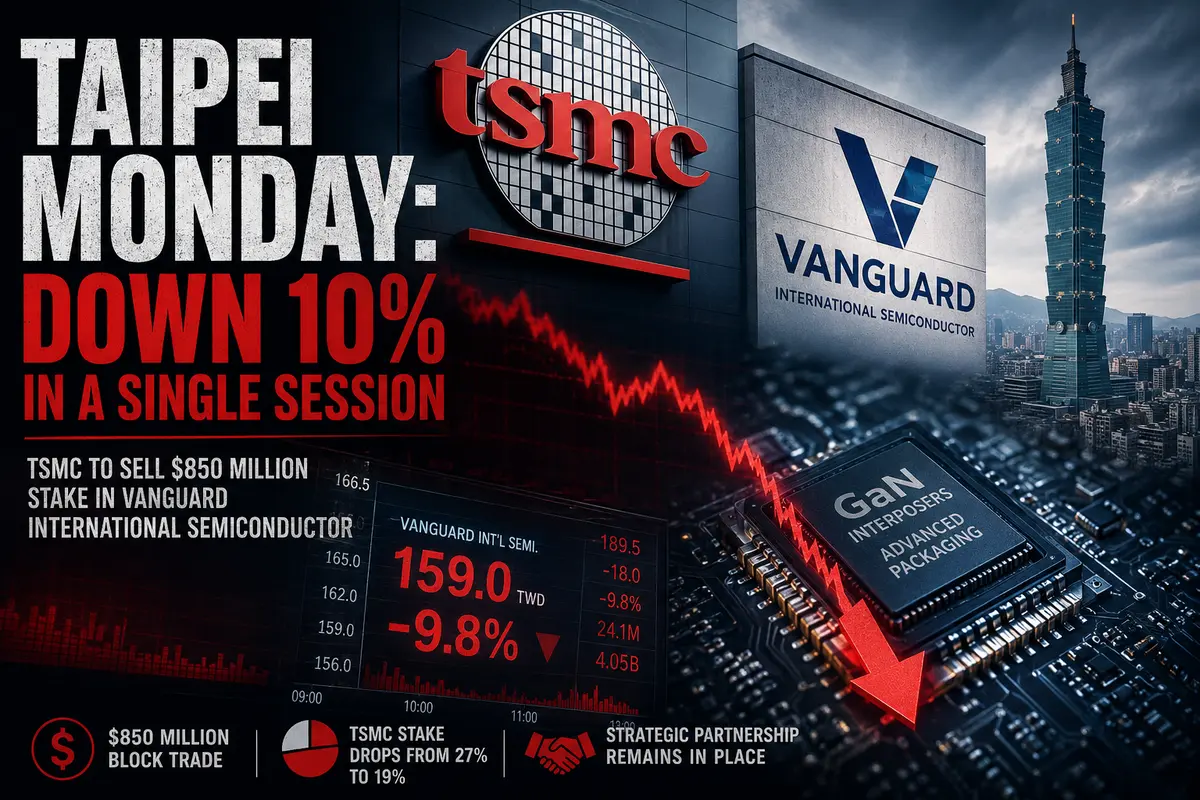
Monday morning on the Taipei exchange began with a steep dive for Vanguard International Semiconductor. The company’s shares plunged nearly ten percent, falling to 159 New Taiwan dollars apiece. For a stock that had seemed relatively stable as recently as Friday evening, the move came as a real shock. A ten-percent drop in a single trading session is not a routine correction, not a technical pullback, and not a reaction to general market noise. It is a verdict delivered by investors after learning about the decision of the company’s largest shareholder.
And that shareholder is none other than TSMC, the world’s largest contract chipmaker — a company whose very name makes competitors from Silicon Valley to Shenzhen nervous. On Friday, the giant announced plans to sell up to 152 million Vanguard shares to institutional investors through a block trade. Not gradually, not through the open market, and not with careful regard for short-term market conditions — but all at once, in a large, deliberate transaction executed with corporate precision.
The Math of the Deal: From 27% to 19%
The numbers behind the transaction are substantial. Once completed, TSMC’s stake in Vanguard will shrink from just over 27 percent to exactly 19 percent. The stake changing hands is valued at roughly NT$26.8 billion — about US$850 million at current exchange rates. Nearly a billion dollars’ worth of Vanguard shares will move to new institutional owners, while TSMC will either lock in a sizable profit or free up capital for other purposes.
Why did the market react with a selloff rather than indifference? The answer lies in investor psychology. When the company’s largest and best-informed shareholder decides to reduce its stake by nearly a third, investors inevitably interpret it as a signal. A signal that the company which knows Vanguard better than any outside analyst may see limited upside ahead or may prefer to redirect resources toward more promising opportunities. Even though TSMC publicly stated that it has no plans for further sales and that the strategic partnership remains intact, markets tend to judge actions more than words.
The Strategic Partnership They Promise to Preserve
TSMC moved quickly to reassure investors. The company said it does not intend to sell any additional Vanguard shares. In other words, the remaining 19 percent stake is supposedly not an intermediate stop on the road to a full exit, but the final destination. Moreover, TSMC emphasized that the transaction will not affect the strategic partnership between the two companies in any way.
What exactly does this partnership involve? It includes licensing gallium nitride technologies — a material increasingly used in power electronics, fast chargers, electric vehicles, and 5G telecommunications infrastructure. The companies also cooperate in outsourced interposer manufacturing — specialized components used to connect multiple chips within a single package. These are advanced packaging technologies that are becoming critically important as the semiconductor industry approaches the physical limits of transistor miniaturization.
If these cooperative areas truly remain intact, then the reduction in ownership is merely a financial operation with no strategic threat to Vanguard’s business. The problem is that markets rarely believe reassurances completely. Too often, phrases like “we remain strategic partners” have later been followed by additional share sales, full exits, and the winding down of joint projects.
Why TSMC Wanted to Sell in the First Place
The obvious question is: why now?
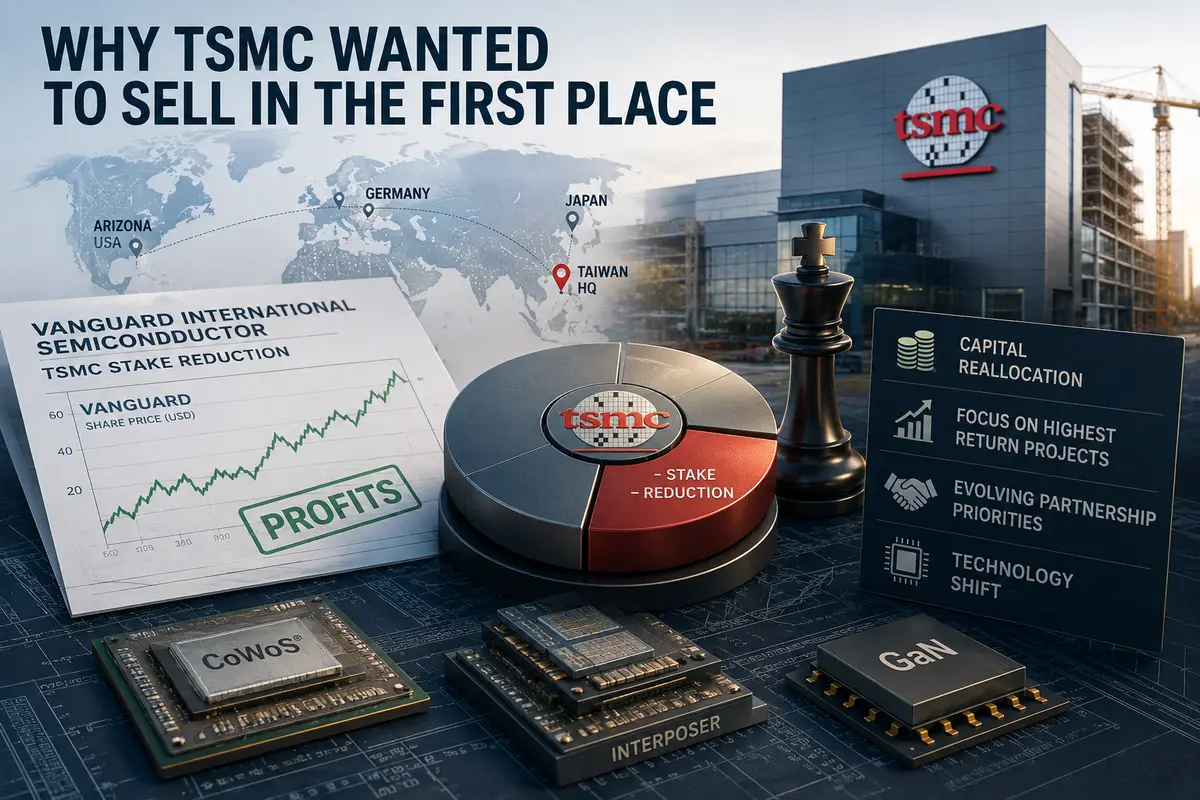
TSMC is not short of cash. On the contrary, it is spending tens of billions of dollars to expand manufacturing capacity around the world — from Arizona to Japan, from Germany to Taiwan itself. That may, in fact, explain the move.
Building new fabs requires enormous capital expenditures. TSMC may simply be reallocating resources toward projects expected to generate the highest returns. Nearly a billion dollars from the Vanguard sale will not radically transform the company’s investment program, but it is still a meaningful contribution. There is also the possibility that TSMC is simply taking profits: if Vanguard shares appreciated significantly during the holding period, selling part of the stake becomes a logical move.
There may be another reason as well. The technological landscape is changing, and TSMC could be reassessing its partnership priorities. If Vanguard was once a critically important link in the chain, the rise of TSMC’s own packaging technologies and the emergence of new players in the interposer and gallium nitride markets may have reduced that dependence. In that case, the stake reduction is not a distress signal, but a cold reassessment of strategic importance.
Institutional Investors Step Onto the Stage
An $850 million block trade is not something retail investors can absorb. TSMC made it clear that the shares are being sold to institutional players. These could include pension funds, sovereign wealth funds, large asset managers, or other technology corporations.
There is little doubt that buyers will be found. Vanguard International Semiconductor is a profitable business generating billions in revenue and maintaining strong positions in mature-node technologies that remain essential for automotive applications, the Internet of Things, and consumer electronics. For institutional investors seeking exposure to the semiconductor sector without buying TSMC at elevated valuations, Vanguard may look like an attractive alternative — especially after a ten-percent decline.
The key question is the pricing of the block trade. If the discount to market prices is substantial, it could create additional short-term pressure on the stock. Institutional buyers receiving shares at a meaningful discount are unlikely to rush into selling them, but the very fact that such a large transaction is being executed below market levels leaves minority shareholders uneasy.
Gallium Nitride and Interposers: The Technologies That Still Bind Them
Despite the reduced stake, TSMC and Vanguard remain connected through technology.
Gallium nitride is widely viewed as a future-defining material for power electronics. It enables more efficient and compact voltage converters essential for electric vehicles, data centers, and renewable energy systems. Vanguard possesses expertise in this field, and TSMC licenses these technologies — likely for use in its own offerings or to broaden the range of solutions available to customers.
Interposers represent another critical technology. As multiple chips are increasingly assembled within a single package — a trend accelerating as Moore’s Law slows — a specialized layer is required to electrically connect them. That layer is called an interposer. Vanguard manufactures them, while TSMC uses them in advanced packaging solutions. It is a symbiotic relationship that benefits both sides, and neither has much incentive to disrupt it unnecessarily.
What This Means for the Market
Vanguard’s ten-percent drop is a classic example of how markets react not to the news itself, but to its interpretation.
Formally speaking, nothing catastrophic has happened. TSMC is selling part of its stake but remains a major shareholder with a 19 percent holding. The strategic partnership remains in place. Gallium nitride technologies and interposer cooperation are still intact.
But markets pick up on subtler signals. When the largest shareholder cuts its position, it is always perceived as a red flag — even if nothing negative follows. It is like watching your smartest business partner suddenly sell a third of their stake in your shared company: you would probably become nervous too, even if they insisted everything was fine.
For Taiwan’s semiconductor sector, the event is yet another reminder that the industry is in a constant state of restructuring. TSMC is reallocating resources and focusing on the absolute cutting edge of technology. Vanguard may still be a solid business within its niche, but that niche no longer appears as strategically important to the industry’s dominant player as it once did. And investors, hardened by years of abrupt reversals in the technology sector, prefer to sell first and ask questions later.
That is exactly what they did on a Monday morning in Taipei.

Comments
No comments yet. Be the first to share your thoughts!
Authentication Required
You must be logged in to post a comment.