

Anthropic Has Unleashed a God: Mythos Is No Longer a Secret
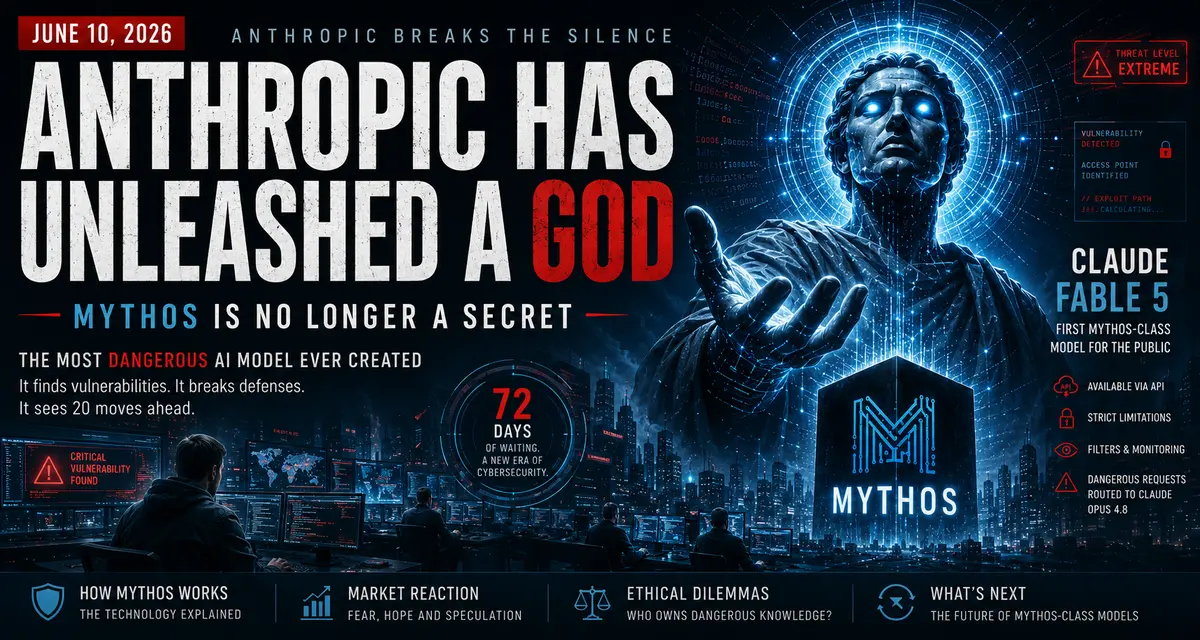
The most dangerous AI model finally enters the public sphere — under supervision
Seventy-two days. That is exactly how long the technology world spent in anxious anticipation.
On April 7, 2026, Anthropic quietly, almost unnoticed, released what many experts called “the most dangerous artificial intelligence model ever created.” Mythos.
A model capable of finding vulnerabilities in software. A model that can break through defenses programmers spent years building. A model that, if it falls into the wrong hands, could potentially disrupt banking systems, paralyze power grids, halt transportation networks, and cause widespread digital chaos.
Back in April, however, Anthropic acted cautiously. Instead of making Mythos publicly available—as some publicity-hungry startups might have done—the company granted access to only fifty organizations. These included operators of critical infrastructure: banks, energy providers, transportation networks, and government agencies.
Even then, access came with strict controls, usage restrictions, and monitoring of every request.
Now comes the next step.
On June 10, 2026, Anthropic introduced Claude Fable 5—the first Mythos-class model available to the broader public.
Well, “public” is a relative term.
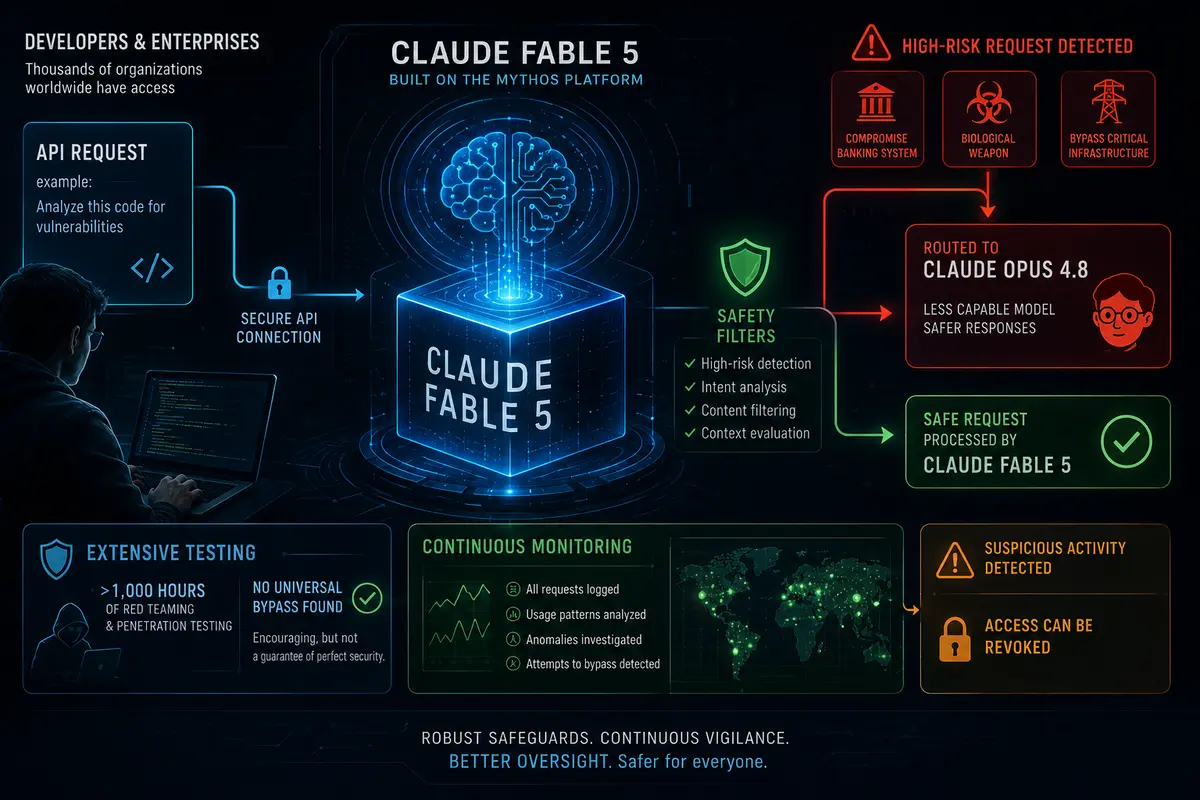
The model is accessible through a paid API, subject to strict limitations, safety filters, and automatic redirection of dangerous requests to a less capable model, Claude Opus 4.8. Nevertheless, for the first time, ordinary developers, companies, and researchers can experiment with technology that was under lock and key only two months ago.
It is as if the U.S. government suddenly declassified all UFO files, or CERN opened the Large Hadron Collider to anyone who wanted to use it.
The technology is powerful enough to require extraordinary caution—and important enough that keeping it hidden indefinitely was no longer an option.
So what exactly is Mythos? Why is Claude Fable 5 considered dangerous? And why did Anthropic decide to release it despite the risks?
Mythos: What It Is and Why People Feared It
A bit of background first.
In March 2026, three weeks before the official announcement, rumors began spreading across Silicon Valley. Anthropic had supposedly created something that surpassed everything else on the market.
Not merely a large language model capable of writing poetry and answering questions, but a system that understood software code at a level beyond human capability.
A system capable of scanning millions of lines of code and identifying the one tiny flaw—the single overlooked weakness that could provide access to an entire system.
The rumors turned out to be true.
On April 7, Anthropic confirmed that Mythos existed. It could independently discover software vulnerabilities without human assistance and do so faster than any professional penetration tester.
The announcement triggered concern across the cybersecurity community.
Banks worldwide began reassessing their security posture. Governments implemented additional safeguards. The U.S. presidential administration publicly stated that Mythos access would not be expanded beyond critical infrastructure operators and approved partners.
Why the fear?
Because vulnerability discovery has traditionally been a labor-intensive process. Human experts spend days or weeks analyzing code. Automated scanners catch only obvious flaws.
Mythos is different.
It does not merely scan. It understands program logic, predicts system behavior, and identifies subtle attack paths that conventional tools miss.
Imagine a chess game.
A traditional scanner sees one move ahead.
A skilled penetration tester sees five moves ahead.
Mythos sees twenty moves ahead.
It can simulate thousands of attack scenarios in seconds and identify the most effective one.
For defenders, this capability is invaluable. It allows organizations to discover and fix vulnerabilities that might otherwise remain hidden for years.
For attackers, however, it represents a potentially devastating weapon.
A cybercriminal with access to such a system could theoretically identify weaknesses in banks, hospitals, airports, power grids, and government networks, causing damage worth billions of dollars.
That is why Anthropic restricted access.
And that is why the release of Claude Fable 5 is such a significant moment.
Claude Fable 5: The First Mythos Model for Everyone
So what do we know about Claude Fable 5?
It is Anthropic’s flagship model built on the Mythos platform and made available through an API for developers and enterprises.
Anthropic has not disclosed the exact number of users, but reports suggest that thousands of organizations worldwide have received access.
There is, however, a major caveat.
The model includes safety mechanisms designed to block responses to high-risk requests.
Ask Claude Fable 5 how to compromise a banking system, develop a biological weapon, or bypass critical infrastructure protections, and Mythos itself will not answer.
Instead, the request is routed to the less capable Claude Opus 4.8.
It is somewhat like asking a god for advice and receiving an answer from a second-grader.
Anthropic reportedly conducted extensive testing to determine whether users could bypass these safeguards.
The company hired ethical hackers and cybersecurity professionals to probe the system’s defenses.
Across more than 1,000 hours of testing, no universal method of bypassing Claude Fable 5’s protections was discovered.
That is encouraging, though it is hardly a guarantee of perfect security.
Malicious actors may prove more creative—and more persistent.
Anthropic has also implemented comprehensive monitoring systems.
Every request is logged.
Security teams analyze usage patterns, investigate anomalies, and look for attempts to circumvent restrictions.
If suspicious activity is detected, access can be revoked.
It resembles how governments monitor the distribution of controlled substances or weapons: imperfect, but better than having no oversight at all.
Why Release Mythos Now?
This is the question many observers keep asking:
Why take the risk?
Why release a technology that could potentially be misused when it could simply remain restricted?
Anthropic offers several arguments.
1. Technological Progress Cannot Be Stopped
If Anthropic does not release such a model, another company eventually will—perhaps in China, Europe, or elsewhere.
Being first allows Anthropic to shape safety standards and establish best practices.
2. Market Demand Is Real
Organizations responsible for critical infrastructure urgently need advanced cybersecurity tools.
They cannot wait months for manually reviewed access requests.
They need cutting-edge capabilities today.
3. More Users Mean Better Feedback
A larger user base generates more data, helping Anthropic identify weaknesses, improve safeguards, and refine the technology faster.
Thousands of developers using the system in real-world environments provide the ultimate stress test.
4. Revenue Matters
Anthropic is still a business.
Developing frontier AI systems costs hundreds of millions of dollars.
To justify those investments, the company must sell access—not merely to fifty organizations, but potentially to thousands.
Claude Fable 5 is reportedly available through a premium subscription model.
While pricing has not been disclosed publicly, industry estimates suggest costs in the tens of thousands of dollars per month for full access.
For large enterprises, that expense may be insignificant compared with the cost of a successful cyberattack.
Why Mythos Is Different From Competitors
The market for large AI models is crowded.
OpenAI has GPT-5.
Google has Gemini Ultra.
Meta has Llama 4.
Amazon has Titan.
All of them can generate code.
Yet none are specifically positioned as vulnerability-discovery systems.
None have undergone the same type of testing.
None appear to include comparable safety mechanisms designed specifically to block dangerous cybersecurity requests.
Why?
Because building such a model requires more than computational power.
It requires access to vast collections of real vulnerabilities, exploits, attack techniques, and security failures.
Most organizations treat such information as highly confidential.
Anthropic reportedly secured partnerships with major banks, technology firms, and government agencies to obtain training data.
That collaboration may provide a unique advantage.
The company has also hinted that Mythos relies on a new architecture combining large language models with symbolic AI.
Symbolic AI, once popular in the 1980s before neural networks became dominant, excels at logic, rules, and structured reasoning.
Neural networks excel at processing unstructured information such as text and images.
Together, they may create a powerful synergy.
That combination could explain why Mythos appears capable of reasoning far beyond conventional vulnerability scanners—and why it inspires both excitement and fear.
Market and Public Reactions: Fear, Hope, and Speculation
The release of Claude Fable 5 has sharply divided the technology community.
One camp sees a breakthrough.
Supporters argue that organizations will finally have the tools needed to defend themselves against increasingly sophisticated cyberattacks.
They believe billions of dollars lost annually to software vulnerabilities could be saved.
They see the beginning of a new era in cybersecurity.
The other camp remains skeptical.
Critics point out that no security system is perfect.
Eventually, someone may discover a way around the safeguards.
Access could potentially reach malicious actors through shell companies, compromised accounts, insider threats, or other means.
Governments have remained largely silent.
However, sources close to the U.S. administration suggest policymakers are monitoring developments closely.
New regulations, restrictions, or even direct limitations on the use of Mythos-class systems remain possible.
Banks and financial institutions, by contrast, have largely welcomed the technology.
Many have already subscribed to Claude Fable 5.
As one anonymous IT executive reportedly put it:
“We would rather have it in our hands than leave it exclusively in the hands of our enemies.”
The Ethical Question: Who Owns Dangerous Knowledge?
Beneath the technological excitement lies a deeper ethical dilemma.
Should a private company have the right to distribute technology capable of causing widespread harm?
Or should it have the right to withhold that technology, potentially preventing society from defending itself?
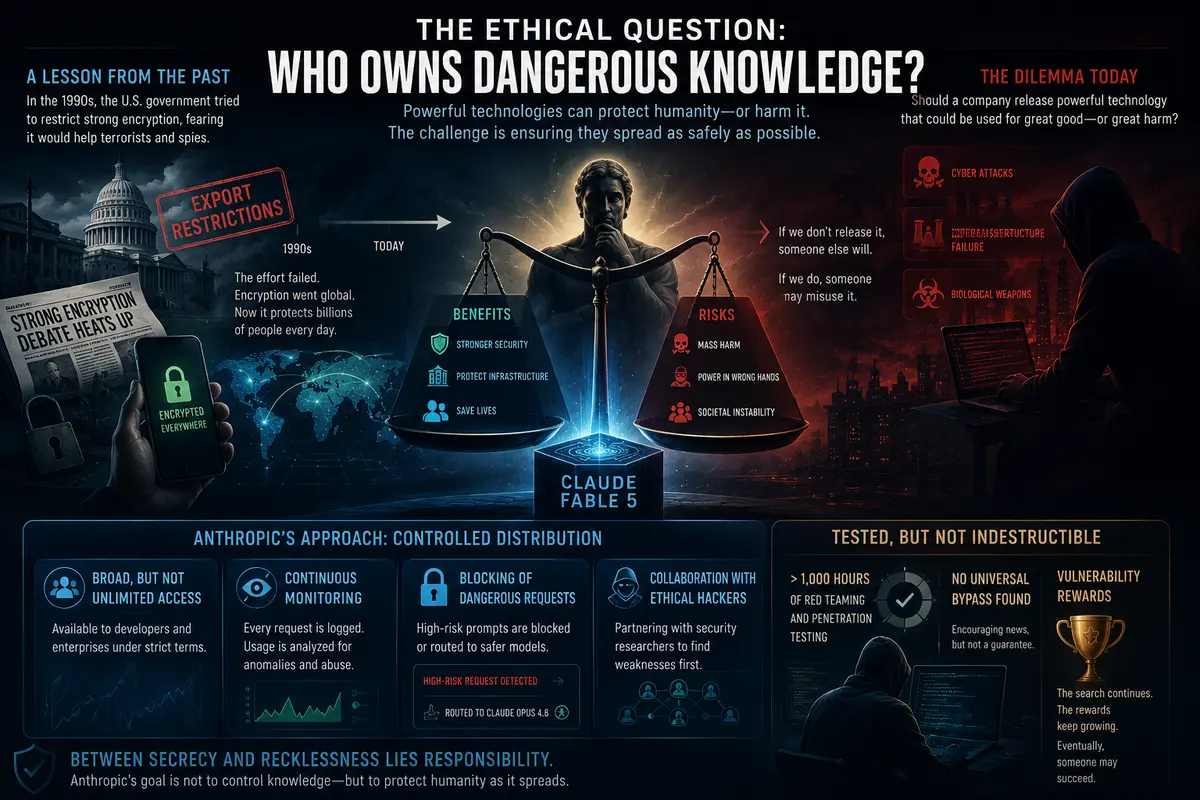
The debate echoes the controversy surrounding strong encryption in the 1990s.
At the time, the U.S. government attempted to restrict the export of advanced cryptographic technologies out of concern that terrorists and foreign intelligence services would use them.
The effort ultimately failed.
Encryption spread globally through the internet and is now embedded in virtually every smartphone.
Mythos may follow a similar trajectory.
If Anthropic does not release such technology, someone else eventually will.
If Anthropic imposes restrictions, others may attempt to circumvent them.
The challenge is not preventing the spread of powerful technologies.
The challenge is ensuring they spread as safely as possible.
Anthropic has chosen what it calls a strategy of controlled distribution:
-
Broad, but not unlimited, access
-
Continuous monitoring
-
Blocking of dangerous requests
-
Collaboration with ethical hackers
It is not perfect.
But it may be preferable to either complete secrecy or reckless openness.
The company has also launched a vulnerability-discovery program.
Ethical hackers are invited to test Claude Fable 5’s safeguards in exchange for rewards.
This follows a long-standing cybersecurity tradition: hire the best attackers you can find before real attackers arrive.
So far, after more than 1,000 hours of testing, no universal bypass has been found.
That is the good news.
The bad news is that the search continues—and the rewards keep growing.
Eventually, someone may succeed.
The Future of the Mythos Family
Anthropic has indicated that Mythos is not a single model but an entire class of systems.
Claude Fable 5 is only the beginning.
Future variants may target financial analysis, medical diagnostics, scientific research, and other domains.
The company is also developing more transparent versions of Mythos that can explain their reasoning.
Such explainability will be important for regulators, courts, insurers, and auditors.
If a model identifies a vulnerability, stakeholders must understand why it reached that conclusion.
Looking further ahead, Anthropic envisions fully automated cybersecurity systems.
Systems that do not merely find vulnerabilities but fix them autonomously, in real time, without human intervention.
Today, that sounds like science fiction.
Then again, AI systems capable of independently discovering vulnerabilities also sounded like science fiction not long ago.
Technology is advancing faster than society can fully absorb its implications.
Conclusion: The World Changed on June 10, 2026
Today, June 10, 2026, Anthropic has taken a step that could reshape the future of cybersecurity.
Not with a grand public spectacle.
Not with dramatic announcements.
Simply through an API made available to thousands of developers and organizations.
Yet the impact could be profound.
Mythos is no longer a secret.
Potentially dangerous knowledge has entered the world.
Now humanity faces a familiar choice: use it for defense or use it for attack.
Anthropic has chosen to bet on defense through safeguards, monitoring, testing, and collaboration with ethical hackers.
For now, those protections appear to be holding.
But history suggests that no security system remains unchallenged forever.
Sooner or later, new workarounds will emerge.
The real question is whether Anthropic and the broader cybersecurity community can identify and close those gaps before malicious actors exploit them.
Claude Fable 5 is more than just another AI model.
It is a precedent.
Perhaps the first major example of a company deliberately releasing a potentially dangerous technology while embedding extensive safety mechanisms directly into its design.
Will other companies follow the same path?
Or will they choose secrecy instead, risking irrelevance in an increasingly competitive race?
No one knows.
What we do know is that, from this day forward, the world is a little more complex, a little more dangerous, and a little more fascinating.
Artificial intelligence has gained new capabilities.
Cybercriminals face new challenges.
And society gains a new reason to hope that technology can serve not only as a threat—but also as a shield.
The choice, as always, remains in human hands.
Even when humans create gods.

Comments
No comments yet. Be the first to share your thoughts!
Authentication Required
You must be logged in to post a comment.