Bar Pipa
We pay for a post of 10$

AI

The Shadow of AI: Why Google Is Increasing Spending While the Market Punishes Its Stock
The Shadow of AI: Why Google Is Increasing Spending While the Market Punishes Its Stock

The Day When an Excellent Earnings Report Failed to Save the Stock

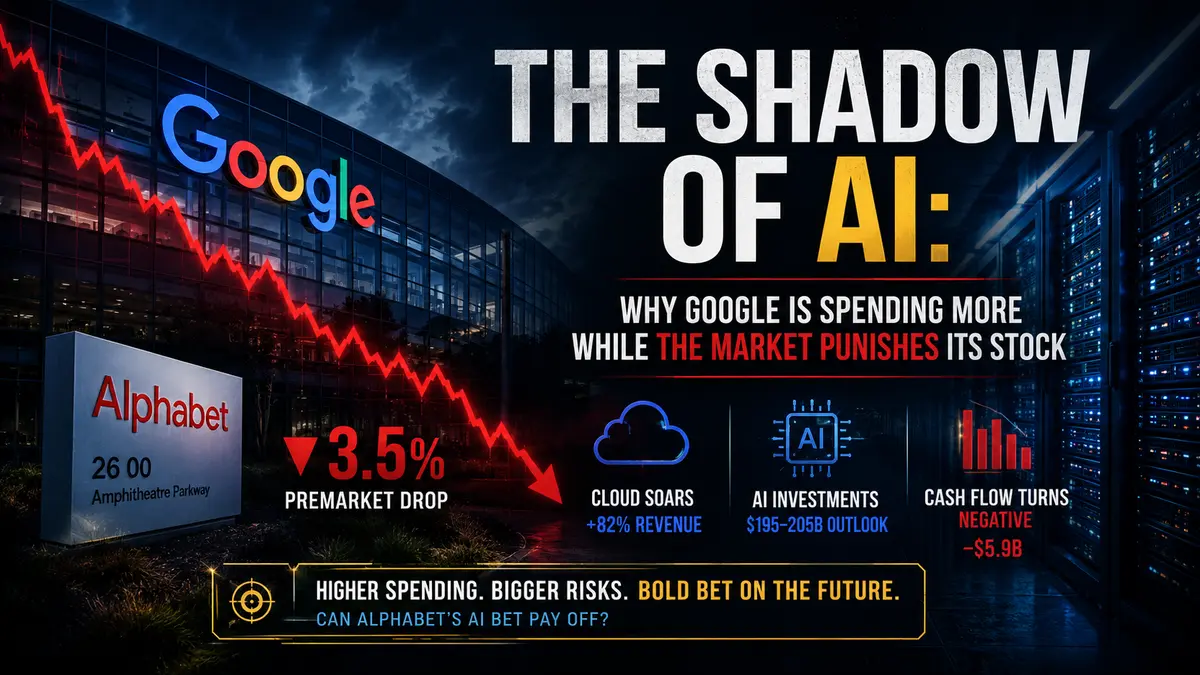
Thursday morning began with a cold shower for GOOGL ... investors. Shares of Google’s parent company fell 3.5% in premarket trading, and the decline was not simply a reaction to bad news. It was the price the company paid after the market found something in its financial results that raised doubts about its future, despite the otherwise brilliant figures.

The earnings report for the second quarter of 2026, released the previous day, was genuinely impressive. Revenue increased by 24% to nearly $120 billion. Earnings per share reached $9.11, significantly exceeding Wall Street forecasts. Google Cloud, the cloud division that had been unprofitable only a few years earlier, became the true star of the report: its revenue soared by 82% to $24.8 billion, while its operating margin exceeded 35%.

At first glance, this appeared to be the perfect earnings report—one that should have sent the stock soaring. However, the market decided otherwise.

What went wrong? The answer lies in capital expenditure. Alphabet’s capital spending doubled year over year, reaching nearly $45 billion in a single quarter. At the same time, the company raised its full-year 2026 capital expenditure forecast to between $195 billion and $205 billion.

These are astronomical amounts that Alphabet is spending on building data centers, purchasing equipment, and developing artificial intelligence infrastructure. The company’s free cash flow turned negative, falling to minus $5.9 billion. This means that despite rising revenue, Alphabet is currently spending more cash than it generates.

For investors accustomed to viewing Alphabet as a powerful cash-generating machine, this came as a shock. They began asking whether Google was spending too much on AI—and, more importantly, whether these investments would ever pay off.

When Chief Financial Officer Anat Ashkenazi said that the company was “still...

Continue reading...
0
0

The Vera Era: How Nvidia Is Rewriting the Rules of Performance and Cooling

The Vera Era: How Nvidia Is Rewriting the Rules of Performance and Cooling

Numbers That Make You Think: 10X Performance per Megawatt

Whenever Nvidia announces a new platform, the world holds its breath. But when the company claims a tenfold increase in performance per megawatt, even the most seasoned analysts take off their glasses and clean them twice. On Tuesday, Nvidia did exactly that, officially unveiling the Vera Rubin platform, which is entering production with the support of more than 300 global partners operating across 350 manufacturing facilities in 30 countries. The scale is impressive, but the numbers are what truly make investors and engineers’ hearts beat faster.

Nvidia’s central claim sounds almost like science fiction: Vera Rubin NVL72 delivers ten times greater performance per megawatt than Grace Blackwell NVL72 when running one of the most demanding artificial intelligence models, DeepSeek-R1. These are not theoretical calculations or marketing slides, but real-world benchmark results published by CoreWeave, one of Nvidia’s key partners. When a company of this caliber confirms the figures, they deserve serious attention.

What does this mean in practice? It means that data centers, which now cost as much as small cities and consume as much electricity as mid-sized countries, could reduce their energy consumption by 90% while maintaining the same level of computing output. More importantly, they could increase computing capacity tenfold without upgrading their power supply or cooling infrastructure. In an era when every watt counts and electricity is becoming an increasingly scarce resource, this is not merely an improvement—it is a revolution.

Nvidia shares responded by rising 2%, closing Tuesday in positive territory amid a broader recovery in the semiconductor sector. That may appear modest, but after the recent sell-off, during which chipmakers’ shares fell sharply across the board, even a 2% gain looks like a confident step forward. The market is beginning to understand that Nvidia is not...

Continue reading...
0
0

The Era of Smart Factories: Mitsubishi Electric and Sony Join Forces in the Race for Industrial AI

The Era of Smart Factories: Mitsubishi Electric and Sony Join Forces in the Race for Industrial AI

A Partnership of Giants: When Vision Meets Automation

Japanese industry, which has always been renowned for its technological excellence, is taking another enormous step into the future. MSBHF ... Electric, a veteran of factory automation with decades of experience, and SNEJF ... Semiconductor Solutions, a recognized leader in sensors and imaging technology, have announced the creation of a joint venture. The future company will be called Advanced Vision Solutions—a name that sounds more like a promise than a simple sign on the door of a new office.

The partnership between these two corporate giants is far more than another business deal. It is an attempt to unite two different philosophies, two engineering traditions, and two approaches to what the factory of the future should look like. Mitsubishi Electric knows virtually everything about robots, conveyor systems, and manufacturing control technologies. Sony, meanwhile, has spent years perfecting imaging technology and learning how to convert light into digital data with extraordinary precision. When these two worlds collide, they create something greater than the sum of their parts.

The joint venture is scheduled to be established in October 2026, although this is merely the formal launch date. Engineers and managers are already working actively to ensure that the company can operate at full capacity from its very first day. Mitsubishi Electric will hold a controlling 60% stake, which makes sense because it will serve as the primary integrator of the solutions at real manufacturing facilities. Sony will retain 40%, but its role should not be underestimated: without its sensors, the entire project would have little practical meaning.

This ownership structure is more than a collection of numbers. It sends a clear message to the market about which company will take the leading role and which will serve as the key technology partner. In reality, however, experience...

Continue reading...
0
0
Tim Drening

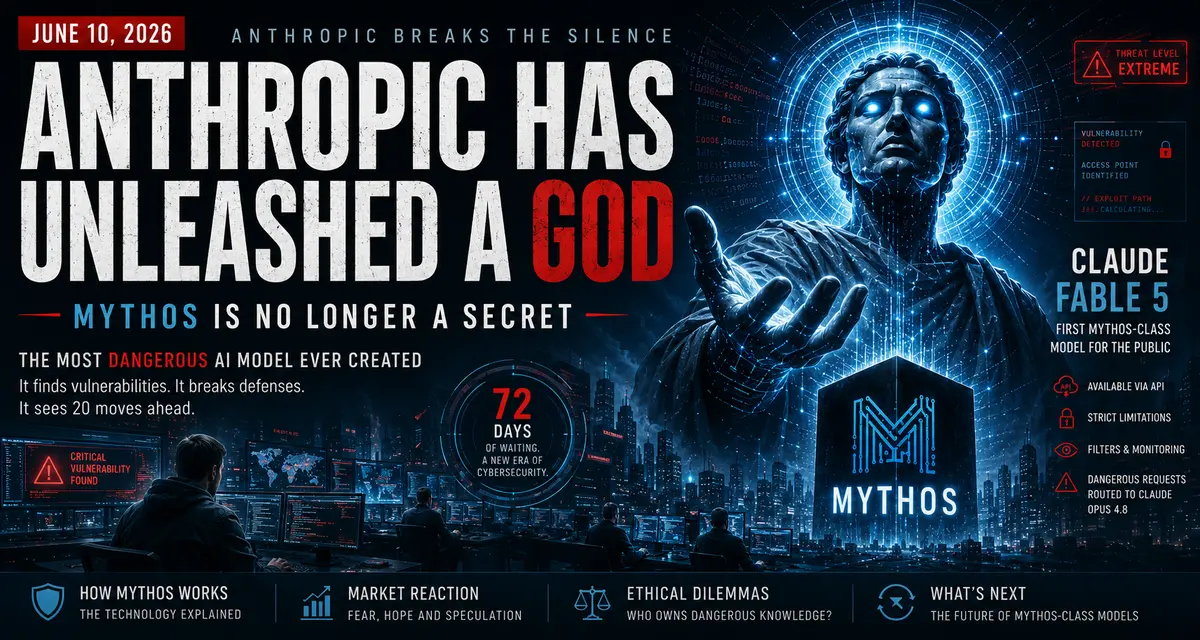
Anthropic Has Unleashed a God: Mythos Is No Longer a Secret

Anthropic Has Unleashed a God: Mythos Is No Longer a Secret

The most dangerous AI model finally enters the public sphere — under supervision

Seventy-two days. That is exactly how long the technology world spent in anxious anticipation.

On April 7, 2026, Anthropic quietly, almost unnoticed, released what many experts called “the most dangerous artificial intelligence model ever created.” Mythos.

A model capable of finding vulnerabilities in software. A model that can break through defenses programmers spent years building. A model that, if it falls into the wrong hands, could potentially disrupt banking systems, paralyze power grids, halt transportation networks, and cause widespread digital chaos.

Back in April, however, Anthropic acted cautiously. Instead of making Mythos publicly available—as some publicity-hungry startups might have done—the company granted access to only fifty organizations. These included operators of critical infrastructure: banks, energy providers, transportation networks, and government agencies.

Even then, access came with strict controls, usage restrictions, and monitoring of every request.

Now comes the next step.

On June 10, 2026, Anthropic introduced Claude Fable 5—the first Mythos-class model available to the broader public.

Well, “public” is a relative term.

The model is accessible through a paid API, subject to strict limitations, safety filters, and automatic redirection of dangerous requests to a less capable model, Claude Opus 4.8. Nevertheless, for the first time, ordinary developers, companies, and researchers can experiment with technology that was under lock and key only two months ago.

It is as if the U.S. government suddenly declassified all UFO files, or CERN opened the Large Hadron Collider to anyone who wanted to use it.

The technology is powerful enough to require extraordinary caution—and important enough that keeping it hidden indefinitely was no longer an option.

So what exactly is Mythos? Why is Claude Fable 5 considered dangerous? And why did Anthropic decide to release it despite the risks?

Mythos: What...

Continue reading...
0
0
Navigation menu
instaforex banner