

OPENAI MOVES INTO HARDWARE: A $230 KEYBOARD AND LEGAL BATTLES WITH APPLE
A SMALL KEYBOARD WITH BIG AMBITIONS
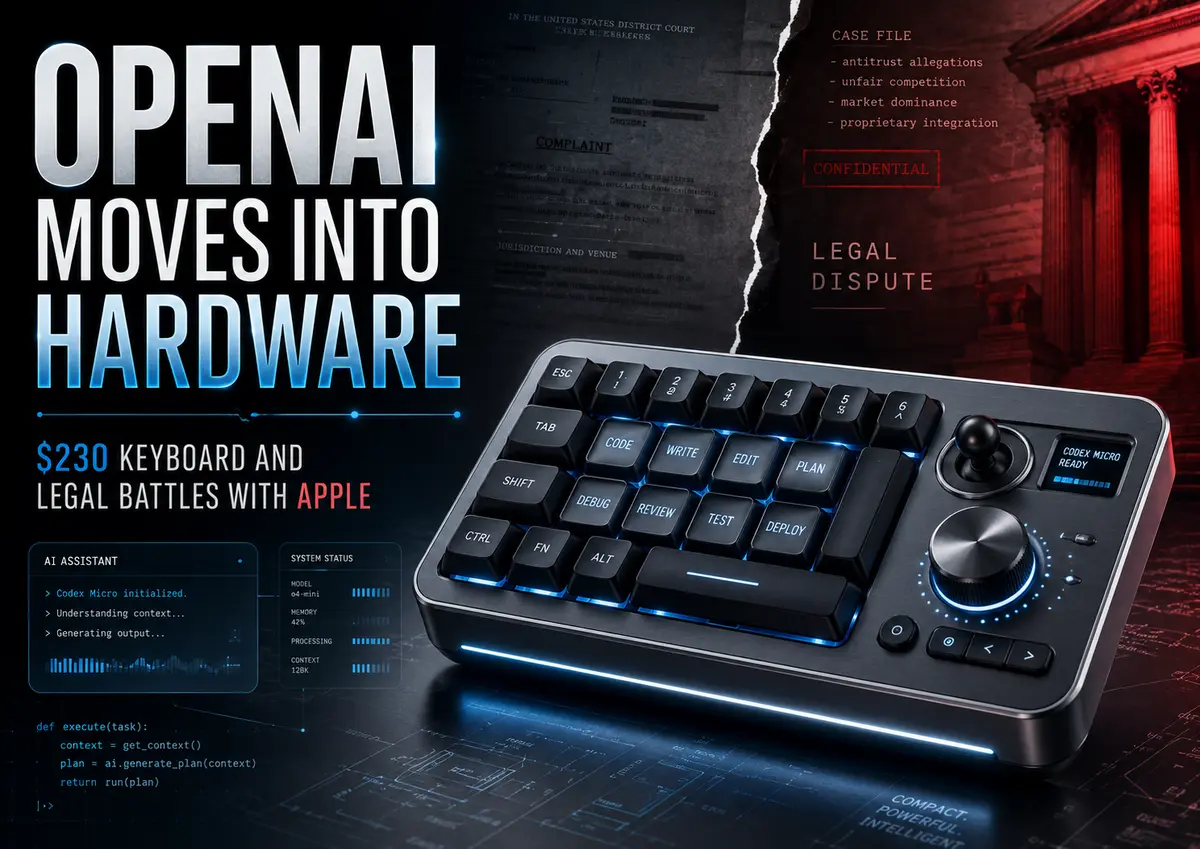
OpenAI has finally taken a step that many people have been expecting for a long time: it has released its own device. The surprise, however, is that it is neither a smart speaker nor a wearable gadget with a voice assistant. It is simply a keyboard—a small, compact keyboard equipped with a joystick and a rotary dial. Its name is Codex Micro.
The device was created in partnership with Work Louder, a Canadian-Italian company known for producing mechanical keyboards for technology enthusiasts and professionals. Visually, Codex Micro resembles some of the manufacturer’s other products, such as the Creator Micro 2, which was developed in collaboration with Figma. Internally, however, it is a completely different story.
The device looks like a compact control panel featuring thirteen illuminated keys, a mini joystick, and a rotary controller. All these elements are connected to Codex, OpenAI’s proprietary AI platform for programming. The idea is simple but ambitious: instead of clicking a mouse and navigating menus on a screen, developers can control their AI agents with the press of a button.
The LED keys display the status of individual agents: white means idle, blue indicates that a task is being processed, green means the task has been completed, and red signals an error. A single click allows the user to switch between different AI assistants, while a double-click brings the selected assistant to the foreground.
The joystick can be used to launch common tasks such as reviewing code, searching for errors, or performing refactoring. The rotary dial is the most interesting element of the device. It controls the AI’s “reasoning level”—in other words, how much time and computing power the neural network will spend solving a particular task. Turn it in one direction to receive a quick response to a simple question. Turn it the other way to launch a deeper analysis of a complex problem.
WHO IS IT FOR, AND WHAT IS THE POINT?
Codex Micro costs $230. That is a steep price for a keyboard, even a mechanical one, especially considering that Work Louder sells similar devices for less. However, OpenAI is positioning the product not as a mass-market device but as a limited-edition release for its most dedicated users.
In practical terms, it is more of a gadget for enthusiasts and fans of “vibe coding” than an essential professional tool. Nevertheless, the company’s ambitions are much more serious than they may initially appear.
Codex, OpenAI’s AI programming platform, has already attracted more than three million weekly users. Almost half of them use Codex not only to write code but also for other purposes, ranging from preparing documentation to creating business plans.
OpenAI clearly wants to strengthen its position in this segment by offering users not merely software but a complete command center for managing AI. In this context, the buttons and rotary controller are not simply fashionable accessories. They represent an attempt to make interaction with artificial intelligence more tactile and intuitive.
However, there is a second and considerably more dramatic side to this story.
THE APPLE OF DISCORD: APPLE’S LAWSUIT
Codex Micro was introduced during a particularly difficult period for OpenAI. Just a few days before the keyboard was announced, Apple filed a lawsuit against Sam Altman’s company. The allegations are serious: systematic theft of trade secrets and the use of confidential information to develop OpenAI’s own hardware devices.
For those who closely follow Silicon Valley, the situation contains a certain amount of irony. In 2024, Apple AAPL ... and OpenAI entered into a major partnership that integrated ChatGPT into the iPhone, iPad, and Mac. By June 2026, however, Apple had changed its strategy and selected Google as its primary AI partner. Now the companies are facing a legal dispute that could damage their relationship for years.
Apple claims that OpenAI has hired approximately 400 former employees from the Cupertino-based company. According to Apple, some of these employees were key figures who brought not only their professional experience but also sensitive information with them.
One example is Tang Tan, who worked at Apple for 24 years and served as vice president of product design for the iPhone and Apple Watch. He now leads OpenAI’s hardware division. Chang Liu, a senior electrical systems engineer with eight years of experience at Apple, joined OpenAI in January 2026. Yu-Ting Peng joined the company behind ChatGPT in April. According to Apple, these hires are all connected as part of a broader pattern.
BEHIND-THE-SCENES MANEUVERING AND SECRET COMPONENTS
In its 41-page lawsuit, Apple provides a number of detailed and controversial allegations.
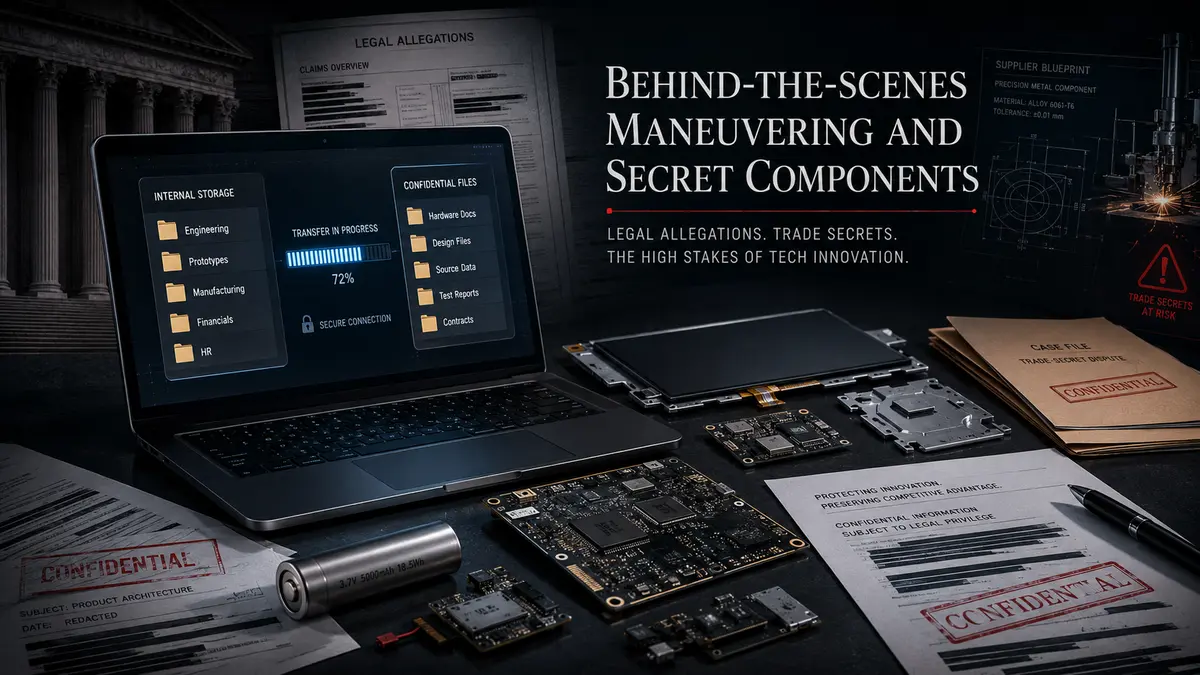
One of the defendants, Chang Liu, allegedly failed to return his work laptop after leaving Apple and discovered that he still had access to the company’s internal storage system. His reaction was reportedly brief: “LOL, I found out I can still access it. This is so funny.”
According to Apple, he downloaded dozens of confidential files related to products that had not yet been released and discussed with a colleague how to avoid attracting the attention of the company’s security department.
The most striking allegation, however, concerns OpenAI’s interview process. Apple claims that Tang Tan, who is now responsible for OpenAI’s hardware operations, asked job candidates who had previously worked at Apple to bring actual device components to their interviews, including batteries, circuit boards, and displays, and to explain them in detail.
Apple states that one candidate was “extremely surprised” that such a request was even possible, as the person had never imagined that these components could be removed from the office.
Another part of the dispute involves io, the company founded by legendary iPhone designer Jony Ive after he left Apple. OpenAI eventually acquired io for $6.5 billion.
Apple claims that io gained access to its confidential metal-processing technologies through shared suppliers by misleading one of the manufacturers. As one expert described the situation, trade secrets can be transferred through suppliers almost as easily as they can be carried away by departing employees.
OpenAI, for its part, categorically denies all the allegations. The company stated that it has “no interest in the trade secrets of other companies.” At the same time, it acknowledged that it is taking Apple’s lawsuit seriously.
In unofficial comments, OpenAI representatives have said that they are not aware of “any evidence” supporting the complaint and that they believe in “fair competition and the freedom of individuals to choose where they work.”
WHY DOES ALL OF THIS MATTER?
At first glance, the release of a niche $230 keyboard and a legal dispute with Apple may appear to be unrelated events. In reality, they are directly connected.
First, Codex Micro is only the beginning. OpenAI is also reportedly developing a much more substantial device: a smart home speaker powered by ChatGPT.
Bloomberg has described it as a “portable screenless speaker with mechanical components that can move independently.” This project is reportedly being led by former Apple engineers who are now at the center of the legal controversy.
Second, the dispute demonstrates how intense the competition has become over the future of “physical AI.” The smartphone and computer markets have already been divided among established players, while wearable devices, smart speakers, and other AI-powered gadgets represent a new and largely unexplored territory.
Apple, which has traditionally been one of the strongest companies in hardware, has no intention of surrendering this market without a fight. Its lawsuit against OpenAI is not merely a legal formality. It is a clear warning: “We will defend our developments, and we know how to do it.”
According to industry experts, Apple has some of the best technology lawyers in the world, and the company is expected to pursue the case aggressively.
Legal disputes have already become a familiar reality for OpenAI. Over the past six months alone, the company has faced pressure from the White House, a lawsuit from Elon Musk—which it won, although not without reputational damage—and intense competition from Anthropic.
Apple’s lawsuit, however, may be the most painful of them all because it strikes directly at OpenAI’s primary weakness: its ability to develop physical hardware products.
There is also an important legal consideration. Even if the case continues for years, the existence of the lawsuit already makes it more difficult for OpenAI to recruit specialists from Apple and increases the level of legal scrutiny surrounding its relationships with former Apple employees.
This could slow the development of new devices and give Apple a strategic advantage.
CONCLUSION: BETWEEN BUTTONS AND COURTROOMS
The announcement of Codex Micro is therefore more than just another gadget story. It is an attempt to enter a new market at the height of a hardware-related crisis.
It is OpenAI’s effort to prove that the company is capable of creating not only software but also physical products, while lawyers and courts determine whether it violated the law in the process.
A customizable keyboard with a joystick and a dial for controlling the depth of an AI system’s reasoning is an attractive technological toy. Behind it, however, lies an enormous risk.
If Apple proves its allegations, OpenAI could not only lose billions of dollars but also face restrictions preventing it from using certain technologies. Even if Apple fails to prove its case, the reputational damage has already been done.
In any event, we are now witnessing the battle for “hardware AI” enter a new and considerably more intense phase. The $230 keyboard is only the opening shot. Much heavier fire is likely to follow.


Comments
No comments yet. Be the first to share your thoughts!
Authentication Required
You must be logged in to post a comment.