

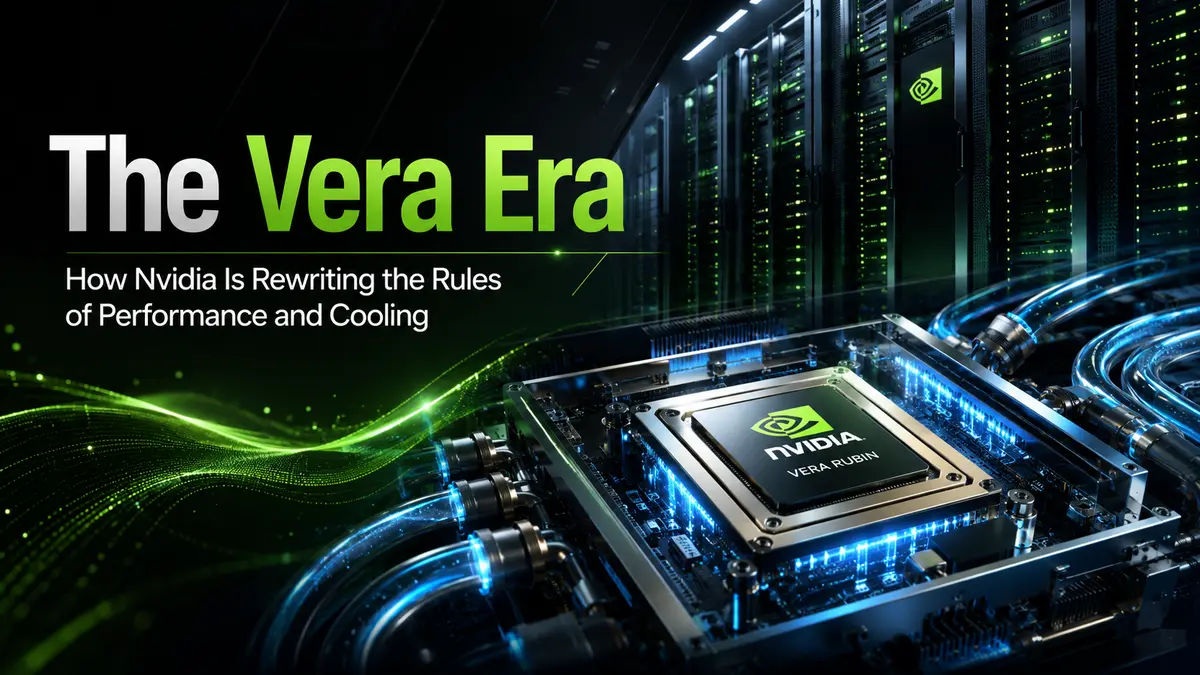
The Vera Era: How Nvidia Is Rewriting the Rules of Performance and Cooling
Numbers That Make You Think: 10X Performance per Megawatt
Whenever Nvidia announces a new platform, the world holds its breath. But when the company claims a tenfold increase in performance per megawatt, even the most seasoned analysts take off their glasses and clean them twice. On Tuesday, Nvidia did exactly that, officially unveiling the Vera Rubin platform, which is entering production with the support of more than 300 global partners operating across 350 manufacturing facilities in 30 countries. The scale is impressive, but the numbers are what truly make investors and engineers’ hearts beat faster.
Nvidia’s central claim sounds almost like science fiction: Vera Rubin NVL72 delivers ten times greater performance per megawatt than Grace Blackwell NVL72 when running one of the most demanding artificial intelligence models, DeepSeek-R1. These are not theoretical calculations or marketing slides, but real-world benchmark results published by CoreWeave, one of Nvidia’s key partners. When a company of this caliber confirms the figures, they deserve serious attention.
What does this mean in practice? It means that data centers, which now cost as much as small cities and consume as much electricity as mid-sized countries, could reduce their energy consumption by 90% while maintaining the same level of computing output. More importantly, they could increase computing capacity tenfold without upgrading their power supply or cooling infrastructure. In an era when every watt counts and electricity is becoming an increasingly scarce resource, this is not merely an improvement—it is a revolution.
Nvidia shares responded by rising 2%, closing Tuesday in positive territory amid a broader recovery in the semiconductor sector. That may appear modest, but after the recent sell-off, during which chipmakers’ shares fell sharply across the board, even a 2% gain looks like a confident step forward. The market is beginning to understand that Nvidia is not simply selling hardware—it is redefining the rules of energy efficiency.
The Anatomy of a Miracle: Engineering Without Compromise
To understand how Nvidia achieved such a dramatic leap, we need to look under the hood. Vera Rubin NVL72 is not simply a collection of processors assembled inside a rack. It is a completely redesigned architecture in which seven chips and five rack trays have been engineered as a single system operating in perfect synchronization. There are no cables, fans, or hoses inside the tray. It is a bold decision that challenges traditional schools of engineering.
Cables have always been a bottleneck. They occupy valuable space, restrict airflow, generate electromagnetic interference, and simply get in the way. By eliminating them, Nvidia’s engineers created room for a more efficient internal layout and, critically, for liquid cooling. Assembling a computing tray now takes just one minute. One minute. In an industry where building server racks previously took hours and required teams of qualified specialists, this moves the process to an entirely new level of automation.
The most interesting part, however, begins with cooling. Vera Rubin uses a liquid-cooling inlet temperature of 45 degrees Celsius. This means the system can operate without chillers—the expensive and energy-intensive devices typically used to cool liquids in conventional data centers. Instead, it relies on dry coolers, which consume significantly less energy and require less space.
Imagine walking into a data center where there are no roaring fans, no vibrating cables, and none of the constant noise that drives operators to distraction. Everything runs quietly and efficiently. This is not merely about comfort. It represents savings on operating expenses that could amount to tens of percentage points of the overall budget. For companies operating thousands of racks, that could translate into billions of dollars in annual savings.
The Partner Network: From Google to Mistral, Everyone Wants Vera
Vera Rubin is not entering the market alone. It is supported by an enormous ecosystem that has already begun deploying the new systems. CoreWeave, GOOGL ... e Cloud, Microsoft Azure, and Oracle Cloud Infrastructure are all integrating the platform into their cloud environments. This is not simply a matter of delivering hardware. It is a comprehensive partnership involving software optimization, customization for specific workloads, and long-term contracts.
Microsoft and Mistral, for example, have announced a multibillion-dollar partnership to expand AI infrastructure in Europe using Vera Rubin GPUs. Mistral, Europe’s leading contender in the AI race, is increasing its capacity by adding thousands of Vera Rubin units. Its models, including Mistral Medium 3.5 and OCR 4, are already available through MSFT ... Foundry, while the models themselves have been integrated into Microsoft Copilot Studio. This is more than a business deal. It represents the creation of a fully fledged European AI hub built on American technology, a development that is both symbolic and strategically important.
Google Cloud, meanwhile, has launched the Vera Rubin NVL72-based A5X instance. These are bare-metal systems with no virtualization layer, no intermediaries, and direct access to hardware resources. The first customer is Ineffable Intelligence, a London-based startup that appears to be preparing something ambitious in the field of AI. Such configurations allow companies to extract maximum performance from the hardware, particularly in latency-sensitive workloads.
Analysts are already revising their forecasts. Should Vera Rubin maintain the deployment pace projected by Nvidia, and provided that its partners can keep up, it could become the fastest rollout of a new architecture in the company’s history. That, in turn, could produce new revenue and profit records despite ongoing macroeconomic turbulence.
The Vera CPU: A Heart That Beats Faster
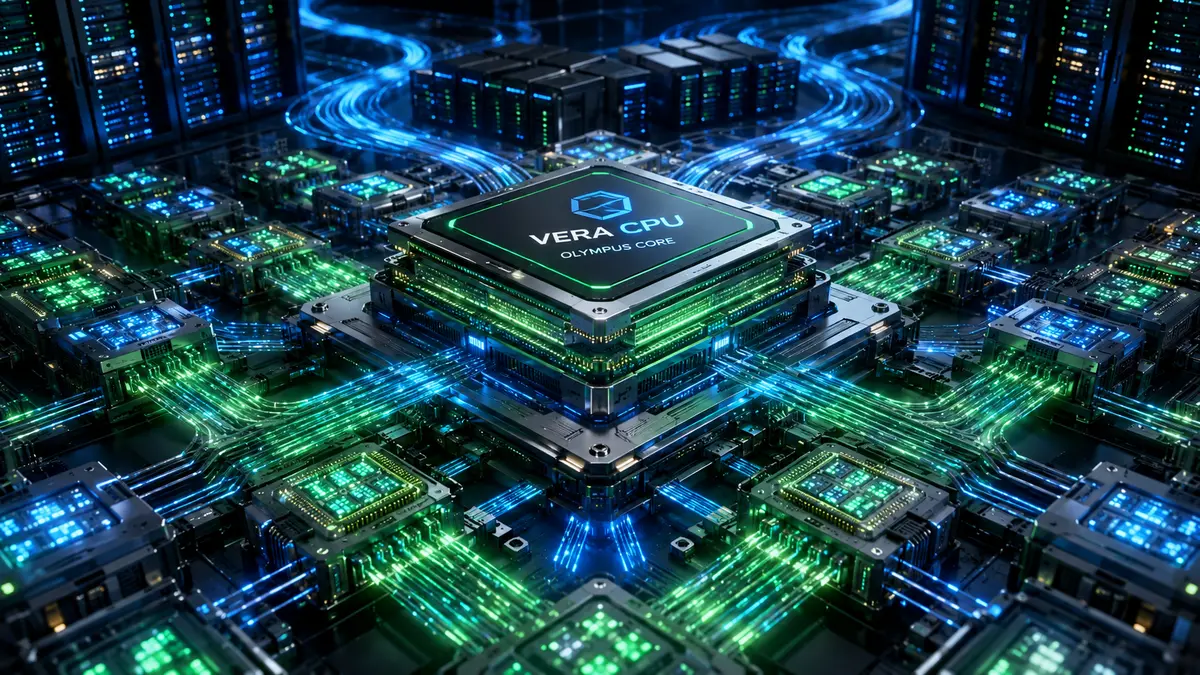
At the center of this entire ecosystem is the Vera CPU. This is not simply another processor. It features a custom core called Olympus, which Nvidia developed specifically for AI workloads. Benchmark results from DeepInfra showed that the Vera CPU can support up to 1.6 times more simultaneous AI agents while maintaining the same quality of service, and can deliver orchestration performance up to 2.2 times faster than alternative processors.
What does orchestration mean in this context? It refers to the management of distributed computing, where thousands of cores work on a single task while exchanging data and remaining synchronized. The faster this process operates, the higher the system’s overall performance. This is where the Vera CPU demonstrates its strengths. It does not simply execute instructions—it manages the entire process so that no core remains idle and no piece of data is delayed.
This is critical for AI agents interacting with users in real time. Every millisecond of latency can result in a lost customer, an incorrect decision, or simply a poor user experience. The Vera CPU enables companies to increase the number of simultaneous agents by 60% without sacrificing service quality. For businesses developing chatbots, virtual assistants, or automated decision-making systems, this means serving more customers using the same hardware.
All of this is complemented by sixth-generation NVLink scaling technology and Spectrum-X Ethernet. NVLink is Nvidia’s proprietary interface for connecting GPUs. Its sixth generation delivers extraordinary bandwidth, allowing hundreds of chips to operate as a single organism. Spectrum-X Ethernet, combined with 102.4T Spectrum-6 switching systems, operates at a level where data-transfer speeds are measured in terabits per second. CoreWeave, Microsoft, SpaceXAI, and Tesla are already deploying these switches, demonstrating that the technology does not merely exist on paper—it is operating under real-world conditions.
Political and Economic Consequences: A New Iron Curtain?
When we step away from the technical details and examine the broader picture, it becomes clear that Vera Rubin is not simply a commercial product. It is also a political instrument. The Trump administration, which has actively promoted the idea of American technological sovereignty, cannot fail to welcome the fact that critical AI computing infrastructure is being built on American hardware.
Nvidia is effectively becoming a systemically important company for the entire global AI infrastructure. To build advanced neural networks, companies need Nvidia chips. To cool them efficiently without being overwhelmed by electricity costs, they need Vera Rubin. This creates a situation in which the United States gains not only technological influence but also economic and political leverage comparable to Saudi Arabia’s influence during the oil boom.
For Europe, which is actively attempting to develop its own AI projects, the Microsoft–Mistral partnership built around Vera Rubin represents both an opportunity and a dependency. On the one hand, European companies gain access to the world’s most advanced technologies. On the other hand, they become vulnerable to American policy should relations between the continents deteriorate.
China is, of course, watching these developments with concern. Companies in Beijing are attempting to create alternatives to Nvidia, but the gap in performance and energy efficiency continues to widen. Vera Rubin establishes a new benchmark that Chinese manufacturers may find extremely difficult to reach in the coming years. This gives the United States a strategic advantage in the race for AI dominance.
What Comes Next: The Ecosystem Around Vera
The launch of Vera Rubin is not the conclusion—it is only the beginning. Thousands of developers around the world are already adapting their algorithms to the new architecture. Specialized libraries, frameworks, and even programming languages optimized for this hardware are beginning to appear. The ecosystem is growing like a snowball, and every new participant further strengthens Nvidia’s market position.
Partners such as CoreWeave are actively publishing benchmark results demonstrating that Vera Rubin’s performance exceeds expectations. This attracts new customers who can see real figures rather than advertising promises. Microsoft and Mistral are already investing billions, creating a precedent for other major market participants. Oracle Cloud Infrastructure is also joining the ecosystem, further increasing the platform’s credibility and reach.
Interestingly, TSLA ... and SpaceXAI, which are already using Spectrum-6 switches, could become not only customers but also beta testers for future versions. Elon Musk, known for his commitment to vertical integration, may provide NVDA ... with feedback that could help improve the platform for extreme workloads.
Conclusion: Vera Rubin as the New Standard
When Nvidia announces a tenfold increase in performance per megawatt, it is not simply another technology headline. It is a signal to the entire market that the industry is entering a new era—an era in which energy efficiency becomes the primary limiting factor, and engineering decisions such as eliminating cables, fans, and hoses become decisive competitive advantages.
Vera Rubin is not merely an incremental improvement over Blackwell. It is a new standard that every other manufacturer will be forced to pursue. Competitors, including AMD ... and Intel, will have to reconsider their roadmaps simply to approach these performance levels. In this respect, Nvidia is not merely maintaining its leadership—it is extending its lead even further.
Investors, partners, developers, and even politicians now view the platform as something greater than a product. It is an infrastructure foundation for the future, upon which the AI economies of entire regions may be built. And if everything proceeds according to Nvidia’s plans, that future may arrive sooner than any of us expect.






Comments
No comments yet. Be the first to share your thoughts!
Authentication Required
You must be logged in to post a comment.