

The Shadow of AI: Why Google Is Increasing Spending While the Market Punishes Its Stock
The Day When an Excellent Earnings Report Failed to Save the Stock
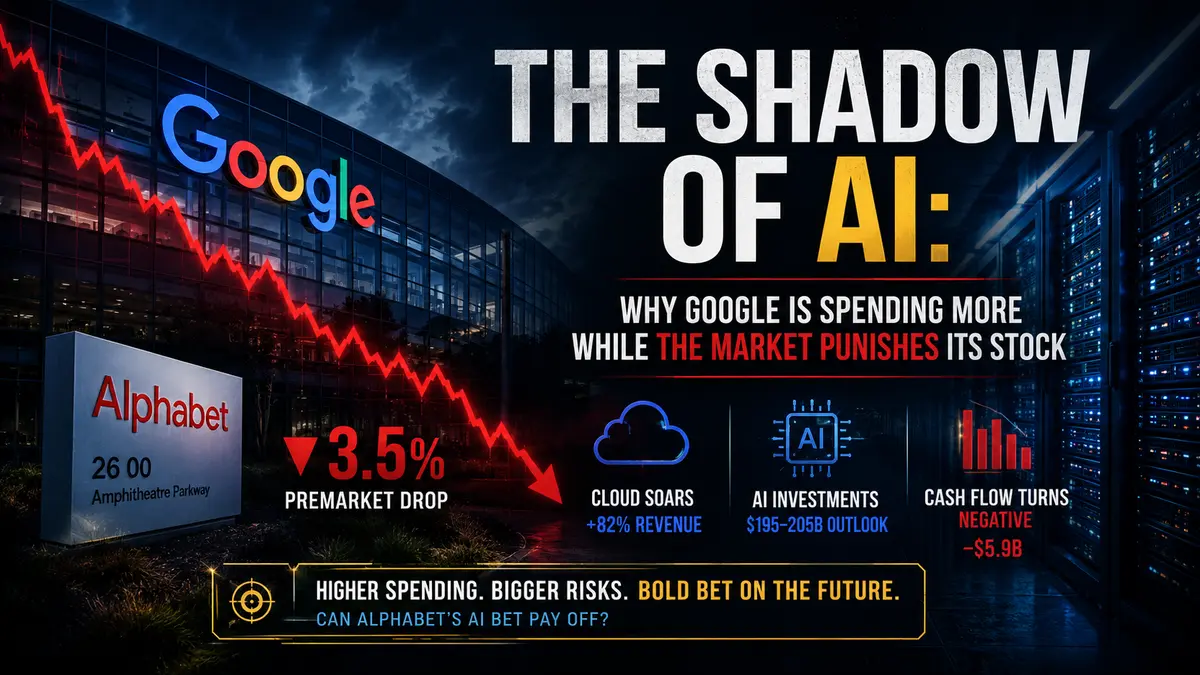
Thursday morning began with a cold shower for GOOGL ... investors. Shares of Google’s parent company fell 3.5% in premarket trading, and the decline was not simply a reaction to bad news. It was the price the company paid after the market found something in its financial results that raised doubts about its future, despite the otherwise brilliant figures.
The earnings report for the second quarter of 2026, released the previous day, was genuinely impressive. Revenue increased by 24% to nearly $120 billion. Earnings per share reached $9.11, significantly exceeding Wall Street forecasts. Google Cloud, the cloud division that had been unprofitable only a few years earlier, became the true star of the report: its revenue soared by 82% to $24.8 billion, while its operating margin exceeded 35%.
At first glance, this appeared to be the perfect earnings report—one that should have sent the stock soaring. However, the market decided otherwise.
What went wrong? The answer lies in capital expenditure. Alphabet’s capital spending doubled year over year, reaching nearly $45 billion in a single quarter. At the same time, the company raised its full-year 2026 capital expenditure forecast to between $195 billion and $205 billion.
These are astronomical amounts that Alphabet is spending on building data centers, purchasing equipment, and developing artificial intelligence infrastructure. The company’s free cash flow turned negative, falling to minus $5.9 billion. This means that despite rising revenue, Alphabet is currently spending more cash than it generates.
For investors accustomed to viewing Alphabet as a powerful cash-generating machine, this came as a shock. They began asking whether Google was spending too much on AI—and, more importantly, whether these investments would ever pay off.
When Chief Financial Officer Anat Ashkenazi said that the company was “still operating in a supply-constrained environment” amid “very strong demand,” her remarks sounded more like an acknowledgment of a problem than a reassurance. Investors interpreted the message differently: Alphabet is spending enormous amounts of money, yet even this is not enough, and spending will continue to rise.
The Cloud Arms Race: Why Alphabet Cannot Afford to Stop
To understand Alphabet’s logic, it is necessary to look at the very heart of today’s technological conflict. Artificial intelligence is not merely a fashionable term. It represents a new technological paradigm that requires enormous computing capacity.
Every new language model and every neural-network training process consumes so much electricity and computing power that older data centers are simply unable to handle the workload.
Google Cloud, which has become one of the company’s main growth drivers, is competing with Amazon Web Services and Microsoft Azure for market share in cloud computing. Alphabet cannot afford to lose this race.
Without building new data centers, purchasing the latest graphics processors from NVDA ... , and continuing to develop its proprietary Tensor Processing Units, or TPUs, Alphabet risks losing customers. Corporate clients that want to use AI for their business operations will not wait for Google to catch up. They will move to competitors instead.
Investing in AI infrastructure is a strategic choice that could determine the company’s future for decades. Alphabet cannot allow itself to fall behind.
Unfortunately, the market often thinks in much shorter time frames. It sees negative free cash flow and begins to panic. Rather than considering how these investments could create a foundation for future growth, investors focus on the company’s current financial metrics.
Anat Ashkenazi attempted to communicate this idea to shareholders. She emphasized the “very strong demand” and explained that Alphabet was operating in a “supply-constrained environment.” However, her comments sounded more like an excuse than an explanation.
The market wanted to know when these investments would begin generating meaningful returns. Instead, investors heard that capital expenditure would “increase substantially” again in 2027. That became the final straw.
The Strength and Weakness of Google Cloud: How the Cloud Division Saved the Quarter
Without Google Cloud, Alphabet’s earnings report would have been good rather than exceptional. However, the cloud division delivered results so impressive that they overshadowed weaknesses elsewhere in the business.
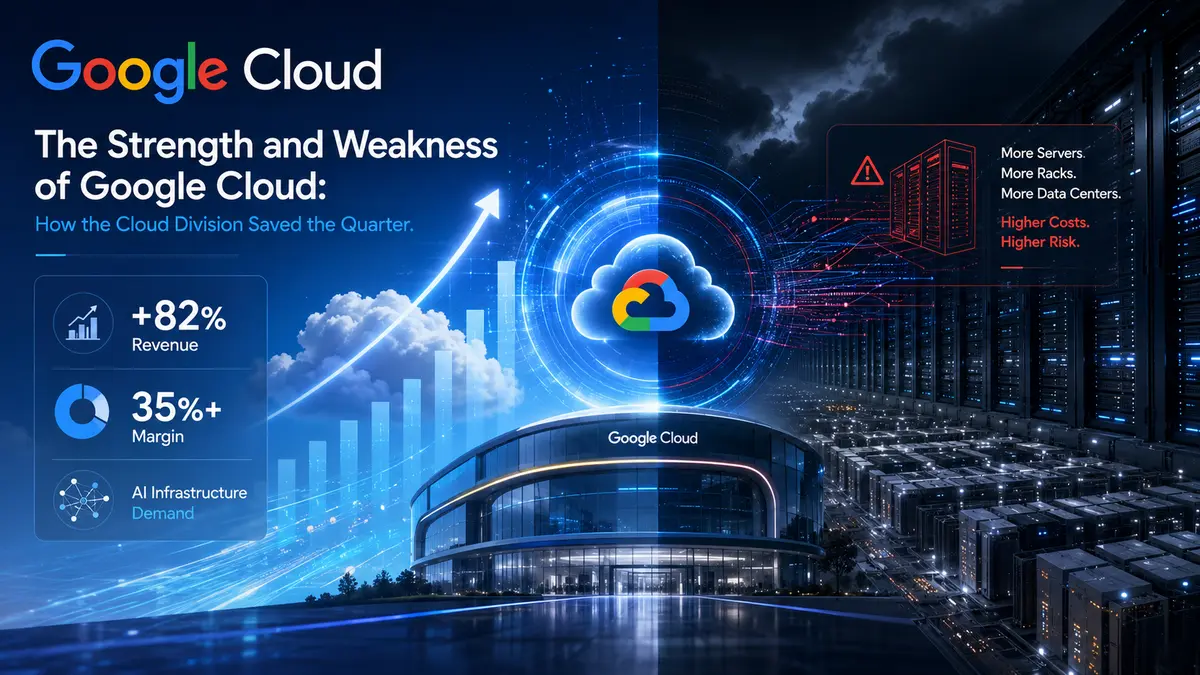
Google Cloud revenue increased by 82% to $24.8 billion. This was not simply growth—it was an explosion that surpassed analysts’ expectations.
The segment’s operating margin expanded to more than 35%. For comparison, Google Cloud was still operating at a loss only a few years ago, and investors questioned whether Google would ever be able to compete effectively with Amazon and MSFT ... in this market.
Those doubts have now largely disappeared. Google Cloud has become more than just a viable business. It is now one of Alphabet’s most important profit drivers.
What is behind this remarkable growth? The answer is strong corporate demand for AI infrastructure and Gemini-based solutions.
Gemini, Google’s flagship artificial intelligence platform, is attracting clients that want to use advanced machine-learning models for their own operations. Its potential applications include data analytics, natural-language processing, content generation, and many other business functions.
Demand is so strong that the company is struggling to meet it, despite record levels of investment.
Even this success, however, was not enough to reassure investors. They recognized that Google Cloud’s expansion requires enormous capital expenditure. Every new client and every additional service requires more servers, more computing racks, and more data centers.
It creates a continuous cycle: to generate more revenue, Alphabet must also spend more money. Until income from AI begins to clearly exceed the cost of developing and operating the necessary infrastructure, the market is likely to remain nervous.
Comparison With Competitors: Why Alphabet Is Suffering More Than Others
Alphabet is not the only company facing concerns about capital expenditure. Every major technology company—from Microsoft and Amazon to Meta—is investing enormous amounts in AI infrastructure.
Why, then, is Alphabet’s stock being punished more severely than the shares of some of its competitors?
The answer lies partly in the structure of its business.
Microsoft, for example, has a powerful software and operating-systems segment that generates stable, high-margin cash flow. Amazon has its retail and logistics operations, which, although not always highly profitable, generate an enormous volume of sales.
Alphabet’s primary source of revenue, by contrast, remains advertising, which is heavily influenced by broader macroeconomic conditions. When investors see the company spending billions of dollars on AI while its core advertising business could suffer during a recession, they become increasingly nervous.
Alphabet has also recently faced a series of antitrust lawsuits that have created additional uncertainty about its future. A court decision requiring the company to separate certain operations or restrict its advertising activities could have a serious impact on revenue.
Against this backdrop, record investment in AI may be interpreted not as a strategic advantage but as an additional risk.
Nevertheless, Alphabet retains one important advantage: its technological foundation and access to data.
Google controls an enormous amount of information that can be used to train and improve artificial intelligence models. This provides the company with a competitive advantage that would be extremely difficult for rivals to replicate.
However, until investors see a clear path toward monetizing this advantage in the near future, they are likely to remain cautious.
The Broader Market: A Turbulent Sea Where Even the Leaders Can Sink
Alphabet’s share-price decline occurred against the backdrop of a broader retreat in US stock indices. The ^GSPC ... S&P 500 fell by 0.3%, the Dow Jones Industrial Average lost 0.3%, and the ^NDX ... declined by 0.4%.
This was not a market crash, but it represented a sufficiently consistent downward movement to demonstrate the general caution among investors. In such an environment, even positive news is treated with skepticism, while every negative signal becomes amplified.
Macroeconomic factors—including inflation, high borrowing costs, and the possibility of a recession—continue to weigh on the market. Investors are seeking safer assets and reducing their exposure to risk.
In this environment, companies with high capital expenditure, such as Alphabet, face pressure from both sides. They must continue investing to avoid falling behind, yet the market punishes them for making those investments.
Despite the current decline, many analysts remain optimistic about Alphabet’s long-term prospects. They believe the company’s AI investments will begin generating returns over the next several years and eventually support renewed growth.
For now, however, the market remains focused on short-term financial performance, which means Alphabet’s shares are likely to remain volatile.
What Comes Next: How Investors Should Evaluate Alphabet
Investors who already own Alphabet shares—or are considering purchasing them—must distinguish between short-term volatility and the company’s long-term prospects.
The current decline was triggered by a specific concern: exceptionally high capital expenditure combined with negative free cash flow. However, Alphabet’s underlying business fundamentals remain strong.
Revenue continues to grow at a double-digit rate, earnings have exceeded expectations, and the cloud division is delivering impressive results. Google Cloud, in particular, has become the company’s primary growth engine and could develop into one of its most important sources of profit.
The key question is how quickly Alphabet will be able to monetize its investments in artificial intelligence.
Chief Financial Officer Anat Ashkenazi indicated that 2026 could represent a peak period for capital expenditure. Spending is also expected to remain high in 2027, although the rate of growth may begin to slow.
Should that happen, Alphabet’s free cash flow could return to positive territory, potentially supporting a recovery in the company’s share price.
For investors willing to wait, Alphabet may remain an attractive long-term opportunity. The company holds strong positions in advertising, cloud computing, and artificial intelligence.
Its ecosystem includes Google Search, YouTube, Android, Google Cloud, and numerous other products that generate enormous value.
Investors seeking rapid returns, however, should remain cautious. Volatility is likely to persist over the next several quarters.
Conclusion: The Price of the Future
Alphabet’s 3.5% share-price decline was not simply a reaction to its quarterly earnings report. It reflected a deeper contradiction affecting the entire technology sector.
Technology companies are being forced to spend enormous amounts on artificial intelligence to remain competitive. At the same time, the market is unwilling to tolerate negative cash flow and is demanding rapid returns on those investments.
Alphabet has found itself at the center of this contradiction.
On the one hand, investing in AI infrastructure is a strategically sound decision that could support the company’s future growth. On the other hand, these investments are creating short-term pressure on the stock—pressure that investors are not prepared to ignore.
The next several quarters will be decisive. Will Alphabet demonstrate that its investments are beginning to pay off, or will the market continue punishing the company for its high spending?
The answer will influence not only the future of Alphabet’s stock but potentially the direction of the entire technology sector. After all, if even a company as powerful as Alphabet cannot convince investors that its AI spending is justified, what does that imply for everyone else?
History, however, suggests that technology giants willing to invest in the future at the right moment often emerge as the eventual winners.
Alphabet appears to be betting on long-term success, even if that strategy causes short-term pain. The only question is whether investors are prepared to share that pain and wait for the potential triumph.




Comments
No comments yet. Be the first to share your thoughts!
Authentication Required
You must be logged in to post a comment.