Bar Pipa
We pay for a post of 10$

Indicies

Yancoal Surges to a One-Month High on Record Production and Strong Coal Prices

Yancoal Surges to a One-Month High on Record Production and Strong Coal Prices

Tuesday: Coal Company Shares Rise Sharply

Tuesday 21.07.2026 became a triumphant day for YACAF ... Australia. The company’s shares jumped 3.7% to A$5.89, reaching their highest level since June 22. This was an impressive result against the backdrop of the largely unchanged S&P/ASX 200 Index, which showed no significant movement.

What was behind this growth? Record production and sales figures, combined with strong coal prices. Yancoal, Australia’s largest coal producer, reported second-quarter results that exceeded market expectations. Attributable saleable coal production increased by 20% compared with the previous quarter, reaching a record 10.8 million tonnes. Coal sales rose by 41% to 11.6 million tonnes.

These were not simply strong figures—they reflected a systematic operational improvement. The company shifted its focus from overburden removal, which involves preparing mining areas for production, to direct coal extraction. This change supported higher output across most of its operations. Yancoal’s management clearly understood that demand for coal remained strong and concentrated its efforts on increasing production.

Coal Prices: Higher Realised Prices

The second important factor was pricing. Yancoal’s average realised coal price increased by 9% quarter on quarter to A$160 per tonne. This reflected an 11% rise in realised thermal coal prices and a 3% increase in metallurgical coal prices.

For a coal producer, the realised selling price is one of the most important performance indicators. Even when production volumes remain stable, higher prices directly increase revenue and profit. As one of the largest companies in the market, Yancoal was able to take advantage of favourable conditions and improve its margins.

Coal prices have been rising amid global uncertainty in the energy sector. Conflict in the Middle East, disruptions to oil supplies and concerns surrounding nuclear energy are creating additional demand for coal as an alternative source of energy. Yancoal has found itself in the right...


Continue reading...
0
0

Asian Stocks Rise as Oil Prices Fall and Investors Await Earnings

Asian Stocks Rise as Oil Prices Fall and Investors Await Earnings

Tuesday: Markets Recoup Their Losses

Tuesday 21.07.2026 became a day of recovery for Asian stock markets. After several days of volatility and selling pressure driven by geopolitical risks, investors returned to buying. The main catalysts behind the rebound were lower oil prices and hopes for a diplomatic resolution in the Middle East.

Wall Street ended Monday with moderate losses, but U.S. stock futures pointed to a stronger opening on Tuesday. The technology-heavy NASDAQ, which is particularly sensitive to shifts in investor sentiment, led the advance.

Japan was one of the main beneficiaries of the positive momentum across Asian markets. The ^N225 ... rose by more than 2% after the market was closed on Monday for a public holiday. Investors actively purchased technology stocks, while overall market sentiment remained positive.

However, South Korea’s KOSPI delivered perhaps the most impressive performance. The index rebounded by almost 4% after falling approximately 5% during the previous session. This is a classic example of a “dead cat bounce,” as investors return to oversold stocks, particularly in the technology sector.

Technology Sector Leads the Recovery

Technology companies were the primary drivers of growth across Asian markets. BC94.L ... Electronics shares surged by 6%, while SK Hynix gained 4.5%. This represented a powerful recovery following several days of declines, during which concerns about inflated valuations and geopolitical risks weighed heavily on the sector.

For investors, the rebound may indicate that the fundamental positions of these companies remain strong. Samsung recently forecast a nineteenfold increase in operating profit for the second quarter, and the markets appear ready to believe these projections. Like Samsung, SK Hynix is a major supplier of memory chips used in artificial intelligence applications, and demand for these products remains high.

However, the recovery of Asia’s technology sector is taking place against a backdrop of continued uncertainty....

Continue reading...
0
0
BCR

Daily Analysis 21 July 2026 | US-Iran Tensions Shake Markets, Sending Oil Higher and Currencies into Focus

Daily Analysis 21 July 2026 | US-Iran Tensions Shake Markets, Sending Oil Higher and Currencies into Focus

Currency & Commodity Analysis:


US Dollar Index


The US dollar index traded near 100.90 on Monday, supported by escalating tensions in the Middle East, which boosted oil prices and exacerbated concerns about inflation and the prospect of higher interest rates. The US military said it conducted new airstrikes against Iran on Sunday after three US service members were killed, while Tehran declared that the ceasefire with the US had effectively collapsed and said it intercepted four ships passing through the Strait of Hormuz over the weekend. Meanwhile, Cleveland Federal Reserve President Beth Hammark joined a growing number of Fed officials on Friday in warning of persistent inflation. The market currently estimates a 53% probability of a Federal Reserve rate hike in September, up from 47% the previous day, although the general expectation is that the central bank will keep rates unchanged at its meeting this month. The dollar index was essentially flat on Friday, closing at 100.76, supported by safe-haven demand triggered by renewed escalation of US-Iran tensions, but traders reduced their bets on a near-term Fed rate hike due to moderate US inflation data.


From a technical perspective, the dollar index is currently trading at 100.90, closely below the 9-day moving average of 100.91. The MACD histogram shows a moderate increase in bearish momentum, indicating weak short-term momentum, but limited downside potential. Technically, the index has been declining from its previous high of 101.80, reaching a low of 95.36 before gradually stabilizing and rebounding, and is currently in a consolidation phase. Market assessments of the US economic fundamentals are also mixed. Regarding inflation, June data showed some easing, enough to raise the probability of the Fed keeping rates unchanged at its July meeting to 86%. The market's pricing in further interest rate hikes may still be...

Continue reading...
0
0

FTSE 100 Falls as Conflict Escalates and Oil Breaks Above $90

FTSE 100 Falls as Conflict Escalates and Oil Breaks Above $90

Monday on the London Stock Exchange: An Anxious Start to the Week

The first trading day of the week began with a noticeable decline in the British market. The FTSE 100 had fallen by 0.61% by the middle of the trading session, reflecting a broader deterioration in sentiment across European markets. Investors are fleeing risk, and they have good reasons to do so.

The conflict in the Middle East has entered a new and more dangerous phase. For the ninth consecutive night, the US military has carried out strikes against Iranian targets. These are no longer isolated operations but a systematic effort to suppress Iran’s military capabilities. Tehran’s response is becoming increasingly aggressive and is spreading to neighbouring countries in the Persian Gulf.

Germany’s DAX lost 0.16%, while France’s CAC 40 declined by 0.05%. However, the British market proved to be the most vulnerable. The reason is the United Kingdom’s dependence on imported energy and the sensitivity of its economy to rising oil prices. As the market is currently demonstrating, oil prices are climbing rapidly.

The Pound Sterling: A Small Island of Stability

Against the backdrop of a falling stock market, the pound sterling has remained relatively resilient. The British currency rose by 0.08% to $1.3466. This modest but symbolic appreciation suggests that investors still have confidence in the British economy despite the external shocks.

The focus is now on the UK political landscape. Andy Burnham is expected to formally take office as prime minister on Monday, and his promise to give households “breathing space” from the rising cost of living has resonated with voters. However, the extent to which this promise can be implemented in practice remains an open question.

Burnham’s position on North Sea oil production is attracting particular attention. US President Donald Trump has already welcomed plans...

Continue reading...
0
0

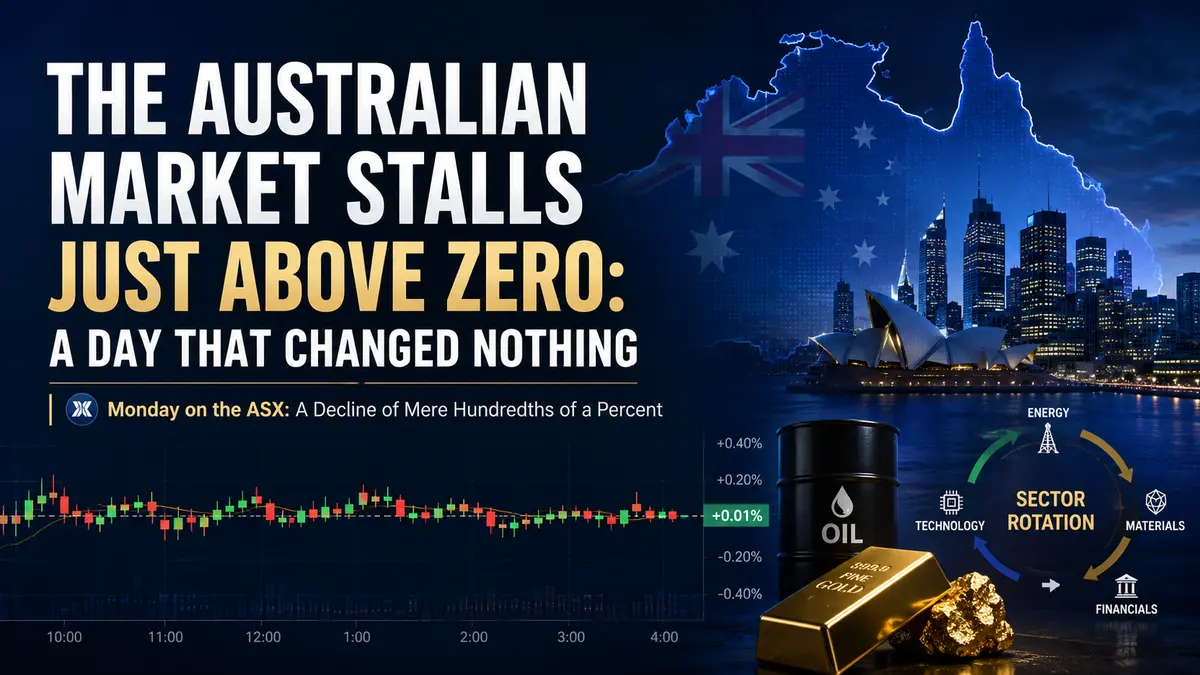
The Australian Market Stalls Just Above Zero: A Day That Changed Nothing

The Australian Market Stalls Just Above Zero: A Day That Changed Nothing

Monday on the ASX: A Decline of Mere Hundredths of a Percent

The Australian stock market ended the first trading day of the week with an almost imperceptible move lower. The S&P/ASX 200 Index lost just 0.06%—such an insignificant amount that it could easily be dismissed as statistical noise. Yet behind this microscopic decline was a day full of contrasts: some companies surged, others fell to record lows, while the overall result remained virtually unchanged.

Trading on the Sydney Stock Exchange was marked by a tug-of-war. The information technology, utilities, and healthcare sectors pushed the index lower, while other industries attempted to keep it afloat. In the end, the battle finished in a draw—but the apparent calm was deceptive. Within the market, a genuine drama was unfolding, with winners and losers changing places at a dizzying pace.

The final tally showed 583 declining stocks compared with 485 advancing stocks, while 389 shares remained virtually unchanged. This suggests that sellers outnumbered buyers, but the overall decline remained minimal because the day’s strongest performers delivered impressive gains.

The Top Three Performers: Who Pulled Ahead?

Against a backdrop of general stagnation, three companies posted impressive gains of more than 4%.

Yancoal Australia, a coal-mining company, took first place, rising 6.16% to AUD 5.69. The strength of the coal sector was no coincidence. Energy prices surged amid the escalation of the conflict in the Middle East, making coal increasingly attractive as an alternative source of energy. Investors concerned about potential disruptions to oil supplies have been shifting toward coal-related assets, placing Yancoal at the centre of this trend.

Contact Energy, a New Zealand energy company, ranked second after gaining 4.56% to AUD 7.80. Interestingly, Contact Energy is traded on the Australian exchange, although its core business is concentrated in New Zealand. The rise in...

Continue reading...
0
0
BCR

Daily Analysis 20 July 2026 | Dollar Weakens as Inflation Cools, Oil Rally Fueled by Middle East Tensions

Daily Analysis 20 July 2026 | Dollar Weakens as Inflation Cools, Oil Rally Fueled by Middle East Tensions

Currency & Commodity Analysis:


US Dollar Index


The US dollar index fell sharply last week, hitting a low of 100.36, as easing inflationary pressures reduced expectations for a near-term Federal Reserve rate hike. Data released last week showed that the Producer Price Index (PPI) unexpectedly declined in June, the first time in nearly a year, mainly due to lower energy costs, following Tuesday's lower-than-expected CPI inflation report. The market lowered its expectations for a September rate hike by the Federal Reserve, with the implied probability falling from 50% the previous day to about 44%. Meanwhile, investors continued to focus on escalating attacks in the Middle East following additional US strikes against Iranian targets. Renewed conflict caused a sharp rise in oil prices this week, raising renewed concerns about the inflation and interest rate outlook. Despite this, President Trump stated last week that Tehran had indicated a willingness to resume negotiations.


The US dollar index exhibited a clear downward consolidation trend last week. Amidst fluctuating expectations regarding the Federal Reserve's monetary policy and the interplay of geopolitical risks, market participants showed significant divergence in their views on the future trajectory of the dollar, and the technical battle between bulls and bears intensified. This week, the market is driven by multiple macroeconomic factors, with expectations regarding the Federal Reserve's interest rate path becoming the dominant factor. A comprehensive assessment of candlestick patterns, moving averages, and the Relative Strength Index (RSI) reveals that the US dollar index is currently in a critical phase of a battle between bulls and bears. Looking back at last week's market performance, the US dollar index entered a technical correction period after falling from its previous high. At the beginning of the week, the dollar saw a short-term rebound due to a reassessment of US...

Continue reading...
0
0
BCR

Daily Analysis 17 July 2026 | Oil Holds Near $80 While Gold Struggles for Direction

Daily Analysis 17 July 2026 | Oil Holds Near $80 While Gold Struggles for Direction

Currency & Commodity Analysis:


US Dollar Index


The US dollar index rose to 100.70 on Thursday, rebounding after two days of decline, as investors assessed the latest economic data showing continued resilience in the US economy. Retail sales met expectations, lower gasoline prices impacted gas station revenue, and sales at auto dealerships and non-store retailers were strong. Meanwhile, initial jobless claims fell to 208,000, a two-month low. The market also continues to focus on developments in the Middle East, with oil prices hovering near a one-month high after the US escalated its attacks on Iran. Against this backdrop, the market currently expects a 12% probability of a Fed rate hike this month and a 56% probability of a September rate hike. The dollar has mostly risen against the pound and the euro.


The dollar index is facing three forces in the short term. First, both CPI and PPI are lower than expected, reducing the urgency for consecutive rate hikes. Second, upstream metal prices remain high, making it difficult for the Fed to quickly shift to easing. Third, the Middle East conflict has a dual impact on oil prices, inflation expectations, and safe-haven demand, potentially increasing demand for the dollar and pushing up long-term inflation risks. The MACD indicator shows the DIFF at 0.2680, lower than the DEA at 0.3584, indicating weak rebound momentum and a current closer to range rebalancing than trend confirmation. Therefore, the area around 100.36 (Wednesday's low) to 100.00 (a psychological level) represents a support zone after recent data shocks, while the area around 100.90 (the 9-day moving average) to 101.00 (a psychological level) corresponds to previous rebound highs and areas of dense trading. The current US dollar index is not simply trading on "falling inflation," but rather assessing whether the rate of decline...

Continue reading...
0
0
BCR

Daily Analysis 15 July 2026 | Gold Fell Below $4000, Renewed Geopolitical Tensions Limited the Dollar’s Decline

Daily Analysis 15 July 2026 | Gold Fell Below $4000, Renewed Geopolitical Tensions Limited the Dollar’s Decline

Currency & Commodity Analysis:


US Dollar Index


The US dollar index fell more than 0.5% on Tuesday to around 100.70, as lower-than-expected US inflation data reduced market expectations for a Federal Reserve rate hike. The annual consumer inflation rate slowed to 3.5% in June from 4.2% in May, below the forecast of 3.8%, with declining energy prices helping to ease overall price pressures. Core inflation also fell to 2.6%, while monthly consumer prices declined by 0.4%, the first monthly decline since 2020. These figures offset recent hawkish comments from Federal Reserve Chairman Kevin Warsh, who reiterated the central bank's commitment to restoring price stability and emphasized that policymakers have no tolerance for persistently high inflation. Meanwhile, renewed geopolitical tensions limited the dollar's decline as the interim peace agreement between the US and Iran collapsed. The US resumed strikes against Iran and reimposed a naval blockade, while Tehran launched new attacks on shipping through the Strait of Hormuz, reigniting concerns about global energy supplies.


After the dollar index climbed back above 100, the core driver was not the growth narrative, but rather the renewed widening of interest rate differentials. The latest economic forecasts place a median interest rate of 3.8% at the end of 2026, higher than the current midpoint of 3.625%. The interest rate futures curve currently points to near 4% by year-end, retaining a significant probability of further tightening over the next 12 months. This explains why the dollar index has been able to hold near 100 despite fluctuating risk sentiment. The real support is not its absolute safe-haven attribute, but rather the cash interest rate differential and expectations of real interest rates. As long as short-term yields do not decline significantly, a dollar pullback is more likely to manifest as consolidation at higher levels rather...

Continue reading...
0
0
Tom Maffin

Taiwan’s Market Holds Firm: A Day of Contrasts and Unexpected Moves

Taiwan’s Market Holds Firm: A Day of Contrasts and Unexpected Moves

Introduction: Marginal Growth Amid Turbulence

Tuesday’s trading session on the Taiwan Stock Exchange ended with a symbolic gain. The Taiwan Weighted Index rose by 0.06%, closing almost exactly where it had opened. This marginal increase may appear insignificant, but it takes on greater importance in the context of current events.

Against a backdrop of geopolitical tensions in the Middle East, rising oil prices, and uncertainty surrounding Federal Reserve policy, the Taiwanese market demonstrated remarkable resilience. The plastics manufacturing, oil, gas and electricity, and chemical sectors strengthened, offsetting weakness in other market segments.

The movements of individual stocks were particularly notable. Aerospace Industrial Development Corp shares surged by 10%, Microtek International Inc gained the same amount, and LARGAN Precision Co Ltd also posted a double-digit increase. At the same time, Novatek Microelectronics Corp shares fell by almost 14%. This contrast reflects the mixed sentiment prevailing across the market.

Top Gainers: Aerospace, Microelectronics, and Optics

Aerospace Industrial Development Corp: A Rocket-Like Surge

Aerospace Industrial Development Corp shares became the day’s strongest performer, rising by 10% to TWD 63.80. This represents the maximum daily increase the company’s shares are permitted to record during a single trading session.

What was behind this surge? Geopolitical tensions in the Middle East may be benefiting the aerospace sector. Rising defense spending and increasing orders for military and civilian aircraft are creating favorable conditions for manufacturers operating in this segment.

The company may also have secured new contracts or announced technological breakthroughs that did not receive broad media coverage but were positively assessed by investors.

Microtek International Inc: Electronic Optimism

Microtek International Inc also posted an impressive 10% increase, closing at TWD 39.60. The company, which specializes in manufacturing scanners and other input devices, may have benefited from broader optimism within certain parts of the technology sector.

Interestingly,...

Continue reading...
0
0
BCR

Daily Analysis 14 July 2026 | Middle East Tensions Lift Oil, CPI Data in Focus

Daily Analysis 14 July 2026 | Middle East Tensions Lift Oil, CPI Data in Focus

Currency & Commodity Analysis:


US Dollar Index


The US dollar index rose slightly to 101.25 on Monday, remaining close to July levels, as investors assessed the situation in the Middle East and the outlook for US monetary policy. A new round of military clashes between the US and Iran, along with conflicting reports about whether the Strait of Hormuz is open to shipping, drove up oil prices. The market is also awaiting this week's US Consumer Price Index (CPI) and Producer Price Index (PPI) reports for further insight into inflation trends, as well as Federal Reserve Chairman Walsh's testimony before Congress for more clues about the central bank's policy path. Traders currently expect at least one Fed rate hike this year, with a roughly 71% probability of a September rate hike. The US dollar depreciated against the euro but appreciated against the yen, as the yen came under pressure after a Reuters report that Japan had no immediate plans to change the asset allocation of its national pension fund.


The daily chart shows that the US dollar index previously rebounded from 99.46 to 101.8000, currently around 101.20, still above the midline of the Bollinger Bands at 100.72, and not far from the upper band at 101.95. The 100.55-100.60 range forms a dense area of ​​recent pullback lows, while the area around 100.72 coincides with the midline and short-term market costs. The index remains above the midline, and the structure is still considered a high-level consolidation after an upward move. However, the MACD indicator's DIFF is 0.3049, lower than the DEA at 0.3956, and the histogram is -0.1813, indicating that the price trend has not yet been broken, but marginal momentum has clearly cooled. 101.50 and 101.80 are previous high resistance levels. The real information at present is...

Continue reading...
0
0
Navigation menu
instaforex banner