

FTSE 100 Falls as Conflict Escalates and Oil Breaks Above $90
Monday on the London Stock Exchange: An Anxious Start to the Week
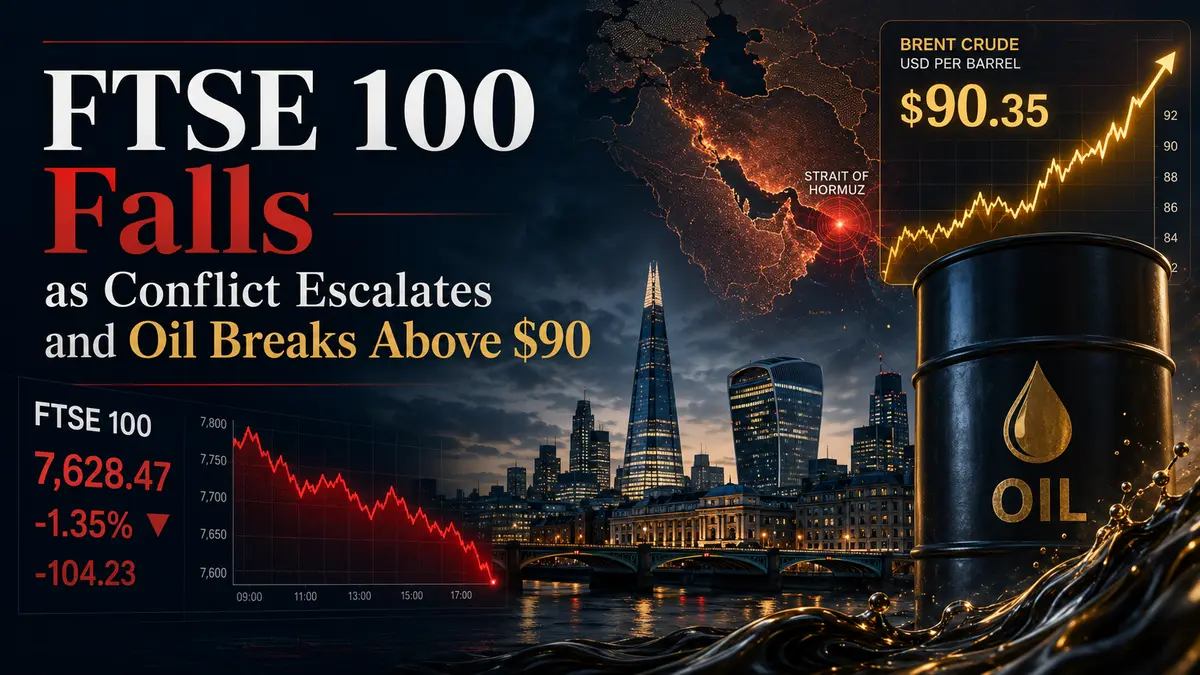
The first trading day of the week began with a noticeable decline in the British market. The FTSE 100 had fallen by 0.61% by the middle of the trading session, reflecting a broader deterioration in sentiment across European markets. Investors are fleeing risk, and they have good reasons to do so.
The conflict in the Middle East has entered a new and more dangerous phase. For the ninth consecutive night, the US military has carried out strikes against Iranian targets. These are no longer isolated operations but a systematic effort to suppress Iran’s military capabilities. Tehran’s response is becoming increasingly aggressive and is spreading to neighbouring countries in the Persian Gulf.
Germany’s DAX lost 0.16%, while France’s CAC 40 declined by 0.05%. However, the British market proved to be the most vulnerable. The reason is the United Kingdom’s dependence on imported energy and the sensitivity of its economy to rising oil prices. As the market is currently demonstrating, oil prices are climbing rapidly.
The Pound Sterling: A Small Island of Stability
Against the backdrop of a falling stock market, the pound sterling has remained relatively resilient. The British currency rose by 0.08% to $1.3466. This modest but symbolic appreciation suggests that investors still have confidence in the British economy despite the external shocks.
The focus is now on the UK political landscape. Andy Burnham is expected to formally take office as prime minister on Monday, and his promise to give households “breathing space” from the rising cost of living has resonated with voters. However, the extent to which this promise can be implemented in practice remains an open question.
Burnham’s position on North Sea oil production is attracting particular attention. US President Donald Trump has already welcomed plans to “open up” drilling in a post published on Truth Social. However, Labour deputy leader Lucy Powell told the BBC that Burnham would not abandon his election pledge to stop issuing new exploration licences.
The new prime minister is expected to visit Aberdeen to support the continued development of existing fields, including Jackdaw and Rosebank, but no new licences will be issued.
This is a compromise that may satisfy neither supporters of strict environmental policies nor advocates of maximum oil production. Nevertheless, amid the crisis in the Middle East and rising energy prices, it appears to be a reasonable position.
Oil Breaks Above $90 as the Geopolitical Risk Premium Rises
Oil was the main driver of market activity on Monday. BZUSD ... Brent crude jumped by 2.35% to $90.18 per barrel, while WTI ... WTI gained 2% to reach $83.40. These are the highest levels recorded in more than a month, and prices continue to rise.
The cause is the escalation of the conflict around the Strait of Hormuz. US Central Command confirmed the completion of a ninth night of strikes against Iran.
The operations targeted Iranian military command centres, air-defence facilities, coastal surveillance systems, naval capabilities, missile and drone launch positions, and communications networks. The objective is to further weaken Iran’s ability to attack commercial vessels and civilian sailors passing through the Strait of Hormuz.
Iran has not remained passive. On Monday morning, the Kuwaiti army announced that its air-defence systems were actively intercepting Iranian drones, describing the attack as “sinful Iranian aggression.” This indicates that the conflict is expanding and that not only the Strait of Hormuz but also other countries in the Persian Gulf are now under threat.
Separately, the United Kingdom Maritime Trade Operations agency issued a warning about a vessel that had caught fire near Kumzar, off the coast of Oman. The cause of the incident has not been established, but against the backdrop of ongoing military operations, suspicions have fallen on Iran.
Trump: “We Control the Strait”
US President Donald Trump made a forceful statement while returning to Washington from the FIFA World Cup final. He told reporters that the strikes had been carried out in honour of the US service members who had been killed — “probably three of them.”
According to Trump, Iran had “suffered serious damage” and had “almost nothing left militarily.” His strongest statement was: “We control the strait. They control nothing.”
These words may indicate that the United States is prepared for further escalation and has no intention of backing down. Control of the Strait of Hormuz is critical to the global economy, and Washington appears to have concluded that diplomacy is not working and has moved towards a military solution.
However, not everyone in the US administration has adopted such an unequivocal position. Secretary of State Marco Rubio told CNN that Washington was receiving “signals through several channels that Iran wants to negotiate, although divisions within the regime are increasing.”
Rubio warned that any agreement would have to be “real” and verifiable. This suggests that the door to diplomacy remains open, although US demands are likely to be strict.
The growing division within the Iranian regime is an important development. If moderate forces in Tehran genuinely favour negotiations while hardliners want the conflict to continue, a diplomatic solution may remain possible even amid external escalation.
However, until negotiations begin, financial markets are likely to remain tense.

UK Sector News: Who Is Winning and Who Is Losing?
In addition to geopolitical developments, corporate news is also influencing the market.
Ryanair reported a 34% decline in first-quarter profit. Rising fuel costs and lower fares outweighed strong passenger traffic. For an airline that is highly dependent on oil prices, this represents a serious blow. If oil prices continue to rise, Ryanair’s profits could decline even further.
Big Yellow Group, a self-storage operator, reported a 3% increase in first-quarter revenue. The opening of new facilities and improved occupancy rates helped offset inflationary pressures. During periods of uncertainty, individuals and businesses look for places to store their belongings, which supports Big Yellow Group’s business.
The most prominent corporate story was Segro’s rejection of Prologis’s improved £13.5 billion takeover proposal.
Segro, one of Europe’s largest owners of warehouse and logistics property, said the offer undervalued the company. The decision demonstrates the confidence of Segro’s management in the company’s prospects, even amid an unstable economic environment.
Inflation Risks: A New Wave?
The main question concerning investors is whether rising oil prices will trigger a new wave of inflation. If they do, central banks may be forced to begin raising interest rates again, which would deal another blow to equity markets.
The increase in oil prices has already started to affect fuel costs for consumers and businesses. If this trend continues, it will reduce household disposable income and raise operating costs for companies. This would be particularly painful for the United Kingdom, where inflation remains above the target level.
The European Central Bank and the Bank of England have already signalled that they may pause interest-rate increases. However, if inflation accelerates, they will have to reconsider their plans. This creates additional uncertainty for financial markets.
What Happens Next?
Monday was a day when geopolitics completely took control of the markets. The ^FTSE ... FTSE 100 fell, oil climbed to its highest level in more than a month, and gold declined, reflecting mixed investor sentiment.
The coming days will show whether diplomacy can prevent further escalation. If negotiations begin, markets may stabilise. If military operations continue, oil prices could rise even further, while equity markets may continue to decline.
In the United Kingdom, attention will be focused on the new prime minister. Andy Burnham is only beginning his term in office, and his first decisions will shape investor attitudes towards the British market.
His position on North Sea production, his promise to provide relief to households, and his approach to diplomacy will all be important.
One thing can be said with certainty: the period of calm in financial markets is over. The conflict in the Middle East, the change of government in the United Kingdom, and renewed inflationary risks are creating a perfect storm, and investors will need to be prepared for every possible scenario.


Comments
No comments yet. Be the first to share your thoughts!
Authentication Required
You must be logged in to post a comment.