

Morning Explosion in Asian Trading
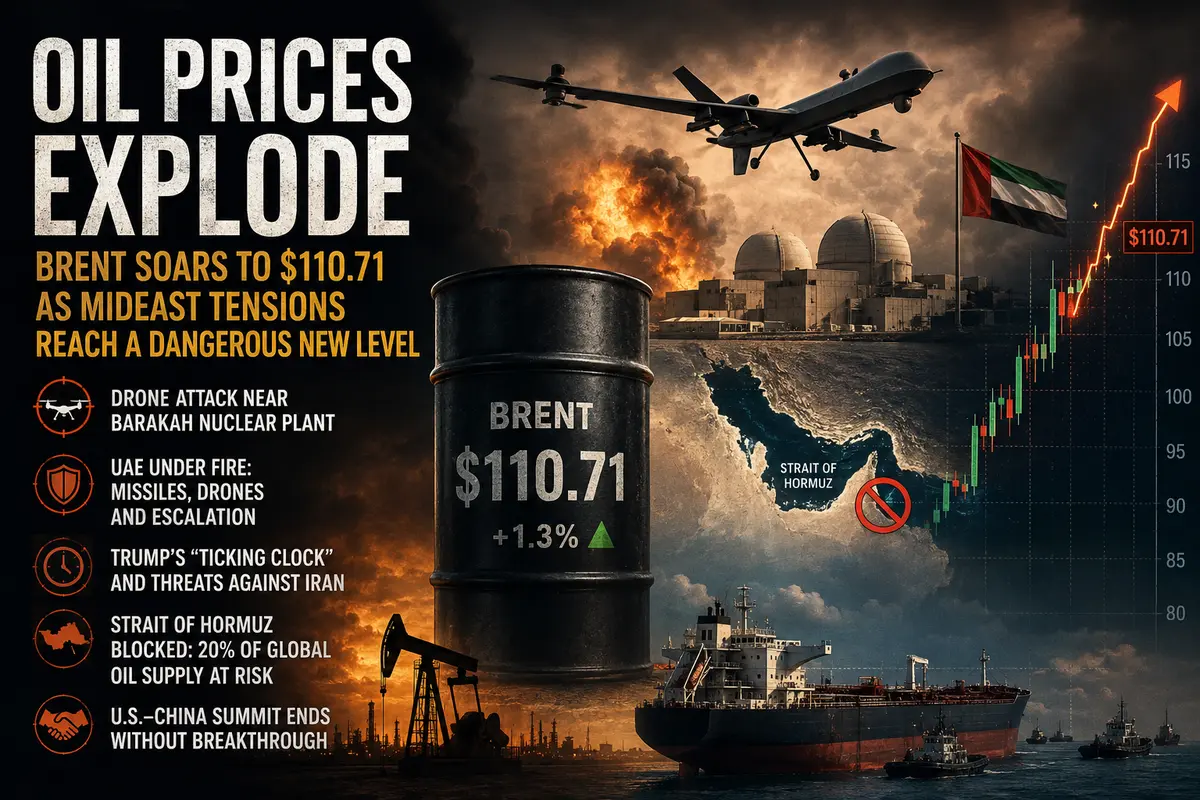
Monday began with a sharp surge in oil prices. As soon as Asian markets opened, July futures for North Sea Brent crude jumped 1.3%, reaching $110.71 per barrel. For early morning trading, when liquidity is still relatively thin, this is a highly significant move. It indicates that a buildup of news over the weekend was bound to spill over into prices.
Traders arriving at their desks in Tokyo, Singapore, and Shanghai were greeted by a troubling picture on their terminals: oil was climbing again, the geopolitical fire in the Middle East showed no signs of cooling, and diplomatic efforts had yet to produce meaningful results. While they were sipping their morning coffee, algorithmic trading systems were already pricing in a new phase of escalation.
Drone Over Barakah: An Attack That Changes the Rules
The key trigger behind the morning spike was an event that at first glance might have seemed like a local incident, but in reality carries far-reaching implications. On Sunday, drones struck a facility near the Barakah nuclear power plant in the United Arab Emirates. The fire that broke out after the attack was contained, but the aftermath left a far deeper impact than the material damage itself.
Barakah is not just a power plant. It is the first and only operational nuclear power station in the Arab world, a symbol of the UAE’s technological ambitions, and a site under close scrutiny from international nuclear safety regulators. A drone strike near such a facility represents an entirely new level of escalation. This is no longer about tankers in the Persian Gulf or oil infrastructure. It is about the potential for a nuclear catastrophe in a densely populated region, and the market reacted accordingly — as a signal that the conflict has entered a far more dangerous phase.
According to available reports, Iran and affiliated groups were behind the attack. Tehran, of course, denies direct involvement, but for the market that no longer matters. What matters is the fact that someone is targeting sites near a nuclear facility in a country that is both a key U.S. ally and a major player in the global oil market. For any risk manager, that is enough to send alarm bells ringing.
Missiles and Drones: The UAE Under Fire
This latest strike is not the first time the UAE has come under attack. In early May, Iran had already launched drone and missile strikes against Emirati territory. At the time, many viewed it as a sharp escalation but hoped it would remain an isolated incident. It is now becoming clear that it was not a one-off show of force, but the beginning of a systematic campaign.
The UAE now finds itself in an extremely vulnerable position. A country that spent years presenting itself as an island of stability and security in a volatile region is now forced to live under the threat of aerial attacks. The strike near the Barakah nuclear plant demonstrated that Iranian drones are capable of reaching strategically critical targets, creating a completely new level of anxiety across the Gulf states, from Qatar to Saudi Arabia.
For the oil market, this means that it is no longer just Iranian oil supplies that are at risk — those were already largely removed from the market due to sanctions and blockades. What is now under threat is the entire region’s oil infrastructure, including the UAE’s production capacity as one of OPEC’s largest producers. That represents a completely different scale of potential supply disruption.
Trump and the “Ticking Clock”: Rhetoric That Freezes the Market
While drones were falling near Barakah, Donald Trump, in his characteristic style, added fuel to the fire. His warning that “the clock is ticking” and that Iran must accept the terms of a deal sounded like an ultimatum without a deadline, but with a very clear threat attached. When the President of the United States says that time is running out, the market interprets it as a sign that military confrontation is becoming increasingly likely.
Meanwhile, sources report that the United States and Israel are actively discussing the possibility of new military operations against Tehran. The mere existence of such discussions — even at a preliminary stage — creates an environment in which oil traders simply cannot afford to maintain short positions. The risk is too high that they could wake up one morning to discover that overnight events have sent oil prices soaring.
Last week, Trump also warned that the ceasefire regime with Iran was “on life support.” It is a disturbing metaphor. The patient is not dead, but remains hooked up to tubes and wires, and one careless move could bring everything crashing down. Peace negotiations have effectively reached a dead end, and no one knows how to break the impasse.
The Strait of Hormuz: A Hostage to the Conflict
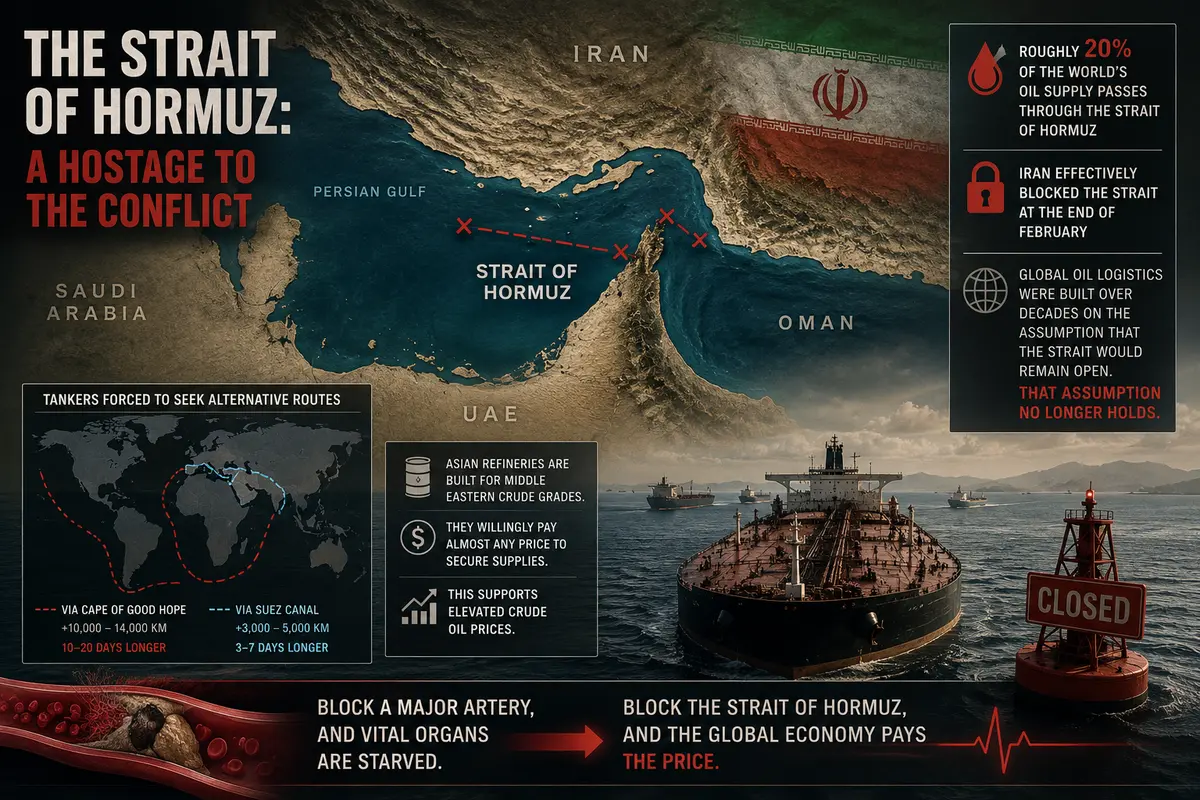
At the center of this entire drama remains the Strait of Hormuz. The narrow waterway through which roughly one-fifth of the world’s oil supply passes remains closed. Iran effectively blocked the strait at the end of February, and since then the situation has not improved.
The closure of the Strait of Hormuz is not merely a technical disruption. It is a tectonic shift in the global logistics of oil supply. Tankers that once passed directly through the strait toward Asia are now forced to seek alternative routes — if such routes even exist. For many Asian countries whose refineries are designed specifically for Middle Eastern crude grades, there are simply no viable alternatives. They are willing to pay almost any price to secure the supplies they need.
This is precisely what continues to support elevated crude oil prices. Even if additional production emerges elsewhere in the world, it cannot compensate for the loss of shipments through Hormuz. It is like blocking a major artery and then wondering why blood is no longer reaching vital organs. Global oil logistics were built over decades on the assumption that the strait would remain open. That assumption no longer holds, and the market is undergoing a painful and costly restructuring.
A Summit That Failed to Deliver Hope
Last week, a U.S.–China summit took place, and many hoped it could produce a diplomatic breakthrough on the Iranian issue. The logic was straightforward: China is one of the few powers that still maintains influence over Tehran, and if Beijing agreed to pressure Iran toward a peaceful resolution, it could open the door to de-escalation.
But the summit concluded without any meaningful agreements on the Iranian crisis. The two sides exchanged routine statements, expressed concern, called for restraint — and parted ways. For the oil market, this signaled that the diplomatic track remains stalled, meaning the geopolitical risk premium embedded in oil prices is here to stay.
The lack of progress involving China is especially alarming because Beijing is effectively the last potential mediator capable of influencing Tehran. Europe is too weak and divided, Russia is itself locked in confrontation with the West, and regional states are either directly involved in the conflict or too small to play an independent role. Without Chinese involvement, a diplomatic resolution appears highly unlikely.
The Oil Market Holds Its Breath
This combination of factors has created what traders call a classic “geopolitical premium” in the oil market. It is an additional price markup reflecting not the current balance of supply and demand, but the probability of future supply disruptions. And the higher that probability, the larger the premium becomes.
Right now, that premium is enormous. The market is no longer pricing in the preservation of the status quo — it is pricing in the possibility of further escalation. Every new drone strike, every hawkish statement from Trump, every report of military consultations between the United States and Israel adds several more dollars to the price of a barrel.
For consumers worldwide, this means continued high prices for gasoline, jet fuel, and freight transportation. For central banks, it means persistent inflationary pressure that prevents interest rate cuts. And for oil-importing nations, especially in Asia, it means a gradual but relentless deterioration in trade balances and rising debt burdens.
Monday morning in Asia began with Brent at $110 per barrel. And as long as drones continue flying over the Middle East, the Strait of Hormuz remains closed, and diplomats fail to find a path out of the deadlock, these numbers may prove not to be the peak, but merely a waypoint on the road to even higher prices.
The clock really is ticking — for the market, and for an entire region frozen in anticipation of what comes next.

Comments
No comments yet. Be the first to share your thoughts!
Authentication Required
You must be logged in to post a comment.