

Strait of Hormuz Closed: Oil Market in Shock
Introduction: The Red Line Has Been Crossed
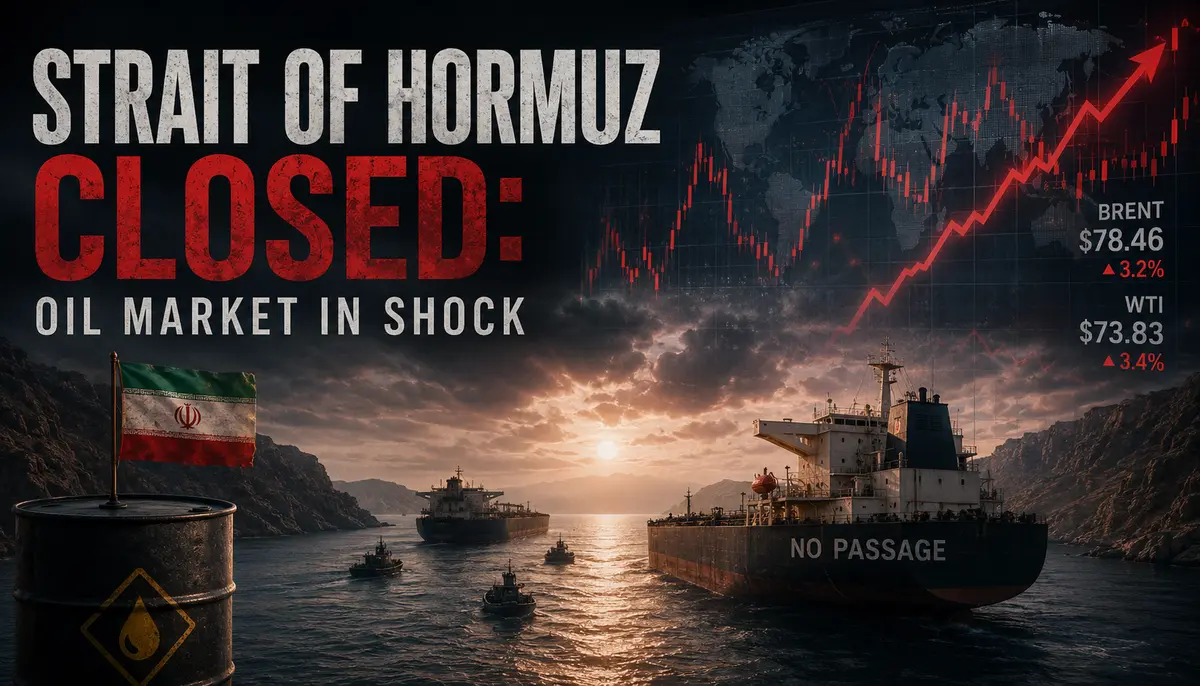
Monday began with an explosion in the oil markets—literally. Iran expanded its missile and drone attacks against Persian Gulf countries, including Qatar and the United Arab Emirates, and then announced the closure of the Strait of Hormuz. Oil prices surged by more than three percent within hours. Brent futures climbed to $78.46 per barrel, while WTI rose to $73.83.
This is not simply another geopolitical escalation. It is a strike at the very heart of the global energy system. The Strait of Hormuz is more than just a maritime route. It is an artery through which the lifeblood of the modern economy flows. Around twenty percent of all the oil consumed worldwide passes through it. Now, according to Tehran, this channel has been closed.
What is behind this decision? Who attacked the commercial vessel? Most importantly, how long will this crisis last, and what will it mean for the global economy? In this article, we examine every aspect of a situation that transformed the oil market in a single morning and forced traders around the world to recalculate their models.
Escalation: How the Strait Came to Be Closed
From Ceasefire to War in a Matter of Days
The history of this conflict is a classic example of how fragile peace can collapse in an instant. Just a week ago, it appeared that diplomatic efforts to restore the memorandum of understanding between the United States and Iran were producing results. Negotiations were underway, mediators were working, and both sides were avoiding drastic moves.
Then everything changed. Trump announced the end of the ceasefire and intensified strikes against Iranian facilities. Tehran, which had exercised restraint for a long time, responded. Its response proved far more severe than Washington had expected. Missile attacks against Qatar and the UAE marked a new level of escalation because both countries had traditionally been regarded as neutral or even friendly toward Iran.
When an Iranian missile struck a commercial vessel in the Strait of Hormuz, the conflict reached a point of no return. Tehran announced the closure of the strait. Although the United States immediately challenged the claim, stating that shipping routes remained open under the protection of the US military, markets had already begun pricing in the worst-case scenario.
Why the Strait of Hormuz Is So Important
To understand the scale of what is happening, it is necessary to recognize the role the Strait of Hormuz plays in the global economy. It is a narrow maritime corridor, only about thirty kilometers wide, connecting the Persian Gulf with the Indian Ocean. Oil tankers from Saudi Arabia, Iraq, Kuwait, Qatar, and the UAE pass through it.
Under normal conditions, around 17–18 million barrels of oil travel through the strait every day. That represents approximately one-fifth of the world’s seaborne oil trade. In addition, roughly one-third of all liquefied natural gas transported by sea passes through the strait.
Any disruption to this channel is not merely a regional problem. It is a problem for the entire world. Asia—particularly China, Japan, South Korea, and India—is critically dependent on oil transported through the Strait of Hormuz. Europe is also dependent on these supplies, although to a lesser extent.
Now, according to Tehran’s official statement, this channel has been closed. Even if shipping continues in practice and the United States provides military protection, the announcement itself creates enormous uncertainty and pushes prices higher.
Market Reaction: Numbers That Speak for Themselves
An Immediate Price Surge
The market reacted immediately. Brent crude for September delivery rose by 3.2 percent to $78.46 per barrel. WTI for delivery in the same month posted an even stronger increase, climbing 3.4 percent to $73.83.
But this may only be the beginning. During the previous week, both contracts had already gained more than 4 percent amid the escalating conflict. In other words, oil prices rose by approximately 7–8 percent in just over a week. If the escalation continues, the increase could become significantly larger.
What Traders Are Pricing In
Oil prices now contain a geopolitical risk premium whose exact size is difficult to calculate. It is clear, however, that the market expects the current level of tension to persist for at least the next several weeks.
Traders are also beginning to price in the possibility of coordinated action by major oil producers. If supplies through the Strait of Hormuz genuinely decline, Saudi Arabia, the UAE, and other countries may attempt to offset the losses by increasing production from fields located in other regions.
Another factor is the possibility of releases from strategic petroleum reserves. The United States and other members of the International Energy Agency hold significant oil reserves that could be used to stabilize the market in the event of serious supply disruptions.
Consequences for the Global Economy
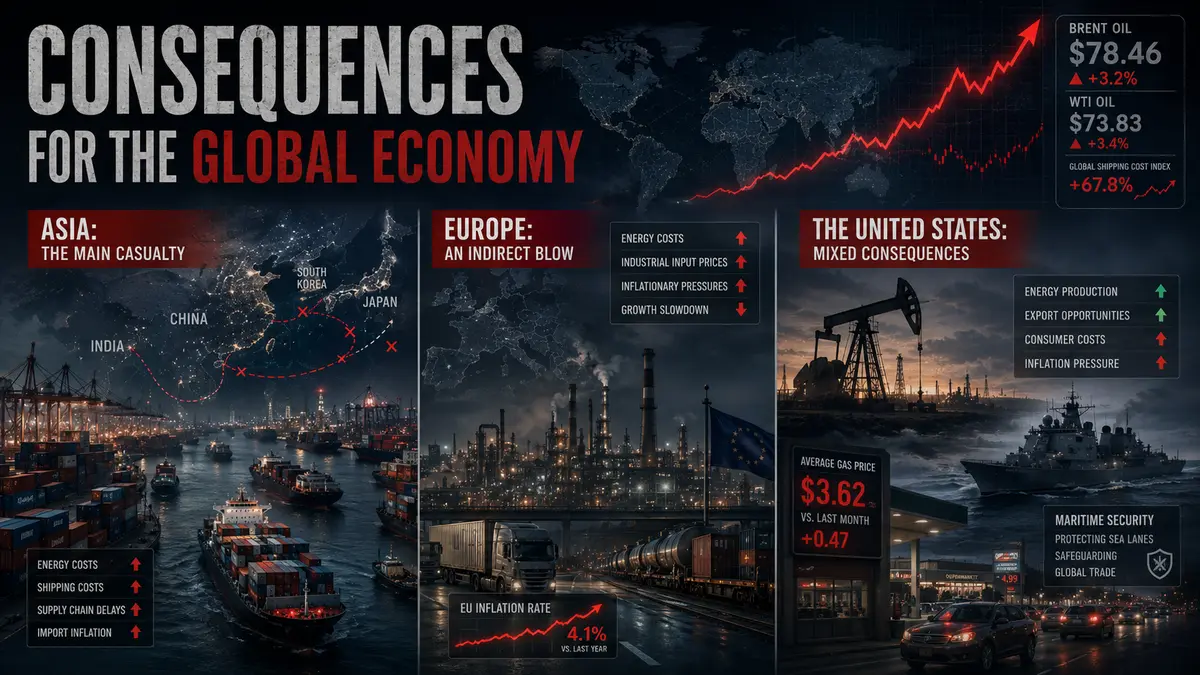
Asia: The Main Casualty
Asia would suffer the most from the closure of the strait. China, Japan, South Korea, and India all import enormous volumes of oil through the Strait of Hormuz. If supplies decline, these countries will have to seek alternative sources.
This would mean longer shipping routes, higher freight costs, and ultimately higher prices for consumers. Rising oil prices quickly translate into more expensive gasoline and diesel, as well as higher prices for all goods transported by trucks and ships.
Asia could also face problems related to refining capacity. Most refineries in the region are designed to process specific grades of crude oil, and switching to alternative grades may require time and additional investment.
Europe: An Indirect Blow
Europe is less dependent on the Strait of Hormuz than Asia, but it would still feel the consequences. Higher oil prices would weigh on the European economy, which is already experiencing difficult conditions. Inflation could accelerate, forcing the European Central Bank to maintain a restrictive monetary policy.
Countries that are heavily dependent on energy imports—particularly Germany, Italy, and France—would be especially vulnerable. Rising energy costs could undermine the competitiveness of European industry and slow the region’s economic recovery.
The United States: Mixed Consequences
For the United States, the situation has two sides. On the one hand, rising oil prices mean higher revenues for American shale producers, which may increase production and exports. On the other hand, higher gasoline prices hurt US consumers and could accelerate inflation.
The United States also acts as a guarantor of maritime security in the region, and any escalation requires additional military spending. If the conflict continues for an extended period, it could become a serious burden on the federal budget.
Strategic Reserves and Possible Responses
What Is the Strategic Petroleum Reserve?
The US Strategic Petroleum Reserve is the world’s largest emergency oil stockpile, created to protect the country from major supply disruptions. It holds around 700 million barrels of oil, enough to cover the country’s import requirements for several months.
However, the United States is not the only country with such reserves. China, Japan, South Korea, and European countries also maintain strategic stockpiles. The International Energy Agency coordinates the actions of its member states during periods of crisis.
In the current situation, markets expect that the United States and its allies may decide to release some of their reserves to contain prices. However, such decisions are not made immediately, and their impact may be limited.
OPEC+ Actions
OPEC+ will also be monitoring the situation closely. The alliance has significant spare production capacity, particularly in Saudi Arabia and the UAE, which could increase output to compensate for lost Iranian supplies.
However, there is also a political dimension. Saudi Arabia and the UAE are not interested in oil becoming excessively cheap, but they also do not want prices to rise to levels that could trigger a global recession.
In addition, OPEC+ may encounter logistical difficulties. Increasing production and exports takes time, and not all member countries are capable of rapidly raising output.
Outlook: Possible Scenarios
Optimistic Scenario
The most optimistic scenario assumes that the escalation will be short-lived. Diplomatic efforts would resume, the parties would agree to a new ceasefire, and shipping through the Strait of Hormuz would return to normal.
In this case, oil prices could stabilize and then begin to decline as the geopolitical risk premium gradually disappears from market quotations. Even under this scenario, however, volatility would remain elevated for the next several weeks.
Realistic Scenario
A more realistic scenario assumes that tensions will remain high for several weeks or months. The United States would continue to protect commercial shipping, while Iran would periodically threaten to close the strait and carry out limited attacks.
Under these conditions, Brent crude prices could remain elevated in the range of $80–90 per barrel, with the possibility of short-term spikes above $100 in the event of renewed escalation.
The global economy would suffer from higher energy prices, but a catastrophe could still be avoided. Strategic reserves and increased production by other producers could partially offset the loss of supplies.
Pessimistic Scenario
The worst-case scenario would involve a prolonged closure of the strait and a full-scale war between the United States and Iran. Under these circumstances, oil prices could surge to $150–200 per barrel, triggering a global recession.
Asia, and China in particular, would face an extremely difficult situation. Energy companies would be forced to seek alternative routes, but those routes have limited capacity. Global trade would be disrupted, and an economic downturn would become unavoidable.
This scenario currently appears unlikely, but markets have already begun pricing in the possibility of its partial realization. Traders around the world are recalculating their models in preparation for the worst.
What This Means for Investors
Trading Strategies
For traders, the current situation presents both an opportunity and an enormous risk. High volatility can generate rapid profits, but it can also result in catastrophic losses if the market moves in the opposite direction from expectations.
Many investors are currently increasing the share of energy stocks in their portfolios in anticipation of further oil price growth. However, it is important to remember that the geopolitical risk premium can disappear just as quickly as it appeared.
Long-Term Prospects
For long-term investors, the crisis in the Strait of Hormuz is a reminder of how vulnerable the global energy system remains. The transition to renewable energy sources and the development of alternative supply routes are becoming increasingly important.
Investments in green energy and energy-efficient technologies may prove not only ethically justified but also financially profitable over the long term.
Conclusion: A New Reality for the Oil Market
Monday will go down in history as the day the Strait of Hormuz was closed. Even if the closure is only temporary, the announcement itself changes the rules of the game in the oil market. The geopolitical risk premium has returned, and it will remain embedded in prices for as long as the threat persists.
An oil price increase of more than 3 percent in a single day is a serious signal. Markets are revising their models, investors are adjusting their portfolios, and policymakers around the world are searching for ways to de-escalate the situation.
Most importantly, the crisis serves as a reminder of the fragility of the global energy system. We have grown accustomed to oil flowing freely, but a single political mistake can interrupt that flow at any moment.
All eyes are now focused on the Persian Gulf. The way events develop over the coming hours and days will determine not only the price of gasoline at filling stations around the world but also the stability of the global economy. The Strait of Hormuz is closed. The only questions are how long it will remain closed and how far the escalation will go. The world is holding its breath.

Comments
No comments yet. Be the first to share your thoughts!
Authentication Required
You must be logged in to post a comment.