

Cryptocurrency: Why Everyone Is Talking About It and Whether I Should Get In (Spoiler: I’m Just Watching for Now)

Hi, this is NorthRay.🙌
While I’ve been learning Forex, indices, and gold trading, the entire internet has been shouting about Bitcoin.
— “Bitcoin hits a new all-time high!”
— “Crypto crashed — time to buy!”
— “A kid from Omsk bought Dogecoin and now drives a Lamborghini.”
I honestly tried to ignore it. But curiosity won.
So I decided to figure out what cryptocurrency actually is, how it works, what exchanges people trade it on, and whether it’s something a beginner trader like me should get involved with.
Spoiler: I still haven’t bought a single coin. But at least now I understand what everyone is talking about.
What Is Cryptocurrency? (A Simple Explanation)
Cryptocurrency is digital money. It has no physical form. No coins in your pocket, no banknotes in your wallet — just numbers on a screen.
The biggest difference between crypto and traditional money is that cryptocurrencies don’t have a central bank. No one can simply print more Bitcoin whenever they feel like it. No one can easily freeze your wallet. No single authority decides what a coin should be worth.
Here’s a simple way to think about it:
Imagine a notebook that is stored on millions of computers around the world at the same time. Every page in that notebook is a “block.” Whenever money is transferred, everyone can see the record. It can’t be erased, altered, or reversed.
That’s blockchain — the technology that powers cryptocurrency.🤔
The Main Features of Cryptocurrency
When I started learning about crypto, I identified five key differences from traditional money.
1. Decentralization
No bank or government controls cryptocurrency. It belongs to everyone and no one at the same time.
2. Limited Supply
There will never be more than 21 million Bitcoins. They can’t be “printed” like dollars or rubles. This helps protect against inflation.
3. Pseudonymity
You have a wallet address — a long string of letters and numbers. Anyone can see the transactions linked to that address, but identifying the actual owner is much more difficult.
4. Irreversible Transactions
Once you send cryptocurrency, there’s usually no way to get it back. You can’t call the bank and cancel the payment. Send it to the wrong address, and it could be gone forever.
5. A 24/7 Market
Unlike the U.S. stock market, which closes overnight, the crypto market never sleeps. Monday morning? Sunday at 3 a.m.? Trading continues. That’s both an advantage and a disadvantage.
The Most Popular Cryptocurrencies You Should Know
There are thousands of cryptocurrencies. Some are serious projects, while others are little more than hype or scams. Here are the main ones everyone watches.🧠
Bitcoin (BTC)
The first and most famous cryptocurrency. Often called “digital gold.” It’s the most valuable and widely trusted cryptocurrency.
Ethereum (ETH)
The second most popular cryptocurrency. Its key feature is smart contracts — programs that run automatically without intermediaries. Entire ecosystems of decentralized applications are built on Ethereum.
Stablecoins (USDT, USDC)
Cryptocurrencies pegged to the U.S. dollar. One USDT is usually worth about one dollar. They’re often used to lock in profits without leaving the crypto ecosystem.
Meme Coins (Dogecoin, Shiba Inu)
These started as jokes but sometimes explode in value due to hype and social media attention. You can make money on them — or lose everything very quickly. Extremely risky.
My beginner’s opinion: if I ever decide to enter crypto, I’ll start with Bitcoin and Ethereum, not dogs, frogs, or other meme coins.
What Is a Crypto Exchange and Why Do You Need One?
A crypto exchange is a platform where you can buy, sell, or trade cryptocurrency.
Think of it as a currency exchange office, but online. You deposit dollars or euros, buy Bitcoin, and later sell it back if the price rises.🎢
How It Works
-
Register on an exchange.
-
Complete identity verification (KYC).
-
Deposit funds via bank transfer or card.
-
Buy cryptocurrency.
-
Either keep it on the exchange or transfer it to your personal wallet.
Types of Crypto Exchanges
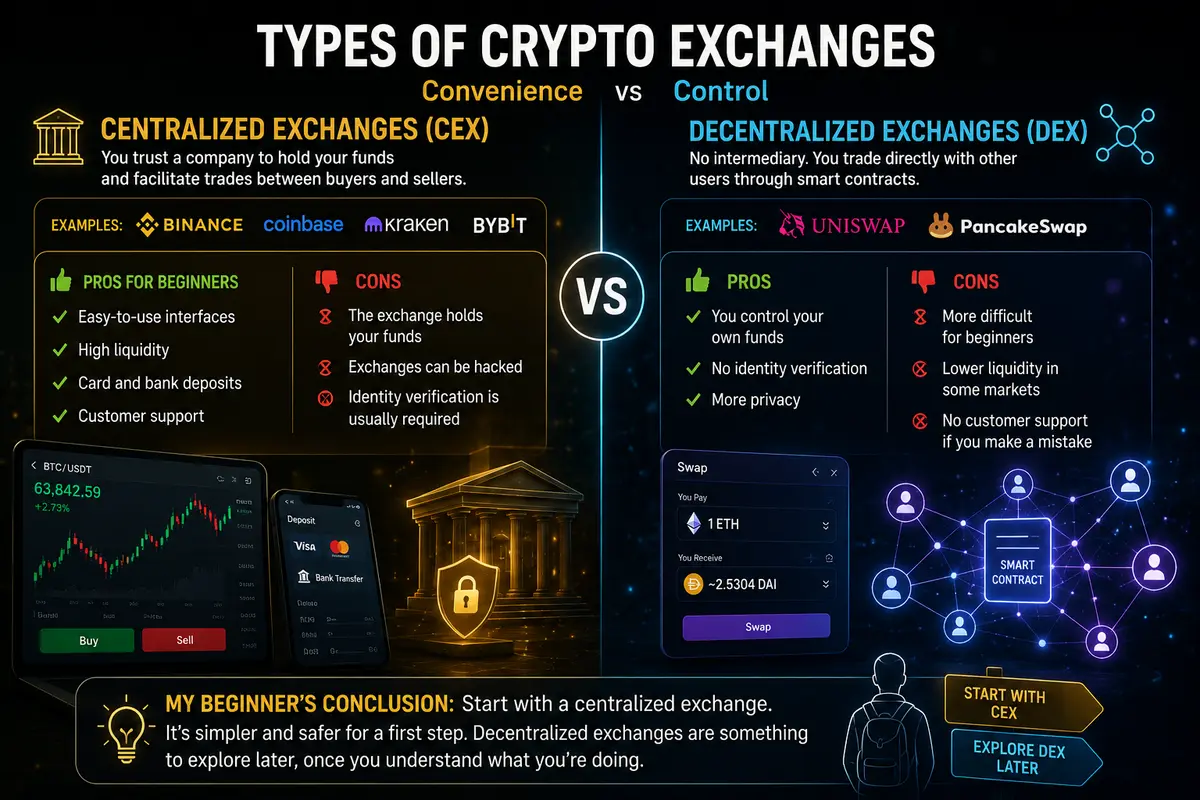
As I learned more, I realized exchanges fall into two main categories. Choosing between them is basically choosing between convenience and control.
Centralized Exchanges (CEX)
Examples: Binance, Coinbase, Kraken, Bybit.
How they work: You trust a company to hold your funds and facilitate trades between buyers and sellers.
Pros for Beginners
-
Easy-to-use interfaces
-
High liquidity
-
Card and bank deposits
-
Customer support
Cons
-
The exchange holds your funds
-
Exchanges can be hacked
-
Identity verification is usually required
Decentralized Exchanges (DEX)
Examples: Uniswap, PancakeSwap.
How they work: No intermediary. You trade directly with other users through smart contracts.
Pros
-
You control your own funds
-
No identity verification
-
More privacy
Cons
-
More difficult for beginners
-
Lower liquidity in some markets
-
No customer support if you make a mistake
My beginner’s conclusion: Start with a centralized exchange. It’s simpler and safer for a first step. Decentralized exchanges are something to explore later, once you understand what you’re doing.📉
How Crypto Differs from Forex and Stocks
I compared crypto to markets I already know — Forex, indices, and stocks.
What this means for me:
Crypto is extreme. You can gain 50% in a week. You can also lose 50% in an hour.
What You Should Know Before Your First Crypto Trade
I’m not trading crypto yet. But if I were starting, these would be my rules.
Rule #1: Never Invest More Than You Can Afford to Lose
Crypto can fall 80% in a month. This isn’t a joke. Investing money needed for food or rent is reckless.
Rule #2: Start Small
Buy $10–20 worth of Bitcoin simply to learn how everything works. No need to jump in with a large deposit.
Rule #3: Use Stop-Loss Orders
Risk management matters in crypto just as much as anywhere else.
Rule #4: Store Crypto in Your Own Wallet
If you’re holding a significant amount, move it from the exchange to a personal wallet. Don’t leave large balances on exchanges indefinitely.
Rule #5: Ignore “Signal Sellers”
“Investor Bob guarantees 500% returns in a month” usually means one thing: scam.
Crypto attracts scammers the way honey attracts flies.
Strategies for Crypto Beginners
I read several beginner guides and found three common approaches.
HODL (Buy and Hold)
The simplest strategy. Buy Bitcoin or Ethereum and hold for years. Sell later if the price rises.
Best for:
People who believe crypto will appreciate over the long term.
Swing Trading
Hold positions for several days or weeks and capture medium-term price movements.
Best for:
People who can follow the market regularly but not 24/7.
Day Trading
Opening and closing trades within the same day.
Best for:
Experienced traders with time, discipline, and strong nerves.
My choice for now:
If I ever enter crypto, I’ll probably start with HODLing. Buy a small amount of Bitcoin and forget about it for six months. Active trading can stay in Forex, where I already understand at least something.🤫
How I’d Choose a Crypto Exchange
If I were choosing one today, I’d focus on several factors.
1. Security
-
Two-factor authentication
-
History of hacks
-
Insurance or protection funds
2. Fees
-
Trading fees
-
Withdrawal fees
-
Deposit fees
3. Liquidity
Can I quickly sell a large amount without significant slippage?
4. Available Coins
Does the exchange offer Bitcoin, Ethereum, and the assets I’m interested in?
5. Regulation and Reputation
Is the exchange operating legally? Does it have licenses? What do users say about it?
Popular Exchanges for Beginners
Coinbase — the easiest for beginners, though fees are higher.
Binance — the largest global exchange with low fees and a huge selection of coins.
Kraken — reliable and well-respected.
Bybit — also very popular, especially among active traders.
What I’ve Decided for Now
I’m not going to abandon Forex and rush into Bitcoin.
At least not yet.🏆
Why?
-
I’m still a beginner in the currency markets. Learning two complex fields at once would spread my attention too thin.
-
Crypto is too volatile for my current experience level.
-
I don’t have a crypto strategy yet. Trading without one is just another way of losing money.
What Will I Do?
-
Continue studying the market.
-
Watch Bitcoin and learn what drives its price.
-
Open a demo account on a crypto exchange and practice with virtual money.
-
If I feel ready, allocate a small amount I can afford to lose and start with a simple HODL approach.
What I Learned Today
First: Cryptocurrency isn’t magic. It’s simply digital money built on blockchain technology. It has advantages (decentralization, limited supply) and disadvantages (extreme volatility and fraud risks).
Second: There are centralized exchanges (better for beginners) and decentralized exchanges (better for advanced users). Starting with a CEX makes the most sense.
Third: Trading crypto is generally harder than trading currencies or stock indices. Volatility is higher, risks are greater, and the market never sleeps.
Fourth: If you decide to get involved, start small and have a clear strategy. For beginners, HODL is probably the simplest option.🤝
What’s Next?
— I’ll keep studying blockchain and Bitcoin.
— I may open a crypto exchange demo account.
— If it goes well, I’ll write a separate post about my first trade (probably a paper trade).
— But my main focus remains Forex and indices. Crypto is more about expanding my knowledge for now.
If you’ve ever looked at Bitcoin and wondered, “Should I get in?” — you’re not alone.
Just remember the golden rule:
Never invest more than you’re prepared to lose.
Especially in a market where a coin can drop 30% in a single day.
For now, I’m watching. Learning. Observing.
But I’m not diving in headfirst.
— NorthRay🤩
(with Bitcoin on the chart, but not yet in the wallet)

Comments
No comments yet. Be the first to share your thoughts!
Authentication Required
You must be logged in to post a comment.