

Taiwan’s Market Plunges 3.5%: Chips, Glass, and Power Drag Everything Down
A Wednesday That Brought Nothing Good
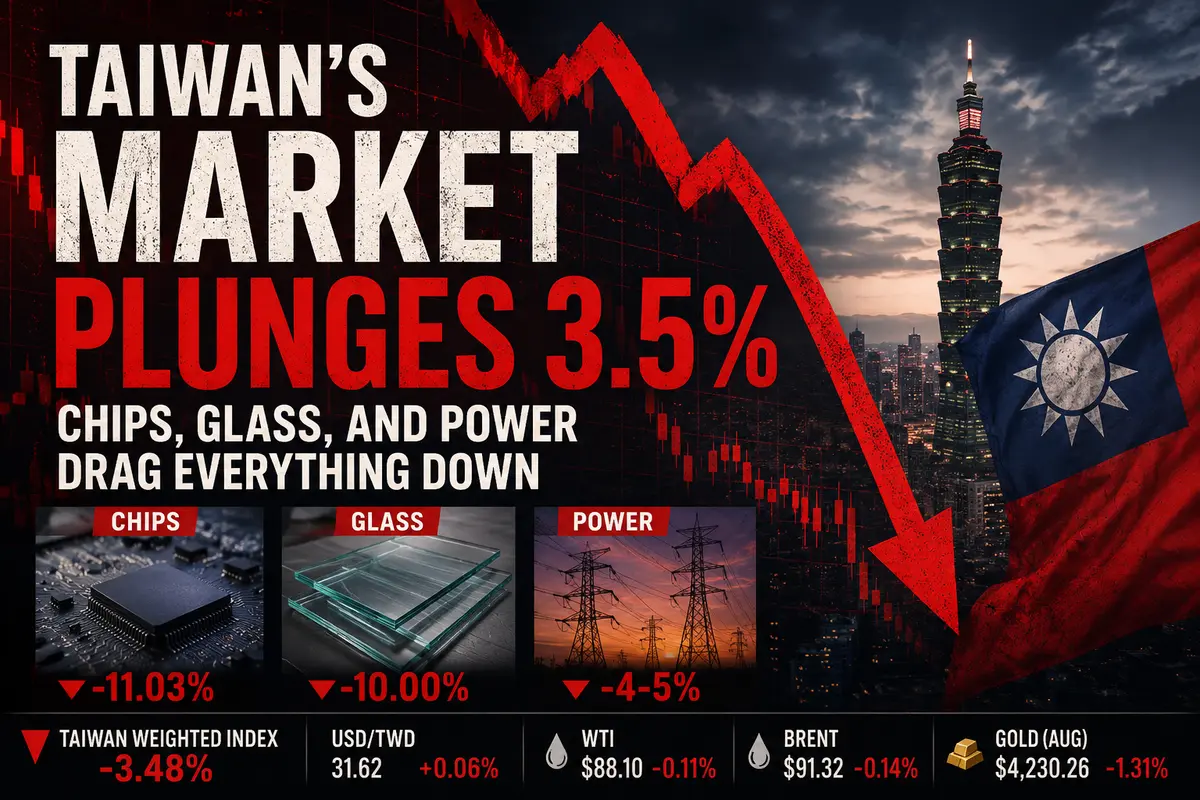
When you wake up in Taipei and open your brokerage app, you expect to see green numbers. Or at least yellow ones. But not red. On the morning of June 10, 2026, everything was red. Not just red—blood red. Taiwan’s benchmark stock index, the Taiwan Weighted Index, the island’s main economic barometer, plunged 3.48% in a single day. Without any obvious domestic trigger. Simply because the world around it seemed to be falling apart.
This was not just a decline. It was a stampede for the exits. Investors sold everything they could. Technology stocks—especially semiconductor companies—were hit first. Glass manufacturers were dumped as well. Energy companies were not spared. Three sectors that form the backbone of Taiwan’s economy came under pressure simultaneously.
Who was to blame? External factors, as is often the case. The conflict in the Middle East, driving up oil prices and fueling panic. Expectations of prolonged high interest rates from the Federal Reserve, which continue to suppress demand for risk assets. An overheating artificial intelligence sector that, after months of relentless gains, has finally entered a correction. And, of course, the ever-present geopolitical tensions surrounding Taiwan itself.
But let’s take it step by step.
Technology Sector: The Main Casualty
Taiwan is semiconductors. Semiconductors are Taiwan. The island produces more than 60% of the world’s chips and over 90% of the most advanced ones. TSMC, UMC, MediaTek, ASE Group—names familiar to every investor on the planet. And when those names fall, the entire market follows.
On Wednesday, Taiwan’s technology sector suffered the steepest losses. Shares of WT Microelectronics, one of Asia’s largest distributors of electronic components, plunged 11.03%. A loss of NT$31 per share in a single session is enormous. Investors fled a company widely viewed as a barometer of electronics demand across Asia. If WT Microelectronics is falling, investors assume chip orders are slowing.
Shares of AP Memory Technology, a producer of specialized memory products for mobile devices and Internet-of-Things applications, dropped 10%. Formosa Sumco Technology, a manufacturer of silicon wafers for semiconductors, also lost 10%. A ten-percent decline in one day is not a correction—it is a rout.
What is driving the selloff? Two factors stand out.
The first is the recent weakness in South Korean chip stocks. Samsung and SK Hynix fell 8–10% earlier in the week before staging a partial rebound, but investor nerves had already been shaken. Taiwan’s market, like South Korea’s, depends heavily on global semiconductor demand. When Korean chipmakers stumble, Taiwanese firms often follow.
The second factor is artificial intelligence. The AI boom that inflated valuations for the past eighteen months has begun to lose momentum. NVIDIA, the biggest beneficiary of the AI craze, has lost roughly 5–6% in recent sessions. Broadcom, a key supplier to data-center infrastructure, delivered a disappointing outlook. Investors began asking difficult questions: Have stocks risen too far, too fast? Is the sector overvalued? Many decided it was time to lock in profits.
Taiwanese chipmakers that supply components for AI infrastructure found themselves directly in the firing line. Even TSMC, the island’s most resilient corporate giant, reportedly fell around 3%.
Glass Manufacturing: An Unexpected Loser
What does glass have to do with any of this?
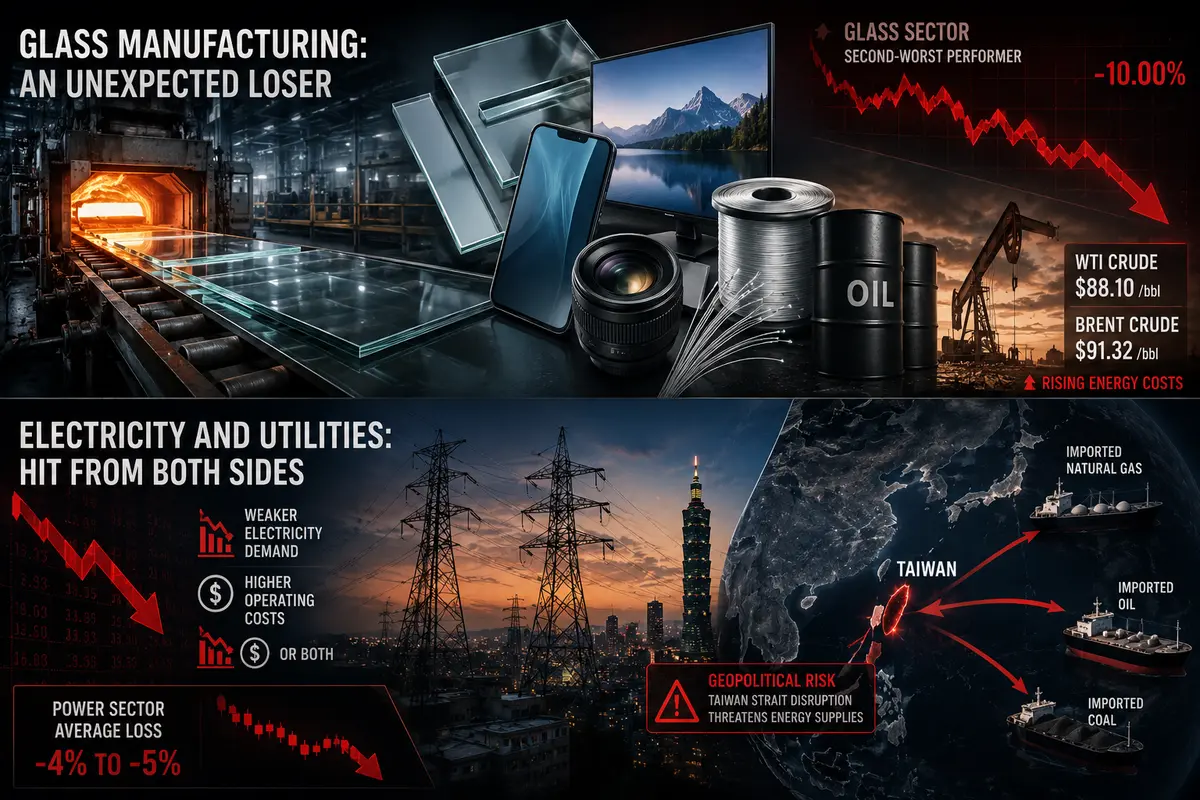
In Taiwan, glass manufacturing is not just about windows and bottles. It includes display glass for smartphones, televisions, and monitors. It includes optical glass used in camera lenses. It includes fiberglass for telecommunications infrastructure.
The glass sector posted the second-worst performance after technology. Investors became concerned about slowing demand for consumer electronics. If consumers buy fewer smartphones and televisions, manufacturers need less display glass. In an environment of high inflation and expensive credit, consumers are indeed tightening their budgets.
Glass production is also highly energy-intensive. Energy prices continue to rise amid instability in the Middle East. WTI crude traded around $88.10 per barrel on Wednesday, while Brent hovered near $91.32. Higher energy costs mean rising production expenses and shrinking profit margins. Investors generally avoid companies facing deteriorating profitability.
Electricity and Utilities: Hit From Both Sides
Taiwan’s power sector also spent the day deep in the red.
This is particularly worrying because energy underpins the entire economy. When utility stocks decline sharply, investors are usually anticipating weaker electricity demand, higher operating costs, or both.
Taiwan is especially vulnerable because it possesses very limited domestic fossil fuel resources. Most of its natural gas, coal, and oil are imported. Rising global energy prices make those imports more expensive. On top of that, geopolitical risks remain significant: any disruption in the Taiwan Strait could threaten energy supply chains.
Investors sold utility stocks aggressively on Wednesday. While comprehensive figures are unavailable, analysts estimate average sector losses of roughly 4–5%.
The Day’s Winners: Strange Islands of Hope
Amid a sea of red, a few green islands remained.
Some companies not only survived the selloff but actually advanced. Their performance served as a reminder that the stock market is not a monolith—it is a collection of thousands of individual stories.
Ho Tung Chemical Corp surged 10%, reaching a three-year high of NT$12.65. The company operates in the chemical sector—not exactly the most fashionable industry. But in uncertain times, investors often seek refuge in established businesses. Chemicals are not AI, chips, or glass. They remain essential for fertilizers, plastics, and cleaning products. Ho Tung Chemical may have benefited from investors rotating out of high-risk growth assets.
Career Technology MFG Co. Ltd., a manufacturer of printed circuit boards, also gained 10%. Printed circuit boards are the foundation of virtually all electronic devices. Even if smartphone sales weaken, automobiles, industrial equipment, and medical devices still require PCBs. Investors may have viewed the company as relatively resilient.
SciVision Biotech Inc. climbed nearly 10% as well. Biotechnology tends to be less dependent on macroeconomic cycles. Demand for medicines and medical technologies does not disappear during economic downturns. SciVision became something of a safe harbor amid the turbulence.
These companies demonstrated that profits can still be made even on a day of widespread market losses—provided investors choose the right stocks. For most market participants, however, that lesson came at a high cost.
What Happened to Currencies and Commodities?
The stock-market decline also spilled over into other asset classes.
The Taiwan dollar (TWD) weakened slightly against the U.S. dollar. USD/TWD rose 0.06% to 31.62. The move was modest, but it reflected capital outflows from the island. When foreign investors sell Taiwanese stocks, they typically convert the proceeds into U.S. dollars before moving funds abroad. Demand for dollars rises, and the TWD weakens.
Against the Chinese yuan, the Taiwan dollar was essentially unchanged. This is notable because, despite ongoing geopolitical tensions, markets do not appear to be pricing in a dramatic weakening of Taiwan’s currency relative to China’s. Both currencies remain under pressure from broader global forces.
The U.S. Dollar Index (DXY), which measures the dollar against a basket of six major currencies, slipped 0.02% to 99.87. The dollar eased slightly after reaching a two-month high earlier in the week. However, the pullback appears technical rather than fundamental. The Federal Reserve continues to maintain elevated interest rates, preserving the dollar’s appeal.
Gold continued its decline. August gold futures fell 1.31% to $4,230.26 per ounce, marking an eleven-week low. High interest rates and a strong dollar remain the primary drivers. Even tensions in the Middle East have failed to provide meaningful support, as markets are more concerned about inflation and potential Federal Reserve tightening than geopolitical conflict.
Oil prices edged lower on Wednesday as well: WTI slipped 0.11% to $88.10 per barrel, while Brent lost 0.14% to $91.32. However, those declines followed a sharp rally earlier in the week. Overall, oil remains expensive, placing additional pressure on economies that rely heavily on imported energy. Taiwan is one of them.

Comments
No comments yet. Be the first to share your thoughts!
Authentication Required
You must be logged in to post a comment.