

Why most breakout fail, and how to spot the real one.
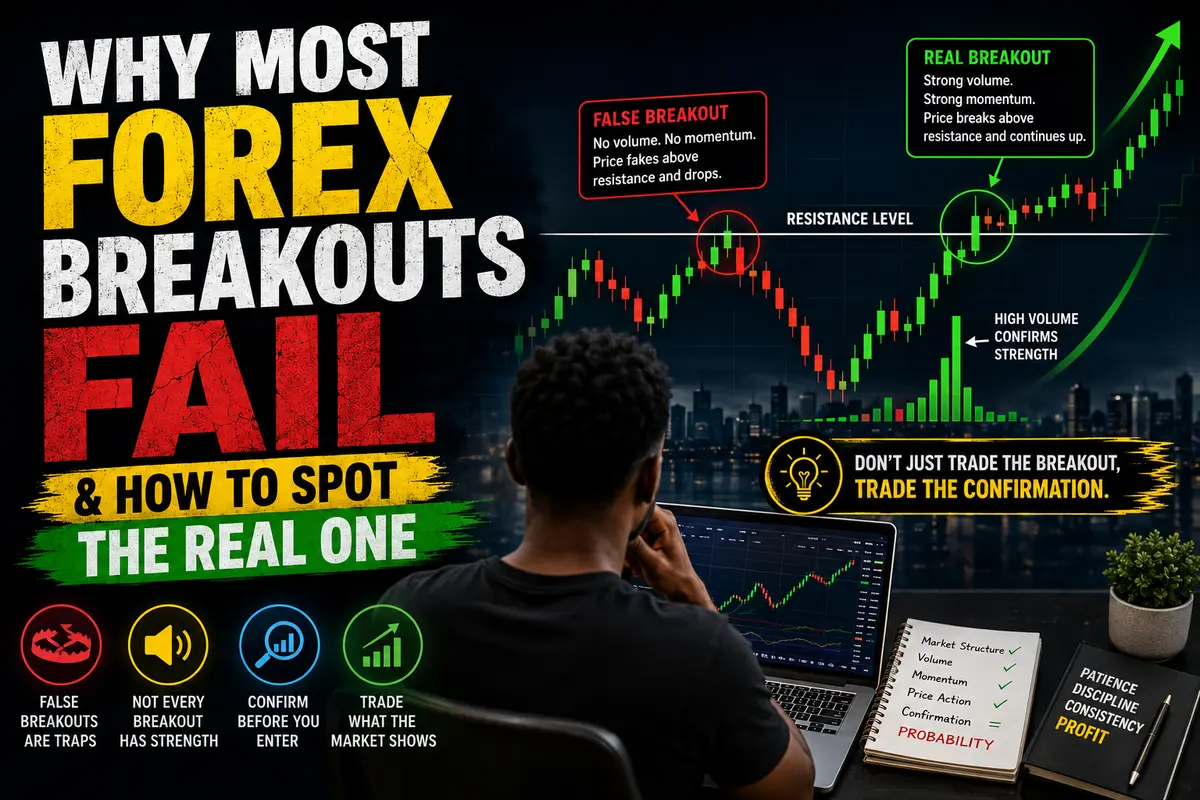
Before you continue reading, let me ask you something.
Have you ever sat in front of your chart, spotted a resistance level, and said to yourself, “If this price breaks, I’m entering immediately”? I have seen many traders do exactly that. In fact, almost every beginner does it at some point.
The funny thing is, the market has a way of humbling us.
You wait for hours. Price keeps respecting one level. Eventually, one candle breaks through it and your heart starts racing. You don’t want to miss the move, so you click Buy. Five minutes later, price turns around as if nothing happened and starts moving against you. Your stop loss gets hit, and you just sit there looking at the screen, wondering, “What just happened?”
If you’ve experienced this before, welcome to the club.
One mistake many of us made when we started learning forex was believing that every breakout was the beginning of a new trend. We assumed that once price crossed support or resistance, the market had already chosen its direction.
With experience, you realise the market is not always that straightforward.
Sometimes, that breakout is nothing more than a trap.
I remember discussing this with another trader one evening. He said, “Anytime I enter on a breakout, the market reverses. But when I don’t enter, that is when the trade flies.”
We both laughed because almost every trader has felt that frustration.
The problem isn’t that breakouts don’t work. They do. The problem is that not every breakout deserves your money.
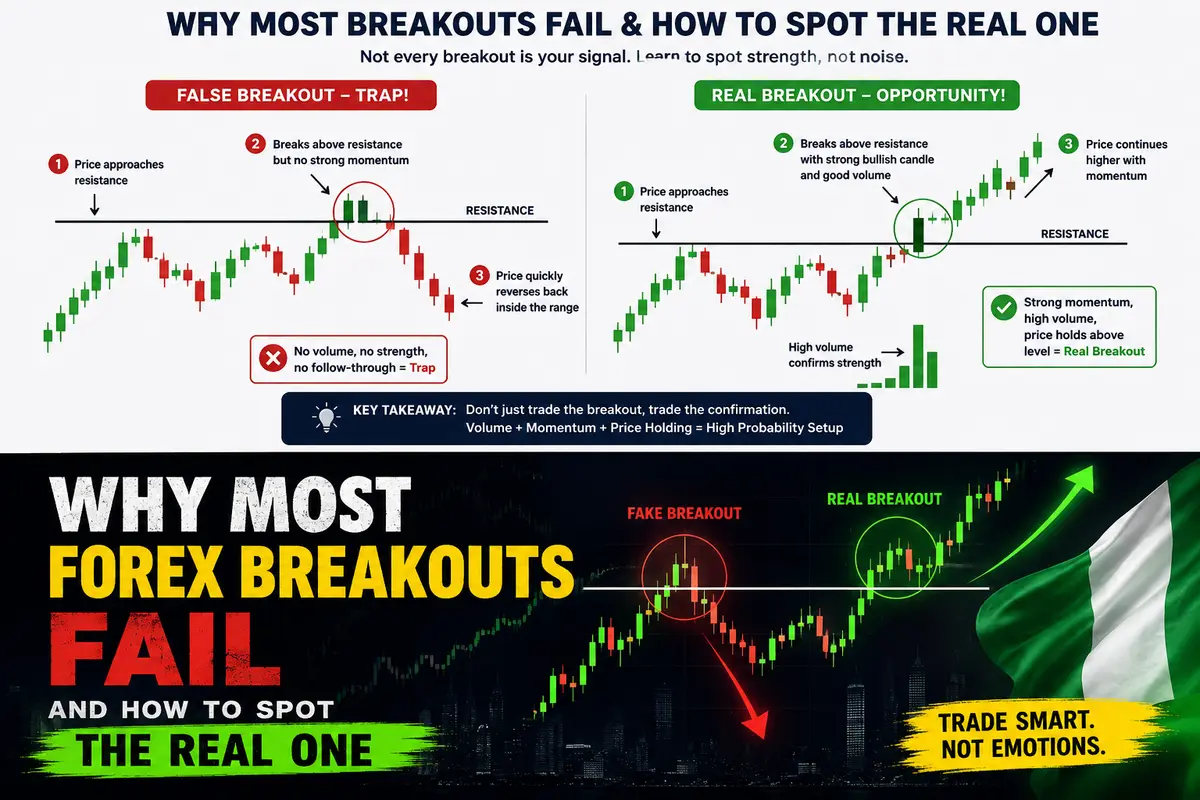
Let’s imagine price has been struggling to move above a resistance level all morning. Around the London session, one strong green candle suddenly closes above that resistance.
A beginner immediately thinks, “This is it.”
An experienced trader thinks differently.
Instead of rushing into the trade, the experienced trader keeps watching.
What happens next?
Does another bullish candle appear with the same strength?
Do buyers continue pushing price higher?
Or does the next candle quietly fall back below the resistance level?
That small difference changes everything.
One lesson I wish someone had taught me earlier is this: a breakout is not confirmed because of one candle.
One candle can be emotional.
One candle can react to news.
One candle can simply attract traders before reversing.
The market always tells a clearer story if you’re patient enough to listen.
Another thing I’ve noticed is that many beginners hate waiting.
Once they see movement, they feel they must enter immediately because they are afraid of missing out.
Ironically, that fear is what gets them into bad trades.
Professional traders don’t mind missing the first few pips.
Their mindset is different.
Instead of asking, “How quickly can I enter?”
They ask, “Has the market proved this breakout is genuine?”
That single question can save you from countless unnecessary losses.
One habit that changed the way I looked at breakouts was waiting for the retest.
At first, I thought waiting meant I would miss profitable trades.
The opposite happened.
I started avoiding many fake breakouts.
Think about it like this.
Imagine someone tells you a newly built bridge is open for use. Will you immediately drive your most expensive car across it without looking? Most people won’t.
You’ll probably watch a few vehicles cross first.
Trading works the same way.
When resistance is broken, allow price to come back and test that same level.
If buyers defend it and price starts moving higher again, that breakout suddenly carries more weight.
The same applies to support.
If price breaks below support, comes back to test it from underneath, and sellers reject it again, the move becomes much more convincing.
Another thing we don’t talk about enough is the higher timeframe.
Many traders focus only on the five-minute chart.
Meanwhile, the one-hour and four-hour charts are saying something completely different.
Imagine trying to swim against a strong river current.
You might move for a while, but eventually the current wins.
That is what happens when you trade against the bigger trend.
One small breakout on a lower timeframe doesn’t automatically mean the market has changed direction.
Then there is news.
Every trader has seen this before.
An economic report is released.
Price shoots up like a rocket.
People start buying everywhere.
A few minutes later, the market crashes back down and leaves everyone confused.
That wasn’t a strong trend.
It was simply volatility.
The biggest lesson forex has taught me is that patience pays more than excitement.
You don’t need to trade every breakout.
You don’t need to prove you can catch every move.
Your job is simply to wait until the market gives you enough reasons to trust what you’re seeing.
At the end of the day, the traders who stay profitable are not always the smartest people in the market.
Most of them are simply more patient.
They understand that another opportunity will always come tomorrow.
And because they know that, they don’t allow one candle to convince them to risk their account.

Comments
No comments yet. Be the first to share your thoughts!
Authentication Required
You must be logged in to post a comment.