

Bar Pipa
We pay for a post of 10$

Economic Calendar

ECB Eve Jitters, Euro Firms on Inflation Data & CAC 40 Steadies Friday, 5 June 2026 | European Session — London Open | Capital Street FX Research Desk
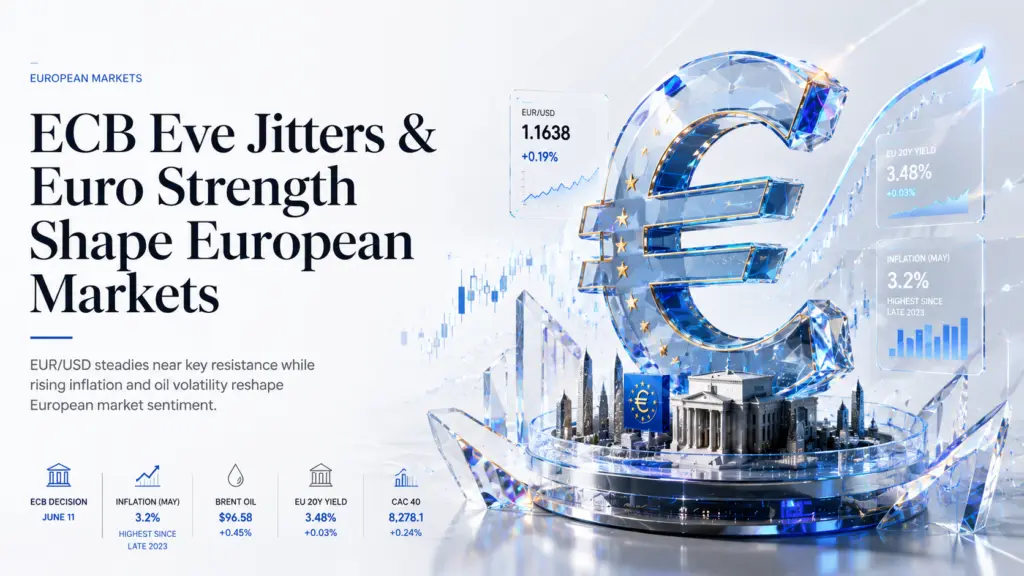
ECB Eve Jitters, Euro Firms on Inflation Data & CAC 40 Steadies Friday, 5 June 2026 | European Session — London Open | Capital Street FX Research Desk

KEY EVENT: ECB Rate Decision — June 11  |  25bp Hike 90% Priced  |  ECB Deposit Rate 2.00%  |  Euro CPI 3.2% (May, highest since late 2023)

EUR/USD 1.1638  ·  EUR/GBP 0.8644  ·  Lead $2,014.51/T  ·  Corn 420.56¢/bu  ·  CAC 40 8,278.1  ·  AstraZeneca £13,150  ·  EU 20Y 3.48%  ·  USDT $1.0001  ·  BNB/USD $594.5


Session Overview — European Markets

Friday's European session opens with an unusual and defining tension: the euro is firming ahead of a rate hike that is already almost fully priced — a reminder that in modern markets, anticipation can both deliver and disappoint. With the European Central Bank's June 11 decision six days away and May eurozone inflation confirmed at 3.2%, the question is no longer whether the ECB will hike, but how hawkish the guidance will be and what comes next.

The macro backdrop is dense. Eurozone inflation rose to 3.2% in May — its highest reading since late 2023, with core at 2.5% and services inflation surging to 3.5%. These data points have pushed money markets to price a near-certain 25 basis-point hike at the June 11 meeting, lifting the ECB deposit rate from 2.00% to 2.25%, with a second hike priced for September and a third increasingly likely before year-end. ECB Governing Council member Isabel Schnabel on Monday added a hawkish note: it is too early to determine the exact number of rate hikes — a deliberate signal that the ECB is not inclined to front-run market guidance. Bank of Italy Governor Fabio Panetta was equally pointed: the forward-looking picture calls for a recalibration to counter the risk of persistent inflationary tensions.

Beneath the ECB narrative, the geopolitical picture remains the dominant risk overlay. Iran hostilities continue to disrupt oil supply chains and push energy-driven inflation across Europe. A conditional Lebanon...


Continue reading...
0
0
NorthRay

Economic Calendar: Why My Trade Died After the Words “Fed Rate” (and How I Started Looking at It Differently)

Economic Calendar: Why My Trade Died After the Words “Fed Rate” (and How I Started Looking at It Differently)

Hi, this is NorthRay.🎉

Remember when I told you about the time I opened a trade, and an hour later the price suddenly shot in the opposite direction — and I had no idea why?

I sat there staring at the chart thinking:

“What just happened? Did someone drop a nuclear bomb? Has the market gone insane?”

Then I checked the news.

Turns out that exact same hour, the head of the U.S. Federal Reserve (Fed) said a couple of sentences about interest rates.
The market reacted.
My trade died.

That was the first time I heard about the economic calendar.

And I realized: opening trades blindly without knowing what news is coming out today is like walking through a minefield blindfolded.🧐

What Is an Economic Calendar? (In Simple Words)

An economic calendar is a schedule of all major economic events around the world.

When the U.S. unemployment report comes out.
When the European Central Bank announces interest rates.
When Germany publishes industrial data.
When world leaders make important agreements.

All of it is in the calendar.

Simple analogy:

Imagine you want to cross the street. You look at the traffic light.
Green — you walk.
Red — you stop.

The economic calendar is your traffic light. It tells you:

“Be careful now, an important report is coming out.”
Or:
“The market is calm right now, it’s okay to trade.”

Without a calendar, you’re crossing the street with your eyes closed.
Maybe you’ll get lucky. Maybe not.🧠

Why News Affects the Market So Much (I Learned This the Hard Way)

The market is not just a chart. It’s people. Millions of traders around the world.

They read the news.
And they make decisions.

Good economic news → people buy the country’s currency → price goes up.

Bad news → people...

Continue reading...
0
0
Navigation menu
