

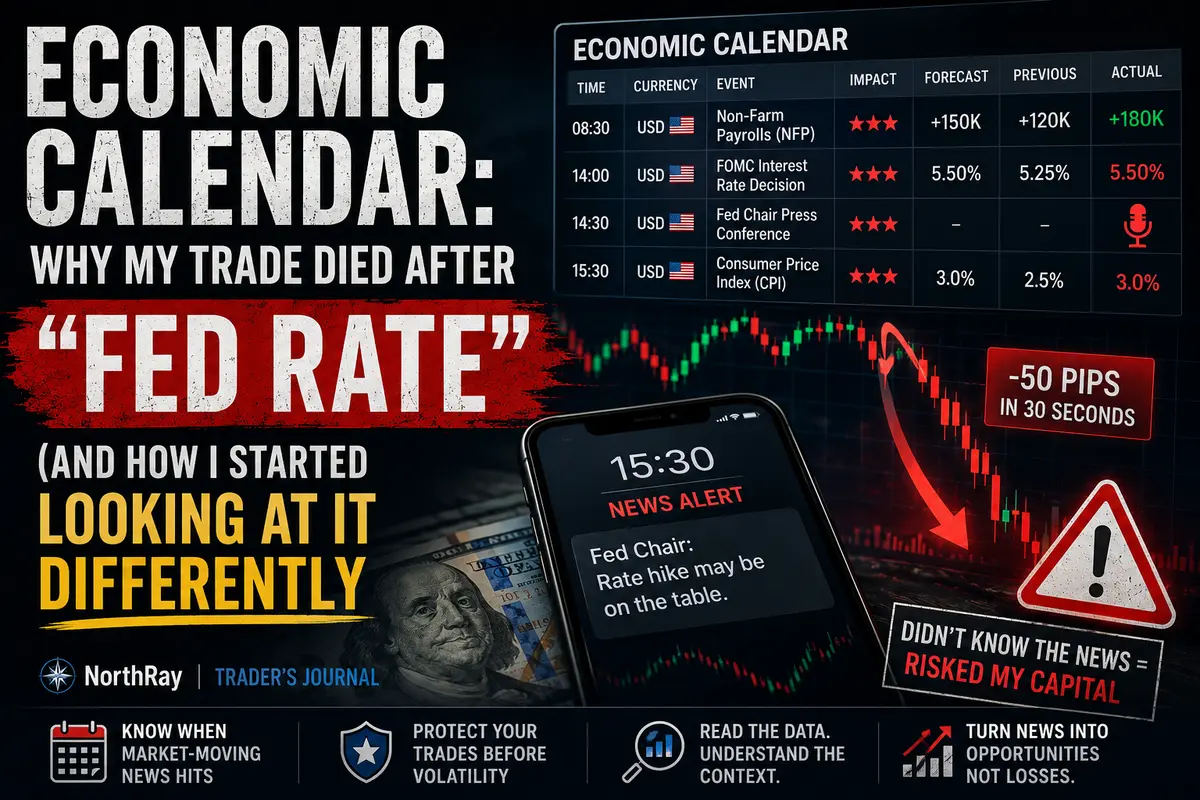
Economic Calendar: Why My Trade Died After the Words “Fed Rate” (and How I Started Looking at It Differently)

Hi, this is NorthRay.🎉
Remember when I told you about the time I opened a trade, and an hour later the price suddenly shot in the opposite direction — and I had no idea why?
I sat there staring at the chart thinking:
“What just happened? Did someone drop a nuclear bomb? Has the market gone insane?”
Then I checked the news.
Turns out that exact same hour, the head of the U.S. Federal Reserve (Fed) said a couple of sentences about interest rates.
The market reacted.
My trade died.
That was the first time I heard about the economic calendar.
And I realized: opening trades blindly without knowing what news is coming out today is like walking through a minefield blindfolded.🧐
What Is an Economic Calendar? (In Simple Words)
An economic calendar is a schedule of all major economic events around the world.
When the U.S. unemployment report comes out.
When the European Central Bank announces interest rates.
When Germany publishes industrial data.
When world leaders make important agreements.
All of it is in the calendar.
Simple analogy:
Imagine you want to cross the street. You look at the traffic light.
Green — you walk.
Red — you stop.
The economic calendar is your traffic light. It tells you:
“Be careful now, an important report is coming out.”
Or:
“The market is calm right now, it’s okay to trade.”
Without a calendar, you’re crossing the street with your eyes closed.
Maybe you’ll get lucky. Maybe not.🧠
Why News Affects the Market So Much (I Learned This the Hard Way)
The market is not just a chart. It’s people. Millions of traders around the world.
They read the news.
And they make decisions.
Good economic news → people buy the country’s currency → price goes up.
Bad news → people sell → price goes down.
Example from my own experience:
A U.S. inflation report comes out. Inflation is higher than expected.
That means the Fed may raise interest rates.
The market panics.
The dollar rises.
The euro falls.
My EUR/USD Buy trade goes deep into the red within 10 minutes.
If I had checked the calendar beforehand, I simply wouldn’t have opened a trade before the news. Or I would’ve placed a much wider stop-loss.✍️
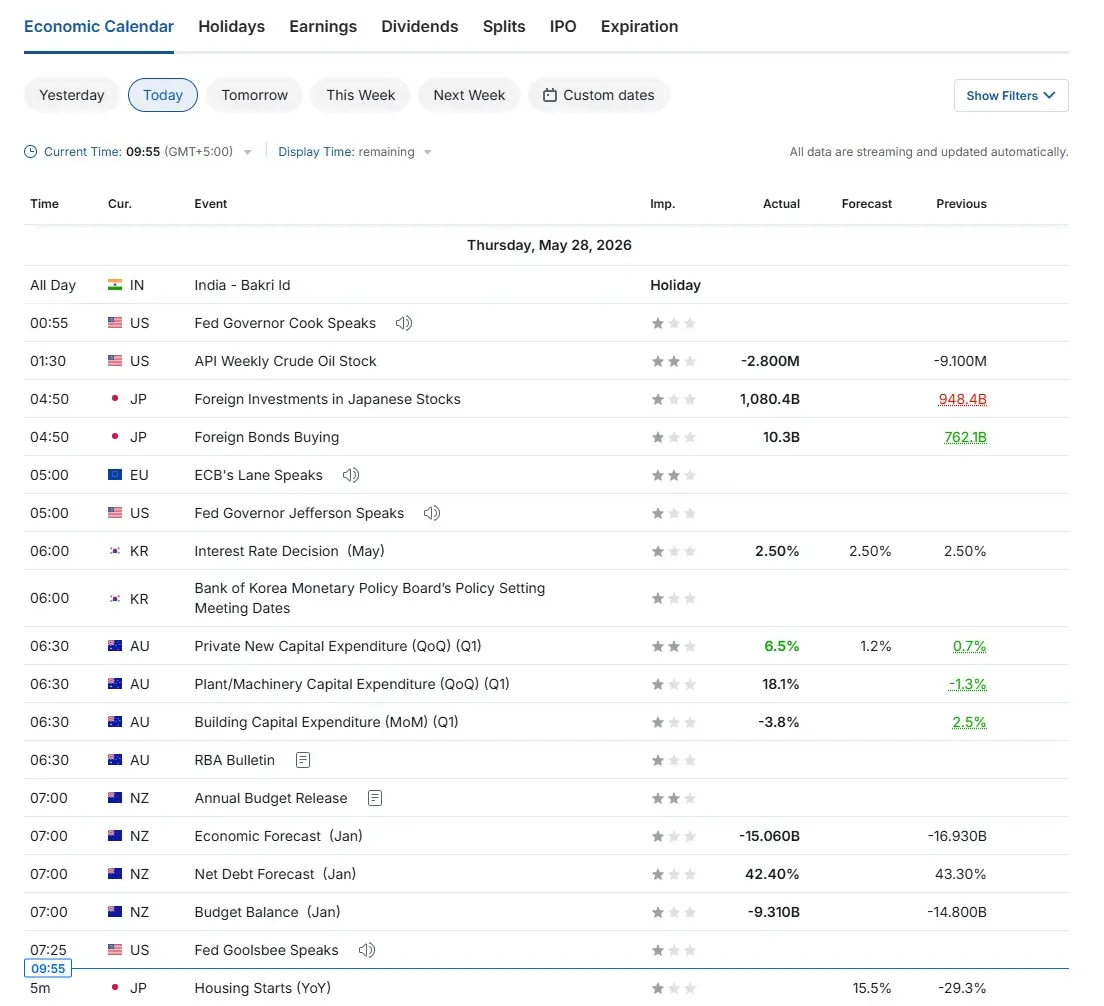
What an Economic Calendar Looks Like (and Where to Find One)
Every decent broker has one — usually inside the trading platform or on their website.
But I use free websites. For example:
-
Investing.com (they have a Russian version too)
-
ForexFactory (classic, all in English)
-
Myfxbook (also good)
I chose Investing.com because the interface is simple, it’s available in Russian, and the filters are convenient.
Let me explain each column:
-
Time — when the news comes out (in my timezone).
-
Currency — which currency is affected (USD = dollar, EUR = euro, GBP = pound).
-
Event — what exactly is being released (inflation, interest rate, unemployment).
-
Importance — usually stars or colors: high (red), medium (yellow), low (green).
-
Forecast — what economists expect.
-
Previous — the previous reading.
-
Actual — the real result after publication.
The Most Important News Events (What I Watch First)
There are tons of reports. Maybe 50 per day.
If you try to follow all of them, you’ll go crazy.
So I picked the ones that truly move the market.📉
For the U.S. Dollar (USD)
-
Fed interest rate decisions
-
NFP (Non-Farm Payrolls) — released on the first Friday of every month
-
Inflation data (CPI)
-
Speeches from the Fed Chair — one sentence can move the market
For the Euro (EUR)
-
ECB rate decisions
-
Germany’s GDP (Germany is the engine of the Eurozone)
-
Eurozone inflation
For the British Pound (GBP)
-
Bank of England rate decisions
-
UK inflation and GDP
For Gold (XAU/USD)
-
Fed rates (gold is extremely sensitive to the dollar)
-
Inflation reports
-
Geopolitical events (wars, crises)
My rule:
If there are high-impact “red” news events for the currency I trade, I either:
-
close my trades before the release,
-
or reduce my position size significantly.
Three Types of Market Reactions to News (This Is Important)
I used to think that if the forecast matched the actual result, the market wouldn’t move.
Turns out it’s more complicated.👀
Type 1: Actual Result Better Than Forecast
Expected: +100K jobs
Actual: +150K
Reaction: currency rises (economy stronger than expected).
Type 2: Actual Result Worse Than Forecast
Expected: +100K
Actual: +50K
Reaction: currency falls (economy weaker than expected).
Type 3: Actual Result Very Different From Previous Data
Previous: +200K
Current: +50K
Even if the forecast was +50K, the market may still drop because “things used to be better.”
My most painful example:
U.S. inflation data came out.
Forecast: 3.0%
Actual: 3.0%
I thought:
“Perfect match. Market won’t move.”
It moved.
Because the previous reading was 2.5%. Inflation had increased, even though it matched expectations. The dollar strengthened.
Since then, I don’t just look at the forecast — I also compare it to the previous value.🥳
How I Use the Calendar (My Routine)
I do this every morning. Takes 5 minutes.
Step 1: Open the Calendar
I go to Investing.com and check today’s events.
Step 2: Look for Red Events
I mark everything with high importance (usually shown in red).
Step 3: Check the Currency or Instrument
If there’s major USD news, the dollar will likely become volatile.
If I have an open EUR/USD trade, I need to be careful.
Step 4: Make a Decision
I have three options:
-
Close the trade BEFORE the news
-
Keep the trade but use a wide stop-loss
-
Avoid opening new trades one hour before the release
Step 5: Set a Reminder
I set a reminder so that 15 minutes before the release I’m already watching the chart with either:
-
no open positions,
-
or protected positions.
My Biggest Mistakes With the Economic Calendar
Mistake #1: Ignoring It Completely
“I’m a technical trader. News doesn’t matter.”
Spoiler: it does.
If the market reacts emotionally, it affects me too.🤫
Mistake #2: Opening Trades Two Minutes Before News
Price looked calm.
I opened a Buy trade.
Two minutes later the report came out — and price dropped 50 pips in 30 seconds.
Now my rule is:
No new trades 30 minutes before major news.
Mistake #3: Ignoring the Previous Reading
Like in the inflation example above — forecast matched, but the market still moved.
Now I always check previous data too.
Mistake #4: Thinking I Knew How the Market Would React
I was convinced:
“If rates go up, the dollar will rise.”
Sometimes it does.
Sometimes it falls because “the market already priced it in.”
Now I don’t try to predict reactions.
I simply leave the market before major news or protect my positions.
Then after the release, I watch where price actually goes and decide from there.🥇
What I Realized Today
First:
The economic calendar is not optional. It’s mandatory.
A trader who ignores the calendar is playing Russian roulette.
Second:
You don’t need to predict how the market will react.
You only need to know WHEN the news is coming out and stay cautious around that time.
Third:
The most dangerous period is:
-
30 minutes before the release,
-
and the first 30 minutes after.
During this time price can move chaotically. Sometimes the best trade is no trade.
Fourth:
After the news, a trend often forms.
Experienced traders may trade that momentum.
For now, I mostly observe.
My Plan Going Forward
-
Every morning starts with checking the economic calendar.
-
I mark all high-impact events in my notebook.
-
30 minutes before important news I either close trades or widen stop-losses.
-
After the release I wait 15–30 minutes before entering the market.
-
I keep statistics on how markets react to different reports. Maybe over time I’ll learn to anticipate certain behaviors.
What’s Next
-
Tomorrow morning, first thing: I open the calendar and check the week ahead.
-
If there’s an interesting release and a strong market reaction, I’ll write a separate breakdown post.
-
Slowly I’m adding “news trading” into my system — but very carefully. For now, mostly observing.
If you still don’t check the economic calendar — start today.
At least open it and see what major events are scheduled this week.
It won’t make you a millionaire.
But it might save you from staring at a collapsing chart wondering what just happened.🍀
— NorthRay
(with the economic calendar open in a second tab, red marks on tomorrow’s events, and a promise to never again open a trade five minutes before Powell starts speaking)

Comments
No comments yet. Be the first to share your thoughts!
Authentication Required
You must be logged in to post a comment.