

Money That Feeds: How the Card Works
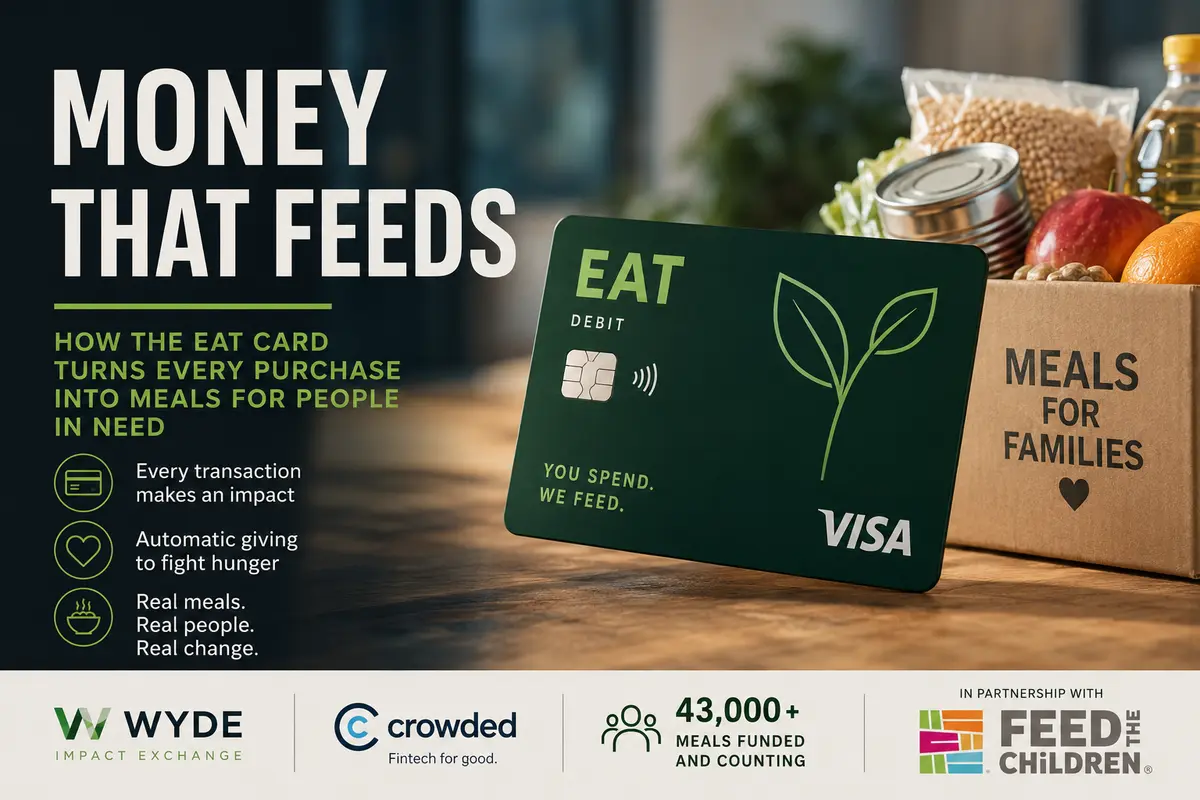
The nonprofit organization WYDE, which has already attracted attention with its Impact Exchange concept, is preparing to launch a new financial tool. In partnership with the fintech platform Crowded, it is introducing a debit card called EAT that runs on the Visa infrastructure. At first glance, it sounds like a standard business card, but embedded within it is a mechanism that could reshape how businesses participate in charitable giving.
The concept is simple and elegant. Every time a cardholder — whether an entrepreneur, company, or organization — makes a purchase, a small portion of the transaction is automatically directed to hunger-relief organizations. No separate donations, no additional actions, no checkboxes or “donate” buttons. The money goes to charity automatically, simply because the business continues operating and spending on its everyday needs.
That is the core innovation. Charity stops being a separate act that requires a conscious decision and instead becomes integrated into daily financial activity. A company buys office supplies, pays for lunch with clients, or covers software subscriptions — and with each transaction, a few cents or dollars are sent to those fighting hunger. Over the course of a year, those contributions can add up to thousands of meals.
Crowded: Fintech Infrastructure for Good
WYDE’s partner in launching the card is Crowded — a fintech company specializing in services for nonprofit organizations. This is an important detail because the charitable sector has historically suffered from a lack of modern financial infrastructure. Banks are often reluctant to open accounts for nonprofits, payment systems are rarely tailored to their specific needs, and donation accounting is frequently handled through semi-manual processes.
Crowded manages the entire technical side: payment processing, fraud protection, and integrated card management. This means cardholders receive the same level of convenience and security as with any other Visa business card, while the charitable component operates quietly in the background without requiring additional effort.
For WYDE, the partnership provides a way to scale its model without building its own payment infrastructure. For Crowded, it creates an opportunity to expand beyond the nonprofit sector and offer its product to mainstream businesses that want to contribute to social good without changing their usual workflows.
From Crypto Exchange to Debit Card: The Evolution of Impact Exchange
To understand where the idea for this card came from, it’s necessary to look at what WYDE has been doing so far. The organization operates the so-called Impact Exchange — a platform it describes as the world’s first social impact exchange. Instead of trading stocks or traditional tokens, the exchange deals in financial instruments tied to social outcomes.
The “charitable consumption” model that WYDE tested in cryptocurrency trading works like this: users’ financial activity generates charitable grants. People trade, transactions occur, and part of the fees or spreads are directed to nonprofit organizations. Now WYDE is expanding that model from the crypto market into everyday business spending.
It is a logical move. Despite its scale, the cryptocurrency market remains relatively niche. Business expenses, on the other hand, amount to trillions of dollars annually worldwide. If even a tiny fraction of that flow is redirected toward fighting hunger, the impact could far exceed what is possible through a crypto exchange alone. In essence, WYDE is taking a proven mechanism and applying it to a much larger arena.
Forty-Three Thousand Meals and a Partnership with Feed the Children
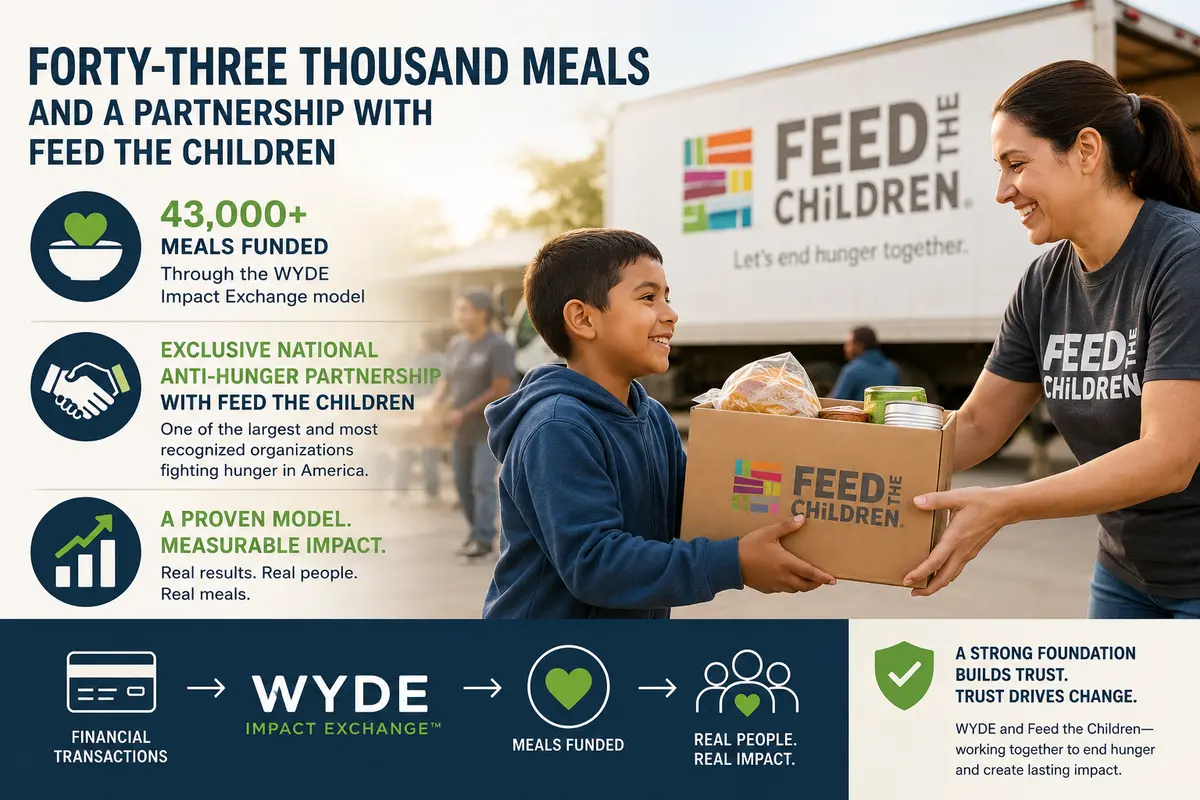
The launch of the card comes alongside tangible achievements by WYDE. The organization has already surpassed 43,000 funded meals through its Impact Exchange model. These are not abstract promises or impressive presentation figures — they represent real meals delivered to real people through a mechanism embedded in financial transactions.
In addition, WYDE has entered into an exclusive national anti-hunger partnership with Feed the Children. This is not just another charity from a long list; it is one of the largest and most recognizable organizations in its field. The partnership gives WYDE both legitimacy and operational capacity: Feed the Children knows how to deliver food where it is needed, while WYDE provides the financial mechanism to fund that work.
These accomplishments create the foundation for the card launch. Potential cardholders see not just an appealing idea, but a functioning model with measurable results. That lowers the barrier to adoption: businesses are more likely to join an initiative that has already demonstrated effectiveness.
Continuous Funding Instead of One-Time Campaigns
One of the greatest challenges facing the nonprofit sector is unstable funding. Donations often come in waves: after major disasters, people give generously, but within months the flow dries up. Charitable organizations are forced to spend enormous resources on fundraising instead of focusing on their core mission.
WYDE’s card addresses this problem in a radically different way. It creates a continuous funding mechanism based on regular commercial activity. Businesses operate every day, make transactions every day, and every day a portion of that money goes toward fighting hunger. No fundraising campaigns, no gala dinners, no donation-request emails. Businesses simply conduct business, while charitable giving happens automatically in parallel.
The model resembles the concept of “embedded donations,” which many fintech startups have attempted to implement, but WYDE may have found the right balance. The amount deducted from each transaction is so small that cardholders barely notice it. Yet multiplied across thousands of transactions and thousands of users, it becomes a meaningful and predictable funding stream.
Who Needs It — and Why It Could Take Off
The card’s target audience consists of businesses that want to associate themselves with social impact but are unwilling to dedicate additional resources to it. Small and medium-sized enterprises, startups, and socially conscious companies can use the card to integrate charitable giving into their operations without additional costs or effort.
For large corporations with existing corporate social responsibility programs, the WYDE card could serve as an additional tool complementing current initiatives. And for nonprofit organizations already using Crowded’s services, it offers a payment solution aligned with their mission for employees and volunteers alike.
The card’s success will depend on several factors. How extensive is Visa’s acceptance network in the regions where WYDE’s target audience operates? What percentage of each transaction actually goes to charity, and could it be so small that the impact becomes merely symbolic? How convenient will card management through the Crowded app be? Those answers will come after launch, but the concept itself appears sufficiently developed to attract serious attention.
The Bigger Picture: Finance That Changes the World
The launch of WYDE’s debit card is part of a broader trend toward merging finance with social impact. For decades, these two spheres existed separately: businesses earned money and then, if they chose, donated part of their profits to charity. The new model proposes a different approach — charity becomes embedded directly into the mechanisms of earning and spending money.
This trend can already be seen in impact investing, ESG criteria, and the rise of social bonds. But the WYDE card makes the idea tangible at the level of everyday transactions. Every swipe of the card becomes a micro-donation; every business lunch becomes a contribution to the fight against hunger.
Will this model scale beyond the niche of socially responsible businesses? Could it someday become a standard for corporate spending? Those questions remain open. But one thing is already clear: WYDE has found a way to turn routine financial transactions into acts of goodwill. And in a world where charity often requires conscious effort, this automation of generosity may be exactly what has been missing.

Comments
No comments yet. Be the first to share your thoughts!
Authentication Required
You must be logged in to post a comment.