
The Quantum Threat to Bitcoin: Why the World’s Largest Banks Are Warning About the End of the Cryptographic Era
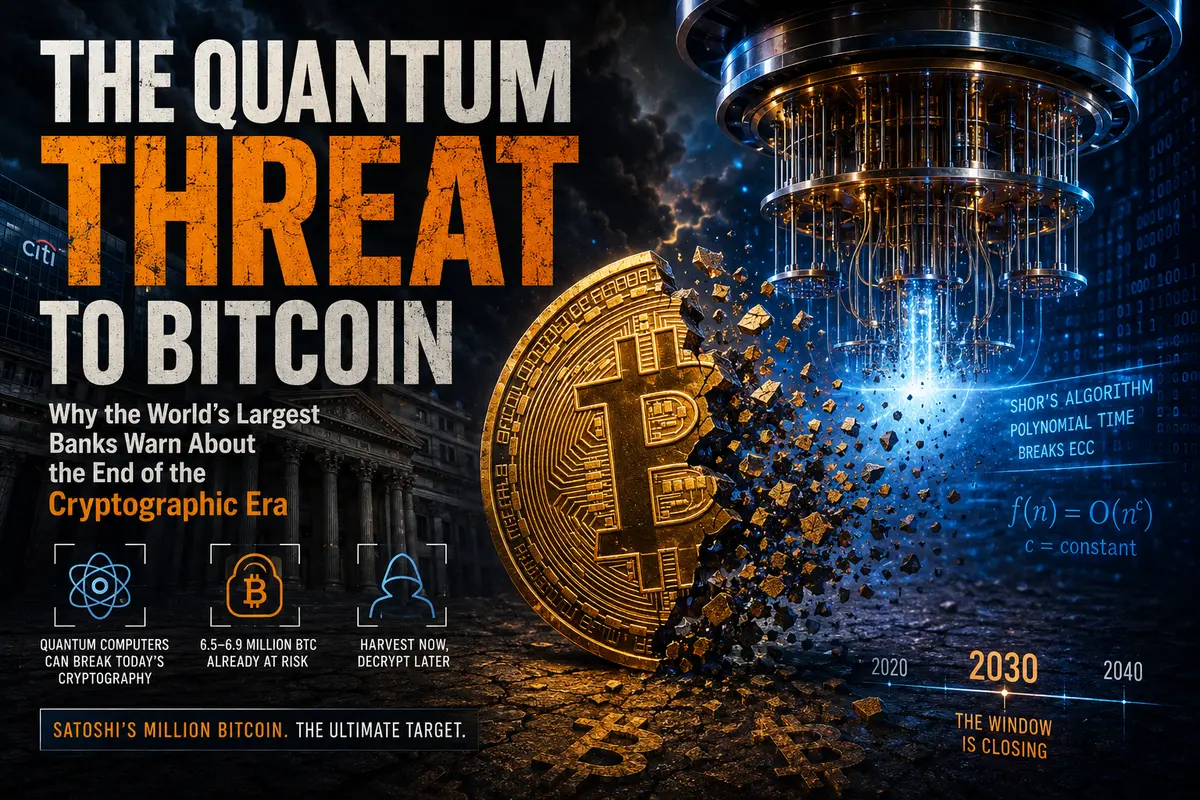
When financial giants like Citigroup publish alarming analytical reports, they rarely do so with sensational headlines or emotional rhetoric. Their language is usually dry, calculated, and clinically precise. That is exactly why such reports carry so much weight. Behind the carefully chosen wording lies not speculation, but a cold assessment of systemic risk.
And when an institution managing trillions of dollars begins warning about “shrinking time horizons” and a “growing threat” to the very foundation of cryptocurrencies, it is no longer science fiction. It is a signal that a fundamental problem has moved from theory into strategic reality.
This is not about another Bitcoin price correction, a temporary bear market, or the collapse of a crypto exchange. The issue runs much deeper: can the cryptographic foundation of digital assets survive the coming age of quantum computing?
Cryptography Is the Real Foundation of Bitcoin
Most people think about Bitcoin in terms of price movements, mining, ETFs, or halving cycles. But the true backbone of the network lies much deeper — in mathematics.
Bitcoin’s security is built on public-key cryptography, specifically the Elliptic Curve Digital Signature Algorithm, or ECDSA. This system allows users to prove ownership of funds without exposing their private keys.
In simplified terms, a Bitcoin address is like a lock that anyone can see and send money to. The private key is the unique key capable of opening that lock and moving the funds.
The entire architecture depends on one critical assumption: deriving a private key from a public key must be computationally impossible within any practical timeframe. Even with the combined power of modern supercomputers, the task remains effectively unattainable.
For years, this mathematical barrier was considered absolute.
Why Quantum Computers Change the Rules Entirely
The danger of quantum computing is not merely that quantum machines are “faster.” Their threat comes from operating according to fundamentally different principles.
A classical computer solves cryptographic problems through sequential computation and brute-force limitations. Breaking ECDSA with classical hardware involves exponential complexity — meaning that each increase in key size dramatically multiplies the required computational effort.
Quantum computers operate differently. Through superposition and quantum interference, they can run Shor’s algorithm — a mathematical breakthrough capable of transforming certain cryptographic problems from exponentially difficult into polynomially solvable ones.
In practical terms, a task that would take classical supercomputers billions of years could theoretically be completed by a sufficiently advanced quantum computer in hours or minutes.
That is the nightmare scenario facing the crypto industry.
Today, no quantum computer capable of attacking Bitcoin exists. But the pace of progress is accelerating faster than many experts expected. Research initiatives by IBM, Google, and other advanced laboratories are steadily moving the industry toward machines powerful enough to challenge modern cryptography.
Only a few years ago, most analysts believed this threat belonged to the 2040s. Today, many experts believe the danger could emerge in the early 2030s — or even sooner.
Why Millions of Bitcoins Are Already Vulnerable
The most alarming part of the discussion is that the problem does not concern hypothetical future coins. It affects existing Bitcoin today.
According to estimates referenced in Citi’s analysis, approximately 6.5–6.9 million BTC may already be directly exposed to quantum risk. That represents nearly one-third of all Bitcoin that will ever exist.
The vulnerability stems from the structure of early Bitcoin addresses.
Many people mistakenly assume that a Bitcoin address and a public key are the same thing. They are not. A Bitcoin address is actually a hash of the public key. Until coins are spent, the underlying public key remains hidden behind additional cryptographic protection.
However, once a transaction is made, the public key becomes permanently exposed on the blockchain so the network can verify the signature.
The oldest wallet format, known as P2PK (Pay-to-Public-Key), is especially vulnerable because the public key is visible from the beginning. These addresses were common in Bitcoin’s earliest years.
As a result, many early miner wallets, dormant addresses, and ancient holdings have effectively become future targets for quantum attacks.
“Harvest Now, Decrypt Later”
One of the most disturbing concepts in modern cybersecurity is known as “harvest now, decrypt later.”
The logic is simple.
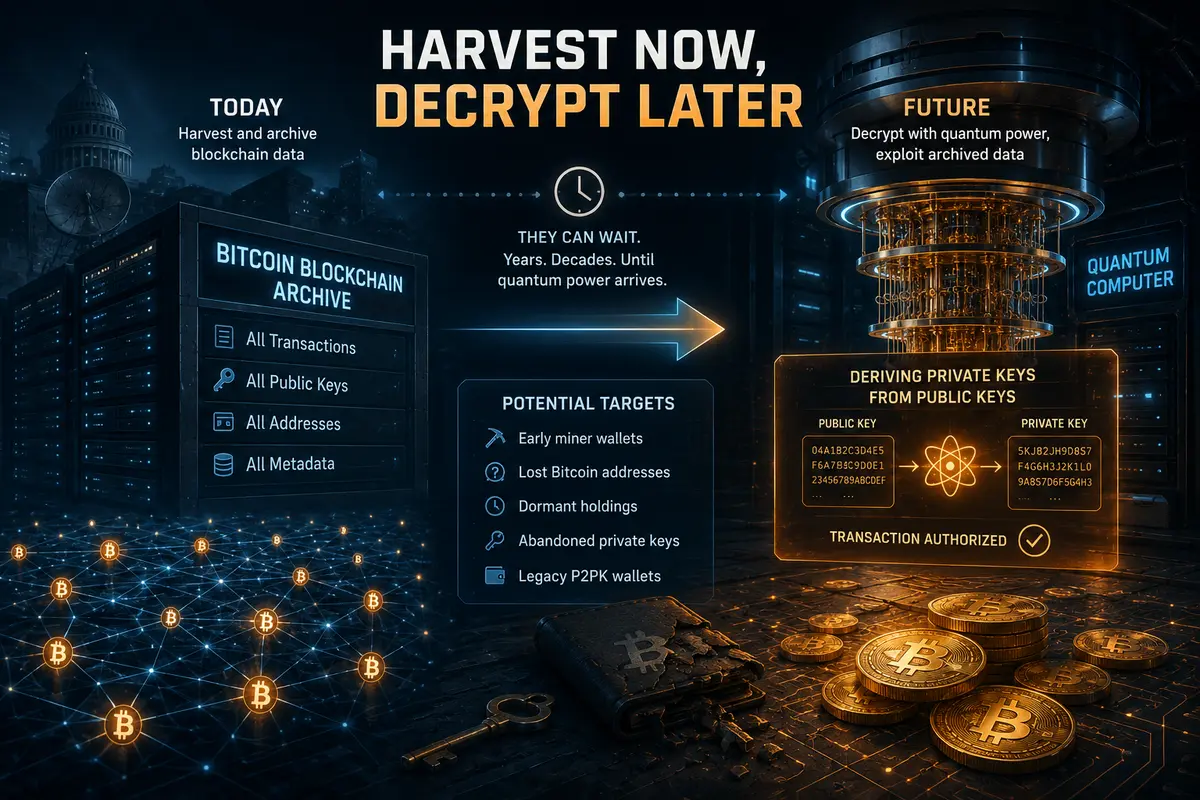
Governments, intelligence agencies, or major corporations can already archive the entire Bitcoin blockchain and store all exposed public keys today. They do not need quantum computers yet.
They can simply wait.
The moment sufficiently powerful quantum hardware becomes available, all those archived records become instantly exploitable.
The attack would not initially focus on intercepting live transactions. Instead, attackers would process decades of historical blockchain data in bulk.
Potential targets include:
-
early miner wallets;
-
lost Bitcoin addresses;
-
dormant holdings;
-
abandoned private keys;
-
legacy P2PK wallets.
A quantum computer could derive private keys from exposed public keys and authorize transactions as though it were the legitimate owner.
And the most dangerous part is that many of those coins no longer have active custodians capable of moving them to safety.
The Ultimate Prize: Satoshi Nakamoto’s Wallets
No discussion of quantum risk is complete without mentioning Satoshi Nakamoto.
It is widely believed that Bitcoin’s creator controls roughly one million BTC, much of it stored in vulnerable P2PK addresses with permanently exposed public keys.
From a technical standpoint, these wallets may eventually become one of the most valuable targets in human history.
But the implications go far beyond money.
If Satoshi’s wallets were ever compromised, it would represent not only the largest digital theft ever recorded, but also a devastating symbolic blow to Bitcoin itself. It would shatter the myth of absolute cryptographic invulnerability that underpins the network’s ideological foundation.
And if one million BTC suddenly moved onto the market, the consequences for global financial systems and crypto markets could be catastrophic.
Why Ethereum May Adapt Faster
Interestingly, many analysts believe that networks like Ethereum may be better positioned to survive the quantum transition.
The reason is not fundamentally different cryptography. Ethereum still relies on elliptic curve systems similar to Bitcoin’s.
The real difference lies in governance and adaptability.
Bitcoin is intentionally conservative. Major changes require broad consensus among developers, miners, infrastructure providers, and users. Reaching agreement on fundamental upgrades is notoriously difficult.
The network’s history already demonstrates how divisive protocol changes can become, particularly during the block-size wars.
Ethereum operates under a different culture. With more centralized coordination through the Ethereum Foundation and a long history of regular protocol upgrades, the network can implement radical technical changes much more rapidly.
As a result, many experts believe Ethereum could transition toward post-quantum cryptography far faster than Bitcoin.
Can Bitcoin Defend Itself?
Despite the alarming forecasts, Bitcoin is far from defenseless.
Developers have already begun discussing proposals such as BIP-360 and BIP-361, which explore integrating post-quantum cryptographic schemes into the Bitcoin protocol.
Among the leading candidates is lattice-based cryptography, widely considered resistant to Shor’s algorithm.
But this introduces another major challenge.
Post-quantum signatures are dramatically larger than current Bitcoin signatures. Transactions that are relatively lightweight today could become kilobytes — or even tens of kilobytes — in size.
That would create severe consequences:
-
blockchain bloat;
-
increased storage requirements;
-
higher transaction fees;
-
heavier network load;
-
reduced scalability.
In other words, preserving security could come at the cost of efficiency.
The Most Painful Question: Should Vulnerable Coins Be Frozen?
Yet the deepest dilemma is not technical — it is philosophical.
What happens to already vulnerable coins?
Even if Bitcoin successfully migrates to quantum-resistant cryptography, millions of exposed addresses would remain permanently vulnerable.
The only realistic solution may involve a radical hard fork capable of invalidating or forcibly migrating old vulnerable outputs into new secure address formats.
But such a move would challenge one of Bitcoin’s core principles: the sanctity of ownership.
Who has the authority to decide the fate of dormant coins? Can a decentralized network confiscate inactive assets in the name of collective survival? And if it does, does Bitcoin remain the same system it once claimed to be?
This is where the quantum problem evolves from a technological threat into a crisis of ideology.
The End of the Era of Absolute Cryptography
Quantum computing will probably not destroy cryptocurrencies entirely. More likely, it will force the industry through a brutal evolutionary transition.
The networks that survive will be those flexible enough to replace their cryptographic foundations before quantum attacks become practical realities.
For Bitcoin, this may become the greatest challenge in its history.
On one side lies the preservation of immutability and absolute property rights. On the other lies the possibility that a future quantum attacker could drain millions of coins — including those belonging to Satoshi Nakamoto himself.
That is why Citi’s report feels less like a financial forecast and more like a warning siren.
It is not a funeral march for Bitcoin.
It is the sound of an alarm clock ringing inside a sleeping giant that spent too long believing its armor was mathematically eternal.
The unsettling truth is that time is not eroding that armor mechanically — it is eroding it mathematically.
Comments
No comments yet. Be the first to share your thoughts!
Comments only for logged-in users.