
The Quantum Threat to Bitcoin: Why the World’s Largest Banks Are Warning About the End of the Cryptographic Era
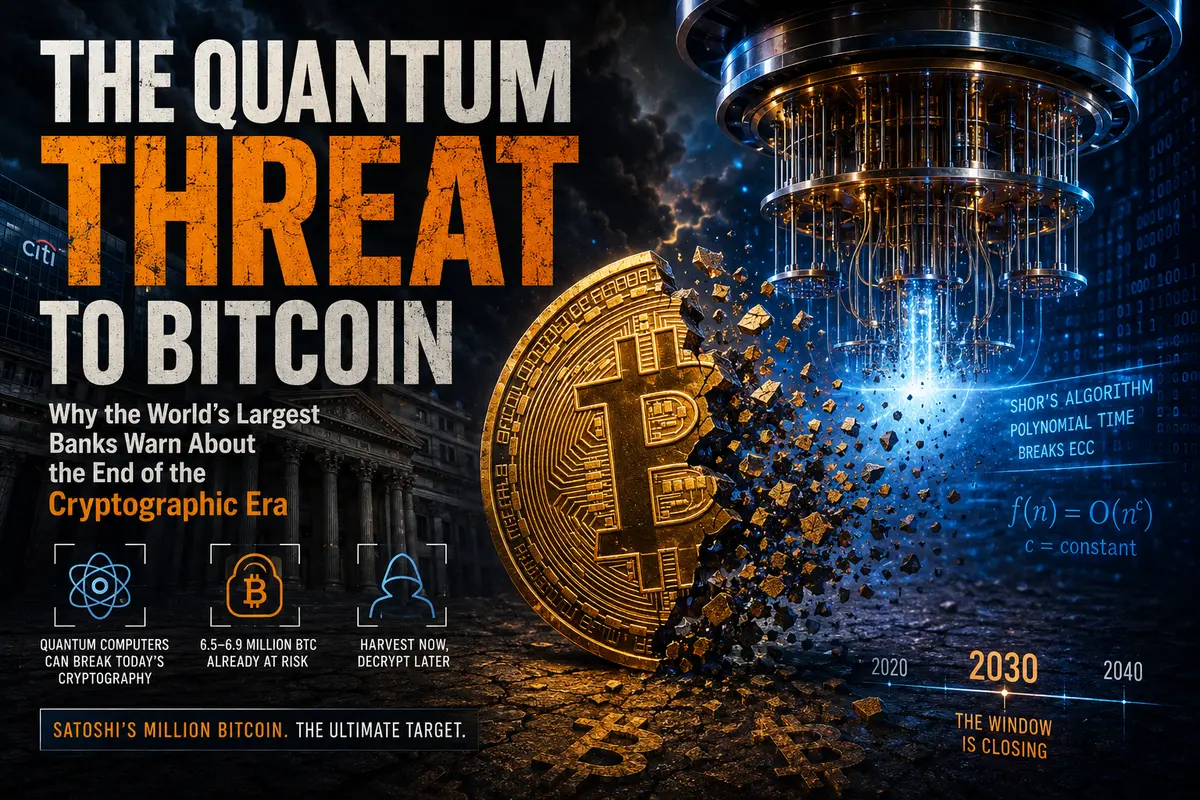
When financial giants like Citigroup publish alarming analytical reports, they rarely do so with sensational headlines or emotional rhetoric. Their language is usually dry, calculated, and clinically precise. That is exactly why such reports carry so much weight. Behind the carefully chosen wording lies not speculation, but a cold assessment of systemic risk.
And when an institution managing trillions of dollars begins warning about “shrinking time horizons” and a “growing threat” to the very foundation of cryptocurrencies, it is no longer science fiction. It is a signal that a fundamental problem has moved from theory into strategic reality.
This is not about another Bitcoin price correction, a temporary bear market, or the collapse of a crypto exchange. The issue runs much deeper: can the cryptographic foundation of digital assets survive the coming age of quantum computing?
Cryptography Is the Real Foundation of BitcoinMost people think about Bitcoin in terms of price movements, mining, ETFs, or halving cycles. But the true backbone of the network lies much deeper — in mathematics.
Bitcoin’s security is built on public-key cryptography, specifically the Elliptic Curve Digital Signature Algorithm, or ECDSA. This system allows users to prove ownership of funds without exposing their private keys.
In simplified terms, a Bitcoin address is like a lock that anyone can see and send money to. The private key is the unique key capable of opening that lock and moving the funds.
The entire architecture depends on one critical assumption: deriving a private key from a public key must be computationally impossible within any practical timeframe. Even with the combined power of modern supercomputers, the task remains effectively unattainable.
For years, this mathematical barrier was considered absolute.
Why Quantum Computers Change the Rules EntirelyThe danger of quantum computing is not merely that quantum machines are “faster.”...