

I Wanted a Robot to Trade for Me. I Almost Bought the “Magic Button.” Good Thing I Stopped in Time.

Hi, this is NorthRay.💪
Do you know what I was looking for in my first days of trading?
Not a strategy. Not knowledge. Not discipline.
I was looking for a magic button.
A button that would open trades for me. One that never sleeps, never gets scared, and never makes stupid mistakes. One that makes money while I drink coffee or sleep.
And I found one. Or rather, someone offered it to me.
-
“Trading robot with a 95% win rate.”
-
“Copy trading — copy professional traders and earn money.”
-
“Passive income of 30% per month.”
I almost fell for it because it sounded perfect.
But then I asked myself one question:
“If it’s really that simple and profitable, why isn’t every trader already a millionaire?”
So I started digging. And here’s what I learned.
What Are Trading Robots (Expert Advisors)?
A trading robot (or Expert Advisor) is a program that automatically opens and closes trades according to a predefined algorithm.
You install it in MetaTrader 4, turn it on, and the robot analyzes the chart, presses Buy and Sell, and sets stop-losses by itself.
No involvement from you. 24/5. No emotions. No fear. No greed.
Sounds like a beginner’s dream, right?
I downloaded a free robot, installed it on a demo account, and turned it on.
It opened a trade. Then another. Then another.
An hour later, I checked the results: three losing trades and one winning trade. Overall result: negative.
I thought:
“Maybe I downloaded a bad robot. Maybe I should buy a paid one?”
That’s when I started doing real research.
How I Almost Bought a Robot (And Why I’m Glad I Didn’t)
I visited a website selling a “super robot with 90% accuracy.”
Beautiful website. Equity growth charts. Reviews (probably fake). A 70% discount “today only.”
Price: $299 instead of $999.
I was already reaching for my credit card when one comment on a forum stopped me:
“If the seller really had a robot with a 90% win rate, they wouldn’t sell it for $300. They’d trade it themselves and become a billionaire within a year.”
Simple logic.
Devastating logic.
I didn’t buy it.
Instead, I decided to understand how robots work, what their pros and cons are, and whether I even needed one.🤥
How Trading Robots Actually Work
A robot is simply a set of rules. It does exactly what it has been programmed to do.
If the code says, “When the Stochastic indicator drops below 20, buy,” then the robot will buy every single time the Stochastic drops below 20.
It doesn’t think.
It doesn’t understand context.
It doesn’t know whether the market is ranging or whether a major news event is about to hit.
It simply follows instructions.
Advantages of Trading Robots
-
No emotions. No fear, no greed.
-
Never gets tired. Can trade 24/5.
-
Executes trades quickly.
-
Never breaks its own rules.
Disadvantages of Trading Robots
These were the things that surprised me:
-
They are usually optimized on historical data. Live markets can behave very differently.
-
Every robot loses effectiveness when market conditions change.
-
They require constant testing and adjustment. It’s work, not “buy it and forget it.”
-
90% of robots sold online are junk. They look great in backtests but blow up real accounts.
-
Robots can’t truly understand news events. A major announcement can destroy an algorithm in minutes.
My Conclusion
A robot is a tool.
Like a hammer.
It won’t turn a beginner into a professional.
If I can’t trade profitably myself, a robot won’t save me.🧐
What Is Copy Trading?
Copy trading is when you automatically replicate another trader’s positions in real time.
You choose a “successful trader” by looking at their statistics, returns, and drawdowns.
Then you click “Copy.”
That’s it.
Every time they open a trade, the same trade is opened in your account. Every time they close one, yours closes too.
Sounds even easier than using a robot.
No setup. No programming.
Just choose and profit.
At least, that’s what I thought.
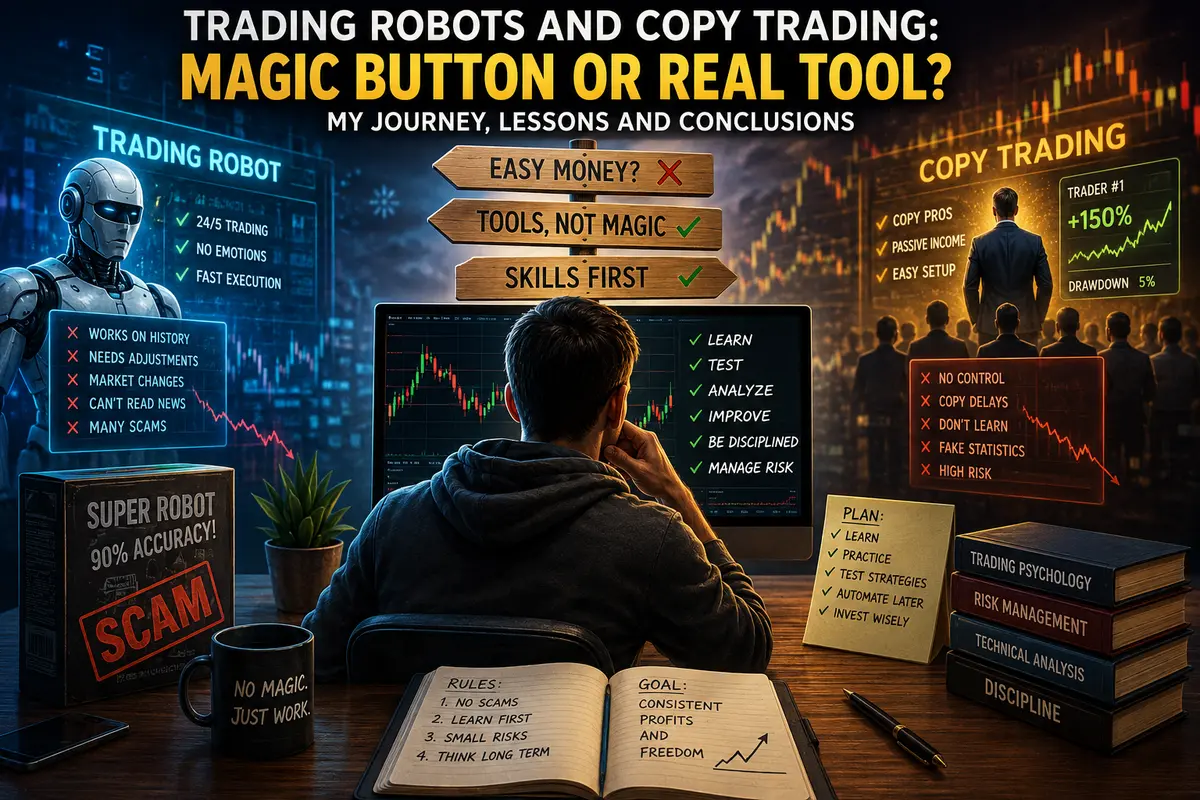
How I Almost Signed Up for Copy Trading (And Why I Changed My Mind)
My broker’s platform has a section where you can copy other traders.
I opened the rankings.
One trader showed:
-
150% monthly return
-
5% drawdown
-
500 followers
I thought:
“This is the person who’s going to make me rich.”
Then I started reading reviews.
Turns out there’s a common trick:
A trader opens multiple accounts.
One account gets lucky and produces 150% returns.
That account gets displayed in the rankings.
People start copying.
The following month, market conditions change and the “genius” blows up the account.
Along with everyone who copied them.🙄
Why Copy Trading Can Be Dangerous for Beginners
-
You don’t control the trades. The trader can open a huge position at a risky moment and you lose money.
-
Copy delays exist. By the time the signal reaches you, the price may have moved significantly.
-
You don’t learn anything. You just copy. When the trader disappears or fails, you’re left with no skills.
-
Statistics can be misleading. Some traders use aggressive strategies on small accounts that don’t scale to larger capital.
My Conclusion
Copy trading is a tool.
It can be useful for passive investing if you choose a reliable trader with a long and transparent track record.
But it is not a way to learn trading.
What Experienced Traders Told Me
I asked on a forum:
“Should a beginner use trading robots or copy trading?”
About 90% of the responses were the same:
“Learn to trade yourself first. Spend at least a year on a demo account. Then, if you want, use a robot to automate your own strategy—but not as a replacement for yourself.”
And:
“Copy trading is not passive income for beginners. It’s a fast way to lose money if you don’t understand what you’re copying.”
So I made a decision.📉
First, I learn.
With my own hands.
Through my own mistakes.
When I can trade consistently profitably on a demo account—and later on a live account—then maybe I’ll automate my strategy or allocate part of my capital to a proven trader.
But not before that.
The One Situation Where a Robot Is Actually Useful for Beginners
After all my research, I found one honest use case:
Strategy Testing
MetaTrader 4 has a feature called the Strategy Tester.
You can take a robot—or simply define a set of trading rules—and run it against years of historical market data.
The robot will show:
-
Total profit
-
Drawdowns
-
Win rate
-
Performance statistics
This helps you:
-
Understand whether a strategy works at all.
-
Identify weaknesses (for example, if it collapses during major news events).
-
Optimize parameters.
That’s what I’m doing right now.
Not to trade automatically.
But to test my ideas without risking even a demo account.🎯
The Rules I Set for Myself
After everything I learned, I came up with a few clear rules.
Rule #1: No Purchased Robots
I don’t believe in “super-profitable robots for $299.”
If a strategy truly works, its owner will trade it—not sell it.
Rule #2: No Copy Trading Until I Have at Least a Year of My Own Experience
First, I learn to trade myself.
Later, I may allocate a small portion of my capital to copy trading.
No more than 10–20% of my account.
Rule #3: A Robot Is Only for Automating My Own Strategy
When I eventually find a strategy that works consistently on a demo account, I may automate it.
As an assistant.
Not as a replacement.
Rule #4: Stop Looking for Easy Money
Robots and copy trading are not magic buttons.
They are tools.
With advantages, disadvantages, and risks.
There is no free lunch.
What I Learned Today
First: Robots do not create money out of thin air. They simply automate a strategy. If the strategy is bad, the robot will lose money faster than a human.
Second: Copy trading is not a way to learn trading. It is a way to delegate trading to someone else. If you don’t understand trading yourself, you cannot properly evaluate the trader you are copying.🗓️
Third: The most dangerous thing is believing in easy money. That belief is exactly what robot sellers and copy-trading “gurus” profit from.
Fourth: First I learn. Then I automate. Not the other way around.
My Plan for Robots and Copy Trading
-
Continue learning manual trading: support and resistance levels, trends, the Stochastic indicator, and news analysis.
-
Study the MT4 Strategy Tester. Program simple trading rules and test them on historical data.
-
Observe copy trading from the sidelines. Analyze top traders and their statistics without copying them.
-
In six months to a year, consider automating my own strategy or allocating a small amount of capital to copy trading.
-
Never buy robots that promise guaranteed profits.💪
What’s Next
-
I’ll continue trading manually and collecting statistics.
-
I’ll keep learning how to use the Strategy Tester. If there’s interest, I’ll write a separate post about how I test trading ideas on historical data.
-
If you have experience with robots or copy trading, share it in the comments (honestly, without advertising). I’d love to hear real stories.
If you’ve ever dreamed of finding a “magic button,” you’re not alone.
I did too.
And I’m glad I didn’t press it before understanding how it all works.
Robots and copy trading are not bad.
They’re simply tools.
But for beginners, they’re more likely to do harm than good.
Because the most important skill in trading is learning to manage yourself.
And no robot can do that for you.🥇
— NorthRay
No robots. No copying. Just my own hands, my own mind, and a demo account—for now, that’s enough.

Comments
No comments yet. Be the first to share your thoughts!
Authentication Required
You must be logged in to post a comment.