

Comprehensive Asset Analysis

Fundamental Analysis
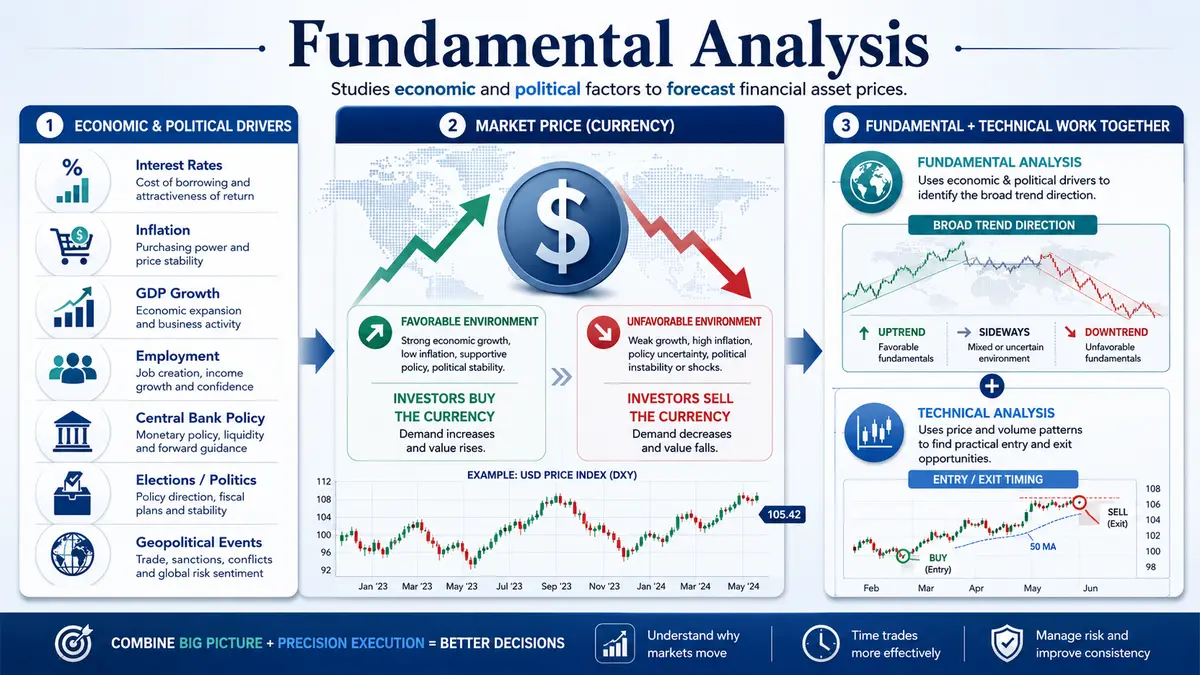
Fundamental analysis is the study of economic and political factors aimed at forecasting the price movements of financial assets.
A country’s national currency acts as its economic litmus test. If the domestic environment is favorable, the value of the national currency rises (as investors buy it); if something is wrong, it falls (as investors sell it).
Fundamental analysis differs from technical analysis in its core premise: it assumes that price changes are driven by various fundamental economic factors, whereas technical analysis assumes that studying the price action itself is sufficient.
While fundamental analysis reveals the broad direction of a trend dictated by major political and economic drivers, technical analysis helps evaluate these changes from a practical standpoint. For instance, technical analysis is better suited for pinpointing the exact time to enter or exit a trade.
Macroeconomic Indicators
Macroeconomic indicators are metrics that describe the economic health of a country. The release of economic data from the United States typically has the most significant impact on the global market.
The publication of economic data is a crucial moment for financial market participants. By interpreting this data correctly, traders can secure substantial and, more importantly, quick profits.
The exact time of an indicator’s release is always known in advance. Traders use specialized economic calendars that provide the release time, the previous reading, the forecasted value, and the actual value published at the moment of the release. These calendars also highlight particularly important news events, public holidays, financial committee meetings, and more (one popular example is the economic calendar provided by Investing.com).
Generally, the release of strong economic data leads to the appreciation of the national currency, prompting investors to buy it. However, keep in mind that if the actual data closely matches the forecast, the market reaction is usually minimal or non-existent. A sharp market reaction typically only occurs when there is a surprise — meaning the actual data differs significantly from the forecast.
Occasionally, the market’s reaction to news can seem paradoxical, though this is quite rare. The most important skill in news trading is the correct interpretation of the published metrics.

Production
Gross Domestic Product (GDP) is the broadest measure of economic activity and serves as the primary gauge of the economy’s overall health.
-
The annualized (quarterly x4) percentage change in GDP shows the growth rate of the economy as a whole.
-
Consumer spending is currently the largest component of US GDP and has the heaviest impact on the final figure.
-
The data can be highly volatile, fluctuating significantly from quarter to quarter.
-
Impact: Readings higher than expected are viewed as positive/bullish for the USD, while lower-than-expected readings point to a negative/bearish market for the USD.
Employment
The Unemployment Rate measures the percentage of the total labor force that is unemployed but actively seeking employment and willing to work in the US.
-
A high percentage indicates weakness in the labor market.
-
A low percentage is a positive sign for the US labor market and should be viewed as a bullish factor for the USD.
Initial Jobless Claims track the number of individuals who filed for unemployment benefits for the first time during the past week. This data is collected by the Department of Labor and published in a weekly report.
-
The number of claims is used to gauge the health of the labor market; an increase implies that fewer people are being hired.
-
This weekly data can be quite volatile. Generally, a shift of at least 35,000 claims signals a meaningful change in job growth.
-
Impact: Higher-than-expected figures are viewed as negative for the USD, while lower-than-expected figures indicate a positive direction for the USD.
Job Creation (Non-Farm Payrolls)
Non-Farm Payrolls (NFP) measures the change in the number of employed people during the previous month, excluding the farming sector.
-
Non-farm employees account for roughly 80% of the workers who produce the entire Gross Domestic Product of the United States.
-
This is the most critical piece of data within the broader employment report, offering the best overall snapshot of the economy.
-
Monthly changes and subsequent data revisions can be highly volatile.
-
Impact: Readings above expectations are considered positive for the USD, while readings below expectations point to a negative market for the USD.
Inflation
The Core Consumer Price Index (Core CPI) reflects changes in the prices of goods and services, excluding the volatile food and energy sectors.
-
CPI measures price changes from the perspective of the consumer.
-
It is the primary metric used to track purchasing trends and inflation in the US.
-
Impact: Higher-than-expected readings are viewed as positive for the USD (since a common way to combat inflation is by raising interest rates, which attracts foreign investment). Conversely, data falling short of the forecast negatively impacts the USD.
The Producer Price Index (PPI) is an inflationary indicator that measures the average change in selling prices received by domestic producers for their goods and services.
-
PPI measures price changes from the perspective of the seller.
-
It tracks three areas of production: industry, commodities, and processing.
-
When producers pay more to create goods and services, they typically pass those higher costs on to the consumer. Because of this, PPI is considered a leading indicator of consumer inflation.
-
Impact: Better-than-expected readings are viewed as positive for the USD, while lower-than-expected readings indicate a negative market for the USD.
Government and Trade Balance
The Trade Balance measures the difference in value between imported and exported goods (exports minus imports).
-
It is the largest component of a country’s balance of payments.
-
Export data provides insight into US economic growth, while imports act as a gauge of domestic demand.
-
Because foreign entities must purchase the national currency to pay for the country’s exports, this metric can have a significant impact on the USD.
-
Impact: Higher-than-expected readings are viewed as positive for the USD, while lower-than-expected figures suggest a negative market for the USD.
Construction
Building Permits track the number of authorizations for new construction issued by the government. It acts as a leading indicator for the overall health of the real estate market.
-
Impact: A reading above expectations is seen as positive for the USD, while a reading below the forecast indicates a negative market for the USD.
Central Bank Meetings and Monetary Policy
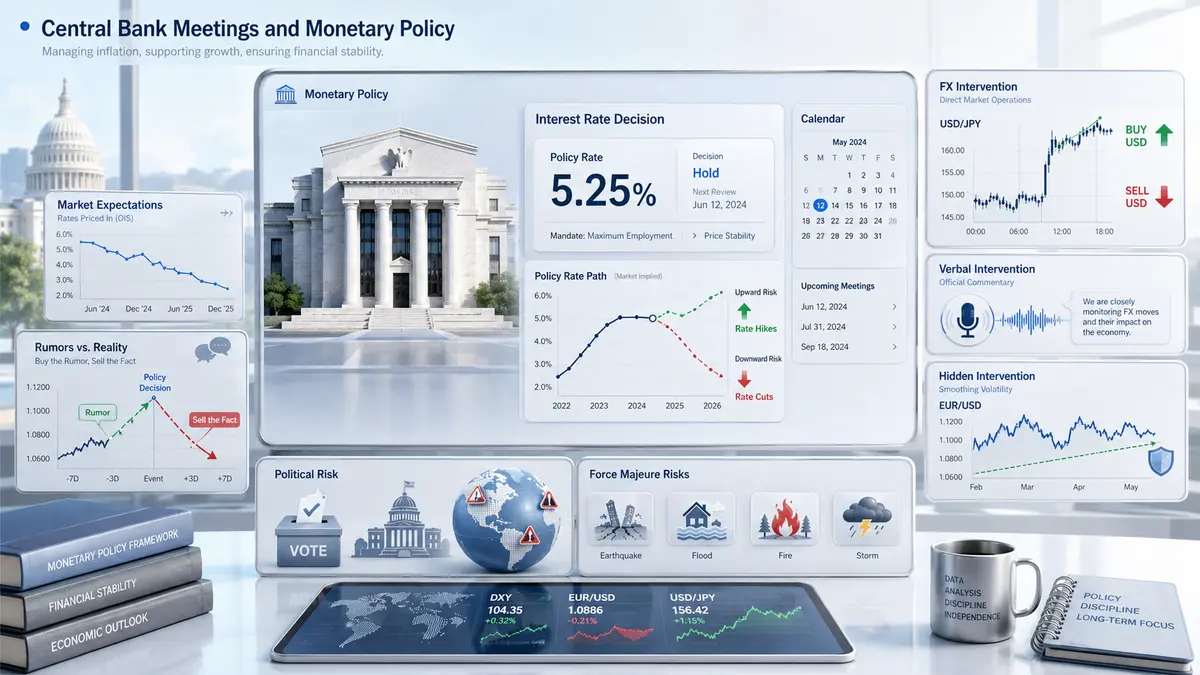
The primary focus during Central Bank meetings is any potential change to the benchmark interest rate. Members of the Federal Open Market Committee (FOMC) vote on short-term interest rates. Because this decision directly impacts the value of the national currency, investors monitor the voting results closely.
-
A rate hike that exceeds forecasts will positively impact the US dollar.
-
Conversely, a rate lower than forecasted will act as a negative factor for the American currency.
Currency Interventions
An intervention is the direct interference of a Central Bank in the foreign exchange market to stabilize the national currency’s exchange rate through massive buying or selling.
-
Explicit Intervention: The Central Bank actively dumps or buys the targeted currency in massive volumes to achieve the desired effect. The resulting price movement can span anywhere from 100 to 500 pips!
-
Verbal Intervention: A psychological tactic used by monetary policy authorities to influence market participants. For example, the head of the Bank of Japan (BOJ) might state during a speech that the JPY exchange rate is too high (keeping in mind that Japan’s export economy benefits from a cheaper currency). This signals that the BOJ will likely conduct a physical intervention soon. Because interventions cause massive market swings that everyone wants to profit from — and because the exact timing is never announced—investors rush to open sell positions on the JPY immediately after the speech. Since these speeches are broadcast globally, a massive wave of short-selling hits the market. If everyone is selling the JPY, its value plummets rapidly — achieving the Central Bank’s goal without an actual physical intervention!
-
Hidden Intervention: The Central Bank quietly supports the national currency at a specific targeted level. This type of intervention is difficult for the broader market to detect.
Additional Factors Influencing the Currency
Political Factors
While political factors generally take a backseat to economic ones, they can play a foundational role during specific periods.
-
Presidential Elections: Elections are usually accompanied by uncertainty, as the market doesn’t yet know what to expect from the new leadership. Uncertainty is almost universally a negative factor for economic growth. Conclusion: Presidential elections often lead to a drop in the national currency.
-
Cabinet Changes and Resignations: Shuffles or unexpected resignations within the government, the Central Bank, or monetary policy committees breed uncertainty — just like presidential elections. Conclusion: Leads to a drop in the national currency.
-
Geopolitical Crises: Major global conflicts and tensions (e.g., events in the Middle East, Ukraine, etc.) act as severe negative factors for the currencies of the involved or adjacent nations. Conclusion: Leads to a drop in the national currency.
Rumors and Expectations
This category involves both economic and political factors, but strictly in the form of rumors and forward-looking expectations.
If a rumor related to fundamental factors surfaces globally, market participants try to enter trades as quickly as possible to secure a good price, which in itself moves the market (similar to a verbal intervention). When the actual event (the fact) finally occurs, it either confirms or denies the rumor.
-
If the rumor is confirmed: Little to no price movement will occur, as the majority of participants have already “priced in” the event by entering the market earlier.
-
If the rumor is denied: The market will violently reverse direction. Participants who entered based on the rumor will scramble to close their positions, triggering a sharp “pullback.”
Force Majeure Circumstances
These are highly disruptive events that cannot be forecasted and occur relatively rarely. Force majeure circumstances include sudden emergencies and natural disasters such as earthquakes, devastating floods, tsunamis, large-scale fires, and similar catastrophic events.

Comments
No comments yet. Be the first to share your thoughts!
Authentication Required
You must be logged in to post a comment.