Bar Pipa
We pay for a post of 10$

Asian Trading

Lin Brings

Gold Futures Fell During Asian Trading
Gold Futures Fell During Asian Trading

Introduction: A Tuesday When the Yellow Metal Lost Its Shine

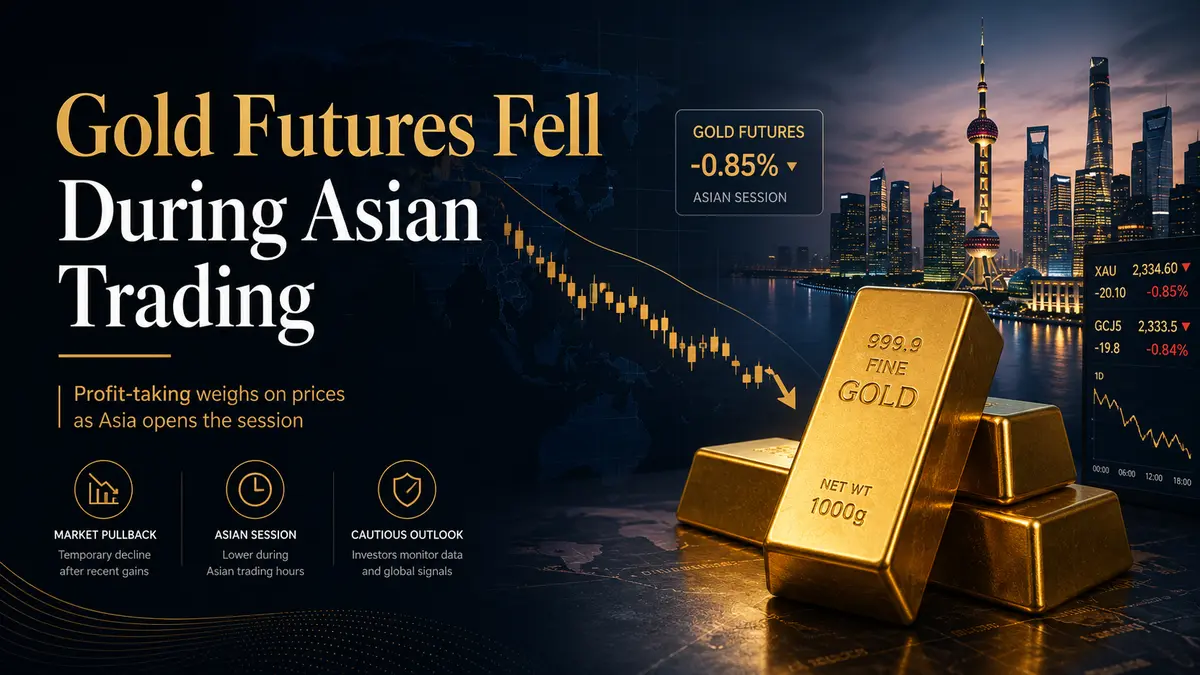
Tuesday, the Asian trading session. Traders in Shanghai, Singapore, and Tokyo opened their terminals and saw an unusual picture. Gold, which had been performing confidently in recent weeks, suddenly moved lower. Futures for August delivery fell to $4,137.80 per troy ounce, losing 0.71% compared with the previous close. This is not a collapse, but it is a noticeable move that makes investors think.

What is happening? Gold, often considered a “safe haven” during periods of uncertainty, suddenly lost some of its appeal. Silver, gold’s faithful companion, fell even more sharply — by 1.95% to $61.12 per ounce. Copper, which had risen the day before amid a weaker dollar, also declined by 0.91% to $6.19 per pound. All metals moved in the same direction — downward.

The dollar index, by contrast, rose by 0.09% to 100.71 points. This is a small strengthening of the U.S. currency, but for gold, which is traded in dollars, even such a move matters. When the dollar rises, gold becomes more expensive for holders of other currencies, which reduces demand and pushes prices lower.

Technically, gold found support at $4,042.80 and resistance at $4,214.91. The current price of $4,137.80 is roughly in the middle of this range. If gold continues to fall, it may test support at $4,042.80. If it reverses, resistance at $4,214.91 will become the next target.

What is behind this decline? Several factors. First, the strengthening of the dollar amid expectations ahead of the release of the Fed minutes. Second, reduced geopolitical uncertainty after the peace agreement between the United States and Iran. Third, technical factors — after a strong rally that pushed gold toward historical highs, a correction began.

Let’s examine why gold is falling, what this means for investors, and where...

Continue reading...
0
0

WTI Oil Rises in Asian Trading: Geopolitics Returns

WTI Oil Rises in Asian Trading: Geopolitics Returns

Introduction: A Tuesday When Oil Woke Up

Tuesday, the Asian trading session. Traders in Singapore, Tokyo, and Shanghai open their terminals and see that WTI oil is back in the green. August futures rise to $69.02 per barrel, gaining 0.69% compared with the previous close. This is not a record-breaking increase, but it is happening against the backdrop of events that could change the dynamics of the entire oil market.

What is behind this move? Geopolitics. Iran attacked vessels in the Strait of Hormuz, immediately bringing fears of supply disruptions back to the markets. Oil prices rose, and although the increase is still modest — just under 1% — it could mark the beginning of a more serious rally if the situation escalates.

Technically, WTI oil found support at $67.04 and resistance at $69.31. The current price of $69.02 is approaching the upper boundary of this range. If oil manages to break through resistance at $69.31, it could open the way toward $70 and higher. If it pulls back, support at $67.04 will be tested again.

The dollar index remained virtually unchanged — 0.00% at 100.62 points. This means the move in oil is not related to the currency factor but is driven by other reasons. The main one is geopolitical tension.

Brent oil also rose by 0.74% to $72.52 per barrel. The spread between Brent and WTI is $3.50, which is within the normal range. Markets are moving in sync, indicating the global nature of the growth factors.

Let’s take a closer look at what is really happening in the Strait of Hormuz, why it matters for oil prices, and where the market is heading.

Geopolitical Factor: The Strait of Hormuz Back in Focus

Attack on Vessels: The Return of Fear

The main news on Tuesday was reports that...

Continue reading...
0
0
Tom Maffin

WTI Oil Rises in Asian Trading: Is There Life Above $69?

WTI Oil Rises in Asian Trading: Is There Life Above $69?

Introduction: A Friday Morning That Started in the Green

Friday. Morning in Asia. Traders in Singapore, Tokyo, and Shanghai open their terminals and see a pleasant picture: WTI crude is back in the green. Futures for August delivery are rising to $69.11 per barrel, gaining 0.61% compared with the previous session’s close. Yes, the increase is not breathtaking, but after several weeks of volatility and declines, even such a modest gain feels like a breath of fresh air.

What is behind this movement? Over the past few weeks, the oil market has looked like a roller coaster: news from Iran, hawkish rhetoric from the Fed, inventory data, dollar fluctuations — all of this created chaos in which traders lost their bearings. But today, on this Friday, oil has found the strength to move higher.

Resistance is located at $71.60 per barrel. Support is at $67.05. The main battle is taking place between these two levels. And while the price remains closer to the lower boundary than the upper one, it is too early to speak of a trend reversal. Still, any upward movement, even 0.6%, gives hope to those who believe in a recovery in the oil market.

Interestingly, WTI’s rise is accompanied by a similar move in Brent. September Brent crude futures rose by 0.72% to $72.32 per barrel. The spread between Brent and WTI is $3.21 per barrel, which is within the normal historical range. The markets are moving in sync, suggesting that the growth factors are global rather than local.

So what exactly is pushing oil higher this Friday morning? Let’s take a closer look.

Macroeconomic Background: A Weak Dollar, Strong Oil

The Dollar Index Falls — Oil Gets Support

One of the classic factors influencing oil prices is the exchange rate of the dollar. Oil is...

Continue reading...
0
0
Navigation menu
instaforex banner