
Bar Pipa
We pay for a post of 10$

Crypto

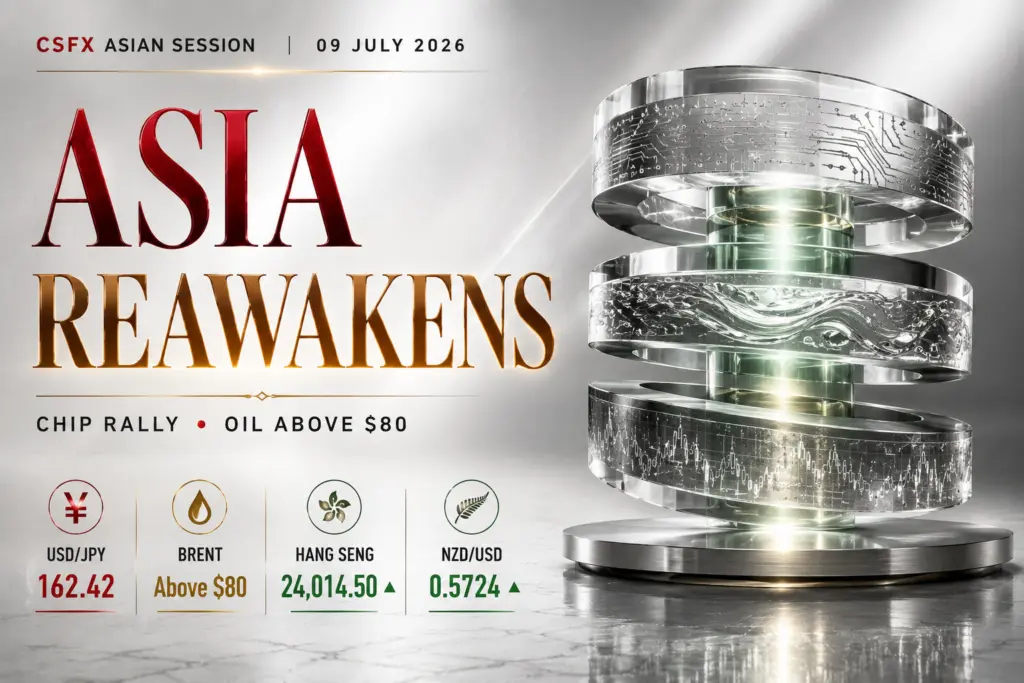
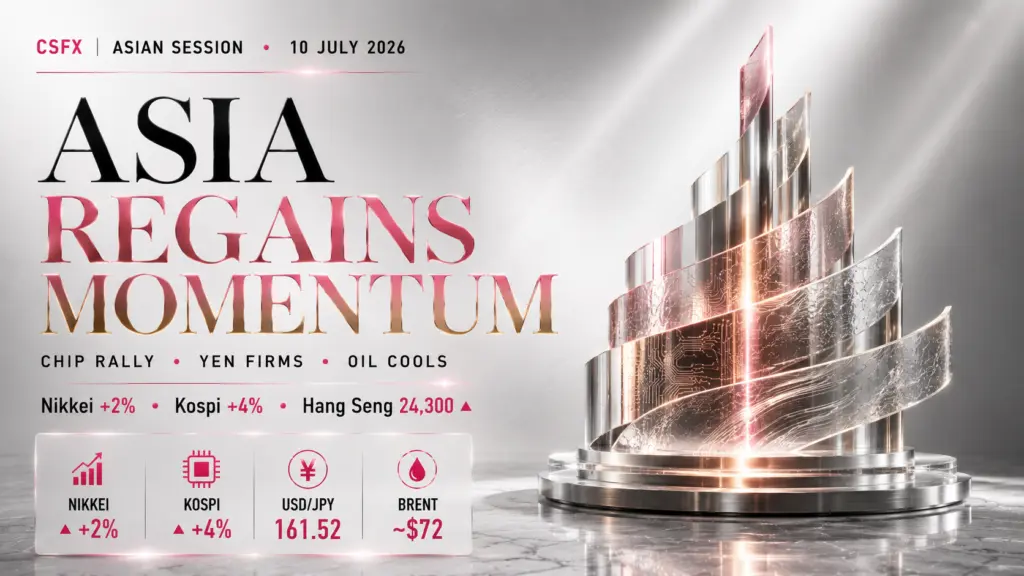
Asia Rallies on Chips and Cooling Iran Tensions. The Yen Firms on Pension Flows. Japan’s PPI Just Ran at 7.1%. Natural Gas Hits a Six-Week Low
Asia Rallies on Chips and Cooling Iran Tensions. The Yen Firms on Pension Flows. Japan’s PPI Just Ran at 7.1%. Natural Gas Hits a Six-Week Low

Nikkei +2%, KOSPI +4%, Hang Seng +1.2-1.9% near 24,300 — best week in over a year. SK Hynix $26.5B US offering priced at $149. US official: Washington committed to negotiated Iran resolution. Yen at 161.52 on Finance Minister Katayama’s pension-fund push. Japan June PPI 7.1% YoY (vs 6.8% expected). Natural gas at six-week low $3.00 on Freeport LNG maintenance and 61 Bcf storage build. Bitcoin above $64,000. Hang Seng on track for best week in over a year.

HIGHEST CONVICTION: Buy the Hang Seng on dips toward 24,050, target 24,700. Chip rebound, robust IPO pipeline (Luxshare, Zhipu AI), and Iran-US de-escalation signal = a multi-pronged case, not a single-catalyst trade.


What Turned the Week Around

Three things happened in the space of twenty-four hours that changed the session’s entire character. First: a US official said late Thursday that Washington remains committed to a negotiated resolution with Iran, with technical talks continuing and regional mediators pushing to revive a nuclear deal. This is not a ceasefire. It is a signal that the negotiating channel is still open, and that is enough to take oil off its highs and restore risk appetite. Second: SK Hynix’s $26.5 billion US share offering priced at $149, drawing strong investor demand and sparking an overnight Wall Street tech rally that carried directly into Asian trade. Third: Finance Minister Satsuki Katayama signalled that Tokyo will explore measures to encourage the Government Pension Investment Fund and other public pension funds to substantially increase their domestic asset holdings. That alone moved the yen and JGB yields.

The result is a session where everything is working simultaneously: equities are up, the yen is firming, JGB yields are easing from a three-decade high, copper is breaking above its prior range high, and crypto is recovering. The risk is that all...

Continue reading...
0
0
Tom Maffin

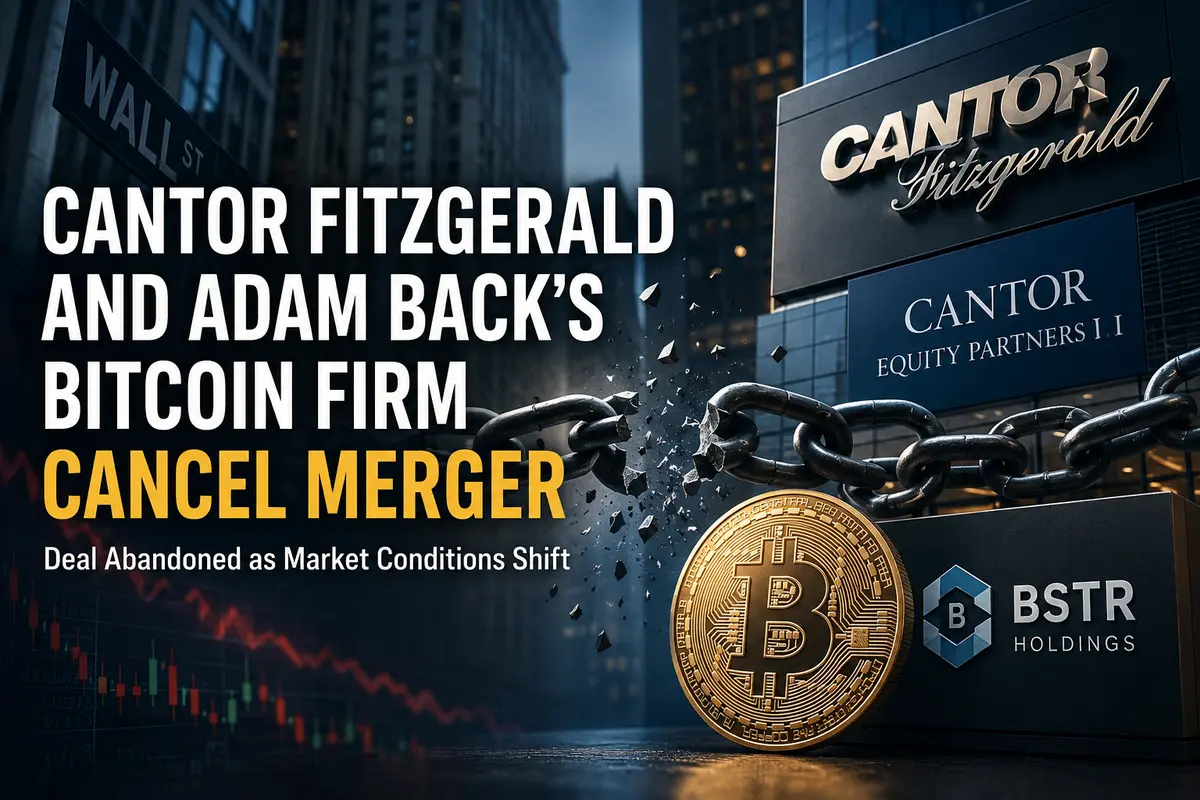
The Collapse of the Bitcoin Marriage: Why Cantor and Adam Back’s Empire Broke Off the Engagement

The Collapse of the Bitcoin Marriage: Why Cantor and Adam Back’s Empire Broke Off the Engagement

Introduction: The Call That Changed Everything

It was supposed to be a landmark event for the crypto industry. One of Wall Street’s oldest financial firms, Cantor Fitzgerald, was joining forces with the bitcoin investment company of the legendary Adam Back. A man who stood at the origins of Bitcoin, whose work is linked to Satoshi’s white paper, was bringing his business to the public market through a SPAC. The deal was expected to legitimize cryptocurrency in the eyes of conservative institutional investors and generate billions in profits.

And then — silence. Followed by a dry statement: the parties were abandoning the original terms. The merger was canceled. But not entirely. They want to negotiate a revised deal. The financial parameters were not disclosed. The timeline was not specified. Private financing was annulled. The shareholder meeting scheduled for July 10 was postponed indefinitely.

So what happened? Why did a deal that seemed almost guaranteed a year ago fall apart at the last moment, leaving investors confused? Was it a crisis of trust, funding problems, or a sign that bitcoin euphoria is beginning to fade?

The SPAC Mechanism: A Shortcut to the Stock Market That Became a Rocky Road

What Is a SPAC and Why Was It Chosen

To understand the scale of what happened, it is important to recall what a SPAC is — a special purpose acquisition company. In essence, it is a “blank check”: a company with no operating business that goes public, raises money from investors, and then searches for a target to acquire. If the deal goes through, the private company becomes public without a traditional IPO.

This mechanism was incredibly popular at the beginning of the decade. It promised speed, less bureaucracy, and access to capital even for companies that were not ready for a full...

Continue reading...
0
0
Big Pip

Cryptocurrency Glossary

Cryptocurrency Glossary

Note on Cryptocurrency

Note on Cryptocurrency Part 2

Note on Cryptocurrency Part 3

1. Token Sales, Fundraising, and Market Entry

  • ICO (Initial Coin Offering): The sale of project tokens before they begin trading on an exchange, typically offered at a discounted price to attract early-stage investments for the project's further development.

  • IDO (Initial DEX Offering): A pre-listing token sale where the investment round is conducted through the mediation of a decentralized exchange (DEX), utilizing automated liquidity pools.

  • IEO (Initial Exchange Offering): A pre-listing token sale where the investment round is conducted under the mediation and oversight of a centralized exchange (CEX).

  • Token Sale (General Concept): Fundamentally, abbreviations like ICO, IDO, and IEO all denote the exact same process: selling tokens before public trading begins. The only difference lies in the participation conditions and the format of the hosting platforms. This type of early-stage investing is historically considered highly profitable.

  • STO (Security Token Offering): A public offering of tokenized digital securities that are fully regulated and backed by real-world assets, such as company shares, bonds, or real estate.

  • IGO (Initial Game Offering): A capital-raising event specifically tailored for blockchain-based gaming projects (GameFi), where early investors purchase in-game tokens or NFTs.

  • Allocation: The specific amount of tokens or investment quota guaranteed to an investor during a token sale or presale event.

  • Whitelist (WL): A pre-approved list of registered wallet addresses that are granted exclusive, guaranteed rights to participate in a token sale, IDO, or NFT minting event before the general public.

  • Vesting: A programmatic lock-up period during which founders, team members, and early investors cannot sell their tokens. Tokens are gradually unlocked over a set schedule to prevent massive market dumps.

  • Cliff: A specific, initial period within a vesting schedule (e.g., 6 months) during which absolutely no tokens are unlocked or distributed.

...

Continue reading...
0
0

Chips Rally Around SK Hynix. Iran Hits 85 US-Linked Gulf Sites. Treasury Yields Push Toward a 10-Month High. The Dollar Still Cannot Find Its Footing

Chips Rally Around SK Hynix. Iran Hits 85 US-Linked Gulf Sites. Treasury Yields Push Toward a 10-Month High. The Dollar Still Cannot Find Its Footing

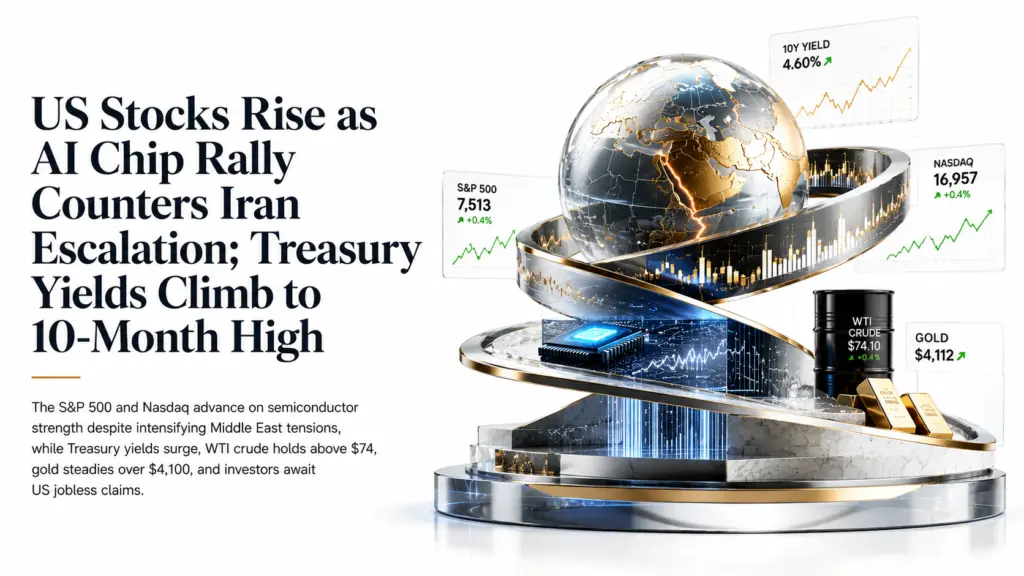
S&P 500 up 0.4% near 7,513 on SK Hynix US share offering demand and the AI/chip trade. US struck ~90 Iranian targets over two days. Iran retaliated by hitting ~85 US-linked military sites in Bahrain and Kuwait. 10Y Treasury toward 4.60% — 10-month high. 5Y at 4.33%. Fed hike probability for September repriced to ~70%. WTI consolidating near $74 after an 11% two-session surge. Bitcoin stuck at $62,850 with Fear & Greed at 22.

HIGHEST CONVICTION: Fade the US 5-year Treasury yield rise toward 4.40%. The hawkish repricing is oil-shock driven, not demand-driven. Oil shocks are historically less persistent for Fed policy than domestic wage and services inflation.


The Divergence That Defines the Session

Equities are up 0.4%. Bond yields are at 10-month highs. Both things are happening simultaneously and the reason they can is that they are responding to different inputs from the same Iran story. The equity market is buying the chip trade — SK Hynix’s US share offering drew strong demand, and that demand signal is rippling through every AI and semiconductor name on the board. The bond market is buying the inflation argument — the same Iran escalation that is producing the Hormuz risk premium is feeding directly into the rate-hike probability.

The US struck roughly 90 Iranian targets over two sessions. Iran retaliated by hitting approximately 85 US-linked military sites across Bahrain and Kuwait. President Trump declared the ceasefire MoU over. These are not conditions that typically produce equity rallies. The reason stocks are higher is that six of eleven S&P sectors closed positive on Wednesday even as the index fell, evidence that the rotation into chips is powerful enough to run against the macro headwind. Wednesday’s FOMC minutes — the first released under Chair Kevin Warsh — showed policymakers genuinely divided on further...

Continue reading...
0
0

European Stocks Rebound. AstraZeneca Plunges 9%. Bund Yields Ease From a Two-Month High. Oil Retreats. The Dollar Still Cannot Find a Haven Bid

European Stocks Rebound. AstraZeneca Plunges 9%. Bund Yields Ease From a Two-Month High. Oil Retreats. The Dollar Still Cannot Find a Haven Bid

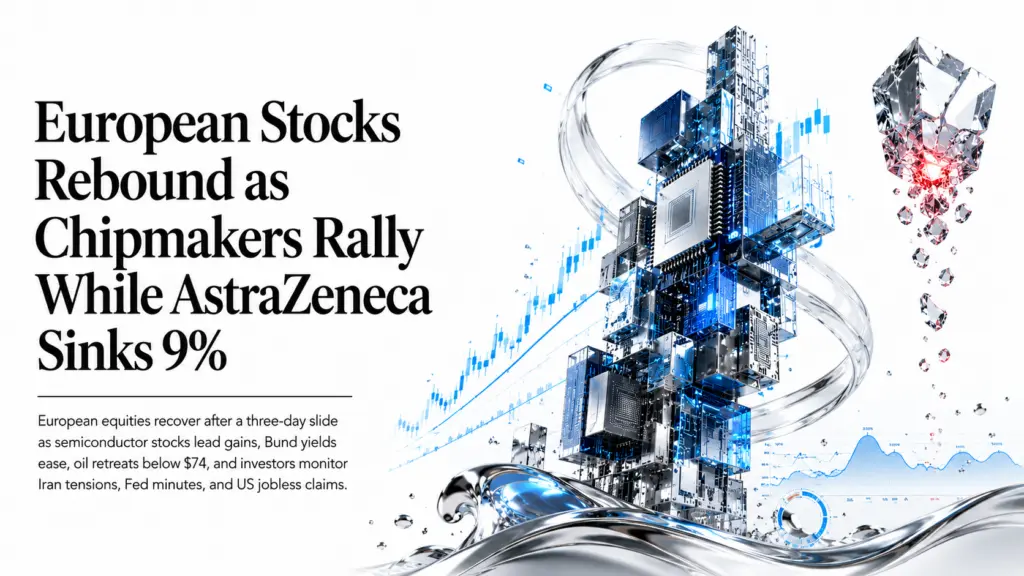
CAC 40 up 0.6%. DAX up 0.7%. ASML +2.6%, Infineon +3.1%, STMicro +3.7%. FTSE 100 in the red: AstraZeneca down over 9%, its worst day since 2017, after Wainua failed a late-stage cardiac trial. Bund 10Y easing to 3.06% from Wednesday’s two-month high of 3.10%. EUR/USD climbing toward 1.1450 — German trade surplus €19.1B (vs €14.5B prior). GBP/USD at a three-week high above 1.3400. Oil retreating nearly 2% to $73.10. Silver bouncing to $59.12 from Wednesday’s $57.22 low. Crypto holding losses: BTC near $62,300, Fear & Greed at 22.

HIGHEST CONVICTION: Fade the EU 5-year Bund yield rise toward 2.90%. The hawkish ECB repricing looks stretched relative to an oil shock that is potentially reversible if Qatar-mediated diplomacy gains traction.


Two Markets Inside One European Session

Thursday’s European session is a cautious rebound built on a fragile premise: that the Iran situation will de-escalate again, just as it did in June. The Stoxx 600 is up around 0.5%, led by semiconductor names — ASML up 2.6%, Infineon up 3.1%, STMicroelectronics up 3.7% — following strong investor demand for SK Hynix’s US share offering. France’s CAC 40 has recovered around 0.6% of Wednesday’s 2.2% slide. Germany’s DAX is up around 0.7%. The broader rally is happening on reports that Qatar is pressing Tehran to honour the existing memorandum of understanding and contain the escalation.

London is the session’s obvious exception. The FTSE 100 is in the red because AstraZeneca, its second-largest constituent, has plunged more than 9% — its steepest one-day fall since 2017 — after its gene-silencing drug Wainua, developed with Ionis Pharmaceuticals, failed a late-stage trial to prevent cardiac complications. One failed drug trial is erasing more index points than three European chipmakers are recovering.

The entire continental rebound rests on the assumption that Qatar’s mediation succeeds. Trump...

Continue reading...
0
0
Big Pip

Note on Cryptocurrency Part 3

Note on Cryptocurrency Part 3

Part 1

Part 2

ASSET SCREENING METHODOLOGIES, ADVANCED DATA AGGREGATION, AND YIELD MECHANICS

1. Methodology for Evaluating Promising Listed Tokens (Major Exchanges)

The most formidable challenge facing any cryptocurrency investor is identifying digital assets capable of generating substantial, asymmetric returns. With over 19,000 distinct tokens actively trading across global digital asset marketplaces, implementing a rigorous, quantitative screening framework is non-negotiable for capital preservation and growth.

1.1 Core Quantitative and Qualitative Metrics

When analyzing an asset already listed on top-tier centralized exchanges (CEX), a disciplined market participant must systematically audit the following parameters:

  • Exchange Liquidity Depth and Listing Architecture: Evaluate the number and tier of exchanges hosting the token. If an asset is exclusively traded on low-tier, unregulated platforms, it suffers from acute liquidity risk. Conversely, a token integrated into major platforms like Binance, Coinbase, or Kraken exhibits robust liquidity, deep order books, and institutional-grade oversight, which significantly lowers the risk of market manipulation.

  • Circulating Supply vs. Fully Diluted Valuation (FDV): An investor must never look at nominal token price alone. You must analyze the ratio of circulating supply to the maximum capped supply. If a project has a current market capitalization of $100,000,000 but only 10% of its tokens are in circulation, its Fully Diluted Valuation (FDV) sits at $1,000,000,000. The remaining 90% represents latent supply inflation that will inevitably dilute future spot buyers as those tokens enter the market.

  • Venture Capital Infrastructure and Entry Benchmarks: Identify the institutional venture capital (VC) firms that backed the project during its seed, private, or strategic funding rounds. Tier-1 funds (such as Paradigm, a16z Crypto, Pantera Capital, or Multicoin Capital) conduct exhaustive due diligence before deploying capital. Furthermore, calculate the multiple of the current market price relative to the initial ICO (Initial Coin Offering) or seed round price. If early institutional buyers are...

Continue reading...
0
0
Big Pip

Note on Cryptocurrency Part 2

Note on Cryptocurrency Part 2
Part 1 Part 3 NON-CUSTODIAL WALLETS, DEX OPERATIONS, AND FIAT GATEWAYS

1. Registration and Configuration of Web3 Wallets for Decentralized Finance (DeFi)

1.1 What is MetaMask and Why is it the Industry Standard?

To interact seamlessly with decentralized exchanges (DEX) and automated smart contracts, you will require a non-custodial online wallet. Unlike standard exchange accounts, a non-custodial wallet grants you absolute control over your digital assets. The most popular and versatile solution across the crypto industry is MetaMask. MetaMask is a software cryptocurrency wallet that serves as a digital bridge between a traditional web browser and various blockchain networks. It allows users to receive, securely store, and send digital assets, as well as authenticate themselves on Web3 applications. Developed by ConsenSys in 2016, it currently supports the vast majority of EVM-compatible networks (such as Ethereum, Binance Smart Chain, Polygon, Avalanche, and others). MetaMask operates as a lightweight browser extension (it is highly recommended to use Google Chrome dedicated strictly to financial transactions, as outlined in the first part of this memo).

1.2 Step-by-Step Installation and Basic Security Setup

It is absolutely critical to download the wallet exclusively from official sources to avoid malicious phishing clones circulating on the web.
  1. Downloading: Navigate to the official website [https://metamask.io](https://metamask.io) and click "Download" in the upper right corner.
  2. Installation: Select "Install MetaMask for Chrome". This will redirect you to the official Chrome Web Store. Click "Add to Chrome" and confirm by selecting "Add extension".
  3. Initialization: In the automatically opened tab, click "Get Started" and then select "Create a Wallet".
  4. Agreement and Password: Read the privacy data policy, click "I Agree", and create a complex local password.
Crucial Concept to Understand: The local password you just created protects the application only on this specific computer from someone physically gaining access to your monitor. MetaMask is...
Continue reading...
0
0

Chips Rebound. Oil Surges for a Third Day. Brent Clears $80. Bonds Are Getting Routed. The RBNZ Just Hiked for the First Time in Three Years

Chips Rebound. Oil Surges for a Third Day. Brent Clears $80. Bonds Are Getting Routed. The RBNZ Just Hiked for the First Time in Three Years

Trump declared the ceasefire MoU “over” and the US struck Iran for a second straight day. Brent is above $80 for the first time since June 22. The 10-year JGB yield is at its highest since September 1996. US Treasuries have added 10 basis points this week. The RBNZ hiked 25bp to 2.50% and signalled more. And Asia’s chipmakers are up 3–7% on a single Nvidia headline. Two completely different markets. Same session.

HIGHEST CONVICTION: USD/JPY is failing to track its own yield support near the 40-year peak. The pair eased 0.2% to 162.42 even as US 10-year yields climbed. Intervention risk and matching JGB yield rises are the explanation. This is a fade, not a chase.


The Oil Story That Is Breaking Bonds

President Trump declared the US-Iran ceasefire memorandum of understanding “over.” The US military launched fresh strikes on Iran for a second consecutive day, this time specifically targeting infrastructure that would help reopen the Strait of Hormuz. Brent crude cleared $80 per barrel for the first time since June 22, up roughly 9% on the week. WTI trades near $74.40. Trump said later he does not expect a return to full-scale war, which capped the initial panic, but the damage to inflation expectations was already done.

Fed funds futures now imply about 38 basis points of policy tightening this year, back to where pricing sat a week ago. Wednesday’s FOMC Minutes showed that a handful of participants already saw a case for raising rates in June before the committee agreed to hold. The oil-driven repricing is pulling Fed expectations back in a hawkish direction at the worst possible time for bond markets.

The 10-year JGB yield just hit its highest level since September 1996. Australia’s 10-year is at its highest since early June. The US 10-year...

Continue reading...
0
0
Big Pip

Note on Cryptocurrency

Note on Cryptocurrency
Hello everybody! I'm leaving a note for myself here about cryptocurrency, you can use it too. Part 2 Part 3 OPERATIONAL GUIDE, SECURITY PROTOCOLS, AND MARKET NAVIGATION

1. Understanding Cryptocurrency and Its Core Concept

1.1 Fundamental Definitions and Operational Philosophy

Cryptocurrency must be comprehended fundamentally as an advanced cryptographic technology and a fully decentralized payment ecosystem. Unlike traditional financial architectures, it operates entirely in an automated, programmatic mode without the oversight of an internal or external administrator, central bank, or institutional intermediary. The underlying framework relies on a distributed ledger network (blockchain), where transactions are validated by decentralized nodes through mathematical algorithms and consensus mechanisms, rendering the history of data immutable and transparent. In practice, this independence from human intervention ensures that no single sovereign entity can manipulate token supplies, freeze autonomous smart contracts, or retroactively alter transaction logs. To transition successfully into digital asset management, an investor must abandon conventional assumptions regarding centralized financial oversight and instead master the principles of cryptographic proof, mathematical security, and absolute self-custody.

1.2 Real-World Application and Sovereign Integration Case Studies

To understand how this autonomous payment mechanism scales into institutional and sovereign frameworks, consider the operational models implemented by forward-thinking jurisdictions such as Switzerland and the Kingdom of Bahrain:
  • Switzerland (The Canton of Zug): Universally recognized as the cornerstone of the global "Crypto Valley," the Canton of Zug has legally integrated digital assets into its civic infrastructure. Local authorities fully accept Bitcoin (BTC) and Ethereum (ETH) for commercial and individual municipal tax payments up to a threshold of 100,000 CHF. Transactions are seamlessly settled through specialized institutional brokers who convert digital tokens into Swiss Francs on behalf of the state treasury, proving that decentralized payment systems can coexist perfectly alongside highly regulated traditional fiscal regimes.
  • The Kingdom of Bahrain: Positioned as a premier...
Continue reading...
0
0

Nearly One Million Investors Lost $3.8 Billion on Trump’s Memecoin

Nearly One Million Investors Lost $3.8 Billion on Trump’s Memecoin

Introduction: The Sunday When Illusions Collapsed

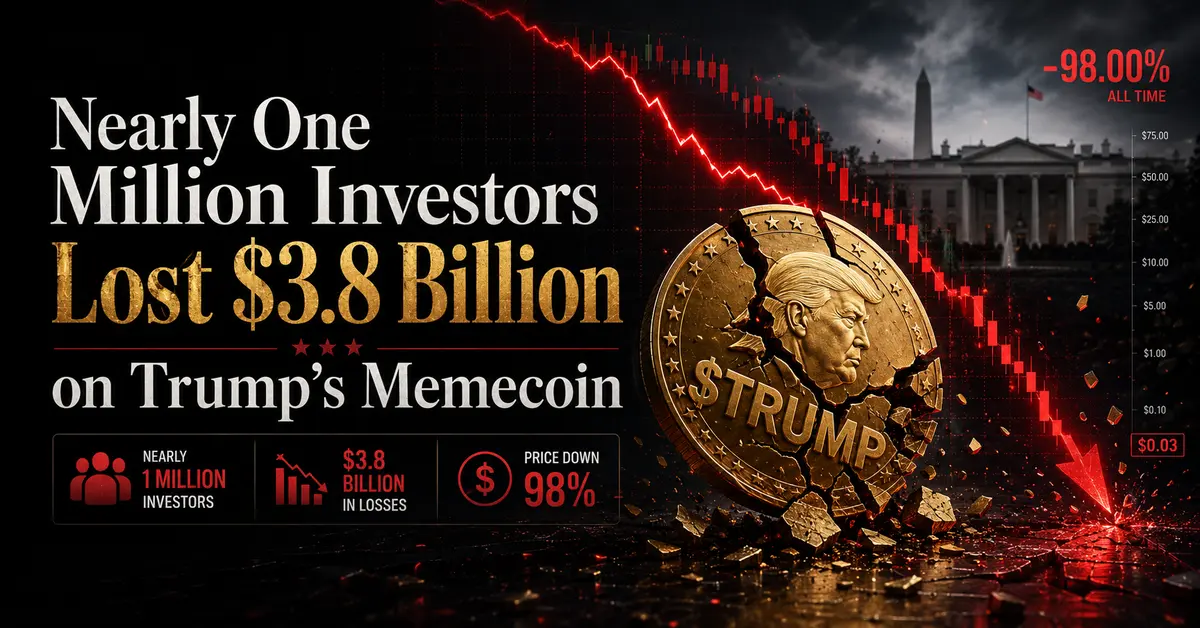
Sunday. $TRUMP is trading at $1.69. That is almost 98% below its all-time high of $75.35, reached at the peak of the hype. The numbers that were supposed to make people rich instead left them with empty wallets and the bitter realization that they had become part of one of the biggest financial disasters in crypto history.

Nearly one million people. 988,905 accounts, to be exact. That is roughly two out of every three $TRUMP buyers. Together, they lost a total of $3.8 billion. Not thousands, not millions — billions. With a capital “B.” This was not just a bad investment. It was a mass financial collapse, comparable in scale to pyramid scheme failures or the dot-com crash.

What happened? Trump announced the memecoin three days before his inauguration in January 2025. It was the peak of the hype. Crypto enthusiasts who had seen Dogecoin and Shiba Inu turn ordinary people into millionaires rushed to buy. They believed that Trump’s brand, his political influence, and the buzz around his return to the White House would turn $TRUMP into the next gold mine.

But reality proved brutal. A memecoin is not an investment — it is a bet on hype. And when the hype disappeared, the price collapsed. Those who bought at the peak were left with almost nothing. Those who bought near the bottom also lost money, because the bottom kept moving lower.

Trump, meanwhile, earned $636 million from this memecoin. That is almost half of the $1.4 billion he received from the crypto industry last year. His administration, to put it mildly, was in no rush to regulate the industry. The SEC stated that it would not regulate memecoins as securities and withdrew a number of lawsuits against crypto companies.

Let’s break down...

Continue reading...
0
0
Navigation menu
instaforex banner