

Note on Cryptocurrency

Hello everybody! I’m leaving a note for myself here about cryptocurrency, you can use it too.
OPERATIONAL GUIDE, SECURITY PROTOCOLS, AND MARKET NAVIGATION
1. Understanding Cryptocurrency and Its Core Concept
1.1 Fundamental Definitions and Operational Philosophy
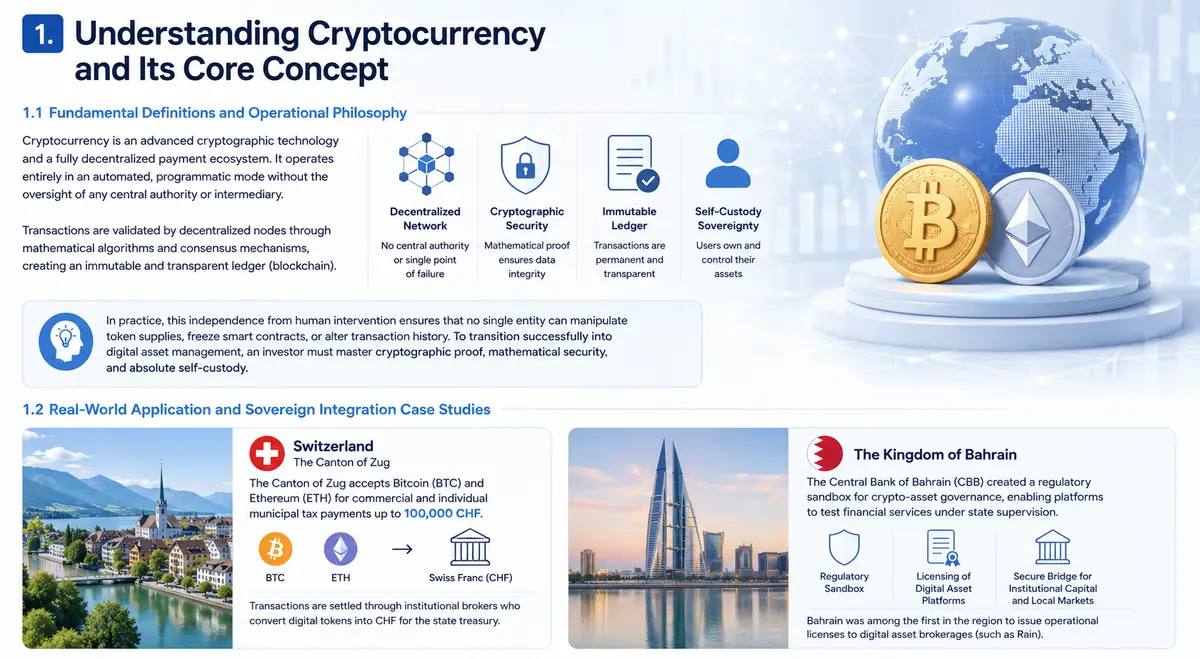
Cryptocurrency must be comprehended fundamentally as an advanced cryptographic technology and a fully decentralized payment ecosystem. Unlike traditional financial architectures, it operates entirely in an automated, programmatic mode without the oversight of an internal or external administrator, central bank, or institutional intermediary. The underlying framework relies on a distributed ledger network (blockchain), where transactions are validated by decentralized nodes through mathematical algorithms and consensus mechanisms, rendering the history of data immutable and transparent.
In practice, this independence from human intervention ensures that no single sovereign entity can manipulate token supplies, freeze autonomous smart contracts, or retroactively alter transaction logs. To transition successfully into digital asset management, an investor must abandon conventional assumptions regarding centralized financial oversight and instead master the principles of cryptographic proof, mathematical security, and absolute self-custody.
1.2 Real-World Application and Sovereign Integration Case Studies
To understand how this autonomous payment mechanism scales into institutional and sovereign frameworks, consider the operational models implemented by forward-thinking jurisdictions such as Switzerland and the Kingdom of Bahrain:
- Switzerland (The Canton of Zug): Universally recognized as the cornerstone of the global “Crypto Valley,” the Canton of Zug has legally integrated digital assets into its civic infrastructure. Local authorities fully accept Bitcoin (BTC) and Ethereum (ETH) for commercial and individual municipal tax payments up to a threshold of 100,000 CHF. Transactions are seamlessly settled through specialized institutional brokers who convert digital tokens into Swiss Francs on behalf of the state treasury, proving that decentralized payment systems can coexist perfectly alongside highly regulated traditional fiscal regimes.
- The Kingdom of Bahrain: Positioned as a premier financial hub in the Middle East, the Central Bank of Bahrain (CBB) proactively designed a comprehensive regulatory sandbox explicitly tailored to crypto-asset governance. This initiative allowed digital asset platforms to pilot their financial services within a bounded ecosystem under state monitoring. Consequently, Bahrain became one of the first nations in the region to issue formal operational licenses to digital asset brokerages (such as Rain), establishing a highly secure, programmatic bridge that permits institutional capital to flow safely into localized decentralized markets.
2. Workstation Software Preparation, Device Hygiene, and Cyber Defense
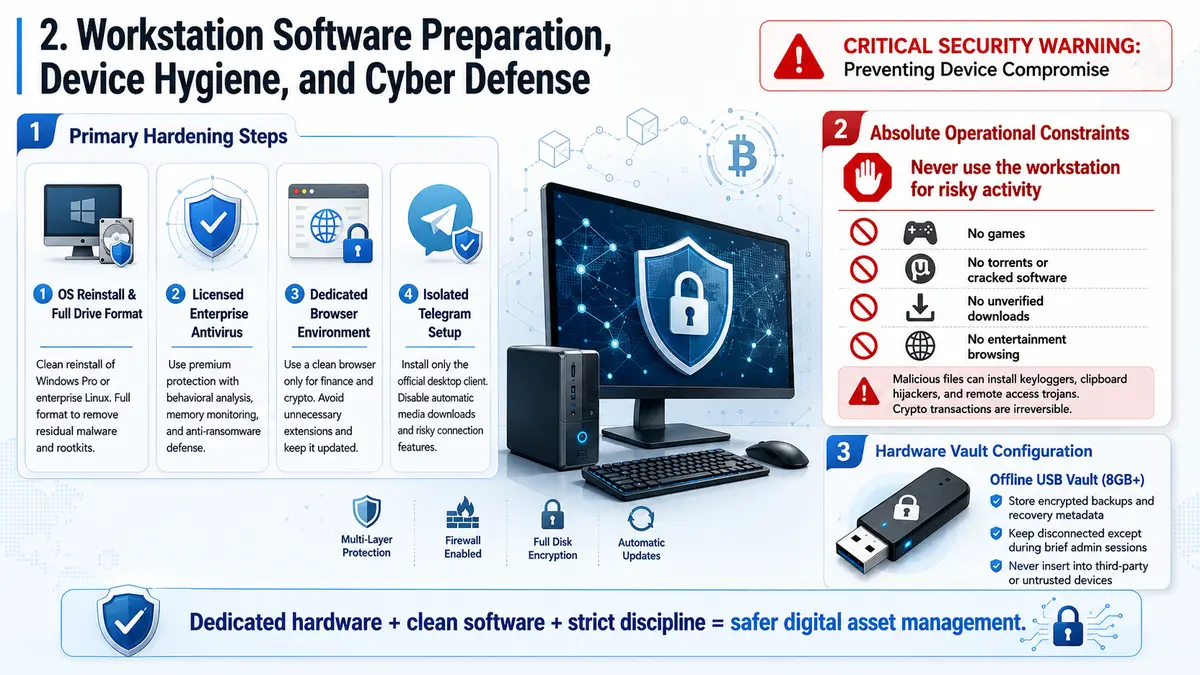
CRITICAL SECURITY WARNING: PREVENTING DEVICE COMPROMISE
The digital asset ecosystem is densely populated with highly sophisticated malware, including keyloggers designed to record seed phrases, clipboard hijackers that dynamically substitute recipient wallet addresses during transaction compilation, and remote access trojans (RATs). Because crypto transactions are cryptographically irreversible, any software compromise results in immediate and unrecoverable capital forfeiture. Traditional desktop computers used for daily web browsing, entertainment, or casual applications are fundamentally unsafe for capital management.
2.1 Primary Hardening Steps for Personal Computers (PC)
Before executing a single transaction, configuring an online account, or generating a private cryptographic key, you must transition your physical hardware into an isolated, secure workstation by strictly enforcing the following protocol:
- Operating System Reinstallation & Storage Overwrite: You must completely reinstall your operating system (preferably utilizing a clean, verified distribution of Windows Pro or an enterprise-grade Linux kernel) accompanied by a mandatory full low-level format of the internal hard drive or solid-state drive (SSD). Quick formatting is insufficient; a full format ensures that residual malicious blocks, latent rootkits, and tracking scripts are permanently purged from the storage geometry.
- Deployment of a Licensed Enterprise Antivirus: Install a premium, licensed cyber-security suite featuring proactive heuristic analysis, continuous memory monitoring, and behavioral anti-ransomware shields. Relying on default, un-updated, or pirated security software exposes the system to zero-day exploits specifically engineered to target active browser extensions.
- Isolating the Browsing Environment via Google Chrome: Dedicate Google Chrome exclusively to your financial and cryptocurrency interactions. Do not install non-essential third-party extensions, custom themes, or ad-blockers from unverified developers, as these frequently serve as vectors for supply-chain cyber attacks. Keep Chrome updated to its latest stable release to ensure memory-isolation vulnerabilities are continuously patched.
- Securing an Isolated Telegram Deployment: Install the official, native Telegram desktop client directly from the developer’s official repository. Disable all automatic media downloads, automated script executions, and peer-to-peer connection configurations within the privacy settings to block automated network-probing tools and malicious payloads hidden inside community-shared files.
2.2 Absolute Operational Constraints
The dedicated financial workstation must never be utilized to download video games, torrented movies, cracked utility software, or unverified files. Malicious actors routinely bundle data-scraping trojans within popular media and software cracks. Once a system is infected, even the most advanced security protocols can be bypassed via kernel-level memory monitoring.
2.3 Hardware Vault Configuration (Physical Media)
It is strongly recommended to acquire a high-quality physical USB flash drive with a storage capacity of at least 8GB, dedicated solely to cryptographic administrative storage. This drive functions as an offline physical vault. It must be utilized to store encrypted configuration backups, local password databases, and cold recovery metadata. This physical device must remain completely disconnected from your computer at all times, except during brief, highly controlled administrative sessions. It must never be inserted into any external or unverified third-party hardware.
3. Engineering a Secure and Crated Information Landscape
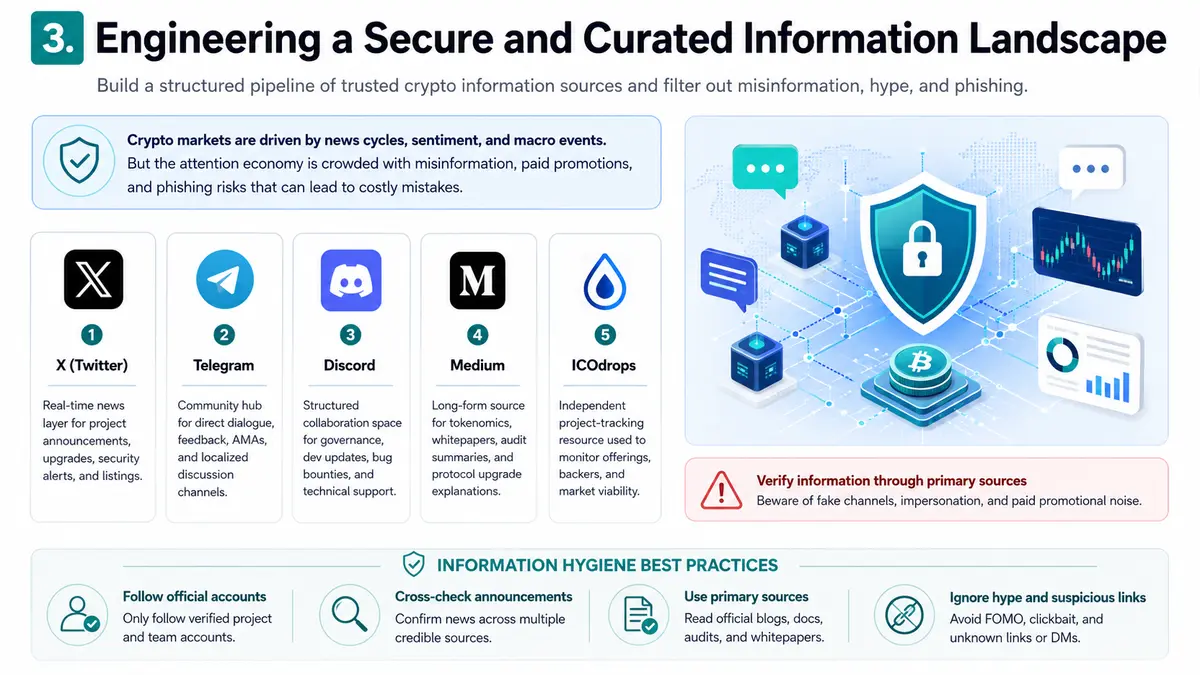
The cryptocurrency markets are profoundly driven by structural news cycles, speculative sentiment, and macroeconomic announcements. However, this environment is also saturated with coordinated misinformation, paid promotional campaigns, and elaborate phishing syndicates. To achieve sustained success, an investor must actively filter out market noise and establish a structured pipeline to receive data directly from primary cryptographic sources.
3.1 Core Platforms and Information Optimization Protocols
- 1. X (Formerly Twitter) — The primary real-time communications layer for global crypto networks. Every emerging blockchain project, core developer, and cryptographic research foundation utilizes this platform as their principal channel for public disclosure. Teams publish immediate milestones, network upgrades, security vulnerabilities, and upcoming exchange listings here. Source Context: https://twitter.com/
- 2. Telegram Messenger — The decentralized community management hub. Project developers deploy official, localized discussion channels to facilitate direct dialogue between users, engineering teams, and liquidity providers. It serves as a real-time feedback loop where investors can monitor community engagement, assess developer responsiveness, and attend structured Ask-Me-Anything (AMA) audio sessions. Source Context: https://web.telegram.org/
- 3. Discord — The infrastructure layer for governance and technical collaboration. Discord operates via structured, permissioned servers that segment community engagement into distinct operational channels (e.g., development logs, governance votes, bug bounties, technical support). It allows advanced investors to interact directly with smart contract engineers and participate in early testnet protocols. Source Context: https://discord.com/
- 4. Medium — The long-form analytical publication medium. Cryptographic foundations use Medium to distribute detailed economic models (tokenomics), comprehensive technical architecture whitepapers, auditing reports, and granular explanations of protocol upgrades that cannot be adequately compressed into brief social media posts. Source Context: https://medium.com/
- 5. ICOdrops — One of the most authoritative independent data aggregators in the digital asset sector. It acts as an active initial offering tracker, where an analytical team systematically vets incoming projects, evaluates their institutional backers, and scores their viability based on community-vetted metrics, providing an unbiased barrier against speculative market hype. Source Context: https://icodrops.com/
4. The Structural Typology of Cryptocurrency Exchanges
Historically, the global financial landscape remained unaware of the emergence of a radical asset class: Bitcoin and its underlying blockchain framework. Due to its mathematically hard-capped supply and exponential technological adoption curves, the digital asset ecosystem has evolved into one of the most lucrative financial asset classes in human history. To contextualize this growth relative to legacy financial systems, consider the historical average compound annual returns across global asset classes:
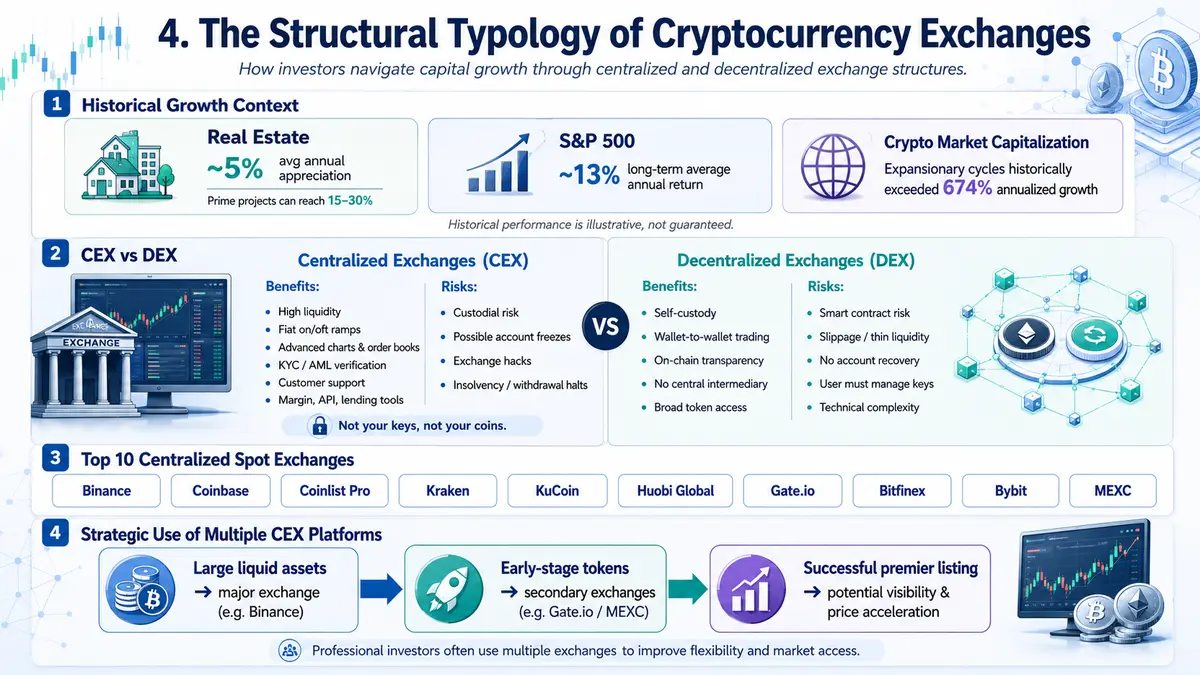
- Real Estate (Stabilized, Income-Generating Assets): Typically yields an average capital appreciation of approximately 5% annually. High-tier development projects in prime metropolitan locations can yield 15% to 30% annually, heavily constrained by geographical risk, construction timelines, and physical liquidity barriers.
- The S&P 500 Index: Representing the aggregate market capitalization of the 500 largest publicly traded corporations in the United States, it delivers a historically validated long-term average return of approximately 13% annually, serving as the benchmark for traditional institutional capital equity.
- Aggregate Cryptocurrency Market Capitalization: Has historically demonstrated annualized growth trajectories exceeding 674% during expansionary cycles. While accompanied by significant volatility, the sheer velocity of capital expansion highlights the immense wealth-generation potential that sets the digital asset economy completely apart from legacy markets.
To safely navigate this capital velocity, an investor must master the distinct structural mechanics of the two primary exchange architectures: Centralized Exchanges (CEX) and Decentralized Exchanges (DEX).
4.1 Centralized Spot Cryptocurrency Exchanges (CEX)
Centralized Exchanges operate as highly organized commercial trading platforms that act as intermediaries to execute order-matching between buyers and sellers.
They facilitate high-throughput spot trading, allowing users to exchange digital assets for other tokens or directly convert them into state-issued fiat currencies (legal tender bank notes and coins utilized for daily domestic commerce).
Operational Advantages & Professional Tools: CEX platforms require mandatory account registration and Identity Verification (KYC/AML). They provide institutional-grade trading interfaces, detailed historical charting over various timeframes, deep liquidity depth, competitive trading fees, and 24/7 dedicated customer support. For advanced market participants, they offer complex margin trading, API access for algorithmic trading robots, and structured lending protocols.
Systemic Vulnerabilities: Because CEX platforms are private corporate entities, they operate as custodians of your capital. When your assets are stored on a CEX, you do not possess the underlying cryptographic private keys (“Not your keys, not your coins”). The platform can unilaterally freeze assets due to regulatory pressures, experience database hacks, or halt operations entirely due to insolvency, permanently blocking user withdrawals.
Below are the Top 10 Centralized Spot Exchanges, selected based on institutional liquidity depth, verified trading volume, active user web traffic, and established market trust metrics:
- [CEX] Binance: The largest global exchange by trading volume, featuring unmatched liquidity and an expansive ecosystem, though it enforces strict compliance and token vetting guidelines.
- [CEX] Coinbase: A publicly traded corporation in the United States, celebrated for its extreme regulatory compliance and secure fiat-to-crypto gateways.
- [CEX] Coinlist Pro: A specialized platform renowned for hosting highly sought-after initial token sales and compliance-centric early liquidity distribution.
- [CEX] Kraken: One of the oldest and most cryptographically secure exchanges globally, maintaining clean reserves and advanced fiat integration.
- [CEX] KuCoin: Known as “The People’s Exchange,” it offers a vast catalog of mid-cap and micro-cap alternative tokens alongside advanced trading tools.
- [CEX] Huobi Global: A foundational exchange with deep liquidity pools tailored extensively for Asian and international institutional markets.
- [CEX] Gate.io: A highly comprehensive trading platform that hosts thousands of early-stage alternative cryptocurrencies long before they achieve mainstream listing.
- [CEX] Bitfinex: An advanced platform providing institutional order-matching engines, highly sophisticated margin funding, and deep professional liquidity.
- [CEX] Bybit: A dominant global exchange combining ultra-fast order execution engines with comprehensive spot and derivative trading pairs.
- [CEX] MEXC: A high-velocity platform famous for its aggressive speed in listing newly launched tokens and offering ultra-low transaction fee structures.
Strategic Application of Multiple CEX Platforms: A professional investor utilizes multiple centralized exchanges simultaneously to maximize market agility. While a dominant platform like Binance serves as a secure anchor for large-scale liquid assets, it strictly lists mature, heavily vetted tokens. Conversely, highly promising, micro-cap projects typically launch their initial market presence on early-stage exchanges like Gate.io or MEXC. By establishing verified positions on these secondary platforms, an investor can accumulate early tokens at low valuations.
When that project successfully scales to a premier listing on Binance, its market recognition spikes, triggering explosive capital appreciation for early holders.
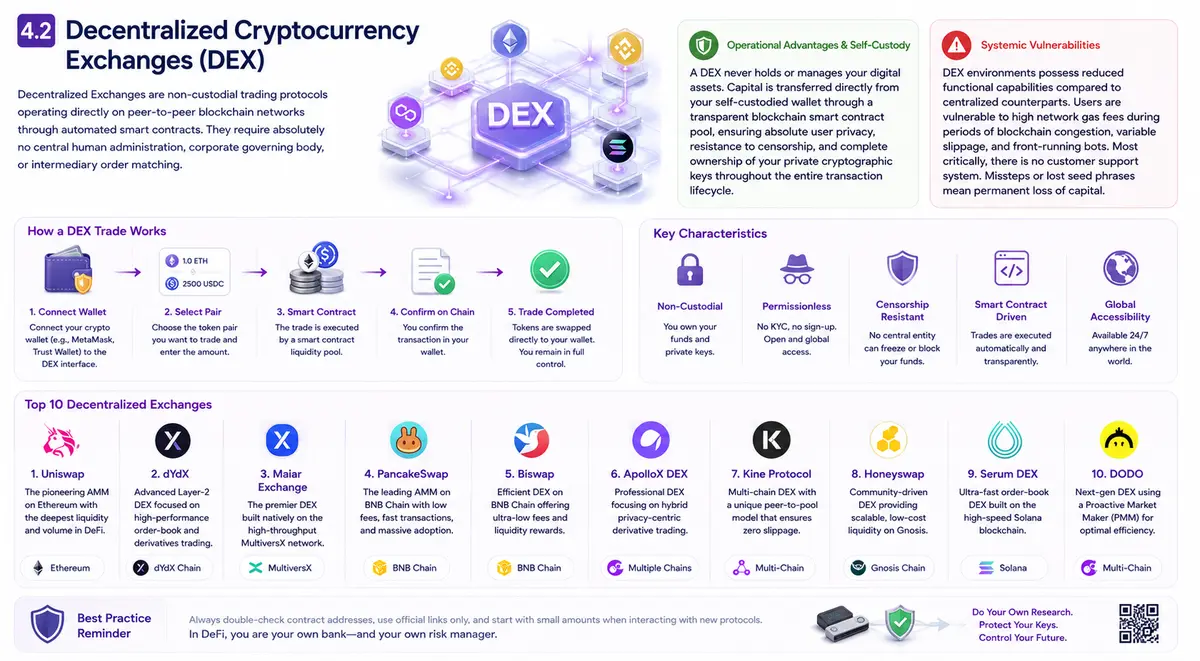
4.2 Decentralized Cryptocurrency Exchanges (DEX)
Decentralized Exchanges are non-custodial trading protocols operating directly on peer-to-peer blockchain networks through automated smart contracts. They require absolutely no central human administration, corporate governing body, or intermediary order matching. To trade on a DEX, users are not required to undergo account registration or identity verification; instead, they directly connect their personal software or hardware wallets (such as MetaMask or Trust Wallet) to the protocol interface.
Operational Advantages & Self-Custody: A DEX never holds or manages your digital assets. Capital is transferred directly from your self-custodied wallet through a transparent blockchain smart contract pool, ensuring absolute user privacy, resistance to censorship, and complete ownership of your private cryptographic keys throughout the entire transaction lifecycle.
Systemic Vulnerabilities: DEX environments possess reduced functional capabilities compared to centralized counterparts. Users are vulnerable to high network gas fees during periods of blockchain congestion, variable slippage, and front-running bots. Most critically, because there is no corporate entity or centralized administration, there is no customer support system. If an investor misroutes a transaction, interacts with a malicious smart contract, or misplaces their wallet’s private seed phrase, the capital is permanently unrecoverable.
Below are the Top 10 Decentralized Exchanges, selected based on cross-chain trading volumes, locked protocol liquidity (TVL), and market share within the decentralized finance (DeFi) ecosystem:
- [DEX] Uniswap: The pioneering automated market maker (AMM) model on the Ethereum network, commanding the deepest liquidity and volume across the entire DeFi sector.
- [DEX] dYdX: A highly advanced, layer-2 decentralized protocol specialized in high-performance order-book trading and decentralized asset derivatives.
- [DEX] PancakeSwap: The dominant automated market maker on the BNB Chain, celebrated for its rapid block times, minimal gas fees, and massive retail usage.
- [DEX] Biswap: A highly efficient decentralized exchange on the BNB Chain featuring ultra-low transaction fees and integrated liquidity rewards.
- [DEX] ApolloX DEX: A professional-grade decentralized platform focusing on hybrid privacy-centric derivative trading models.
- [DEX] Honeyswap: A community-driven decentralized application providing scalable, low-cost liquidity options on the Gnosis chain ecosystem.
- [DEX] Serum DEX: An ultra-fast, completely decentralized order-book exchange protocol built to leverage the high-velocity Solana blockchain architecture.
- [DEX] DODO: A next-generation decentralized platform utilizing an innovative Proactive Market Maker (PMM) algorithm to optimize capital efficiency and minimize impermanent loss.

Comments
No comments yet. Be the first to share your thoughts!
Authentication Required
You must be logged in to post a comment.