

Chips Rally Around SK Hynix. Iran Hits 85 US-Linked Gulf Sites. Treasury Yields Push Toward a 10-Month High. The Dollar Still Cannot Find Its Footing
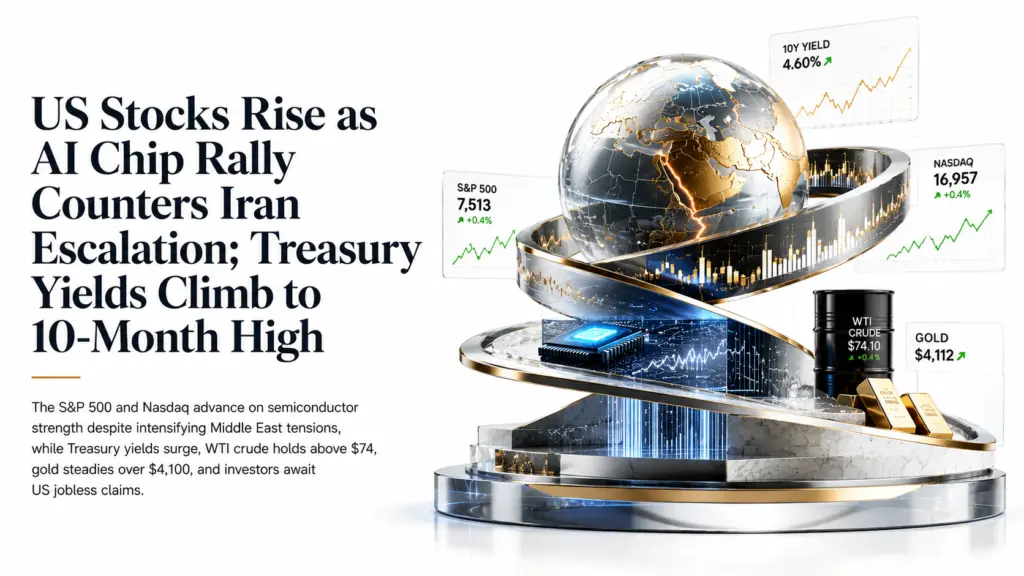
S&P 500 up 0.4% near 7,513 on SK Hynix US share offering demand and the AI/chip trade. US struck ~90 Iranian targets over two days. Iran retaliated by hitting ~85 US-linked military sites in Bahrain and Kuwait. 10Y Treasury toward 4.60% — 10-month high. 5Y at 4.33%. Fed hike probability for September repriced to ~70%. WTI consolidating near $74 after an 11% two-session surge. Bitcoin stuck at $62,850 with Fear & Greed at 22.
HIGHEST CONVICTION: Fade the US 5-year Treasury yield rise toward 4.40%. The hawkish repricing is oil-shock driven, not demand-driven. Oil shocks are historically less persistent for Fed policy than domestic wage and services inflation.
The Divergence That Defines the Session
Equities are up 0.4%. Bond yields are at 10-month highs. Both things are happening simultaneously and the reason they can is that they are responding to different inputs from the same Iran story. The equity market is buying the chip trade — SK Hynix’s US share offering drew strong demand, and that demand signal is rippling through every AI and semiconductor name on the board. The bond market is buying the inflation argument — the same Iran escalation that is producing the Hormuz risk premium is feeding directly into the rate-hike probability.
The US struck roughly 90 Iranian targets over two sessions. Iran retaliated by hitting approximately 85 US-linked military sites across Bahrain and Kuwait. President Trump declared the ceasefire MoU over. These are not conditions that typically produce equity rallies. The reason stocks are higher is that six of eleven S&P sectors closed positive on Wednesday even as the index fell, evidence that the rotation into chips is powerful enough to run against the macro headwind. Wednesday’s FOMC minutes — the first released under Chair Kevin Warsh — showed policymakers genuinely divided on further hikes, with several citing the oil-driven inflation shock as grounds for a September hike. Rate futures now imply roughly 70% probability of a September hike, up sharply from just over half a week earlier.
The equity market and the bond market are both right about the same event. The chip rally is real. The inflation shock is real. They will stay decoupled until one of them has to give way.
Treasury Yields at 10-Month Highs: The Oil-to-Fed Transmission
The 10-year Treasury yield is pressing toward 4.60%, its highest level since May. The 5-year yield has climbed to around 4.33%, up from roughly 4.23% earlier in the week. The 30-year is also near multi-month highs. The whole curve is repricing. The direct transmission channel is oil: Washington revoked the waiver that had allowed Iran to export crude, which pushed WTI up nearly 11% over two sessions, which fed directly into inflation expectations, which fed into Fed rate-hike probability, which drove yields.
The article’s contrarian argument: this is an oil-shock-driven repricing, not a domestic-demand-driven repricing. Historically, oil supply shocks are less durable for Fed policy than wage and services inflation because they reverse when the supply disruption resolves. If Qatar’s mediation effort succeeds and Hormuz flows normalise, the oil premium deflates, the inflation expectation moves in reverse, and yields retrace. The article’s framework: fade the 5-year yield rise toward 4.40%, stop 4.48%, target 4.15%. This is the session’s highest-conviction call and the most contrarian one simultaneously.
US 5Y Yield — SELL RALLY (BEARISH PRICE) E 4.40% / SL 4.48% / TP 4.15%
Gold, Oil, and the Logic of Safe-Haven Confusion
Gold’s behaviour this week is the most analytically interesting commodity story on the board. When Trump declared the ceasefire MoU “over” on Wednesday, gold initially fell to a one-week low near $4,030. That is counterintuitive: geopolitical escalation should support gold via safe-haven demand. What happened instead: markets priced in a higher probability of a Fed rate hike, and higher rates increase gold’s opportunity cost. The Iran story produced an oil shock, which produced an inflation shock, which produced a rate shock, which hit gold. The commodity that is supposed to benefit from war risk got sold because war risk now means higher rates.
Gold has since stabilised above $4,100 near $4,112. China’s central bank reported its largest monthly gold-reserve addition in more than two and a half years in June, underscoring continued official-sector demand as a structural floor. The structural case for gold does not depend on the Iran conflict being resolved. It depends on central bank diversification away from dollar assets, a trend that predates and transcends any single geopolitical episode.
WTI at $74.10 is consolidating after the near-11% surge. The 38.2% Fibonacci retracement of the breakout sits at $73.36, the 50% at $72.50, and the 61.8% at $71.65 — a zone that lines up with rising trendline support from late-June and early-July swing lows. The 100-day has recently crossed above the 200-day, confirming the path of least resistance has shifted higher. This week’s US commercial crude inventory build of 3 million barrels is the one modest offset to the supply-disruption narrative.
Gold XAU — BUY DIPS E $4,080 / SL $4,030 / TP $4,160
WTI Crude — BUY DIPS E $73.30 / SL $71.60 / TP $76.10
USD/CAD and USD/CHF: Two Directions From the Same Dollar
USD/CAD is holding a constructive ascending channel above 1.4150 near 1.4170, pressing against the 9-day EMA at 1.4182. The Canadian dollar is the weakest reserve currency on the board, and the reason is not just dollar strength — it is CAD-specific weakness. Canada’s softer growth profile, the CUSMA/USMCA review uncertainty, and an unusual negative correlation between the loonie and WTI crude (a break from the historically positive relationship) are all working against CAD. The UBS year-end target of 1.43 suggests room for further upside. The Bank of Canada’s July 15 rate decision is the next domestic catalyst.
USD/CHF has done the opposite. The pair was rejected at 0.8108 on Wednesday, confirming a false breakout above 0.8100. It has retreated to 0.8060. The Swiss National Bank has kept its policy rate at 0% for a fourth consecutive meeting and has flagged willingness to intervene if franc appreciation becomes excessive — a statement that caps the CHF safe-haven rally even as investors stay cautiously confident the Iran situation eventually resolves. The 4H RSI is near 46. The MACD is slipping back toward zero. The path of least resistance is lower.
USD/CAD — BUY DIPS E 1.4130 / SL 1.4070 / TP 1.4248
USD/CHF — SELL RALLIES E 0.8100 / SL 0.8140 / TP 0.8000
Crypto: Bitcoin Stuck While Stocks Rally
Bitcoin at $62,850 is still below the broken $65,000 macro structure. The Fear and Greed Index is at 22 — Extreme Fear. Bitcoin dominance is near 56%, which means capital is sheltering in BTC rather than rotating into altcoins. The daily RSI near 49 signals indecision. The MACD is decelerating rather than reversing. The average true range above $2,000 means price can erase apparent trends within a single session. The article’s framework: sell rallies toward $65,450, stop $67,000, target $60,000.
Solana at $78.20 is attempting a bounce off the $73 support shelf — still more than 20% below its 200-day moving average near $99.31. The daily MACD shows a trending-up configuration and the RSI is in neutral-to-constructive territory. PumpSwap fees have surged over 30 days, indicating genuine interest in newer protocols. Raydium and Orca fees have declined over the same period. The on-chain picture is split. The $79.15 daily pivot is the immediate resistance; $85.10 near the Bollinger upper band is the target. The $73.50 stop sits just below the critical $73 shelf.
S&P 500 — BUY DIPS E 7,460 / SL 7,400 / TP 7,560
Bitcoin BTC — SELL RALLIES E $65,450 / SL $67,000 / TP $60,000
Solana SOL — BUY DIPS E $76.50 / SL $73.50 / TP $85.00
Read Full Report: https://www.capitalstreetfx.com/market-analysis/us-stocks-edge-higher-chip-rally-offsets-iran-escalation/

Comments
🔝
Authentication Required
You must be logged in to post a comment.