

Note on Cryptocurrency Part 3
ASSET SCREENING METHODOLOGIES, ADVANCED DATA AGGREGATION, AND YIELD MECHANICS
1. Methodology for Evaluating Promising Listed Tokens (Major Exchanges)
The most formidable challenge facing any cryptocurrency investor is identifying digital assets capable of generating substantial, asymmetric returns. With over 19,000 distinct tokens actively trading across global digital asset marketplaces, implementing a rigorous, quantitative screening framework is non-negotiable for capital preservation and growth.
1.1 Core Quantitative and Qualitative Metrics
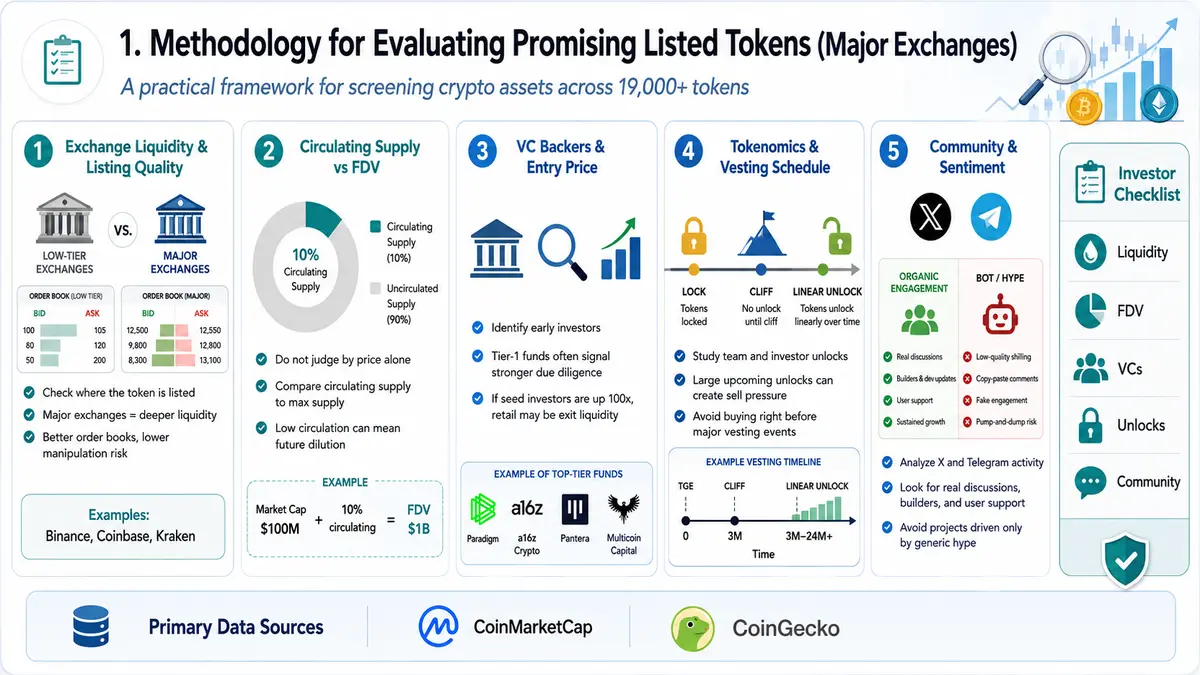
When analyzing an asset already listed on top-tier centralized exchanges (CEX), a disciplined market participant must systematically audit the following parameters:
-
Exchange Liquidity Depth and Listing Architecture: Evaluate the number and tier of exchanges hosting the token. If an asset is exclusively traded on low-tier, unregulated platforms, it suffers from acute liquidity risk. Conversely, a token integrated into major platforms like Binance, Coinbase, or Kraken exhibits robust liquidity, deep order books, and institutional-grade oversight, which significantly lowers the risk of market manipulation.
-
Circulating Supply vs. Fully Diluted Valuation (FDV): An investor must never look at nominal token price alone. You must analyze the ratio of circulating supply to the maximum capped supply. If a project has a current market capitalization of $100,000,000 but only 10% of its tokens are in circulation, its Fully Diluted Valuation (FDV) sits at $1,000,000,000. The remaining 90% represents latent supply inflation that will inevitably dilute future spot buyers as those tokens enter the market.
-
Venture Capital Infrastructure and Entry Benchmarks: Identify the institutional venture capital (VC) firms that backed the project during its seed, private, or strategic funding rounds. Tier-1 funds (such as Paradigm, a16z Crypto, Pantera Capital, or Multicoin Capital) conduct exhaustive due diligence before deploying capital. Furthermore, calculate the multiple of the current market price relative to the initial ICO (Initial Coin Offering) or seed round price. If early institutional buyers are already up 100x on their paper investments, retail buyers risk being used as exit liquidity.
-
Tokenomics and Structural Vesting Schedules: Carefully examine the unlock schedules for the core project team, advisory board, and early investors. Look for long cliff periods (initial lockup durations) and linear vesting timelines. For example, if an analytical audit reveals that a massive token unlock equivalent to 15% of the circulating supply is scheduled to occur next week, the market will likely face heavy structural selling pressure. A professional investor avoids entering a spot position immediately prior to such events.
-
Social Architecture and Community Sentiment Dynamics: True underlying demand is heavily correlated with active community engagement. Use platforms like X (formerly Twitter) and Telegram to analyze the quality of interactions. Distinguish between artificial bot engagement (generic hype phrases) and organic developer activity, governance discussions, and authentic user troubleshooting.
To collect and cross-reference this data, investors rely heavily on primary cryptographic aggregators like CoinMarketCap and CoinGecko.
2. Evaluating Early-Stage, Pre-Listing Projects (High-Risk, High-Reward)
The highest returns in the cryptocurrency markets are historically captured by participating in primary market allocations before an asset lists on major centralized spot exchanges. However, this environment is highly speculative and demands an advanced tier of risk management.
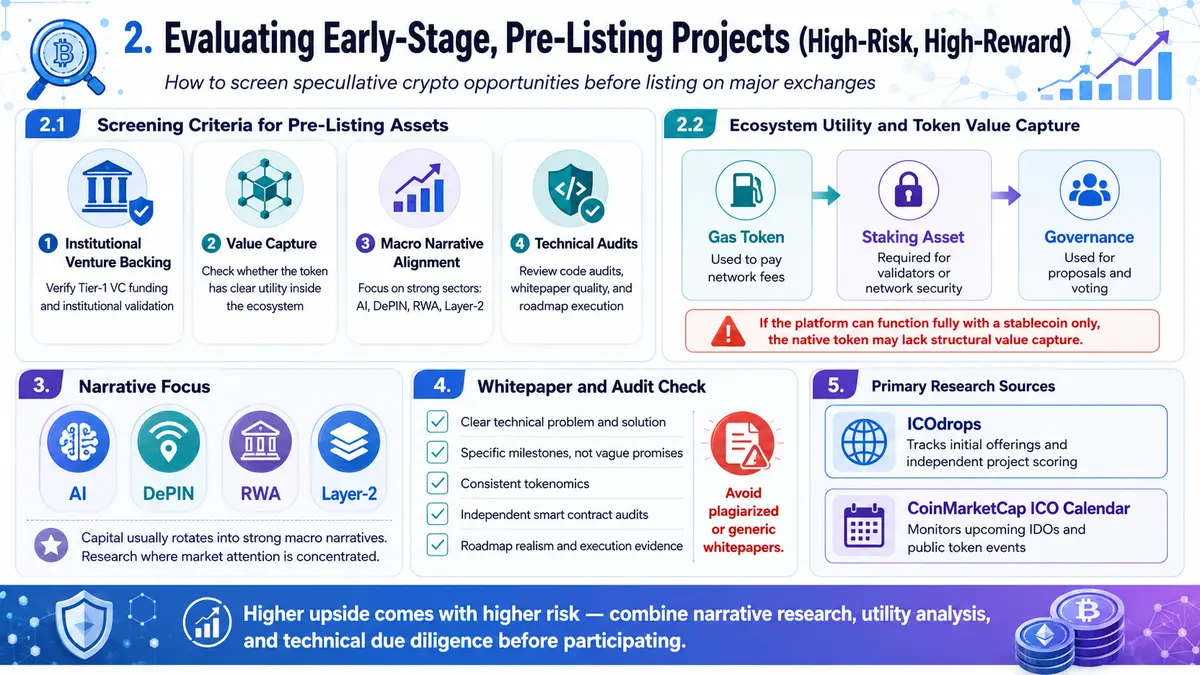
2.1 Screening Criteria for Pre-Listing Assets
While thousands of projects launch applications continuously, separating viable protocols from ephemeral hype requires auditing these fundamental pillars:
-
Institutional Venture Backing: Verification of Tier-1 VC funding and institutional validation.
-
Value Capture: Clear token utility and economic necessity within the native ecosystem.
-
Macro Narrative Alignment: Strategic positioning within high-growth sectors such as AI, DePIN, RWA, or Layer-2 scaling.
-
Technical Audits: Deep verification of the codebase, whitepaper consistency, and execution roadmaps.
2.2 Ecosystem Utility and Token Value Capture
A token must possess clear fundamental utility within its native application ecosystem. Does it function as network gas, a mandatory staking asset for node validators, or a governance voting vehicle? If a platform’s utility can function seamlessly using a stablecoin like USDT without requiring its native token, then the token lacks a structural value capture mechanism.
Capital in cryptocurrency flows cyclically through distinct conceptual narratives.
Align your early-stage research with high-growth sectors such as Decentralized Physical Infrastructure Networks (DePIN), Real-World Asset tokenization (RWA), Layer-2 scaling solutions, and Artificial Intelligence (AI) integrations. Investing outside of dominant structural narratives typically results in capital stagnation.
A project’s Whitepaper serves as its foundational architectural blueprint. It must clearly outline the mathematical models, cryptographic proofs, and engineering solutions to existing industry bottlenecks. Avoid projects with generic roadmaps or plagiarized whitepapers that offer ambiguous timelines instead of specific technical milestones.
To identify primary market opportunities, investors use specialized platforms like ICOdrops, which tracks initial offerings and assigns independent viability scores based on historical fund performance. Additionally, the CoinMarketCap ICO Calendar provides up-to-date schedules for upcoming Initial DEX Offerings (IDOs) and public token generation events.
3. Advanced Navigation of Crypto Analytics Ecosystems: CoinMarketCap and CoinGecko
CoinMarketCap and CoinGecko are the definitive data hubs of the global digital asset economy. Their core objective is to democratize institutional-grade market data, providing retail and professional investors with unbiased, granular metrics to guide allocation decisions.
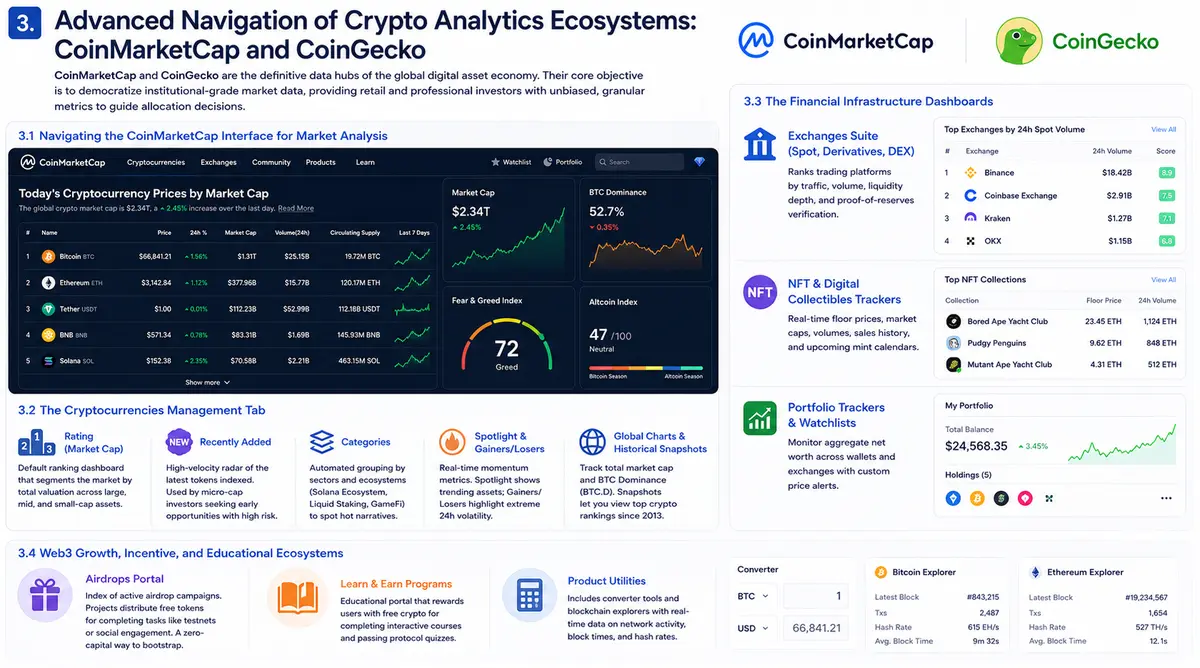
3.1 Navigating the CoinMarketCap Interface for Market Analysis
Understanding the functional layout of these aggregators is vital for efficient market research. Let us analyze the operational capabilities of the primary dashboards:
3.2 The Cryptocurrencies Management Tab
-
Rating (Market Capitalization): The default ranking dashboard that segments the market by total network valuation, illustrating macro capital distribution across blue-chip, mid-cap, and small-cap assets.
-
Recently Added: A high-velocity radar showing the latest tokens indexed into the platform’s database. This tool is highly utilized by micro-cap investors seeking early-stage listings, though it requires extreme caution due to unverified smart contracts.
-
Categories: This panel automatically groups assets by their technical sectors and underlying ecosystems (e.g., Solana Ecosystem, Liquid Staking Derivatives, GameFi). It allows traders to instantly spot which narrative is attracting the highest concentration of daily capital volume.
-
Spotlight and Gainers/Losers: Displays real-time momentum metrics. The “Spotlight” list compiles assets based on search trends and retail behavioral patterns, while “Gainers/Losers” highlights tokens undergoing extreme 24-hour volatility, indicating potential overbought or oversold conditions.
-
Global Charts and Historical Snapshots: Critical tools for macroeconomic cycle tracking. The global charts display historical total crypto market capitalization data and Bitcoin Dominance (BTC.D). Monitoring Bitcoin Dominance allows an investor to mathematically determine whether capital is consolidating into Bitcoin (defensive market state) or flowing out into alternative tokens (Altcoin Season). Historical Snapshots let you view the top crypto rankings dating back to 2013 to study past cycle peaks and valleys.
3.3 The Financial Infrastructure Dashboards
-
Exchanges Suite (Spot, Derivatives, DEX): This matrix ranks trading platforms using algorithms based on web traffic, reported trading volume, liquidity depth, and proof-of-reserves verification. This ensures investors can select execution venues with legitimate volume and minimal trading slippage.
-
NFT and Digital Collectibles Trackers: Compiles real-time floor prices, aggregate market caps, trading volumes, and historical sales data for digital art and tokenized media collections, alongside an upcoming mint calendar.
-
Portfolio Trackers and Watchlists: Personal administrative dashboards that enable investors to monitor their aggregate net worth fluctuations across various private wallets and exchanges in real-time, complete with customized price alert configurations.
3.4 Web3 Growth, Incentive, and Educational Ecosystems
-
Airdrops Portal: A digital index detailing active marketing and token-distribution campaigns. Emerging projects utilize airdrops to distribute native tokens for free to users who complete specific micro-tasks, such as engaging with the protocol’s testnet or social media channels. It serves as a zero-capital bootstrapping mechanism for new market participants.
-
Learn and Earn Programs: An educational portal that rewards users with free token distributions upon the successful completion of interactive courses and cryptographic protocol tests.
-
Product Utilities (Converter and Blockchain Explorer): Includes institutional-grade currency conversion calculators alongside real-time data feeds detailing network activity, block times, and hash rates across dominant layer-1 blockchains like Bitcoin and Ethereum.
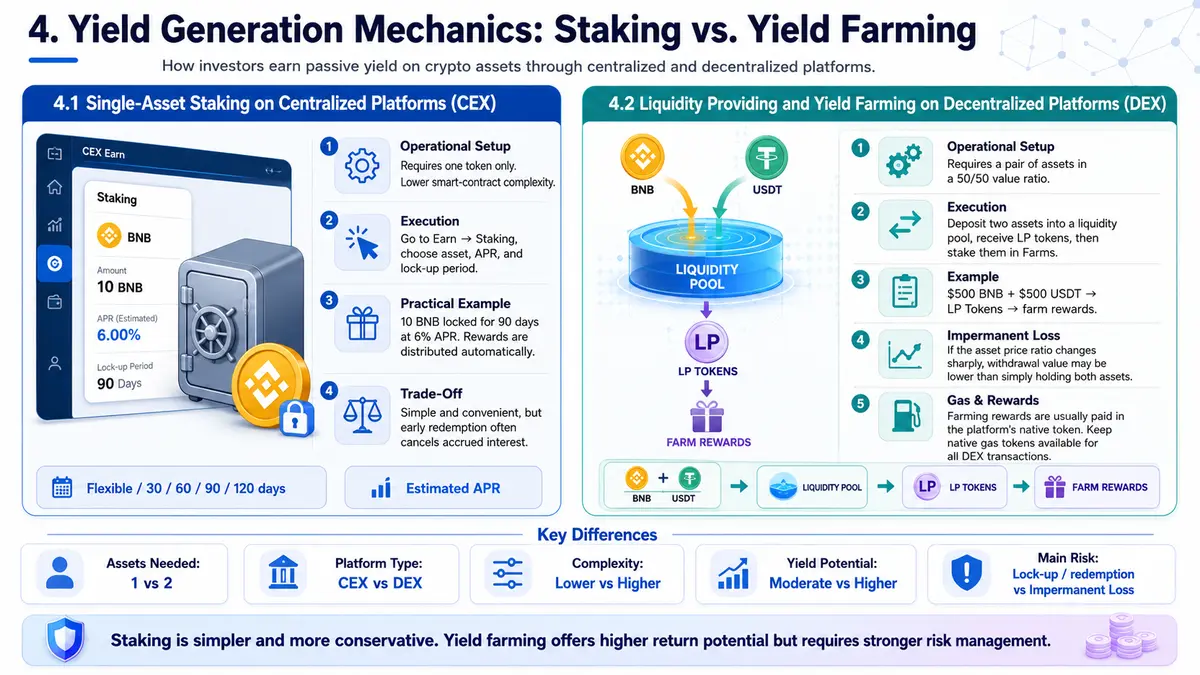
4. Yield Generation Mechanics: Staking vs. Yield Farming
A professional investment strategy extends beyond capturing simple spot price appreciation. Generating programmatic yield on idle crypto assets is a core method for maximizing compounding returns across market cycles.
4.1 Single-Asset Staking on Centralized Platforms (CEX)
Staking is the process of locking a single cryptographic asset to support the operational security, transaction validation, and consensus mechanisms of a Proof-of-Stake (PoS) blockchain network.
When executing staking on a centralized venue like Binance Earn, the exchange handles all backend technical complexities (such as managing validator nodes and preventing slashing penalties) on behalf of the user.
-
Operational Setup: Requires a single type of token. It allows the platform to utilize capital efficiently, offering lower overall smart contract risks.
-
Operational Execution: Navigate to the “Earn” -> “Staking” panel on the exchange. You will be presented with an asset menu detailing the Estimated APR (Annual Percentage Rate) and available duration options (e.g., Flexible, 30, 60, 90, or 120 days).
-
Practical Example: An investor locks 10 BNB into a 90-day staking contract with an advertised 6% APR. The tokens are temporarily locked, and the protocol automatically distributes newly minted BNB rewards directly into the user’s spot account. Early redemption is permitted on most platforms but typically forfeits all accumulated interest.
4.2 Liquidity Providing and Yield Farming on Decentralized Platforms (DEX)
Yield Farming is an advanced decentralized finance (DeFi) mechanism where an investor provides an equal-value pair of distinct digital assets to an Automated Market Maker (AMM) liquidity pool on a decentralized exchange like PancakeSwap. This liquidity pool enables decentralized traders to swap between those two assets, and the liquidity providers (LPs) receive a proportional cut of all transaction fees.
-
Operational Setup: Requires a dual-asset pair of tokens, which directly serves as a deep liquidity pool for peer-to-peer traders.
-
The Mechanics of Execution: To farm on a DEX, connect your Web3 wallet (e.g., MetaMask) and navigate to the “Liquidity Pools” section. You must deposit an exact 50/50 value ratio of two tokens. For example, to provide liquidity to a BNB-USDT pool, you must deposit $500 worth of BNB alongside exactly $500 worth of USDT. In return, the protocol issues you LP Tokens representing your ownership share of the pool. You then stake these LP tokens into the “Farms” dashboard to begin earning rewards.
-
The Risk of Impermanent Loss (IL): Yield farming yields significantly higher annual percentages (APY) than single-asset staking, but it introduces the risk of Impermanent Loss. If the market price ratio of the two deposited assets changes drastically compared to when you deposited them, the AMM protocol automatically rebalances the pool’s internal asset ratio. If you withdraw your liquidity during this imbalance, you may realize a loss compared to simply holding the two separate assets in a cold wallet.
-
Native Tokens and Gas Mechanics: Yield farming incentives are primarily paid out in the DEX platform’s native utility token (e.g., CAKE on PancakeSwap). Native tokens handle essential network functions, including fee distribution and governance voting. These reward tokens can be compounded back into the farm or instantly swapped for stablecoins. Always remember that any transaction on a DEX requires holding a reserve of the underlying blockchain’s native gas token — such as BNB for transactions on the BEP-20 network — to process smart contract executions.

Comments
No comments yet. Be the first to share your thoughts!
Authentication Required
You must be logged in to post a comment.