
Oil Back in the Fire: WTI Surges 3% After New Strikes on Iran
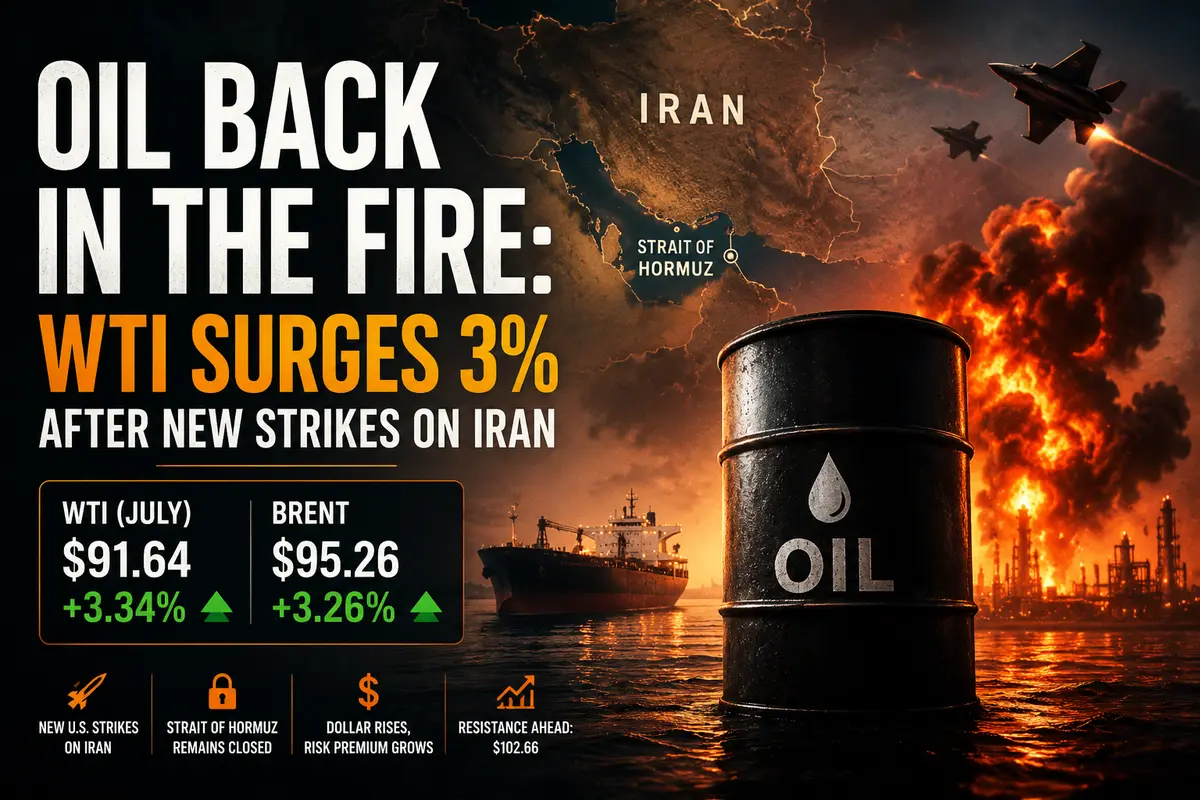
Thursday’s Asian session opened with a powerful rally in oil prices. July WTI futures jumped 3.34%, reaching $91.64 per barrel. Brent crude followed closely behind, gaining 3.26% to settle at $95.26. This is not just another price increase — it is a strong, confident move driven by a very specific catalyst. The reason has a name: new U.S. strikes on Iranian targets, the second round in a single week. A market that was still hoping for peace earlier this week is once again pricing in a geopolitical risk premium.
Three Percent Higher: Anatomy of the Spike
A 3.3% move in a single session is not ordinary volatility — it is a major event. To understand the scale, imagine the oil market repricing the global supply-demand balance within hours by an amount comparable to what would normally take months in calmer conditions. So what happened?
In the early hours of Thursday, U.S. forces carried out strikes against targets in southern Iran. This was already the second such operation in a week, following the first strike on Monday. Washington officially describes the actions as defensive, but the market is not interested in legal wording. What matters is that bombs are still falling, which means the conflict is far from over.
Moreover, President Trump personally dismissed reports on Wednesday about the imminent reopening of the Strait of Hormuz, stating that there is no thirty-day agreement and that neither Iran nor Oman will control the passage. That statement shattered fragile hopes for de-escalation and forced traders to reassess their positions.
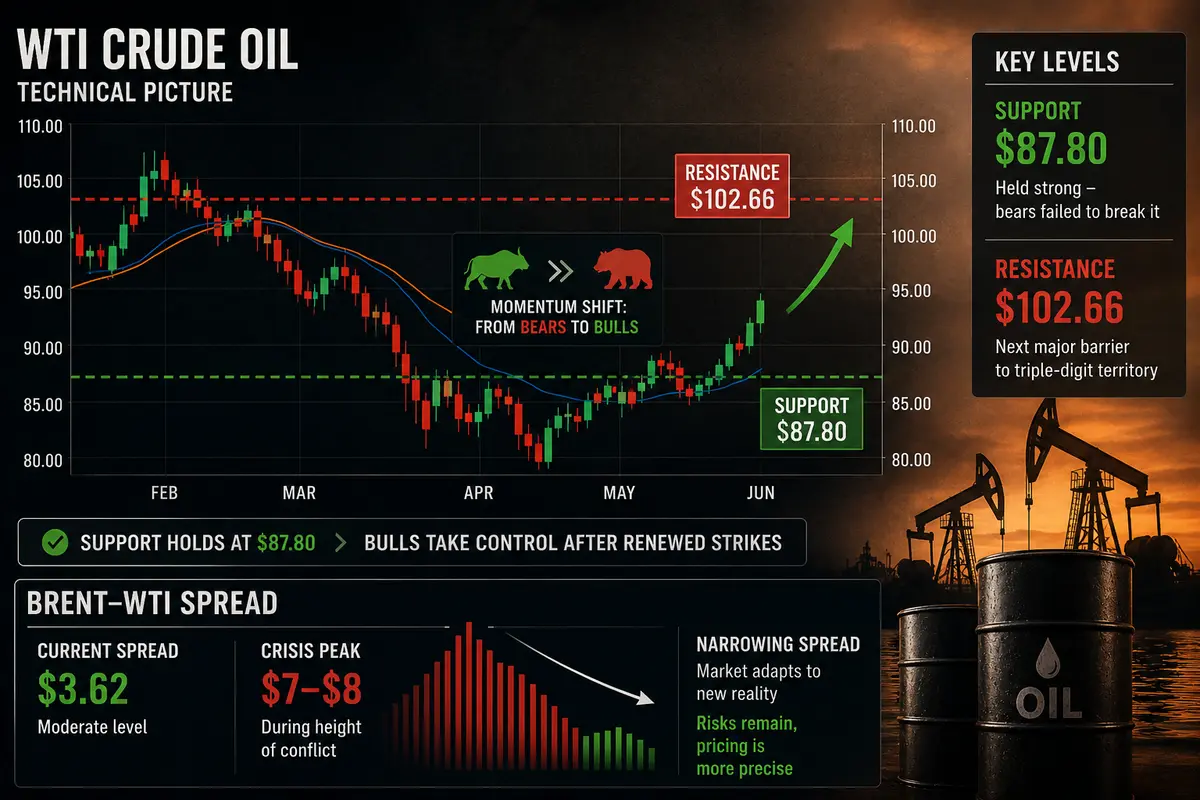
Oil reacted instantly. WTI, which had tested support around $87.80 earlier in the week, exploded higher. Brent broke above $95 and, judging by the momentum, does not appear ready to stop. The market is once again pricing in the risk of prolonged supply disruptions from the Persian Gulf.
Technical Picture: Support Holds, Resistance Ahead
The $87.80 support level that WTI tested in previous sessions held firm. That is an important signal: bears tried to push oil lower on hopes of peace but failed. Now, after the renewed strikes, momentum has shifted back to the bulls.
The next major resistance level stands at $102.66 — the threshold separating the current range from triple-digit territory, where oil traded during the hottest phases of the conflict.
The Brent-WTI spread currently sits at $3.62. That is a moderate level, suggesting the market sees risks for both benchmarks but does not yet consider the situation catastrophic. For comparison, during the height of the crisis the spread widened to $7–8. The narrowing indicates that the market has partially adapted to the new reality. But a tighter spread does not mean risks have disappeared. Rather, it suggests traders have become more precise in pricing regional supply threats.
The Dollar Is Rising Too: Double Pressure on Commodities
The U.S. dollar index gained 0.23% on Thursday, climbing to 99.38. Normally, a stronger dollar should pressure oil prices lower: when the dollar rises, crude becomes more expensive for holders of other currencies, demand weakens, and prices fall.
But today that mechanism is not working. Oil and the dollar are rising simultaneously. Why?
Because both assets are reacting to the same factor — geopolitical stress. The dollar is strengthening as a safe-haven currency as investors flee to safety amid fears of war. Oil is rallying because its supply is under threat. This is classic market behavior during acute geopolitical conflict: fear drives capital into the dollar, while fear of shortages pushes commodity prices higher.
This simultaneous rally is a sign that the market is genuinely nervous.
Strait of Hormuz: The Key That Refuses to Turn
At the center of the entire drama remains the Strait of Hormuz — a narrow waterway through which a substantial portion of the world’s oil supply passes.
Trump made it clear on Wednesday that no rapid reopening should be expected. Earlier reports suggesting a gradual restoration of shipping activity now appear premature. Yes, some tankers may still be moving through the area, but oil flows remain significantly below pre-conflict levels.
This is the key issue. Markets may temporarily calm down on diplomatic headlines, but until physical supply is fully restored, prices are likely to remain elevated. Every day of delay means millions of barrels missing from the global market. Every new strike adds additional risks for tankers considering passage through the strait.
Insurance premiums remain extremely high. Shipowners are reluctant to send vessels into a conflict zone. And this physical reality is keeping oil prices at levels that would have seemed catastrophic just a year ago.
What Comes Next: Scenarios for Oil
Thursday’s surge may not be the end of the story — it could be only the beginning of another major leg higher.
If U.S. strikes continue, if Trump keeps rejecting diplomatic initiatives, and if Iran responds with further escalation, oil could break through the $102.66 resistance level and move toward the highs seen in March and April. Triple-digit prices for both Brent and WTI could once again become reality.
On the other hand, if negotiations in Doha somehow produce a breakthrough — if the sides agree to a ceasefire and reopen the strait — oil could fall just as rapidly as it rose today. The market is currently extremely sensitive to headlines. One Trump tweet or one statement from Tehran could completely reverse direction.
For now, however, the reality is clear: the strikes continue, negotiations are stalling, and the strait remains effectively closed. Oil prices are climbing, and Thursday’s Asian session became yet another reminder that the Iranian crisis has not disappeared. It merely paused briefly — and that pause now appears to be over.
The barrel is looking upward once again, and nobody knows how high it may climb this time. But one thing is certain: cheap oil is unlikely to return anytime soon. Too much gunpowder has accumulated in the Middle East — and too little willingness exists to defuse it.
Comments
No comments yet. Be the first to share your thoughts!
Comments only for logged-in users.