

Calm After the Storm: Oil Takes a Breather, but the Fire Isn’t Out
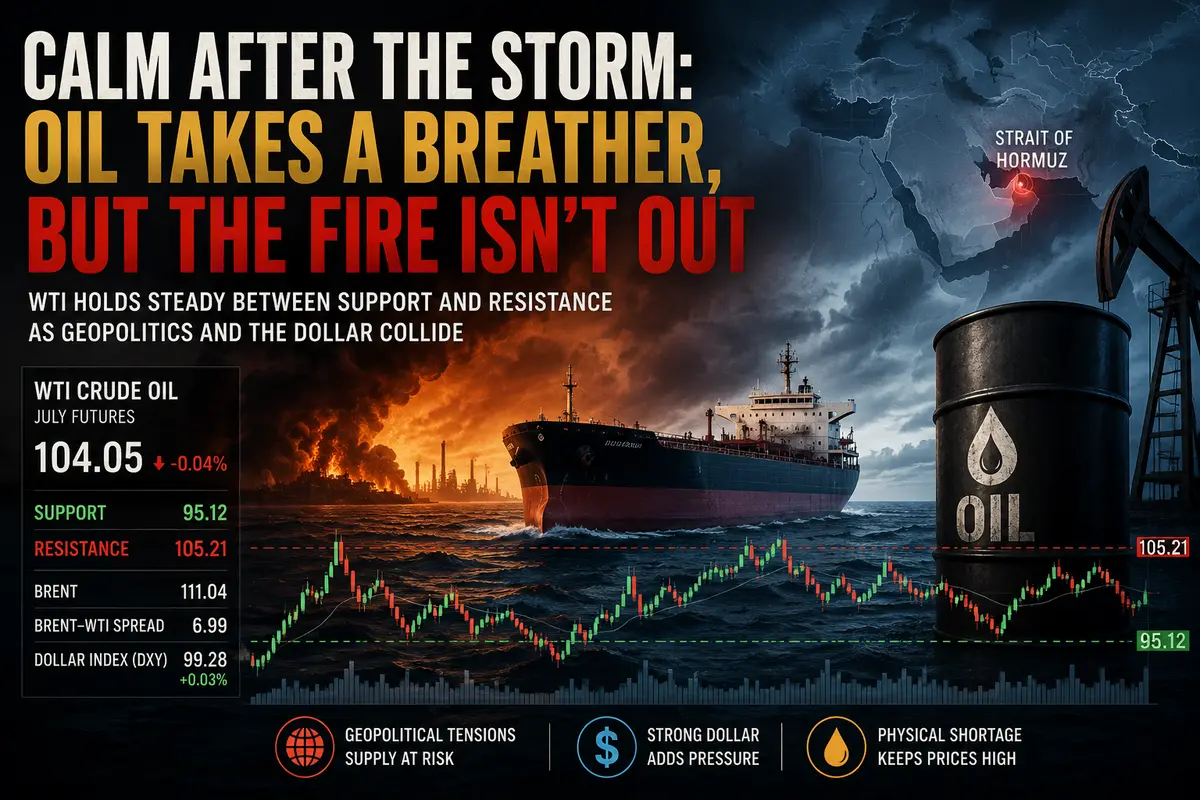
Wednesday’s Asian trading session brought something the oil market has rarely felt in recent weeks — near stillness. July WTI crude futures slipped only marginally, settling at $104.05 per barrel. A decline of four hundredths of a percent is hardly a pullback; it is statistical noise, the faint breathing of a market trying to recover after a marathon. Yet it is precisely during these moments of deceptive calm, when prices hover between support at $95.12 and resistance at $105.21, that the real drama unfolds. Behind this sideways movement lies a battle of fears, expectations, and calculations that will determine where oil heads next — upward toward new highs, or downward, offering relief to the exhausted global economy.
The Thin Line Between Support and Resistance
To understand what is happening in oil right now, one must look beyond fractions of a percentage point and focus on the levels trapping the price. Support at $95.12 is the threshold below which the market refuses to let gravity take over. Whenever oil approached this level in previous sessions, buyers immediately stepped in. This suggests that the fundamental backdrop — supply disruptions, geopolitical tensions, and shrinking inventories — remains so strong that even aggressive sellers hesitate to assault this fortress.
On the other side, resistance at $105.21 acts like an invisible ceiling. Every time prices near this boundary, automated sell orders trigger, profit-taking intensifies, and perhaps traders’ secret hopes emerge that the madness may soon end.
This oscillation between two poles perfectly illustrates the market’s schizophrenia. On one hand, everyone sees the physical shortage of crude. Tankers are avoiding the Strait of Hormuz, insurance premiums have soared, and alternative routes simply cannot compensate for the loss of Iranian and broader Middle Eastern supply. On the other hand, diplomatic efforts remain on the horizon, and every...
