

Calm After the Storm: Oil Takes a Breather, but the Fire Isn’t Out
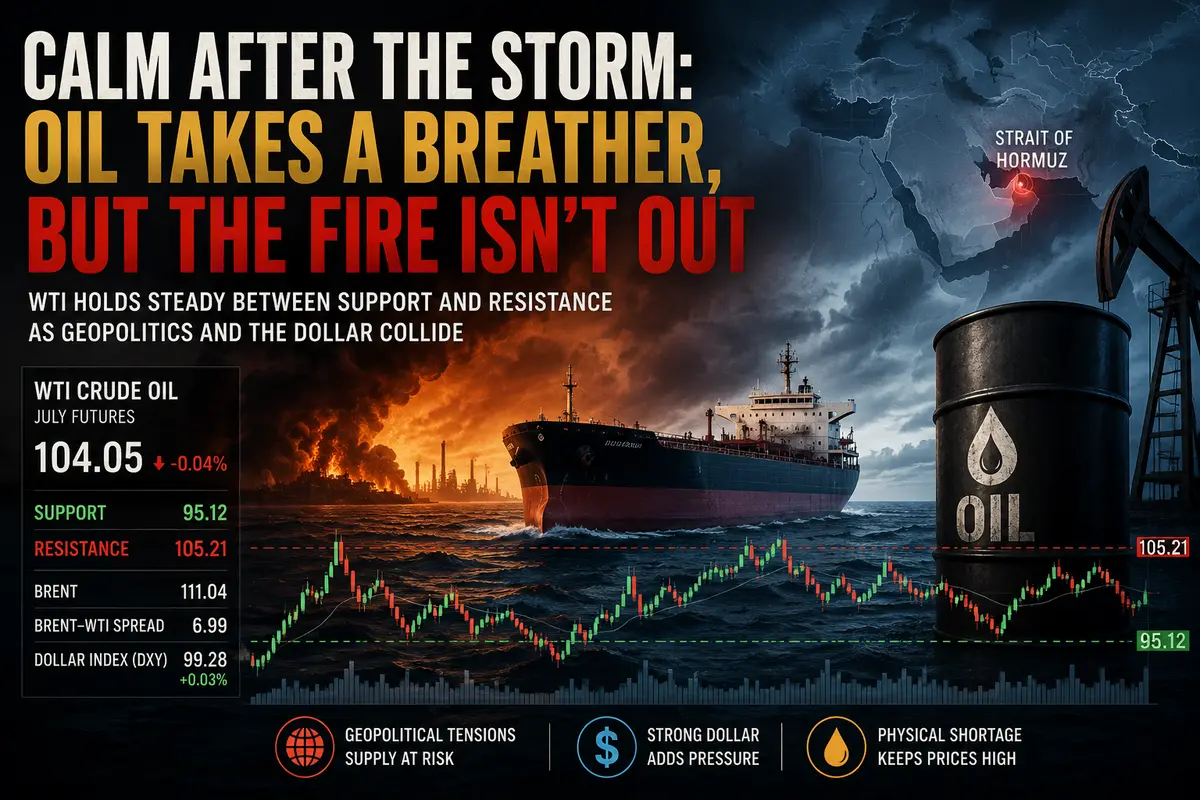
Wednesday’s Asian trading session brought something the oil market has rarely felt in recent weeks — near stillness. July WTI crude futures slipped only marginally, settling at $104.05 per barrel. A decline of four hundredths of a percent is hardly a pullback; it is statistical noise, the faint breathing of a market trying to recover after a marathon. Yet it is precisely during these moments of deceptive calm, when prices hover between support at $95.12 and resistance at $105.21, that the real drama unfolds. Behind this sideways movement lies a battle of fears, expectations, and calculations that will determine where oil heads next — upward toward new highs, or downward, offering relief to the exhausted global economy.
The Thin Line Between Support and Resistance
To understand what is happening in oil right now, one must look beyond fractions of a percentage point and focus on the levels trapping the price. Support at $95.12 is the threshold below which the market refuses to let gravity take over. Whenever oil approached this level in previous sessions, buyers immediately stepped in. This suggests that the fundamental backdrop — supply disruptions, geopolitical tensions, and shrinking inventories — remains so strong that even aggressive sellers hesitate to assault this fortress.
On the other side, resistance at $105.21 acts like an invisible ceiling. Every time prices near this boundary, automated sell orders trigger, profit-taking intensifies, and perhaps traders’ secret hopes emerge that the madness may soon end.
This oscillation between two poles perfectly illustrates the market’s schizophrenia. On one hand, everyone sees the physical shortage of crude. Tankers are avoiding the Strait of Hormuz, insurance premiums have soared, and alternative routes simply cannot compensate for the loss of Iranian and broader Middle Eastern supply. On the other hand, diplomatic efforts remain on the horizon, and every hint of progress in negotiations between Washington and Tehran splashes cold water on the overheated market. Traders are torn between reality — there is not enough oil physically reaching consumers — and hope that tomorrow a ceasefire will be announced and everything will return to normal.
Brent and WTI: One Story Told Through Two Contracts
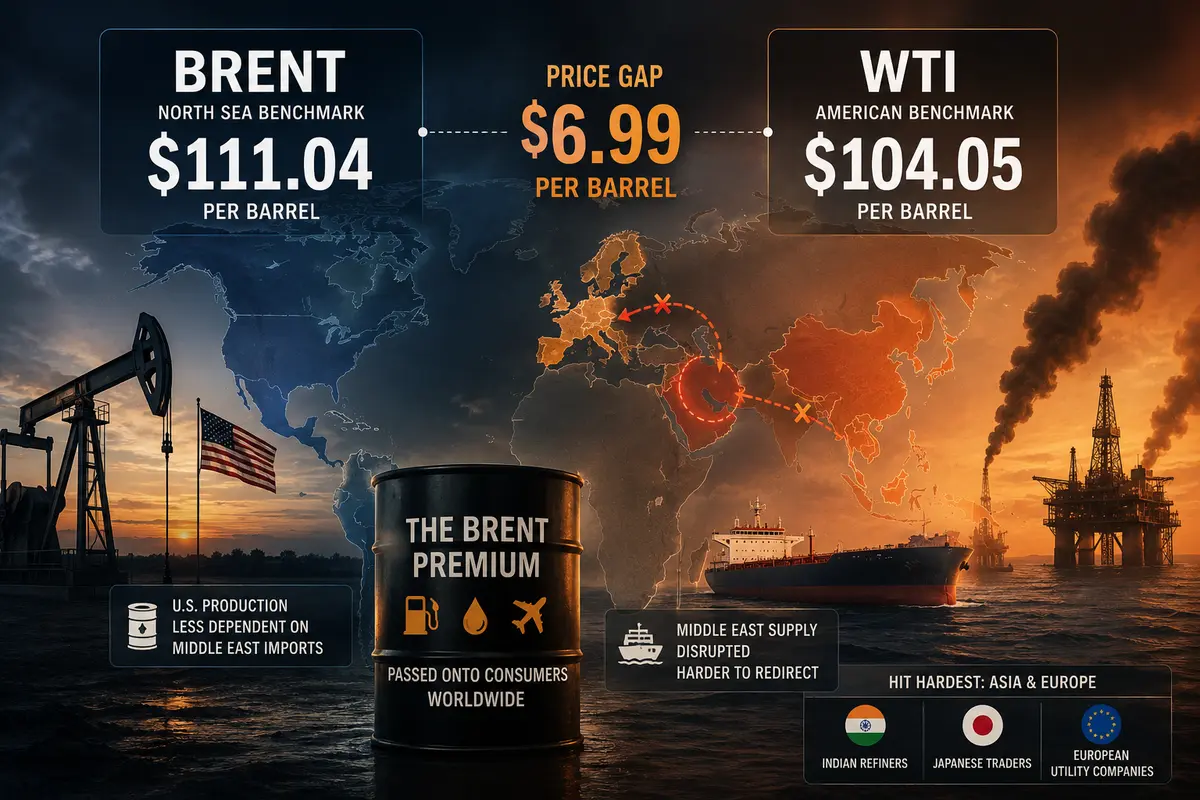
The price gap between Brent and WTI crude, standing at $6.99 per barrel, is far more than a technical detail for arbitrage specialists. It is a geopolitical indicator telling its own story.
Traditionally, WTI — the American benchmark — trades at a discount to Brent, the North Sea benchmark considered the global standard. But the current spread has widened to levels that are making analysts nervous.
Brent, at $111.04 per barrel, trades at a significant premium because the European market has found itself on the front line of the crisis. Middle Eastern oil that would normally flow into European ports is trapped in a conflict zone, and redirecting supply chains overnight is impossible. American WTI, despite reaching historically elevated prices itself, still reflects the conditions of a region that remains a producer and is less dependent on Middle Eastern imports.
This spread screams that the crisis is not evenly global but sharply regional, hitting consumers in Asia and Europe the hardest — those most reliant on Persian Gulf supplies. Indian refiners, Japanese traders, and European utility companies are all forced to pay the “Brent premium,” which is ultimately passed on into gasoline, diesel, and jet fuel prices worldwide.
The Dollar Pressures While Geopolitics Explodes
The dollar index, which added a symbolic 0.03% to reach 99.28, also contributes to the oil puzzle. The relationship is almost mechanical: oil is traded in dollars, and when the U.S. currency strengthens, oil becomes more expensive for holders of other currencies.
But in the current environment, this mechanism is malfunctioning. Normally, a rising dollar puts downward pressure on oil prices, forcing them lower to offset currency effects. Instead, we are seeing the dollar rise on expectations of further Federal Reserve rate hikes while oil refuses to fall, merely drifting sideways. This indicates that the fundamental drivers — supply disruptions caused by the conflict with Iran — are overpowering currency mechanics. When a physical shortage becomes this obvious, exchange-rate fluctuations lose their ability to suppress prices.
Moreover, a stronger dollar during an oil crisis creates a double blow for emerging economies. They are forced to buy more expensive oil using a more expensive dollar. The Indian rupee, which hit another historic low during the same session, is perhaps the clearest example of this deadly spiral. Importers in Mumbai must spend ever more rupees to buy dollars in order to pay for oil that itself costs fifty percent more than it did at the beginning of the year. It is hardly surprising that the rupee continues to weaken while the Indian economy strains under the pressure.
The Illusion of Silence Before the Next Shock
A decline of four hundredths of a percent is so tiny that it can barely be called movement. It is more like a held breath. The market is frozen, awaiting news from two fronts: diplomatic and monetary.
If negotiations with Iran truly lead to de-escalation, oil could collapse below the $95.12 support level and tumble back toward the levels seen at the start of the year. But does anyone really believe that outcome? Judging by Brent holding above $111 and WTI above $104, only a minority does. Most market participants appear to be preparing for a prolonged crisis in which triple-digit oil prices persist for months.
At the same time, the monetary front may deliver its own surprises. If the Federal Reserve proceeds with the rate hikes increasingly discussed after remarks from the Philadelphia Fed president, the dollar could surge sharply higher, placing real pressure on oil. But would that pressure be enough to break the fundamentally bullish trend built on a physical shortage of barrels?
History suggests that during periods of genuine supply disruption, oil can ignore almost anything — rising rates, recessions, even stock market crashes. It responds to only one thing: whether there are enough free tankers at sea. As long as they remain blocked in the Strait of Hormuz, no monetary maneuvering can close the gap in the global energy balance.
Wednesday’s Asian session ended without answers. WTI crude remained trapped in its corridor between support and resistance, like a predator pacing inside a cage, waiting for someone to open the door. Whether diplomats open it by announcing peace, or speculators by launching another assault on triple-digit highs, only time will tell.
One thing, however, is certain: this calm will not last long. Too much explosive pressure has accumulated beneath the surface of this market.

Comments
No comments yet. Be the first to share your thoughts!
Authentication Required
You must be logged in to post a comment.