

Goldman Sachs: The U.S. Economy Remains Resilient, but Spending Is Set to Slow
America Is Holding Up — But It’s Not Bulletproof
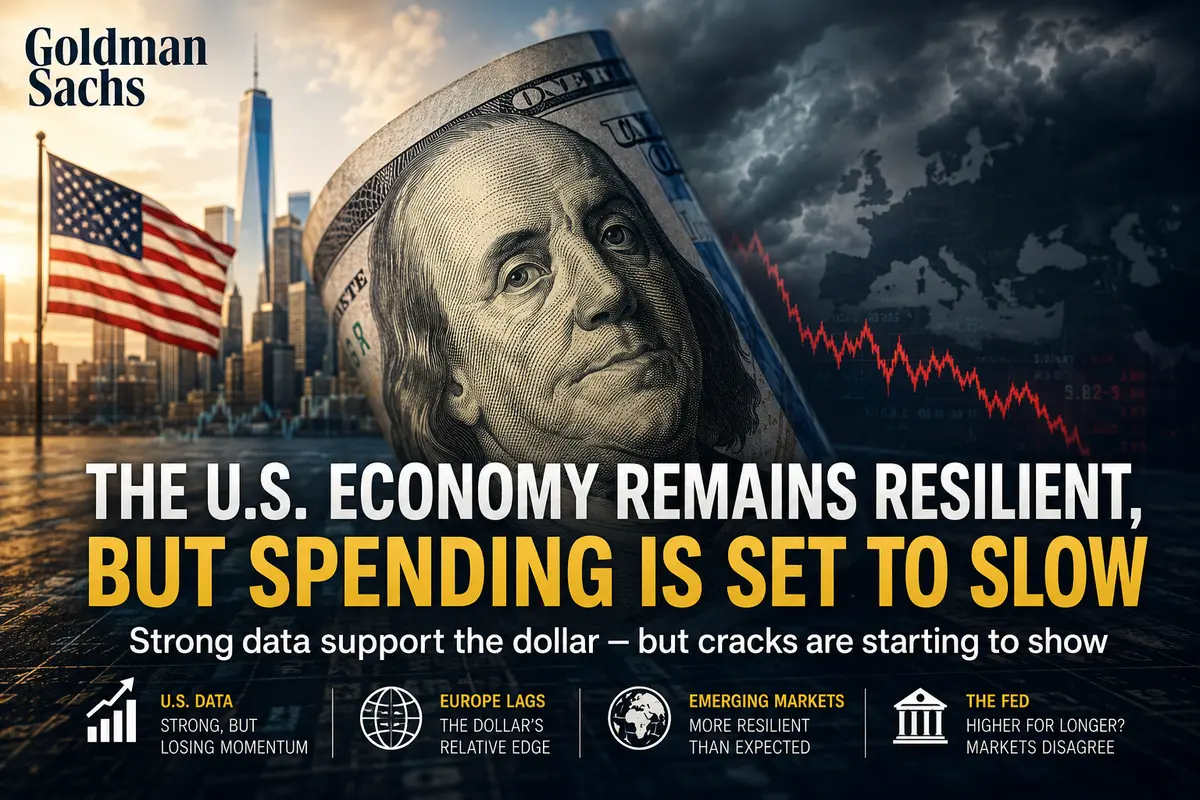
Goldman Sachs, one of the most influential voices in global finance, recently released a detailed assessment of the U.S. dollar and the American economy. The bank’s conclusions are both encouraging and cautionary. On one hand, the U.S. economy continues to demonstrate remarkable resilience. On the other, there are growing signs that this resilience is beginning to show cracks—not fatal or catastrophic cracks, but noticeable ones for those who know how to read between the lines of economic reports and data.
According to Goldman Sachs, the U.S. dollar remains supported by strong economic fundamentals and rising interest-rate expectations. This has been the foundation underpinning the currency for the past eighteen months. However, the bank’s analysts warn that improving global risk sentiment and the resilience of foreign currencies could limit further dollar gains. In other words, the dollar is no longer as attractive as it once was. It remains strong, but its advantage over other currencies is gradually narrowing.
Goldman’s assessment of the latest U.S. economic data is particularly noteworthy. Friday’s employment report exceeded expectations, while resilient ISM business activity indexes pointed to continued economic expansion. Together, these factors support higher Treasury yields and wider interest-rate differentials in favor of the dollar. Europe, Japan, and China continue to lag behind. America remains ahead, and the dollar is reaping the benefits of that leadership.
Yet Goldman also sees the other side of the story. Strong employment and inflation data are positive for the dollar, but they can be negative for equities because they encourage the Federal Reserve to maintain a restrictive monetary stance. And restrictive policy increases recession risk. There is no recession today, but the possibility remains on the horizon—and investors are aware of it.
U.S. Data: Resilience with Signs of Fatigue
What exactly does the data show?
Take the labor market. Nonfarm payrolls increased by roughly 180,000 jobs in May. While this is below April’s 250,000 gain, it remains a solid figure. Unemployment is still near historic lows at around 3.8%, and wage growth continues, albeit at a slower pace than last year.
For the dollar, this is positive. A strong labor market implies a strong economy, and a strong economy supports demand for the dollar. Investors buy dollars to invest in U.S. assets—stocks, bonds, and real estate.
Now consider inflation. The Consumer Price Index rose 3.4% year-over-year in April, down from 3.5% in March but still above the Federal Reserve’s 2% target. Inflation is slowing, but it is not disappearing. Core inflation, which excludes food and energy, remains even more stubborn at 3.6%.
Again, this supports the dollar. Higher inflation means higher interest rates, and higher rates generally strengthen the dollar. Until the Fed begins cutting rates, the dollar is likely to remain attractive to investors seeking yield.
There is, however, an important caveat. Consumer spending—the primary engine of the U.S. economy—is beginning to slow. Goldman explicitly states that spending growth is expected to moderate. Not collapse, but slow meaningfully from previous levels.
The reasons are straightforward: pandemic-era savings are being depleted, credit-card and mortgage rates remain elevated, and inflation continues to erode real purchasing power. Americans are spending less and saving more—or, more accurately, they are being forced to save because their excess cash reserves are running out.
This is a warning sign for the dollar over the medium term. If consumers tighten their belts, economic growth will slow. If growth slows, the Fed may be forced to cut rates. And if rates fall, the dollar could weaken.
That scenario is not imminent. But the trend is emerging, and Goldman is paying attention.
Europe: The Weak Link in the Dollar Story
Goldman emphasizes that strong U.S. economic data primarily supports the dollar against major developed-market currencies, especially those in Europe. Why Europe? Because growth prospects there remain considerably weaker.
The eurozone has been flirting with recession for several quarters. Germany, the economic engine of Europe, is contracting. France is stagnating. Italy, Spain, and Greece continue to carry heavy debt burdens that have become even more difficult to manage under higher European Central Bank interest rates.
The growth differential between the U.S. and the eurozone currently favors America by roughly 1–2 percentage points annually. While not enormous, it is sufficient to encourage investors to favor the dollar over the euro.
Europe also remains more vulnerable to energy-price shocks. Tensions in the Middle East, potential disruptions to the Strait of Hormuz, and elevated oil prices all hurt European industry more than they hurt the United States. America is a net energy exporter; Europe remains a net importer.
Goldman notes that progress in U.S.–Iran negotiations has raised hopes for lower oil prices. If talks succeed, Europe could benefit significantly. But it is far too early to celebrate. Negotiations could easily stall, as they have many times before.
As a result, the dollar’s strength stems not only from America’s own advantages but also from the relative weakness of its competitors. If Europe eventually begins to recover, the dollar could lose part of its edge.
Emerging Markets: Unexpected Resilience
Perhaps the most interesting aspect of Goldman’s analysis is the performance of emerging-market currencies. Contrary to expectations, they have remained relatively resilient despite ongoing geopolitical tensions. This has reduced some of the safe-haven demand that typically benefits the dollar during periods of uncertainty.
Why have emerging-market currencies held up?
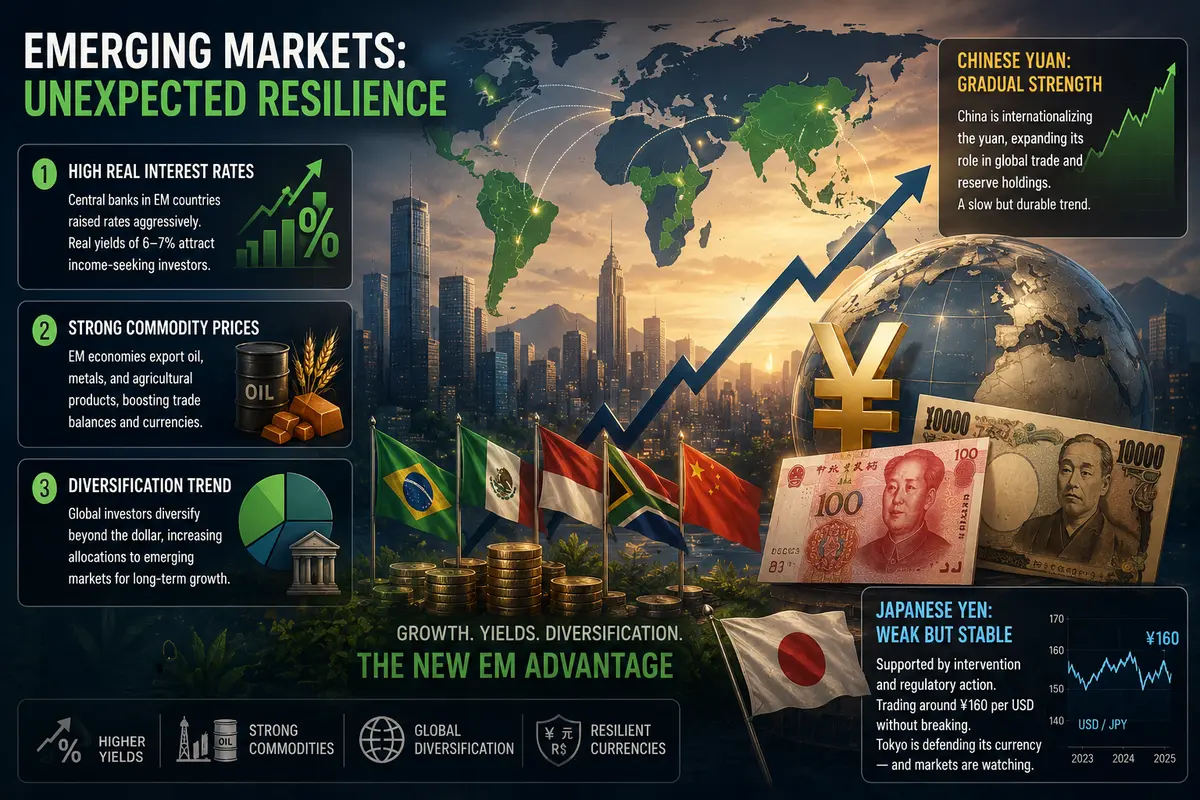
First, real interest rates remain high. In countries such as Brazil, Mexico, Indonesia, and South Africa, central banks raised rates aggressively to combat inflation. Even after adjusting for inflation, real yields often exceed those available in the United States. Investors seeking income are willing to take on additional risk in exchange for annual returns of 6–7%.
Second, commodity prices remain elevated. Many emerging economies are major commodity exporters, benefiting from strong prices for oil, metals, and agricultural products. This supports both their trade balances and their currencies.
Third, diversification is becoming increasingly important. Pension funds, sovereign wealth funds, and insurance companies are looking to reduce their dependence on the dollar by allocating more capital to emerging markets. This is a long-term trend that is unlikely to be reversed by short-term geopolitical turbulence.
Goldman pays particular attention to the Chinese yuan. The bank expects the yuan to continue strengthening gradually, and for that trend to persist longer than many investors anticipate. China is steadily internationalizing its currency, expanding its role in global trade settlement, and encouraging foreign central banks to hold yuan-denominated reserves. The process is slow, but it appears durable.
The Japanese yen, by contrast, remains weak but stable. Goldman attributes that stability largely to intervention by Japanese authorities and the prospect of further regulatory action. The yen has hovered around 160 per dollar without breaking decisively beyond that level. Tokyo has demonstrated its willingness to defend the currency, and markets are taking notice.
Dollar Indexes: Why They Tell Different Stories
Goldman highlights an intriguing phenomenon. The traditional U.S. Dollar Index (DXY), heavily weighted toward the euro and other major developed-market currencies, has risen approximately 1.5% this year. Meanwhile, the broader trade-weighted dollar index has edged slightly lower.
Why the discrepancy?
Because the two indexes measure different things.
The narrower DXY includes only six currencies: the euro, yen, British pound, Canadian dollar, Swedish krona, and Swiss franc. The euro alone accounts for nearly 58% of the index. When the euro weakens, DXY tends to rise. And the euro has weakened largely because of Europe’s economic challenges.
The broader trade-weighted index includes currencies from many more U.S. trading partners, including China, Mexico, South Korea, Brazil, and Canada. Several of these currencies have remained stable or even strengthened against the dollar. As a result, the broader index has not risen and has actually declined slightly.
The implication is clear: the dollar’s strength is relative, not absolute. Against the euro and yen, the dollar is strong. Against the yuan, peso, or Brazilian real, the picture is more mixed. Investors who focus exclusively on DXY may gain a distorted view of the dollar’s true performance.
Outlook: Range Trading, Carry Trades, and the Fed
Looking ahead, Goldman offers a relatively clear outlook.
In the near term, conditions remain favorable for the dollar. The economic impact of tensions involving Iran—which the bank estimates reduce global GDP growth by roughly 0.5 percentage points annually—combined with elevated inflation continues to support U.S. assets. Analysts expect these factors to provide support for the dollar against major developed-market peers in the coming weeks.
However, there are counterarguments. Stronger global equity markets and improving geopolitical sentiment could offset some of that support. If investors become less concerned about conflict and more willing to embrace risk, demand for the dollar as a safe-haven asset may decline.
As a result, Goldman expects the dollar to remain largely range-bound. Neither a major rally nor a dramatic collapse appears likely. Instead, the currency is expected to fluctuate within a relatively narrow trading range.
Such an environment, the bank argues, is particularly favorable for carry-trade strategies. These involve borrowing in low-interest-rate currencies—such as the yen or Swiss franc—and investing in higher-yielding currencies, including the dollar or selected emerging-market currencies. The profit comes from the interest-rate differential.
As long as the dollar remains stable, currency-loss risks remain limited while interest-rate spreads remain substantial, making carry trades especially attractive.
The Federal Reserve: A New Hawk on the Horizon?
Goldman also discusses the Federal Reserve and suggests that markets may soon shift their focus back to monetary policy.
According to the bank’s analysts, Fed Chair Kevin Warsh could adopt a more hawkish stance than markets currently expect. The reason is straightforward: economic activity remains resilient and inflation remains sticky. Inflation is not falling as quickly as policymakers would like, while economic growth has not slowed as much as many forecasters anticipated.
Markets currently price in one rate cut by year-end, perhaps two. Goldman, however, does not rule out the possibility that the Fed may refrain from cutting rates altogether in 2026. Moreover, if inflation begins accelerating again, further rate hikes cannot be completely excluded.
For the dollar, a hawkish Fed is positive. Higher rates for longer support the currency. For equities and the broader global economy, however, it presents challenges, as elevated borrowing costs weigh on valuations and slow growth.
Goldman does not commit to a single forecast. Instead, it outlines a range of possible outcomes. Investors should be prepared for both scenarios—rates remaining high and rates eventually falling—and adjust their portfolios accordingly.
What This Means for Investors
For investors holding dollars or U.S. assets, Goldman’s message can be summarized as follows:
First, do not expect a rapid or significant decline in the dollar. The U.S. economy remains strong, interest rates remain high, and alternatives remain limited. The euro is weak, the yen is weak, and while the yuan is strengthening, it is doing so gradually.
Second, be prepared for volatility. Geopolitical developments can change quickly. U.S.–Iran negotiations could either succeed or break down, and either outcome would have implications for the dollar.
Third, consider carry-trade opportunities. If the dollar remains range-bound, interest-rate differentials between the United States and countries such as Japan, Switzerland, and members of the eurozone may offer attractive risk-adjusted returns.
Fourth, diversify. Do not keep all your eggs in one basket. The dollar is strong, but its strength has limits. Emerging-market currencies may offer higher returns, albeit with higher risks.
Goldman maintains a moderately bullish short-term view on the dollar and a neutral long-term outlook. The U.S. economy remains resilient, but spending is slowing. Interest rates remain supportive, but that support is not unlimited. Geopolitical risks persist, yet markets are gradually adapting to them.
In uncertain environments, it is rarely the smartest participants who thrive—it is the most adaptable. Goldman provides a framework, but the final decision always belongs to the investor.
And the dollar, as always, will continue doing what it does best: remaining the dollar—strong but not invincible, reliable but not unrivaled. Perhaps that very duality is its greatest strength.

Comments
No comments yet. Be the first to share your thoughts!
Comments only for logged-in users.