

Rand Fights Back: How South Africa Challenged the Global Storm
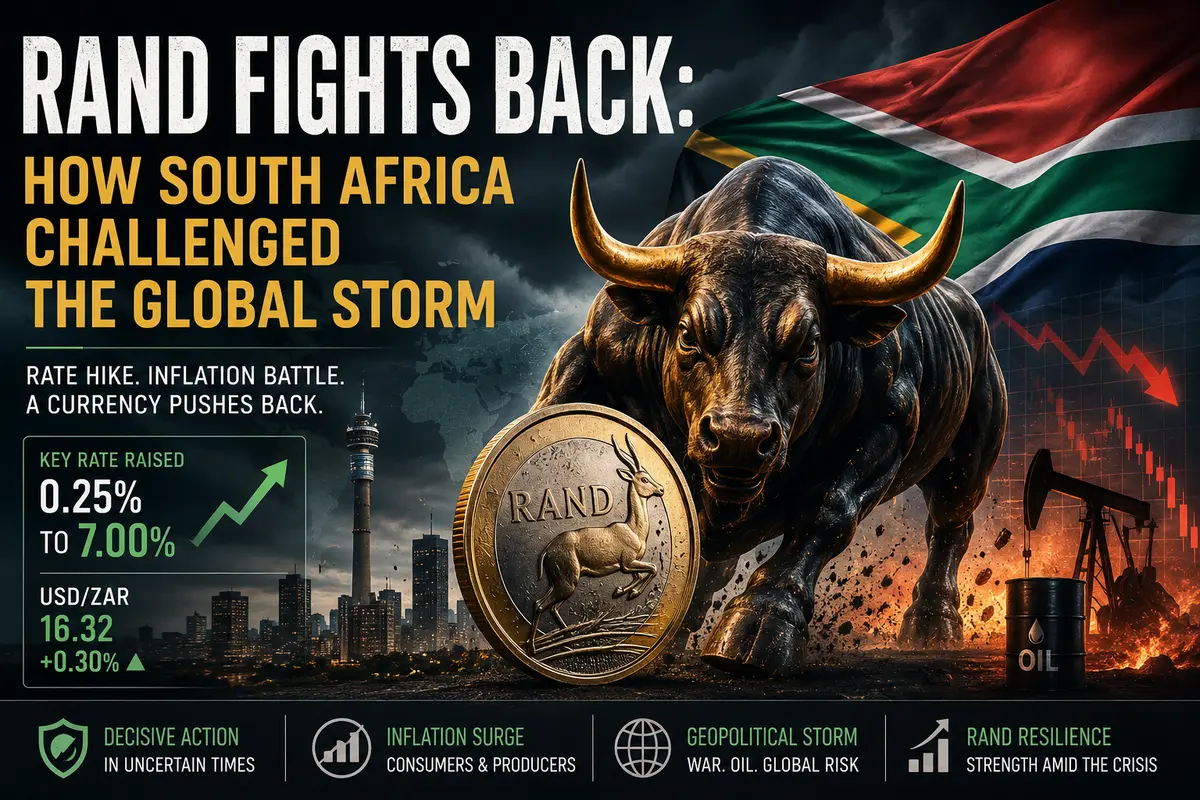
In a world where most emerging markets prefer to hunker down and hope that geopolitical turmoil passes them by, South Africa has done something almost audacious. The South African Reserve Bank raised its benchmark interest rate by a quarter percentage point to 7% per annum—the first rate hike in three years. The market responded not with panic or capital flight, but with strength. The rand gained 0.3%, reaching 16.32 per U.S. dollar. At a time when currencies across the developing world are falling under the pressure of the Iran conflict and a hawkish Federal Reserve, the rand has emerged as one of the few currencies capable of pushing back.
Interest Rates as a Weapon: Why South Africa Tightened Policy
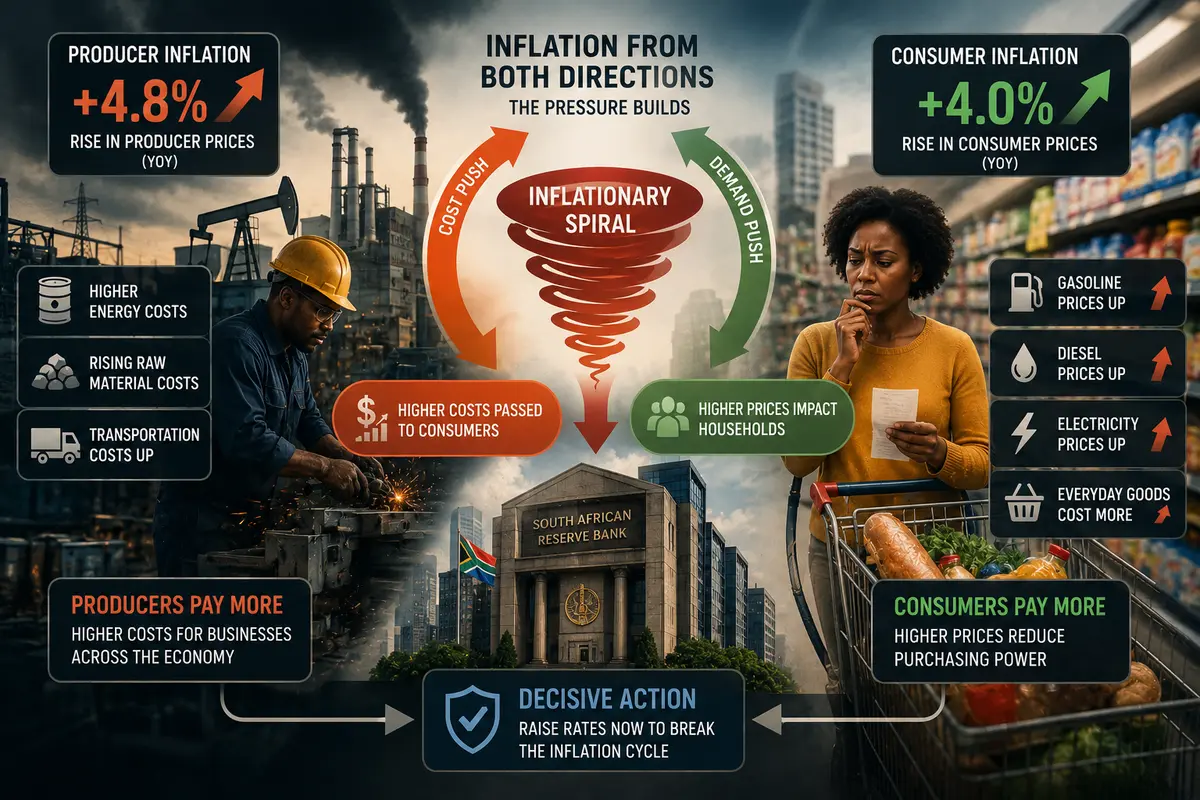
The South African Reserve Bank’s decision was anything but spontaneous. It was driven by economic data that could no longer be ignored. Inflation in South Africa is accelerating. Consumer prices rose 4% year-over-year in April, exceeding the central bank’s 3% target. That alone would be concerning. But the real shock came from producer inflation.
Data released on Thursday showed producer price inflation surging to 4.8% year-over-year. For comparison, the figure stood at just 2.3% in March. That represents more than a doubling in a single month. Producer prices are rising at an alarming pace, and those costs are likely to be passed on to consumers in the months ahead. The central bank saw the warning signs and chose to act before the problem intensified.
Raising interest rates is the traditional central-bank response to inflation. Higher borrowing costs cool demand, restrain price growth, and attract foreign capital. But the remedy comes with side effects: it can also suppress economic growth. At a time when South Africa is already grappling with high energy prices, supply-chain disruptions, and weak domestic demand, the rate hike appears almost heroic. It required political and economic courage—and the central bank demonstrated both.
The Rand Stands Alone: Who Else Has Tightened?
South Africa has become one of the very few emerging markets to raise interest rates amid the Iran crisis. Most countries have chosen to wait.
India, despite a record decline in the rupee, refrained from raising rates. Instead, the Reserve Bank of India relied on currency-market interventions, spending tens of billions of dollars to support the national currency. China has kept rates unchanged for a twelfth consecutive month, balancing the need to support economic growth against inflationary pressures.
Turkey, Argentina, and Nigeria—countries with chronically high inflation—already maintain elevated interest rates, but they did not raise them specifically in response to the Iran crisis. South Africa, by contrast, acted proactively.
This places the country in a unique position. While other emerging markets are losing capital to the U.S. dollar amid geopolitical uncertainty, South Africa is attempting to reverse the trend by offering investors higher returns.
And so far, it has worked. The rand strengthened. The gain was modest—just 0.3%—but in a world where most emerging-market currencies are weakening, even a small victory deserves attention. Investors saw a central bank willing to act rather than merely observe events unfold, and they rewarded that determination with confidence.
Inflation from Both Directions: Consumers and Producers
To understand why the South African Reserve Bank is so concerned, it is necessary to examine the structure of inflation itself.
A 4% consumer inflation rate exceeds the target, but it is not catastrophic on its own. What is alarming is the pace at which inflation is accelerating. Producer inflation is the key factor.
A 4.8% increase in producer prices signals mounting pressure throughout the economy. Manufacturers are paying more for raw materials, energy, and transportation. Eventually, those higher costs will be passed on to consumers. That means consumer inflation could accelerate further in the coming months.
By raising rates now, the central bank is attempting to break that momentum before it develops into a full-scale inflationary cycle.
Energy prices play a particularly important role. Like many countries, South Africa is suffering from rising oil prices linked to the Iran conflict. Gasoline is becoming more expensive. Diesel costs are rising. Electricity prices are climbing. These pressures hit producers directly, forcing them to raise prices. The result is the inflationary spiral that central banks around the world are trying to contain.
Unlike many of its peers, South Africa chose not to wait for that spiral to gather speed. It decided to strike first.
The Geopolitical Context: A War That Pressures Everyone
The South African Reserve Bank’s decision cannot be understood without considering the broader global backdrop.
The Iran conflict has reshaped the global economic landscape. Oil prices are rising. Inflation is accelerating from Washington to Pretoria. Central banks in advanced economies—the Federal Reserve, the European Central Bank, and the Bank of England—are signaling a willingness to tighten policy further. In such an environment, emerging markets find themselves particularly vulnerable.
Capital flows toward the U.S. dollar, U.S. Treasury bonds, and other assets that offer both yield and perceived safety. Emerging economies are left struggling with weaker currencies, higher inflation, and fewer policy options.
Against this backdrop, raising interest rates becomes an attempt to reverse the trend, retain capital, and support the national currency. It is a risky move, but South Africa appears to have concluded that the risks of inaction were even greater.
What Comes Next: Scenarios for the Rand
The move to raise rates to 7% may be only the beginning.
Markets will now watch closely to see how the economy responds. If inflation continues to accelerate, the central bank may be forced to tighten policy again. If inflation begins to ease, policymakers could pause and assess the situation.
For the rand, the global environment will remain the decisive factor. If the Iran conflict escalates further, if oil prices continue to climb, and if the Federal Reserve follows through with additional rate hikes, the rand is likely to face renewed pressure despite the central bank’s efforts.
However, if geopolitical tensions ease, if negotiations lead to the reopening of the Strait of Hormuz, and if inflation fears begin to fade, the rand could strengthen much more significantly. In that scenario, it would benefit both from improving external conditions and from South Africa’s relatively high interest rates.
On Thursday, South Africa demonstrated what decisive crisis management can look like. Rather than waiting, hoping for the best, or relying solely on market interventions, policymakers made a difficult choice.
Raising rates in the midst of war-driven uncertainty and an inflation shock required conviction. The market recognized that conviction. The rand strengthened—modestly, but confidently.
And that may be only the beginning.

Comments
No comments yet. Be the first to share your thoughts!
Authentication Required
You must be logged in to post a comment.