

Oil Continues Its Advance: WTI Breaks Above $80
Introduction: The Third Wave of Growth
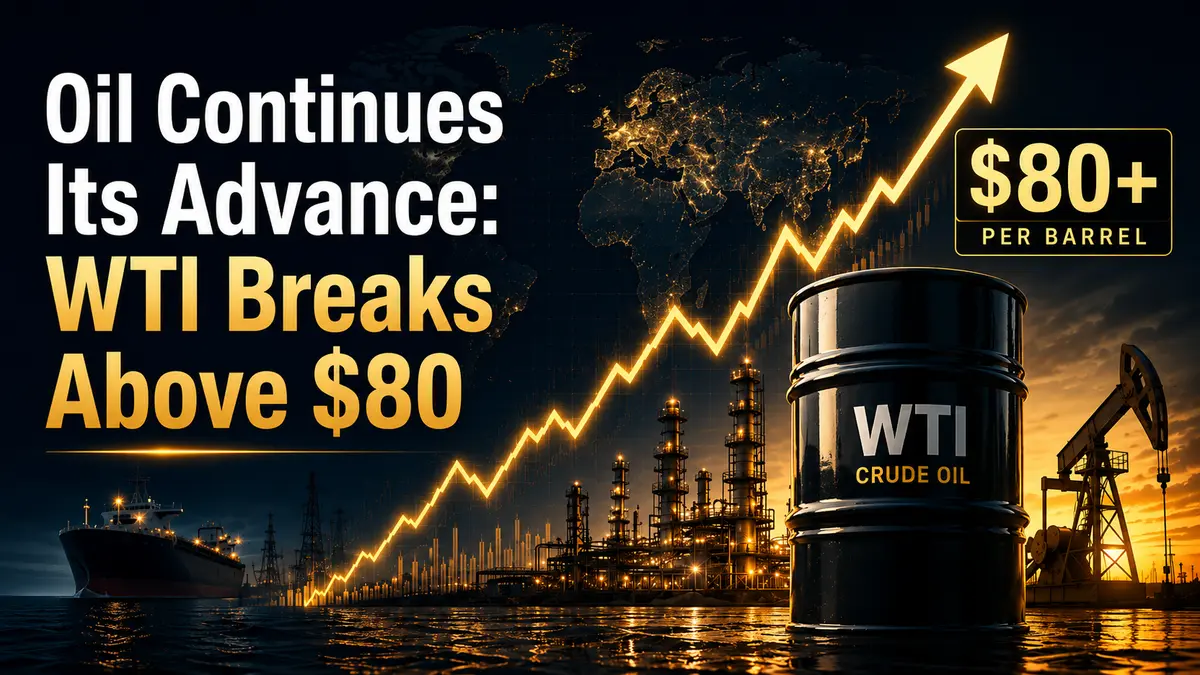
Wednesday morning brought fresh momentum to the oil market. August-delivery WTI crude oil futures rose by 1.08%, reaching $80.20 per barrel. Brent crude, meanwhile, gained 1.39% and settled at $85.91 per barrel. This move continues the rally that began last week and accelerated following the reinstatement of the blockade in the Strait of Hormuz.
What is driving the market now? Geopolitical tensions in the Middle East, a weaker US dollar, and technical factors are all working in favor of the bulls. WTI ... crude has broken through the psychologically important level of $80 per barrel, opening the door to new potential targets.
In this article, we will examine the reasons behind the current rise, the key technical levels, and the prospects for the oil market over the coming days.
Geopolitical Factors: The Strait of Hormuz Blockade Continues to Put Pressure on the Market
The Reinstatement of the Blockade and Rising Oil Prices
The reinstatement of the Strait of Hormuz blockade remains the main geopolitical factor supporting oil prices. The United States announced the restoration of its naval blockade of Iran and the introduction of a transit fee for vessels passing through the strait, raising concerns about potential supply disruptions.
Iran has not remained on the sidelines. Tehran has launched drone strikes against US facilities and targeted vessels in the region with cruise missiles. The escalation is continuing, and markets are pricing in the risk of serious supply disruptions.
The Role of the Strait of Hormuz
The Strait of Hormuz is a narrow maritime corridor through which approximately 20% of the world’s oil passes. Any threat to this region causes anxiety in the markets and pushes prices higher.
Even without actual supply disruptions, the threat of them creates speculative momentum. Traders buy oil to hedge against a potential shortage, providing additional support for prices.
Iran’s Response and the Risks of Escalation
Iran has warned of possible new attacks against energy infrastructure in the region. This creates a risk of further escalation that could lead to actual disruptions in oil supplies.
Investors are closely monitoring the situation. Any deterioration could trigger another surge in prices.
Technical Overview: Key Levels for WTI
Breakout Above $80
WTI crude oil has broken through the psychological level of $80 per barrel, reaching $80.20. This is an important technical milestone that could open the way for further growth.
The next resistance level is $81.27, which was reached during intraday trading. Should oil manage to break above this level, the path toward $85 and potentially higher levels could open.
Support at $70.77
Support is located at $70.77, where the price could retreat in the event of a correction. However, the current momentum suggests that the bulls remain in control of the market.
A breakout above resistance at $81.27 could become a signal for the upward movement to continue.
The Brent–WTI Spread Is Widening
The price difference between BZUSD ... and WTI crude oil contracts currently stands at $5.71 per barrel. The widening spread reflects the geopolitical risk premium incorporated into Brent prices.
The European benchmark is more sensitive to developments in the Middle East, which is why it is rising faster than WTI.
The US Dollar Factor: Weakness Provides Additional Support
The USD Index Is Declining
DX-Y.NYB ... futures fell by 0.07% to 100.64 points. A weaker dollar makes commodities more affordable for holders of other currencies, increasing demand.
The weakening of the dollar also reflects expectations of a more accommodative Federal Reserve policy following inflation data that showed a slowdown in price pressures.
The Impact on Oil
A weaker dollar is an additional supportive factor for oil prices. When the dollar declines, oil prices tend to rise because crude becomes less expensive for buyers using other currencies.
This creates favorable conditions for the rally to continue, provided that the dollar weakens further.
Fundamental Factors: Supply and Demand
US Inventories at Their Lowest Level
Total US crude oil inventories stood at 730.8 million barrels as of July 3, their lowest level since 1984. This puts additional pressure on the market and supports prices.
Declining inventories indicate that demand remains strong while supply is limited.
OPEC+ and Spare Production Capacity
OPEC+ continues to monitor the situation closely. The alliance has spare production capacity that could be used to stabilize the market, but it is not currently rushing to deploy it.
Any decision made by OPEC+ will have serious implications for the market. Should the alliance decide to increase production, it could cool prices. Should it maintain the current quotas, the upward movement could continue.
Demand from China
China remains the world’s largest oil consumer. Despite its economic difficulties, the country continues to increase imports, creating stable demand.
This supports oil prices even in an environment of uncertainty.
Market Psychology: Fear and Greed
Speculative Momentum
The current rise in oil prices is largely driven by speculative momentum. Traders are buying oil in anticipation of further growth amid geopolitical uncertainty.
This creates a self-reinforcing cycle: rising prices attract new buyers, pushing prices even higher.
The Role of Hedge Funds
Hedge funds are actively increasing their long positions in oil, betting that prices will continue to rise. This generates additional demand and supports the market.
However, should market sentiment change, a mass exit from these positions could trigger a sharp decline.
Outlook: Possible Scenarios
Optimistic Scenario
Should the conflict in the Middle East continue to escalate while the dollar continues to weaken, oil prices could extend their advance. WTI could break above resistance at $81.27 and move toward $85 or higher, while Brent could approach $90.
However, this scenario carries risks for the global economy. Excessively high oil prices could trigger a recession.
Realistic Scenario
A more likely scenario is that the current environment of high volatility will continue. Oil may trade within a range of $75–$85 per barrel, reacting to news from the Middle East and macroeconomic data.
This scenario assumes that geopolitical tensions will persist but will not develop into a full-scale war.
Pessimistic Scenario
The worst-case scenario would be an escalation of the conflict into a full-scale war involving several Middle Eastern countries. In such a case, oil prices could surge to $120–$150 per barrel, potentially causing a global recession.
This scenario currently remains unlikely, although markets have already begun to incorporate some of this risk into prices.
What This Means for Investors
Opportunities and Risks
The current situation creates opportunities for short-term traders who can profit from market volatility. However, the risks are also high: any change in the geopolitical situation or macroeconomic data could trigger a sharp movement in the opposite direction.
Long-term investors may consider the current rise a potential opportunity to lock in profits.
Diversification as a Strategy
During periods of uncertainty, diversification becomes a key principle. Investors should consider spreading their risks across different assets, including shares of energy companies, commodities, and defensive assets such as gold.
This approach can reduce dependence on a single factor and protect a portfolio from sharp market movements.
Conclusion: Oil Is on the Rise
The 1.08% increase in WTI crude oil futures to $80.20 per barrel represents a continuation of the rally that began last week. Geopolitical tensions, a weaker dollar, and technical factors are creating favorable conditions for further growth.
The breakout above the psychological level of $80 opens the door to additional gains, although risks remain high. The conflict in the Middle East could intensify, while macroeconomic data could disappoint the market.
For investors, this is a period of both opportunities and risks. Short-term market movements can be profitable, but they require careful risk management. The long-term outlook will depend on developments in the geopolitical situation and the response of central banks.
The oil market remains one of the most volatile and unpredictable financial markets. Until the conflict in the Middle East is resolved, this volatility is likely to persist, creating both opportunities and threats.


Comments
No comments yet. Be the first to share your thoughts!
Authentication Required
You must be logged in to post a comment.