

Asian Currencies Under Pressure as the Dollar Weakens and Iran Takes Center Stage

Introduction: The Calm Before the Storm or the Quiet After It?
Thursday’s trading session in Asian currency markets was surprisingly subdued. Most regional currencies remained confined to narrow trading ranges, as though bracing themselves for an inevitable shock. The weakening of the US dollar, which would normally provide support to Asian assets, was completely offset by increasingly troubling geopolitical developments. Investors who were ready to embrace risk only yesterday have now adopted a wait-and-see approach—and they have compelling reasons to do so.
The Middle East is once again at the center of global attention, and this time the situation appears far more serious than another escalation in rhetoric. For the fifth consecutive day, the US military has carried out strikes against Iranian targets. The Pentagon has not commented on the details of the operations, but regional sources indicate that the attacks are specifically targeting Iran’s military infrastructure.
Tehran, meanwhile, has responded with increasingly forceful statements, and the Strait of Hormuz has become the central subject of every discussion. Iranian officials have once again emphasized that control over this strategic route is not merely a matter of economic advantage but a cornerstone of national security. For financial markets, this sounds like a warning: disruptions to energy supplies are no longer a purely hypothetical threat but an increasingly realistic scenario.
Against this backdrop, the US dollar is struggling to find firm ground. The weakness of the American currency no longer appears to be a temporary correction. Inflation data released the previous day came in below expectations, and markets are now almost unanimous in expecting the Federal Reserve to leave interest rates unchanged at its next meeting.
The US Dollar Index has stabilized near 100.5, hovering close to its monthly lows. However, rather than celebrating the weaker dollar, Asian investors are choosing to keep their powder dry.
South Korean Won: Interest Rates Rise, but Pressure Remains
The Bank of Korea delivered the decision markets had been eagerly awaiting, but its impact was muted. For the first time in three and a half years, the regulator raised its benchmark interest rate by 25 basis points to 2.75%.
The move had been widely anticipated, but it did not become a cure-all for the national currency. USDKRW ... remained near 1,485 won even after the decision was announced. Why has the won failed to receive the support that normally accompanies an interest-rate increase?
The answer lies in the broader context. Investors are currently paying attention not only to domestic monetary policy but also to external risks. South Korea is an export-oriented economy, with semiconductors playing a particularly important role. The sector continues to deliver impressive results, but geopolitical uncertainty is outweighing these domestic achievements.
In recent weeks, foreign investors have been actively selling shares in South Korean technology companies. The resulting capital outflow is putting more pressure on the won than the central bank’s actions can offset.
Moreover, even an interest-rate increase cannot fully compensate for concerns about the global economic outlook. Should a trade war or conflict in the Middle East disrupt international supply chains, South Korea would be among the first countries affected.
Semiconductor exports, which account for a significant share of the country’s economy, could face serious obstacles. The won is therefore caught between the hammer of domestic inflation and the anvil of external instability.
Japanese Yen: On the Verge of Intervention Every Day
The yen remains at the center of traders’ attention, and the situation surrounding the currency is becoming increasingly tense. USDJPY ... JPY declined slightly to 162.1, but the move appeared to be technical rather than fundamental.
Traders are now paying less attention to price charts and more attention to comments from government officials—and those comments are becoming increasingly alarming.
Finance Minister Satsuki Katayama recently addressed a subject that usually remains behind the scenes: a potential revision of the asset allocation structure of the Government Pension Investment Fund, or GPIF.
To an outside observer, this may appear to be a minor technical detail, but it is actually a powerful signal. The GPIF is the world’s largest pension fund, and its investment decisions can have a substantial impact on financial markets. The suggestion that its portfolio structure could be revised sent a clear message: the authorities are becoming increasingly concerned about the yen trading near multi-decade lows.
The yen is weaker than it has been in decades, and for Japan this is more than just a statistical milestone. A weak currency makes imports more expensive, placing additional pressure on consumers and businesses in a country that depends heavily on imported energy.
However, currency intervention is an extreme measure, and Japanese officials fully understand that unilateral action in the foreign exchange market may produce unpredictable consequences. Nevertheless, judging by the latest statements, the authorities’ patience may be running out—and the markets can sense it.
Australia and New Zealand: Slow Movers on the Currency Front
The Australian dollar, which normally responds more actively to changes in risk sentiment, remained relatively subdued this time. USDAUD ... D rose slightly, indicating a modest weakening of the Australian currency.
Once again, external factors were responsible. China, Australia’s largest trading partner, has been publishing less-than-encouraging economic data, dampening the enthusiasm of even the most optimistic investors.
The New Zealand dollar, which received support earlier this week from a 25-basis-point interest-rate increase, is now surrendering part of its recent gains. USDNZD ... moved slightly higher, appearing to undergo a correction after its previous advance.
Like Australia, New Zealand is highly dependent on export prices for commodities. These prices are currently under pressure amid concerns about a slowdown in the global economy.
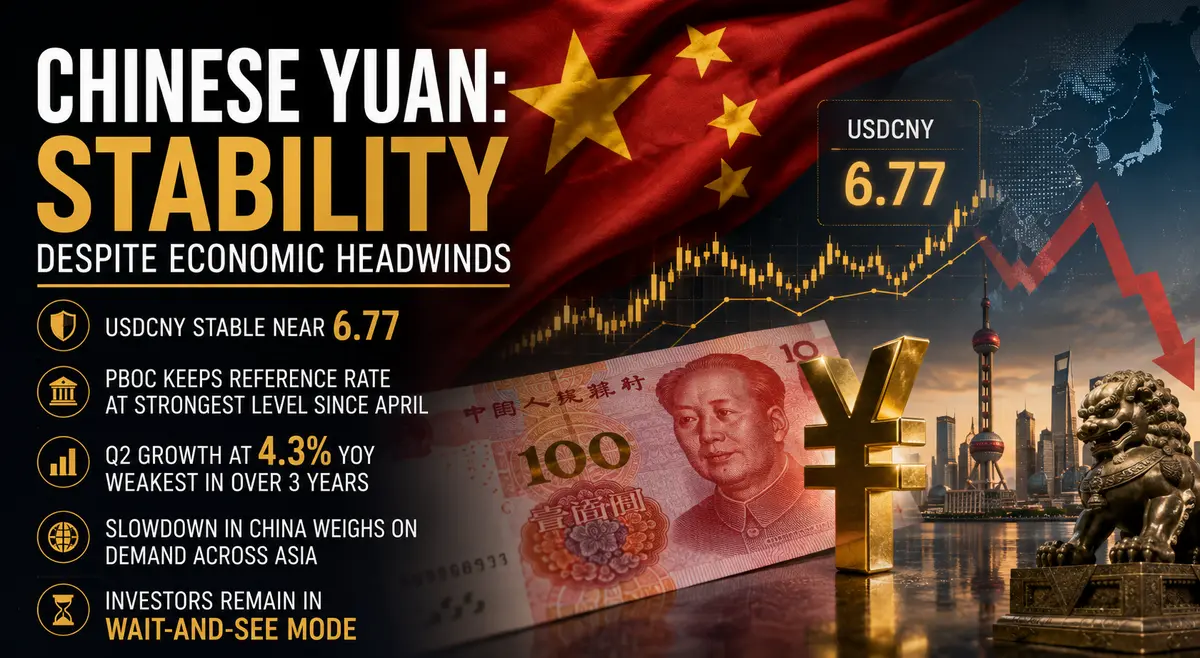
Chinese Yuan: Stability Despite Economic Headwinds
The Chinese yuan demonstrated remarkable resilience—not because it strengthened, but because it remained almost unchanged despite the weakening of the US dollar. USDCNY ... stabilized near 6.77, while the offshore exchange rate, which is normally more volatile, also remained within a narrow range.
The People’s Bank of China set its daily reference rate at the strongest level since April, but the markets barely reacted. Why? Because investors understand that the PBOC is not interested in allowing the yuan to appreciate sharply, despite external pressure.
The regulator prefers stability, and its signals on this matter have been unmistakable.
China’s economic data proved disappointing. Economic growth in the second quarter reached 4.3% year on year, falling short of even the most modest forecasts. This was the weakest growth rate in more than three years.
The Chinese economy, which served as the main engine of growth across Asia for many years, is now showing clear signs of slowing down.
This is bad news for Asian currencies. China is the largest trading partner of most countries in the region, and a slowdown in its economy means weaker demand for exports from Southeast Asia, South Korea, and Japan.
Even if Beijing announces new economic support measures—and the market already expects such steps—they are unlikely to provide immediate support for the yuan. For now, investors are more likely to adopt a wait-and-see position.
Outlook: What Comes Next?
Asian currency markets are currently on high alert. The weakening of the US dollar is a positive factor, but it cannot outweigh geopolitical risks. The conflict in the Middle East remains the main source of uncertainty, and any further escalation could trigger sharp market movements.
Investors continue to monitor the situation surrounding the yen. A possible intervention by the Japanese authorities could become one of the key market events in the coming weeks.
For the South Korean won, the main questions concern the resilience of exports and the direction of capital flows. The Chinese yuan, meanwhile, is likely to remain within a narrow trading range until the People’s Bank of China provides new signals.
The most important factor, however, is the overall atmosphere of uncertainty. When geopolitics becomes the main driver of financial markets, forecasts inevitably become less reliable.
Traders currently resemble chess players calculating not just one possible move by their opponent but several. As long as the situation in the Middle East remains explosive, Asian currencies will continue to balance on the edge.
One thing can be said with certainty: investors should prepare for increased volatility. As always, the stakes are high.

Comments
No comments yet. Be the first to share your thoughts!
Authentication Required
You must be logged in to post a comment.