

WTI Oil Fell During Asian Trading: A Pullback After the Geopolitical Shock
Introduction: A Thursday When Oil Cooled Down After a Hot Wednesday
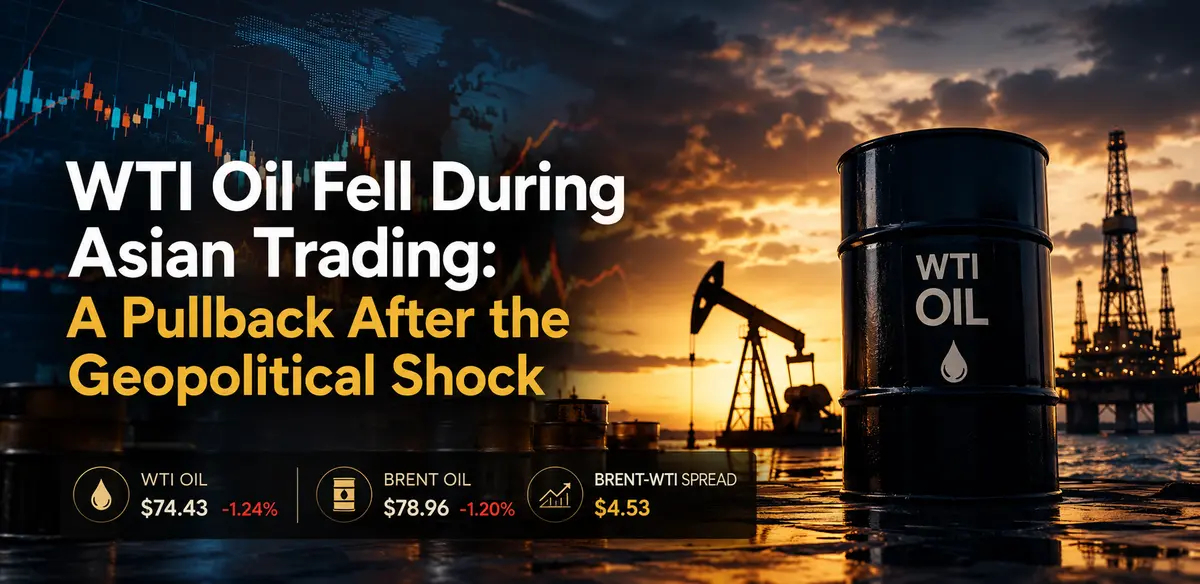
Thursday, Asian trading session. Traders in Singapore, Tokyo, and Shanghai open their terminals and see WTI oil cooling down after yesterday’s geopolitical shock. August delivery futures fall to $74.43 per barrel, losing 1.24% compared with the previous close. This is not a collapse, but it is a noticeable correction after oil surged by more than 5% on Wednesday amid an escalation of the conflict between the United States and Iran.
What is happening? The market is digesting the news. On Wednesday, Iran struck U.S. military facilities, while the United States responded with military strikes on Iranian targets. Oil prices jumped to two-week highs, reflecting fears of supply disruptions. But on Thursday, the initial excitement began to fade. Traders are taking profits while assessing the real risks to supply.
Technically, WTI oil found support at $67.82 and resistance at $76.08. The current price of $74.43 is closer to the upper boundary of this range. If oil continues to decline, it may test support at $67.82. If it turns upward, resistance at $76.08 will become the next target.
The U.S. Dollar Index was virtually unchanged — 0.00% at 100.78 points. This means that oil’s movement is not connected to the currency factor, but is driven by other reasons: a correction after the rally and reassessment of geopolitical risks.
Brent oil also declined by 1.20% to $78.96 per barrel. The spread between Brent and WTI is $4.53, which is significantly above normal. This indicates localized supply issues for Brent, possibly related to the situation in the Middle East.
Let’s examine why oil is correcting after yesterday’s rise, what risks remain, and where the market is heading.
Why Oil Is Falling After Yesterday’s Rally
Profit-Taking
The main reason for the decline is profit-taking. On Wednesday, oil surged by more than 5% amid the escalation of the conflict between the United States and Iran. Traders who entered the market at lower levels locked in part of their profits, creating pressure on prices.
Profit-taking is a normal process in any market. After a strong rally, a correction almost always follows. The question is whether this correction will be deep or whether it will stop at support.
Assessment of Geopolitical Risks
The second factor is the reassessment of real geopolitical risks. On Wednesday, markets reacted in panic to news of military action. But on Thursday, investors began asking questions: How serious are the risks to supply? Will Iran close the Strait of Hormuz? Will the United States strike Iranian oil infrastructure?
So far, the answers to these questions remain unclear. But the market is beginning to price in a more balanced scenario. If disruption risks do not materialize, prices may return to levels seen before the escalation.
Technical Factors
The technical picture also plays a role. Resistance at $76.08 was tested on Wednesday but was not broken. This created conditions for a correction. Traders who expected a breakout were disappointed and began selling.
Support at $67.82 remains an important level. If oil falls to this level, it may find support and turn upward.
Brent vs WTI: What the Spread Shows
A Spread of $4.53 per Barrel
The price difference between Brent and WTI is $4.53 per barrel. This is significantly above the normal range, which is usually around $3–4. This points to localized supply issues for Brent.
Brent is more sensitive to the situation in the Middle East because it is the international benchmark. If the conflict continues to escalate, the spread may widen even further.
What This Means for the Market
A wide spread indicates that markets are pricing supply risks for Brent higher than for WTI. This may be linked to concerns about disruptions in supplies from the Persian Gulf region.
If the spread continues to widen, it may signal that geopolitical risks remain elevated. If it narrows, this would point to a normalization of the situation.
Geopolitical Background: What Is Happening in the Strait of Hormuz
Iran Struck U.S. Facilities
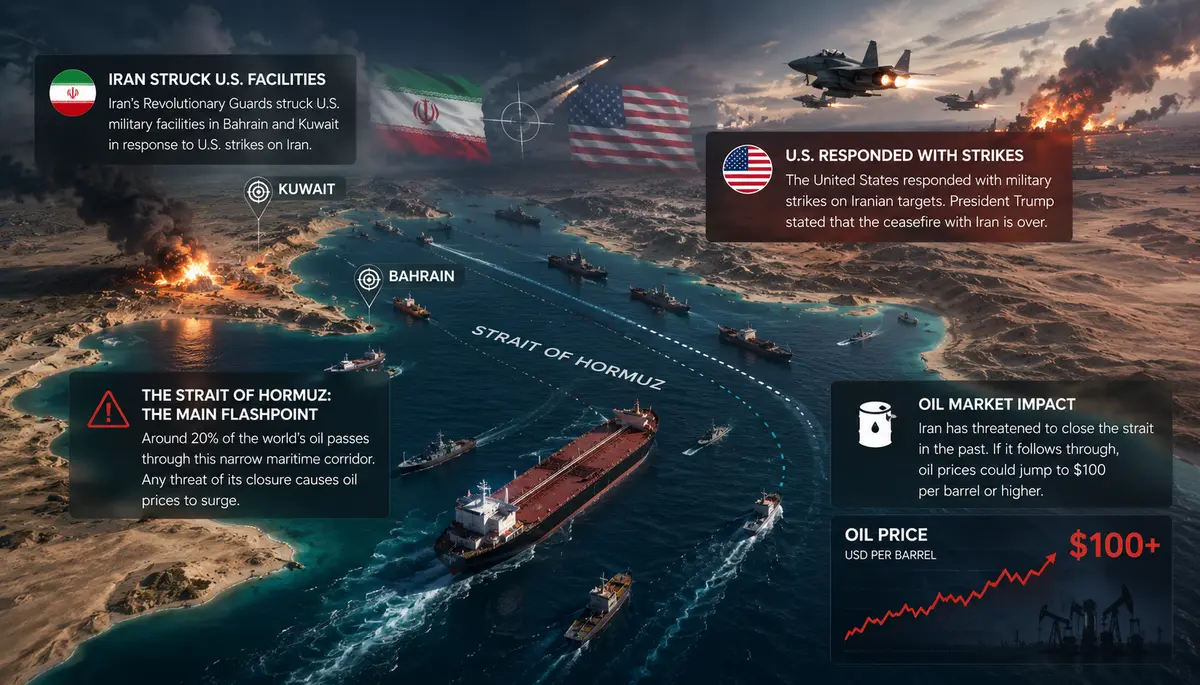
On Wednesday, Iran’s Revolutionary Guards struck U.S. military facilities in Bahrain and Kuwait. This came in response to U.S. military strikes on Iran.
This means that the conflict has entered a new phase — a phase of direct military confrontation. This is a serious escalation that may have far-reaching consequences.
The United States Responded With Strikes
The United States responded to Iran’s attacks with military strikes on Iranian targets. President Donald Trump stated that the ceasefire with Iran was now over.
This means the conflict could develop into a full-scale war. For the oil market, this creates the risk of supply disruptions from the region.
The Strait of Hormuz: The Main Flashpoint
The Strait of Hormuz remains the main flashpoint. Around 20% of the world’s oil passes through this narrow maritime corridor. Any threat of its closure causes oil prices to surge.
Iran has already threatened to close the strait in the past. If it follows through on this threat, oil prices could jump to $100 per barrel or higher.
What Awaits Oil in the Coming Days
Escalation of the Conflict
If the conflict between the United States and Iran continues to escalate, oil prices may rise significantly. Iran could block the Strait of Hormuz, or the United States could strike Iranian oil infrastructure.
In this scenario, WTI oil may test resistance at $76.08 and even break above it. Brent may rise above $80 per barrel.
De-escalation of the Conflict
If the situation stabilizes, oil prices may continue to correct. Traders will take profits, and oil may fall toward support at $67.82.
In this scenario, WTI oil may return to the $70–72 per barrel range. Brent may fall below $76 per barrel.
The Role of OPEC+
OPEC+ may also influence prices. The alliance increased quotas by 188,000 barrels per day for August. If the situation in the Middle East continues to deteriorate, OPEC+ may change its policy.
However, there are disagreements within OPEC+ that may limit its ability to act. The UAE’s exit from the alliance and Iraq’s threats to leave create uncertainty.
Conclusion: Oil at a Crossroads
WTI crude oil futures fell by 1.24% during Thursday’s Asian trading session to $74.43 per barrel. This is a correction after a rally of more than 5% on Wednesday amid the escalation of the conflict between the United States and Iran.
Support is located at $67.82, while resistance stands at $76.08. Brent declined by 1.20% to $78.96 per barrel, while the Brent-WTI spread is $4.53.
Geopolitical tensions in the Middle East remain the key factor for the oil market. Iran struck U.S. military facilities, while the United States responded with military strikes on Iran. The Strait of Hormuz remains the main flashpoint.
If the conflict continues to escalate, oil prices may rise significantly. If the situation stabilizes, they may continue to correct.
Oil is at a crossroads. Geopolitical uncertainty and macroeconomic signals will determine its direction in the coming days and weeks. Investors will closely monitor every new headline from the region, understanding that the situation could change at any moment. For now, WTI oil is correcting after the shock, but the potential for a new rally remains if the risk of supply disruptions materializes.

Comments
No comments yet. Be the first to share your thoughts!
Authentication Required
You must be logged in to post a comment.