

Bar Pipa
We pay for a post of 10$

U.S. Dollar / Mexican Peso

USDMXN FOREX

17.4680
+0.19%

Key Statistics

Volume
23,498
Open
17.4348
Day Range
17.4140 - 17.4810
52W Range
17.0719 - 18.9777
Price AVG 50
17.4003
Prev Close
17.4348

About U.S. Dollar / Mexican Peso

U.S. Dollar / Mexican Peso is a foreign exchange currency pair. It represents the relative value between the two currencies and is traded on the global decentralized forex market.

Asset Type: Currency Pair
Base Currency: MXN

Discussion

Authentication Required

You must be logged in to post a comment.

joy
joy

USD/MXN – Nearshoring Capital Capex, Inelastic Remittance Anchor, and Banxico Carry Mechanics
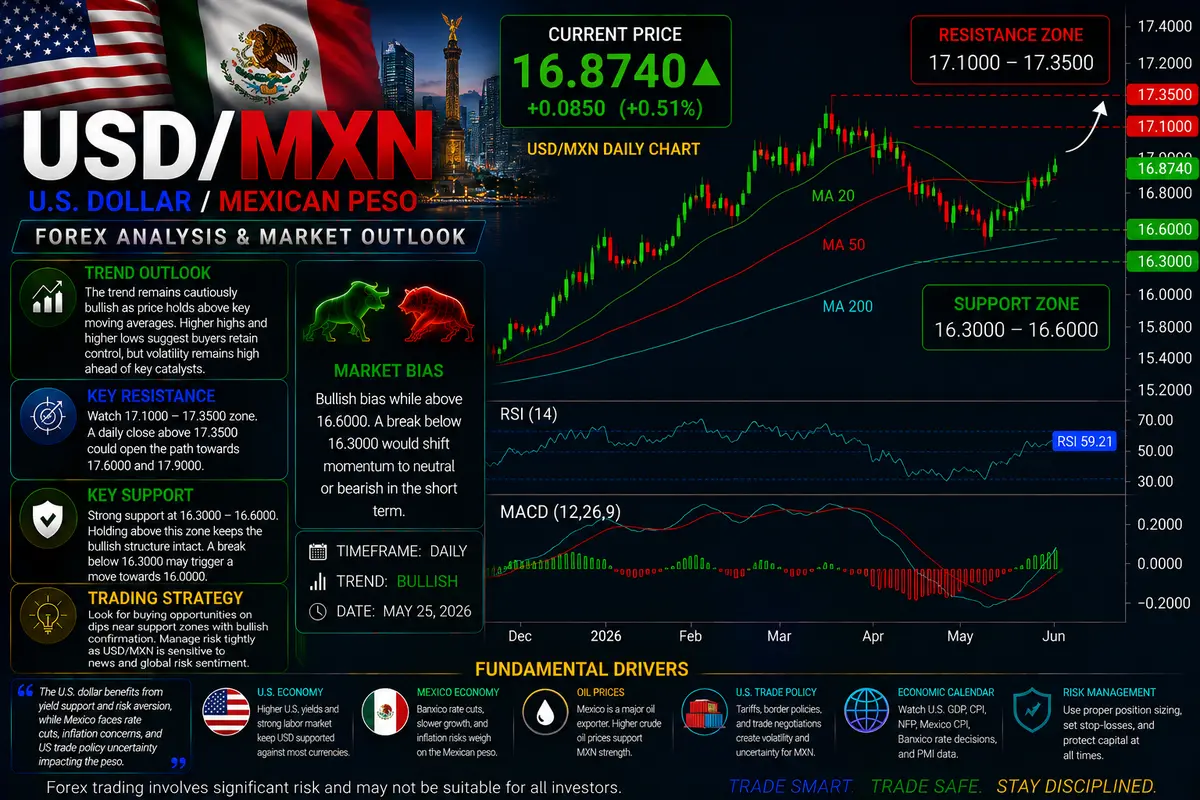
USD/MXN – Nearshoring Capital Capex, Inelastic Remittance Anchor, and Banxico Carry Mechanics

If you ask anyone running an emerging market FX desk where the real institutional volume is in Latin America, they will point you straight to the Mexican Peso. USD/MXN isn't just another regional cross. It's the most liquid currency pair in the Americas outside of the USD and CAD, serving as both a benchmark for global risk sentiment and a primary vehicle for yield-seeking capital.

What makes the Peso fascinating to trade right now is the tug-of-war between structural real-money inflows and short-term speculative carry positioning. To understand where this pair is heading over any meaningful horizon, you have to look past basic chart patterns and break down three specific economic forces: the industrial footprint of nearshoring, the constant buffer of family remittances, and the rate mechanics driving Banxico’s yield curve.

The Nearshoring Shift: Real Capital, Not Just Headlines

For decades, North American supply chains relied on long ocean routes from East Asia. But recent global trade frictions and logistics bottlenecks forced a massive structural pivot. Global manufacturing has been aggressively relocating capacity directly into northern and central Mexico—a trend widely known as nearshoring.

From an FX order book perspective, nearshoring translates into persistent, multi-year selling of US Dollars against the Peso:

  • Long-Term Capex Flows: When a international automaker, electronics manufacturer, or industrial firm builds a new facility in hubs like Monterrey, Saltillo, or Querétaro, they bring hard currency in Dollars. To pay for land acquisition, municipal permits, local construction contractors, and ongoing factory payroll, those corporate treasuries have to convert USD into MXN on spot desks.

  • Sticky Money: Unlike hot-money portfolio flows that enter and exit through liquid bond markets overnight, foreign direct investment in physical plants and equipment is illiquid and long-term. This ongoing conversion stream creates a structural floor beneath the Peso, dampening long-term upward spikes in USDMXN ...
Continue reading...
joy
joy

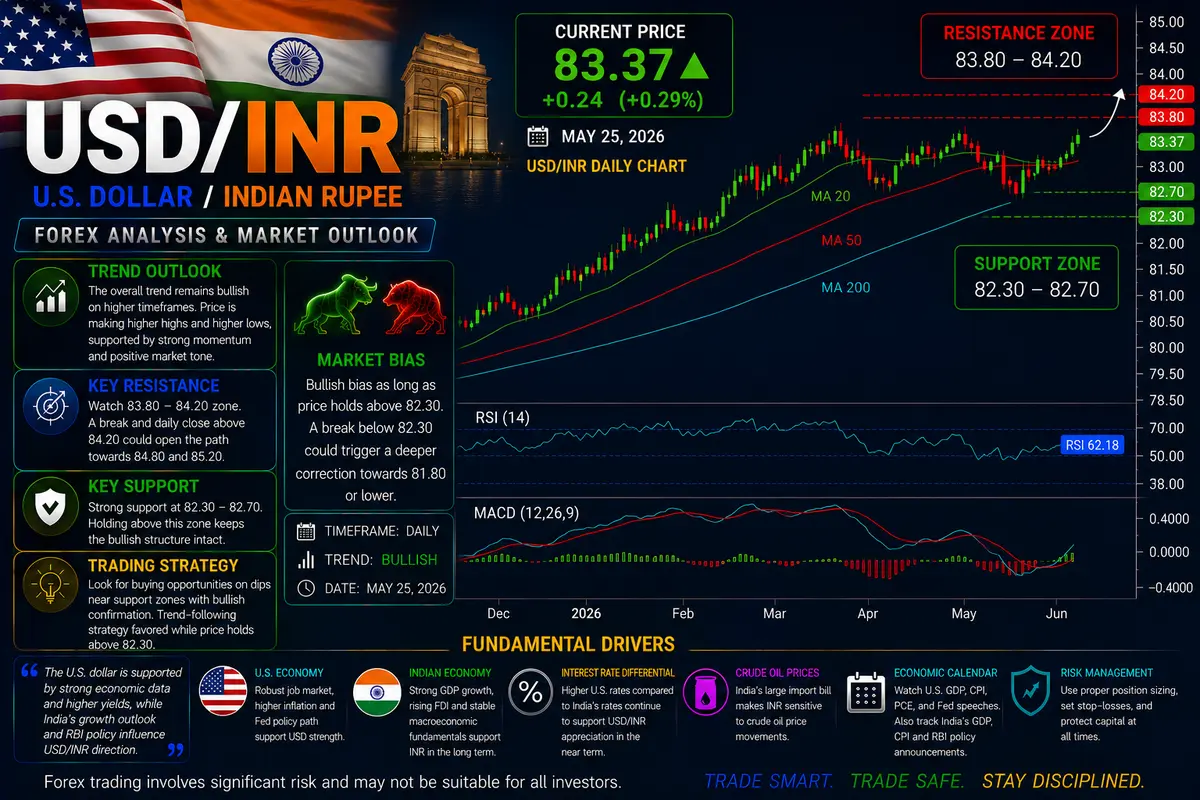
USD/INR – RBI Reserve Accumulation, Crude Import Burdens, and Offshore NDF Market Dynamics

USD/INR – RBI Reserve Accumulation, Crude Import Burdens, and Offshore NDF Market Dynamics

If you take a look at the USD/INR chart over almost any multi-month period, you’ll notice something strange compared to other emerging market currencies. Where pairs like USDZAR ... or USDMXN ... move in wide, jagged swings, USDINR ... trades in flat, horizontal steps separated by sudden, controlled shifts.

That isn't organic price discovery. It's the footprint of the Reserve Bank of India (RBI).

The Rupee operates under a managed float where the central bank acts as the dominant buyer and seller on the order book. To trade this pair profitably, you can't rely on standard technical breakouts. You need to understand how the RBI manages liquidity, how crude oil imports drive commercial dollar demand, and how offshore trading desks interact with the onshore market.

1. How the RBI Controls the Order Book

The Reserve Bank of India doesn't try to lock the currency to a fixed rate. Instead, its primary goal is to suppress intraday and weekly volatility.

This intervention style alters standard market behavior in two distinct ways:

  • Inflow Absorption: When international capital flows into Indian equities or corporate debt, the RBI steps in as a dollar buyer. By absorbing foreign currency, the central bank builds its reserve balance while preventing the Rupee from strengthening too quickly.

  • Outflow Smoothing: During global panics or oil price shocks, foreign capital leaves domestic markets. The RBI responds by selling dollars directly into the interbank market, supplying liquidity to meet import demands and dampening potential upside spikes.

Because the central bank operates as a counterparty on both sides of the market, momentum breakouts frequently fail. When price approaches obvious support or resistance zones, central bank intervention usually absorbs the volume, pushing price back into range-bound consolidation.

2. The Crude Oil Transmission Mechanism

India's current account balance has a permanent structural weakness: a heavy reliance on...

Continue reading...
joy
joy

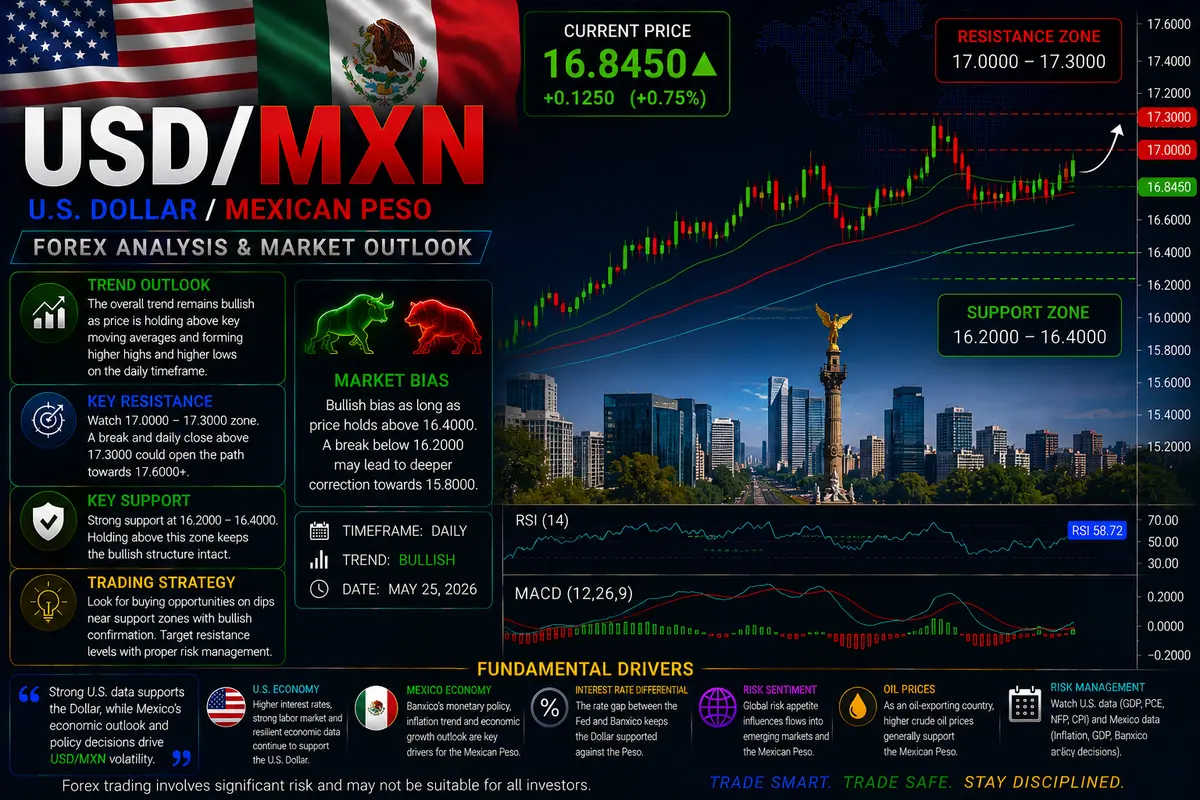
USD/MXN – Nearshoring Flows, Banxico Policy, and Pemex Risk Signals

USD/MXN – Nearshoring Flows, Banxico Policy, and Pemex Risk Signals

Ask any spot trader in Chicago or London about the Mexican Peso and they’ll tell you the same thing: it’s the undisputed king of Latin American liquidity. But calling USD/MXN just an "emerging market currency" misses the entire point.

On institutional desks, the Peso isn't just traded for direct exposure to Mexico. It’s used as a giant, macro sponge. Whenever risk sentiment breaks across South America—or when a global fund needs to quickly hedge a messy basket of illiquid Brazilian real or Colombian peso positions—they don't mess around with local order books that freeze up the moment headline risk hits. They hit the bid on USDMXN ... .

That constant volume creates a weird paradox. On normal days, spreads during North American trading hours are tight—sometimes tight enough to rival minor G10 pairs like AUD or

. Execution feels smooth. Slippage is minimal. But the moment global macro turns ugly, that clean order book can evaporate instantly.

If you want to trade this pair consistently without getting liquidated during random liquidity gaps, you have to track three specific engines: real-economy trade flows, Banxico’s interest rate cushion, and the fiscal bomb ticking inside Pemex.

1. The Real Economy: Physical Trucks and Nearshoring Capital

Forget pure technical analysis for a second. At its core, USD/MXN is anchored by physical goods moving across border crossings like Laredo and El Paso.

Mexico’s manufacturing sector is directly hooked into North American supply chains under USMCA. Those thousands of assembly plants—the maquiladoras—produce everything from pickup trucks to medical equipment destined for US store shelves. When American consumer demand is solid, those factories run non-stop. To cover local payrolls, electricity, taxes, and domestic suppliers, these companies constantly dump Dollars and buy Pesos. That’s a persistent, real-money bid beneath MXN.

Then you have nearshoring.

When global shipping lines ground...

Continue reading...
Navigation menu
instaforex banner
